#024 What Is Content (And Do You Need It To Make Money Online)
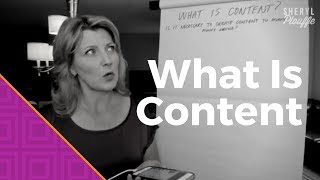
Video-marketing strategist Sheryl Plouffe defines content as information plus context, and argues it's essential for making money online. She shows how to add context through your own experiences or others', drawing on 25 years of TV news storytelling to explain what actually works.
Chapters
Welcome to Personal Brand Breakthrough. I'm Sheryl Plouffe, video marketing strategist, and today we are talking about this. We're doing something a little bit different today. I'm gonna do a little bit of lesson with you. What is content? And this question: is it necessary to create content to make money online? I'm actually gonna save this for a little bit later to answer that. I think what I'd like to do and where I'd like to kind of start is by asking you to post a in the comments below. If you're watching this on Facebook right now, post in the comments your industry, you know, what business are you in. So if you're an entrepreneur, a coach, consultant, a small business owner, I'd love to know what industry you're in so that I can better, you know, use some examples, actually real-life examples from you guys to talk about this topic today. We're gonna talk about what is content. We hear a lot about content online And a lot of people are confused about, A, what is content, but more importantly, how they can actually utilize content to grow their businesses. And that is the premise of today's Personal Brand Breakthrough episode. So what I'm going to do is I just want to go into— while you guys are coming on live and thinking of, you know, posting your comments about the industry that you're in, and I'm also very open to making this like a open Q&A. So if you have questions and you want to ask, by all means post your comments in or your questions in the comments, and I'm going to be watching it as we go. So what I'm going to do while we're doing this, I'm just going to start sharing this out. This is a little tip for you. If you're doing a live Facebook, you can look— well, in this case I'm using my desktop, but share it out to your other groups. Okay, so I'm just gonna do that while we are Waiting for people to come on to Personal Brand Breakthrough. This is the show that I do every Thursday at 2 PM Eastern time. And in the last, oh, I don't know, 3 or 4 weeks or so, I've been doing a lot of interviews, and today I decided to mix it up and talk about this topic and kind of do it almost like a lesson style. So jump on. I'm just sharing this out to some of my groups while you guys come on. Let me know in the comments what industry you're in. If you have any questions about content, have been confused, don't be shy. Just post your questions and let me know what it is about content that confuses you. We're going to talk about this and do a little lesson and draw some stuff on the board. I think by the end of this conversation, it's going to become crystal clear what content is, what it truly is, and how or if it's necessary to create content to make money online. So, okay, so what I'm going to do is just keep this Keep this going here so that I can see when you've commented, if you've asked any questions. I'll be looking back on my phone every so often. Thank you for the shares. I see several shares already. Appreciate that. Okay, so what is content? So let me get out— and I chose purple specifically, brand color. Okay, so what is content? And as I'm moving around here, I noticed that the computer is shaking a little bit, so we'll have to just deal with that. What is content? Well, content basically is two things. It's information, right? Okay, information. Okay, but it's not just information. Okay, it's communication. Right? So when you have— let me just turn toward the camera so you guys can hear me— it's information plus communication. Essentially, okay, that's what content really is. So if you think about this in the, in the realm of online, the online space, social media as an example, that's what we're consuming. We're consuming information and it's being communicated to us through social channels and what have you. But it goes sort of beyond that, you know. If, if content was— and this is You know, my take on this information and it's communicated to you, but there's one sort of missing element here in order for the content to be impactful. And if you are a business owner and you're going to be putting time and energy and effort into creating content, you want it to have an impact. You want— post your questions, guys. I'm happy to answer your questions as we go through the lesson today. What is content? And please comment your industry in the comments, please. The thing that's missing here is in order to have an impact, if you want to have an impact with your content, right? You have to have what's called context. Context. This is basically the magic. This is the solution. This is like the magic formula. Okay, to make your content effective and have an impact online. It's this magic word. Now, context essentially is relevancy. Like, it has to matter to somebody. Relevancy, right? It has to be relevant. Your content, your, your con— the context that you add. I'm gonna explain what context is and how to figure out what kind of context to add to information to make it impactful. That's gonna be today's lesson. Relevancy and usefulness. Okay, let's just take this in for a second. I want to see if you have any questions. Please don't be shy. Ask questions as we go through this. Basically, what I'm showing you here is the solution to being effective with your time and energy online, your own individual time that you spend creating content online or that of your team. So if you have a social media team or you have a small team of people who you've relegated this social media aspect 2, this is the solution to making it impactful. Content is information that's communicated that has— and if you want to have impact, it has to have context. Context means adding, making sure that it's relevant to your audience. And if you are in business, you should know who your audience is, number 1, Marketing 101. And usefulness. So comment below, ask me your questions if you have any. Um, how do you add context to information is the question. Well, there are two ways that you can add context to information, and number one is to draw from your own experiences. Can you guys let me know if you can hear this okay? I'm turning kind of back and forth toward the camera. I'd love to know if you guys can still hear me. Okay, so draw from your own experiences. Okay, your own experiences. Or number 2, I think you might know where I'm going with this, is draw on other people's experiences, right? Draw on others' experiences. Forgive my writing. Okay, so you can draw on your own experiences, or you can draw on other people's experiences to add context to information that's communicated, and that's how you have impact with content. So there's a pattern here. Now the thing is that when we get into this part, if you're a business owner, let me know what your challenges are around content. This is an opportunity for you to kind of pick my brain and get some, actually some live coaching frankly, to help you with this. You know, I've been able to build a 6-figure business in the first year of being a full-time entrepreneur because of this. So if you're right now struggling and you're saying, how come I'm not making enough money? How come I can't charge what I think I'm worth? How come I don't have clients banging down my door? How come I'm not getting interviewed, you know, on podcasts like I see everybody else getting interviewed, right? And people reaching out and people knocking on your door to be guest speakers and things like that. The thing that may be missing from your equation is content, but not just any content. It's got to be relevant and useful. So if it's relevant and useful, you're going to go way further. By the way, if you are watching the— if you're watching me live, hi. If you are watching the replay, then please feel free to comment. I always go back into the broadcast later and I look at the comments even after the fact. So don't be shy if you're watching the replay. Go ahead and ask your questions. I get notified and I always go through and I answer. So feel free to do that. So drawing from your own experiences and drawing from other people's experiences. So as an example, today, as every Thursday, I, you know, come on and do Personal Brand Breakthrough. I'm a video marketing strategist. For those of you who are tuning in and don't know who I am, hi, my name is Sheryl Plouffe, and I went into this video and content today thinking, what is the context that I'm going to— in what context am I going to present this information? This information, you know, if you dig for this, you're going to find this information online. So then the question becomes, what can I add to the story? What can I add to this information contextually that's going to be relevant and useful to people so that it has more impact? And the answer is drawing from, again, experience, you know, my own experience. So let me just do a little list here of ways, places where you can draw from your experience or from others in order to add context. So it could be, for example, a story, some type of experience that has happened in your life. So it could be drawn from story, it could be travel would be a good sort of— it's kind of tied together, but like you go on a trip somewhere and something happens and you you can draw from your experiences in travel to add context to certain types of information. Let's see here. Lessons, you know, like it's kind of like the, you know, the school of hard knocks, lessons learned type of thing, right? So it's like, oh, you know what? I learned something the hard way, and you may be able to draw on how you, or the lesson you learned the hard way in that particular scenario to add context to information. It could be something like a question that someone asked you, right? A question that you were posed. Someone asked you a question. It could be a book. It could be the news. It could be any number of things that happen in life. It's life. Right? It's like what happens— it's stuff, it's life, it's work, it's family. I mean, really, in essence, life, work, and family— that pretty much sums up our existence on planet Earth. So anything that kind of happens in your life can be context to information that makes your content more impactful, relevant, and useful to your audience. So let me know if you're getting this, if this is making sense to you right now. So when I approached this video today, I thought, what kind of context could I add to this information to be impactful to you? And I'm drawing from really kind of more in the, uh, probably more in this area, the story, in that I personally have experienced the ability to be invited on virtual summits and podcasts without really trying. I get contacted all the time by people who want to have me join them on their broadcasts and what have you to share my expertise on video marketing, and it helps me to reach more people. And I've been, as a result, able to build a 6-figure business in the first year of my business as a result of this. That's the context from which I'm coming to this from, from personal experience, from my own story. So let me know if you are getting this. Okay, I've got to pause this, so pardon me just for a second. I have to turn this down. There we go. I'm watching this on the phone at the same time. Okay, so, um, hi Madi, nice to see you. Erin is watching as well. Great. So ask your questions, feel free. If you're watching live, great, and if you're watching the replay, please feel free to ask your questions about content. And if there's anything about this that's confusing to you, I'd be happy to clear it up. This is basically the part where people freak out, because then what happens is entrepreneurs, small business owners, they start to question whether their stories, their travel experiences, any lessons that they may have learned, the questions people are asking them, the books that they're reading, the news reports that they're watching, their point of view would be another one here, point of view, um, their stand, you know, kind of thing. They start to question whether there's validity in this, and it's really probably more of a confidence issue than anything, right? People question whether there's value to other people in their experiences. And this is probably— this is the place where it holds people back. People are held back from sharing and creating great content because they're missing this element. And because the reason why they're missing this element is because they don't see value in this element to add to their content, right? You might be a business owner who says, yeah, but cares about my travel experiences. Nobody cares about my trip to Italy. Well, if you go and create content that's just about your trip to Italy, just about your trip to Italy, and there's nothing in it for the viewer, and it's really not about being relevant or useful to them, then yeah, you're right, they don't care. They really don't. They, you know, they might watch and voyeuristically and be like, oh, that's cool. Yeah, I like wine too, or whatever. That's like home movie style stuff. What the difference between a video that is a business and marketing video and a home movie is, is really structure. Actually just posted about this on Instagram the other day, a video about that. The structure, it's, it's the thought, it's the strategy behind it. The money is in here. The money is in here. Okay, that's the answer to this question. Is it necessary to create content to make money online? And the answer is yes. Yes. Do you need to create content to make money offline? No, not necessarily. You know, you could continue to hand out business cards and put them in those glass jars when you go to the restaurant. You can continue shaking hands with people and networking in person and there's nothing wrong with that. That's the traditional way of marketing, and that's been getting— it's been done that way for like a long, long time, right? And there's nothing wrong with that. But for those of you who are interested to scale, people who want to leverage, who want to reach more people, and you want to do it online because the whole world is online, then yes, the answer is you do need to create content. And here's why. If you don't create content, you stay invisible. No one knows you. No one knows you. So you do have to create content, but it's not just any content. It's not about necessarily what you had for breakfast, unless what you had for breakfast is the context that you're adding to information and communicating it so it has impact. Then then it's useful and it's relevant. And so in certain cases, that would be depending on your niche, which is why I'm asking you to post your comment in this video, what your industry is. I'd love to be able to go in and help you kind of come up with some ideas around your industry and how you can draw in the money pool down here to be able to add context to information. So in the news industry, and that's my background, I, you know, long-time a broadcaster. It came from 25 years of being on television, and 17 of those years were spent doing live television. So thousands and thousands of hours of live TV, and in the million, you know, the, the living rooms of millions of people across the country over the years, right? So that's the premise from which I'm coming from, is from the TV industry. And when we talk about the you know, content from a TV production standpoint. TV studios and networks and stations are creating so much content, and what are they doing really? If you really think about what is it that they're really doing, well, they're telling stories, right? There's tons of context to information being provided to you. That's why it's so relevant and useful and impactful to you. Because it's usually happening in your neighborhood or there's, you know, there is an impact. My specialty is taking the news industry, the TV news industry best practices and bringing them into the entrepreneurial space. So this is the solution for you as a small business owner. You need to be creating content. Either you or someone on your team is responsible for creating the content. This is the pool here. This is the money right here. Hi, Max. Nice to see you. Michael Kelly's watching too. So please post your questions. If you can get good at this, you will have money. You will have money if you get good at this. So I hope that's helpful for you to draw. I thought it'd be interesting to do a lesson on this. If you want to communicate with me and find out more how I help in this area, I'd be happy to do that. I'll leave my email in the comments as well after this broadcast, and you can just shoot me an email and we can take it from there to find out if there's anything I can do to help you get good at this. Because if you get good at this, you start making more money in your business, and it's really as simple as that. So I hope that you've enjoyed this. I'm going to look back on all the comments. Please feel free to let me know what your industry is. And, um, and I'd be happy to go in and take a look and try to bat around some ideas. Let's see if we can come up with some ideas for you on how we can draw from your point of view, your stories, to be able to make more money online. So thank you so much for watching. I hope you have a great rest of your day, and I'll talk to you guys soon, next time on Personal Brand Breakthrough. Bye for now.
More from Sheryl



From 'agreeable' to 'ruthless mentor' to 'strategic sparring partner' #substack #shorts







