3 Keys To $15k Months
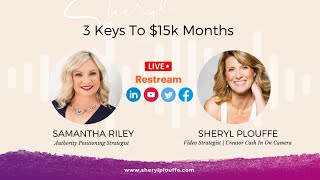
Samantha Riley breaks down three keys to hitting $15k monthly revenue: strip marketing to a simple lead magnet and direct outreach, skip paid ads until your offer is clear, and build systems so the business runs without you. She emphasizes disciplined simplicity over complex tactics.
Chapters
month in your business can set you up for so much success because it's really one of the first milestones that you can hit in your business that makes you feel like, I'm on my way, things are going to be okay, my bills will be paid, right? And it's that first milestone that can be so important. So today we have Samantha Riley with us today, and she knows all about reaching not just $15K per month but way past that. She actually built her first $750K bigger business before she was 30, and she's done this multiple times over the last 28 years. So Samantha, great to have you here on Cashing On Camera to talk about this, because reaching $15K for a lot of people is a huge step. And, and what are some of the problems that you're seeing that are preventing people from even reaching $15K per month in their businesses?
Yeah, so there, there's a lot of things, and I think that And I know we're gonna talk about the 3 keys, but essentially what I want to, I guess, set the foundation is that to get to your $15K month is actually not about implementing lots of fancy things, lots of tactics. It's actually the opposite. It's about making it as simple as possible and just repeating, repeat, repeat, and stay consistent so that you get that feedback from the market that you need so that then you can go forward and, um, you know, be able to build on that. I think a lot of people think that $15K months comes from lots of products, putting lots of, um, you know, lots of tactics, and it's actually the opposite.
I totally agree. $15K per month is— I think both you and I would, would agree that this is, this is beginner level stuff, right? Like, we want to get you And we're going to share again these 3 keys to getting to those $15K months because that now allows you to have cash flow. It allows you to reinvest in yourself. It doesn't make you so stressed. You can be more clear, you can be more strategic, and now you can start. But, but this is just the beginning, right? $15K sets the foundation for going to $20K, $30K, $50K, $100K per month whatever your goal is.
I mean, the sky is the limit, really. Absolutely, absolutely.
So I love this. And, um, so we're gonna go into these 3 keys, and let's start with number 1. Like, what is the first key to helping, let's say, a coach, a consultant, an entrepreneur get to that $15K month?
All right, this is going to be a little bit controversial for some, and I know you and I banted about this for a very long time last time we spoke, and it is get rid of your fancy funnels. Amen. Funnels do not need to be fancy. They will just add stress. They'll add complexity. They'll break. Uh, we don't have the data that we need to be able to run these fancy funnels. Really, before you hit that $15K month, all it is about is making sure that your you have something so that you're able to build your list. So some sort of free resource, lead magnet, you know, video series, whatever it is, some sort of free resource that you can exchange with someone to get their email address. So it's really, really important that we build our email list. And I want to jump in.
I just want to dig in a little bit on that because the, the lead magnet, now all of a sudden, like, someone listening or watching this may say, oh, but you just said I don't need a funnel, but don't I need a funnel to have a lead magnet?
Hmm. So the easiest way to share your lead magnet or this, this, this free resource is actually just to put it out on social media saying, hey, I've got this thing, would you like a copy? Then what we're doing is rather than creating a fancy funnel where someone opts in and they go here and they go here, we're able to move that conversation to a, to a personal message. And I think this is the key here. Is that at this level we want to be connecting with our audience, we want to be conversing with them, having a conversation, building relationship, build rapport, because under $15K we're getting a lot of data and I know I've mentioned that a lot and I'm going to keep mentioning it because we need that data, we need to know what are the pain points, what are the words that your prospects are using, what are their desires, what are their aspirations? And we want to be really clear on this so that as we move on and we move into that sort of $30K, $40K, $50K months, we're able to use that data to then put into, you know, paid marketing, setting up our funnels, because we actually do need funnels. I'm not saying we don't need funnels, I just think we need to pare them back at this point in your business.
Yes, 100%. And I love that you were mentioning about, again, the simplicity of this, right? Is like, this is getting to $15K. If you're under $15K and we wanna get to that first milestone, this is not the time for complication. This is the time for simplicity. But to your point, it's about listening and really listening hard so that you can hear the language patterns that your ideal clients are using and what are their true frustrations and pains and problems and making note of those, by the way. Totally. Those are things that then can then inform products, inform services, inform what copy you write in an email or on social media. And it starts to create this snowball effect because the more people you talk to, the more you're learning about the ideal person, the more that you're getting in their brain. So, right, it's, it's really a key, key piece of this whole component. I love it.
Yes.
So that leads us to key number 2. Yes, tell us about that.
And this is Facebook ads. There is a big belief that to build your business you need to be running Facebook ads. I'm a big believer in running no paid marketing. Until you've clocked these $15K months. And the reason is, and I've heard this over and over and over, people saying Facebook ads don't work. It's not that Facebook ads don't work, it's that until people have really hit their stride, got very clear on what their product is, what the offer is, and exactly who it's for, Facebook ads don't work. It's actually the creative, it's the copy, it's the offer, it's the messaging that, that isn't hitting the spot. If you haven't dialed this in, all you're doing is getting bucketloads of cash and flushing them down the toilet. That is seriously what you're doing. So, you know, just stick to organic, get really clear on your messaging and your offer, and then move into the into paid marketing.
I agree with you 100%. I want to ask you a probing question there, and that is, at what point do— and I have my own opinion, but what point do you believe we need to be in terms of monthly revenue before you would even entertain the idea of ads? Because I think it's a pretty high number. Like, I mean, I really think that you should be— oh gosh, I mean, maybe $30, $50K a month, like kind of in that range before you would even consider ads. But I'd love your opinion?
I think it really depends on the business owner and the business and the community or the network that they have created. I know people that are running million-dollar businesses that still haven't run paid ads because they've built their network big enough so that they're able to, they're able to, you know, speak to enough people. There's a lot of other ways to be able to build your network, and paid marketing is just one piece of that. I personally think that collaborations and podcasts like this collaboration that we're doing now, and I know you're going to be on my podcast too, I feel that these are way, way better ways to build your network. And why would you run paid marketing unless you've kind of exhausted your organic reach? Um, It, again, it really does depend on the person.
Yeah, I mean, again, you don't have to convince me. I'm, I'm all about organic. I don't do any advertising. I remember doing a little bit of advertising way back in the day, like 9, 8 or 9 years ago, with just to some, you know, with some, uh, results, uh, but that was a different time and things have changed radically. And I don't really have any, frankly, interest in running Facebook ads because, to your point, My strategy is more about the collaborations and the relationships and the networking side of what I'm doing with a little bit of social media thrown in. But mostly it's really about building relationships. And I am excited to be on your Influenced by Design podcast, by the way.
Yes, can't wait. Yeah.
Okay, so Facebook, yes, it might not even be in the cards for you depending on what your business is, to Samantha's point. And then let's go into key number 3 to get to 15K months.
Now, we, when we spoke, we called this flexibility. And what we're talking about here, or what I'm talking about here, is taking time off. You know, there's a lot of, there's been a lot of marketing around build a coaching business, you can do it with a cocktail hand and lying at the beach. And I don't mean to be a negative Nancy, but it's not gonna happen like that. It is just not gonna happen like that. When we talk about having an online business and having flexibility, that is a thing. At $15K, where— or up until this certain point, and I actually think it's a little bit more than $15K, there's this belief from people that are running their business that the flexibility means, "I'll just take a day off." That's not what it means at all. I'm at a point in my business where I can take a day off and I actually only do client-facing activities 3 days a week, but my business doesn't stop when I go to the beach or when I go and have lunch with friends. My team is still running the business, my automations are still running, so if you want to have a flexible online business, it's not just about walking away, It's about making sure you've got systems, processes, automations, and team running your business for you. So taking that time, you, and this is where, you know, you could come at me with just about any different perspective and I'd say, yeah, but we still need to take time out. I'm not saying you need to work 24/7, still need to take time out, but just understand that being flexible or running a flexible online business does not mean just walking away from it whenever you want. It'll make your growth very slow, and it will— you'll have a lot of road bumps along the way. Yeah.
Do you— I mean, I, I'm starting not to like the word hustle, but you're really in hustle mode, I think, when you're trying to get up to your like $10K and certainly a $15K milestone. I think you're still in the you know, the grassroots kind of hustle stage. We need to get to that point, and it's not— it's the time to put the pedal to the metal, so to speak.
Yes, definitely. Yeah, let's not, let's not sugarcoat it. I've opened multiple businesses, um, they've all had that, that startup grind to them. If there's someone that's watching that's figured out how not to do that, sure, let me know, but I have not discovered the, the magic pill. There is a hustle and a grind at the beginning because there is just you and, you know, it's your vision that's being put to life and you need to implement it to be able to take it to something bigger where you're, you know, bringing in team or bringing in different coaches or mentors or whatever it is. So it's really important that you do put in the work to get the results that you're after.
Yeah, Patricia writes here, building relationships also builds trust, and I believe that is the key now with the educated buyer.
Absolutely.
It is really about— and that's, and that's a great way of putting it, because when you, you are wanting to build relationships, get to know people, building that level of trust can help you to get to this, to this milestone. Um, I, I love these tips. I think that you're, you're right on, because this is just the beginning. And I think sometimes— and I'd love your opinion about this— sometimes I hear people say I want to reach, let's say I want to make $100,000, right? We often hear like, I want to, I want a 6-figure business. To me, that's just the beginning.
100%.
That's just the beginning. That's not the end of the road. That's like, you need to get to 6 figures and way more. And then statistically, and I don't know the stats off the top of my head, but very few women entrepreneurs, you know, statistically reach 6 figures and fewer still reach 7. And it's an alarmingly low number.
Less than 2% of women reach 7-figure companies. Wow. Yeah, yeah. And in that, not everyone wants to have a 7-figure business. True. But here's what I know, and this might surprise some people: running a 7-figure business is way easier than running a 6-figure business. Way easier. Yeah, it's astoundingly easier.
Well, I love that you, I love that you shared that. And, and I'm not there yet, but that is my next milestone, right? Is my next milestone is getting to 7 figures. So I would love for you to tell us about the Million Dollar Plan.
Yeah, well, there we're talking about, you know, funnels, we're talking about Facebook ads. Really what we're talking about is understanding what the key growth areas are or the foundations of your business. So I've discovered 9 key growth areas for your business that was going to help you to get to 7 figures, because really you do have to have a plan. You can't just run on what I call accidenti and accidentally just end up there. It doesn't work like that. So I've put together this, uh, this workbook that goes through the 9 key areas. It's a perfect time of the year to do it as we're wrapping up 2022, as we're moving into 2023. I was just chatting to someone yesterday who did this last year when she got the workbook, she didn't believe that she had a business that could have 7 figures, and she said within 20 minutes she'd had the massive mind, you know, huge aha moment, and she actually figured out how to do it just by going through this workbook. So I thoroughly recommend downloading a copy, taking some time out and going through that.
Yeah, absolutely. It's like, you know, get a cup of tea, get comfortable, you know, start— I think this is a great time time. The end of the year is always a great time to, uh, to do that reflection too. So Samantha, one thing I want to ask you as well is what is a tip, a tool, a tactic, a technique that's really something maybe new or something you've been using for years since you've been at this for so long too and have had great success? What is something that really is working to help you market for the year we live in?
Oh, um, Something new. Okay, I'm gonna go completely the opposite. I'm gonna say something really old school, and I call it the Yellow Pages strategy. Remember back in the '80s when we used to want to connect with someone and would pick up the phone and we'd call them and we'd have a conversation?
I am old enough to remember that.
I still think that is the best way to market, and Patricia mentioned it just earlier, that Building relationships always builds trust, and we're in a time where the market is the most skeptical they've ever been. So having conversations and reaching out and connecting with people is the best marketing strategy. And I believe that joint ventures and collaborations are the best way to do it because you build connections with people and you're able to exponentially grow your network.
Yes, I agree. And it's, it's fantastic that you've come on the show today to, today to share, uh, 3 keys to getting to that first milestone. And I think many people in our audience, be it watching the videos or watching or listening to the audio, will get great benefit from these 3 keys. And really, I think what it is, is it's, it's things to do but also things to avoid.
Yeah, totally. Yeah.
Samantha, this has been so much fun. Thank you so much for joining us today on Cashing on Camera, and I'll look forward to chatting with you soon.
Thanks, Cheryl.
More from Sheryl



From 'agreeable' to 'ruthless mentor' to 'strategic sparring partner' #substack #shorts







