3 Keys To Leadership with Nicole Pereira
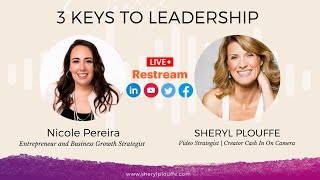
In this conversational interview, host Sheryl Plouffe talks with automotive dealer and mentor Nicole Pereira about essential leadership principles for business owners, especially women. Nicole outlines three core "keys" to effective leadership: (1) casting a compelling vision – developing a clear, shareable picture of the future and communicating it consistently to teams, customers, and partners; (2) listening strategically – tuning in to market trends, competitors, suppliers, and the feedback of employees who execute the vision, while balancing external data with internal direction; and (3) loving others – genuinely caring for people, building trust, and showing that you value them, which underpins influence and sales. Throughout the dialogue, they discuss the importance of vulnerability, sharing failures, and evolving a vision over time. Nicole also shares a modern marketing tip – leveraging YouTube pre‑roll ads for automotive sales – and promotes her mentorship program, the Growth Academy and its Inner Circle, designed to help female entrepreneurs accelerate growth through peer accountability and coaching. The interview blends personal anecdotes, practical advice, and promotional information, concluding with gratitude and a call to action for listeners.
Chapters
Key if you want to grow your business. I can think of no better person to bring on today than my friend, my mentor. We have such a special relationship, Nicole Pereira and I, and we go back several years. Nicole, I'm excited to have you on today because, you know, talking about leadership and 3 keys specifically to how, you know, to really get that leadership role going in your life and in your business, I can think of no better person than you to come on and talk about that today.
Amazing! Well, I'm so excited to be here. What an awesome way to start the week. It's Monday. Get to join you and have a fascinating discussion about leadership.
Well, Nicole, I mean, for those who don't know, you are such an accomplished person. And I will— your bio is below this video somewhere. But you have a long list of accolades, experience. You've been mentored and trained by people like John Maxwell, Joe Dispenza. The list goes on. And so, I know you have a lot to bring to this discussion also from your own experience as someone who is running a multi-million dollar company with over 60 employees, plus all the work that you do in mentorship with women. So, let's dive in, right? I know it's funny because I was thinking about John Maxwell before this conversation. And we know that the book, 21 Irrefutable Laws of Leadership. And I know that you've trained with John. But I'd love to know from your perspective, what are 3 keys that we can really dial into? Maybe it is specifically from the vantage point of women that we can really kind of hone in on so that we can grow our businesses.
Cool. Well, John says everything rises and falls on leadership. And I think in my life experience, that just seems to ring true over and over again. Like in my greatest accomplishments and my biggest failures, you seem to be able to like dial it back to the one foundational thing, which is leadership. Could you get people to follow you or not? Could you execute and implement your vision, or did you just not? And, uh, you know, that book that you refer to, I think it is The Leadership Bible. And, uh, you know, I have learned so much from people like that, like John, but I've also learned a lot from all the shortcomings and times where things just didn't work out, just to keep going.
It's something that I have admired in you. You're really one of my mentors and we have a client relationship as well going both ways. But I think of someone like you who really is not afraid of going back in time and saying, you know what, it wasn't always easy. And you do that especially well in the videos I've produced for you over the years, especially as it pertains to the Growth Academy. You are very open and vulnerable and willing to share the parts that weren't so pretty. You know, why is it important to you to share that step and those steps way back when?
Because if there's one person listening to this conversation today and they're struggling and they're not sure if they should keep going in their business or in something that really matters to them, if I can just say from my experience one more day, just keep going, the best is yet to come. No matter what horrible things have happened in the past, there is still hope for the future. And from a leadership perspective, sometimes those are very public and horrible failures. You, you try to launch a new business and it doesn't go as planned. You, you make a big hire and it doesn't work. You implement a big marketing strategy and it falls flat, and everyone around you can see it. And that's really tough. But you know what I learned is, my goodness, I would not have gotten to where I am today if I just didn't keep showing up. Yeah, yeah.
And it's the willingness, you know. And I just appreciate that about you because I've learned so much from you over the years just being around you so much. So let's dive into the 3 keys as you see it to successful, like, leadership. What would key number 1 be?
So I think the first thing is cast a compelling vision. I mean, leaders are there to paint a picture of a desired future outcome, and your ability to have others follow you is going to be largely dependent on how compelling that picture is that you can paint for people. And I think as leaders, we get really quickly married and fall in love with our vision, but it's highly personal and sometimes we don't share it and share the passion and the details with the same clarity that we can feel inside and to be able to communicate that vision and to share that vision to those around us, to those who we are counting on to execute and to make things happen, then we don't get very far. And sometimes that's when we like also can get to tend to blame people and other people because— but they're just doing the best they can. And if we're not really clear in our vision, then how are they to make decisions in line with that?
So if we do that, if we really get a compelling vision of what we want, do we keep that to ourselves? Or how important is it for us to verbalize that and to be able to express it to someone else? Does it only become real once we've expressed it to someone else? Or can we just keep it to our own selves?
That's a great question. I think the answer is both. Um, yes to both. I mean, I think it's really important that when we receive inspiration and dreams and desires, that we nurture them like we would a seed that we're planting and that hoping to harvest one day. But at some point, um, if we're talking about business here, you've got to share your vision with your team, with your customers, with your suppliers, so that they can get on board with you. And your ability to share that vision, I would say, with clarity and in a compelling way really matters. And it's not just really going to determine your velocity or the speed at which you can travel, but it's going to determine where you go. Because if people don't know where you want to go, they'll take you somewhere, but it might not be the place you intended.
Right. I love that. Yeah, and I think that's important. I think it's important to give it life because it's not probably enough for us to just kind of internally think, 'Oh, I have a vision.' But to put it out there and make it real. So, you were going to say?
Yeah, so I think as leaders, we also have to know how to share the vision and share it in the right chunks, in the right way, to the right people at the right time, right? And so, there's different levels of that. So, how you share your vision with your team and how you share it with your suppliers and how you share it with the people who are Financing your dream. All of those are going to be different depending on the day and the outcome and what you need to do and what you need to accomplish. I think there's an art to that.
How often should the vision change, if at all?
Oh wow, that's such a good one. I think visions evolve over time. Something one of my mentors taught me is that vision leaks and people forget vision. And just because you think you know it and you think you know where your business is going and, and, and and what the roadmap looks like. Doesn't mean other people will remember that. So you may share it one time, but one time's not enough. You need to always be communicating your vision. But if we can think about leaders that we like to follow and then leaders that frustrate us. I mean, some of the leaders that frustrate people the most are the ones who are always changing course, right? Like always changing course. So course corrections, I think that's a sign of good leadership course corrections. But remember that people are really listening to you and they're grabbing onto your vision. And if it's changing dramatically over short periods of time, that's really hard for people to keep up with.
I love that, Nicole. So, the key, the first key is to cast a compelling vision. What is key number 2?
So key number 2 for me is listen. So the ability to listen, and I think Cheryl, when you, when you invited me on today and you said, you said 3 keys to female leadership, I think at the time, but I think that this applies to all, you know, all types of leadership. And when I say listen, I'm not just talking about you and I having a conversation and listening to one another. I think that's really important. I think it's really important to listen strategically as well. You know, so I'm not just talking about listening in a conversation, a one-on-one conversation with one of your employees. I'm talking about like listening to the market. I'm talking about listening to your competitors. I'm talking about listening to your suppliers, listening to your people, but not listening on a variety of different levels to be in tune with what forces are shaping the business environment. But then to also, you know what, to be able to really listen to the people who are executing your leadership. So the people who are operationalizing your leadership and your vision, to be able to listen to them and to take the feedback and to appreciate the perspective that they have and the value that they have. To get really curious about that because that's when you can refine things and that's when you can make better decisions.
We believe that Cash In On Camera and myself personally believe that it's not enough to really have expertise, that in order to really flourish, you need to be seen as an authority. And I think that authority is really tied in with leadership and it's having a really clear understanding and having your finger on the pulse of what's going on in your industry. So, how important is it? And I know with you, you know, you obviously in the automotive industry, you really have to have your finger on the pulse of what is going on. How many, you know, how important is it for an entrepreneur, female or otherwise, to have their finger on the pulse of their own industry?
I think it's really important. And then, I also think there's a danger to becoming obsessed with it. So, there's a balancing act here between charting your own course and listening very intently to outside market forces and being able to discern when to move and when to just listen some more and to stay steady. Because I mean, I've seen leaders who are so obsessed with market trends that they forget that they can shape them.
Right.
Right. We can shape them. We all have a choice. And we can choose how we show up despite market trends. So, you know, market trends sometimes are these huge opportunities or these like forever pitfalls You know, there'd be, there'd be people listening to this today that would say, what in the world is she doing in automotive retail? You know, automotive retail is about to die. And you could make some compelling arguments for it, but it's a, it's a much bigger, more nuanced topic than just that. So continuing to listen until you feel compelled to act and being able to discern that as a leader, I think, is fundamental.
Yeah, so what I'm hearing you say is that is part and parcel of leadership is understanding the balance of knowing your industry but also having the foresight to charge your own path. Yeah.
I love that.
So, key number 1, cast a compelling vision. Key number 2, listen strategically leads us to key number 3.
Yeah, key number 3 is probably my favorite. And it's just to love others. It really is. And if you're watching this and you were hoping for some really hard-hitting business strategy, I love business strategy. I could sit and develop and talk and discuss and collaborate on business strategy all day. But people don't care about how much you know until they know how much you care. And that's something Teddy Roosevelt said. And it's so true. And if we're talking about leadership, then the idea here is that someone once you want someone to follow you. Otherwise, what's the point of leadership? And I don't know about you, but I'm not interested in following people who really don't give a damn about me, to be honest.
Right?
Right.
Okay. There's nothing wrong with saying that because that's human.
That's human.
That's human nature.
Dial into that as a leader and to understand that people have value. And that people are valuable in every shape, size, and format that they come in. And to love that and to see the value in that and to bring out the best in others. I think that's fundamental of leadership.
Yeah, I love that you had key 3 is love others because it isn't the business-minded strategy that I thought that you might say. But it is so tied to leadership, because you really must care about other people.
Absolutely. There's an old adage in sales management that says people buy from people that they know, like, and trust. Sales is leadership, right? I mean, if someone is buying something from you, they're following your lead. They're trusting you to make a decision. It's an absolute form of leadership. But leadership in general, like, you People want to follow people that they know, like, and trust. And how do people come to know, like, and trust you? You love them. You care for them. That doesn't mean it's all, you know, gushy mushy. It means that, like, it's just real world. But there— and it doesn't mean that you don't speak the truth into other people's lives either. But I think absolutely loving people and being able to care for people and then speak truth into people's lives in a business, in a in a very hard-hitting business format is leadership at its best.
I love that. Listen, Nicole, I want to be mindful of your time. And I appreciate you so much jumping on Cash In On Camera today so that we can talk about leadership as it pertains to the world that you live in, which is mentorship for women. But before we go, we have a fun little segment that we do. And it's called, Stop Marketing Like It's 1999. We're all business owners and we all have to market ourselves. And I would love to know from you, what is your modern marketing take? Or, you know, it could be a tip, a tactic, a technique, a tool that you use, some type of idea around stop marketing like it's 1999.
Hit us with it. So video is where it's at. And particularly today, I would say YouTube pre-roll been a game changer in our automotive business. Absolute game changer. And my kids even sometimes think that I'm a YouTube star.
I have to remind them that I pay for those views. But nonetheless, it's pretty cool to have your kids think you're a YouTube star. Well, Nicole, I know you've got a team of 60 people behind you there at Cambridge Centre Honda that you've got to manage. But I'd love for you to also tell our audience about your mentorship for women business owners at the Growth Academy. How can— tell us a little bit about that and how people can get in touch about that.
Yeah, the Growth Academy is a place for female business owners who want to go further faster. So they have a dream, a desire for their business, and they want to take action and they want to see results. The Growth Academy is the place for you. Our signature program is our Inner Circle, where you come alongside with other like-minded business owners who are presented with similar opportunities and similar challenges, and you get the opportunity to be mentored mentored by one another, be held accountable by one another, and to grow alongside each other. It's, it's awesome.
I am an Inner Circle member myself, and it's been invaluable to me. So I really appreciate, Nicole, you jumping on Cash In On Camera with us today. Have a fantastic rest of your day. I know you've got a busy one ahead of you, and I really appreciate your time today.
Thanks so much for having me. It was a lot of fun.
More from Sheryl



From 'agreeable' to 'ruthless mentor' to 'strategic sparring partner' #substack #shorts







