4 Strategies to Rebuild Your Life & Launch Your Next Chapter
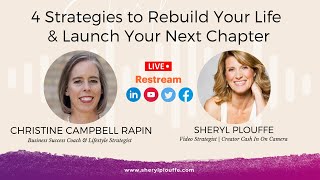
In this Cash In On Camera interview, host Sheryl Plouffe and guest Christine Campbell Rappin explore how to rebuild one’s life after a major setback, using a four‑part framework that Christine calls a "plot twist" recovery plan. Christine shares a personal story of being unexpectedly fired while traveling, the emotional fallout, and the promises she made to herself that led to two successful entrepreneurial ventures. The conversation then walks through each of the four steps: 1. Rising from the Ashes – shifting self‑talk, establishing daily habits, and reclaiming personal power. 2. Recognizing You’re a Diamond in the Rough – reaffirming self‑worth, integrity, and vulnerability, and letting go of external labels. 3. Vision & Manifestation – using a free 10‑question visualization worksheet to define the ideal future, understand success metrics, and see progress as a series of dominoes. 4. Patience & Brick‑by‑Brick Progress – accepting that transformation takes years, trusting the process, and staying aware of small incremental wins. The interview also touches on the host’s own career disruption and the importance of drawing a line in the sand to stop wallowing. Finally, Christine offers a marketing tip: drop corporate titles and tell your authentic story to attract opportunities. Listeners are directed to Christine’s website for the free visualization tool. Overall, the episode blends personal anecdotes, practical mindset shifts, and actionable tools to help viewers craft a new chapter after a career or life upheaval.
Chapters
Life has thrown you a curveball, and there have been many curveballs thrown in the last couple of years. Then this is a conversation that you're going to enjoy with Christine Campbell Rappin, because we're going to talk about how you can actually rebuild your life, launch your next chapter. If you feel like you've kind of hit a crossroads, you, you know, you've been handed a bunch of lemons and you don't know how to make the lemonade. Christine is here to walk us through her 4-part framework on how to rebuild. So Christine, great to have you here on Cash In On Camera today. You know, the last 2 years, I mean, obviously very unprecedented. But you know, people have had problems for far longer than the last 2 years. In the corporate world, I think a lot of people are experiencing a lot of upheaval, maybe downsizing companies, letting people go. All these different things are happening. And so I want you to help us through this process. Why is it important for people to understand that there is even another option that they can pursue?
Yeah, I think plot twists happen to us all. And just when you think life is not weird enough, it gets weirder. But like any great plot twist, there's that big moment of impact. And whether you saw it coming or not, I don't think it matters because you're still in the dark. It's happened. You've had this detonation impact your life and you must choose to rise through it. And I know so many people, it's been a topic. The Great Resignation has been huge, but you might not know that the path ahead of you is actually yours to craft and you have far more control over what you're crafting than you possibly imagine. And I hope this 4-step framework will kind of give you some roadmap to climb out of the darkness and build that really epic comeback because you can.
Well, we're going to walk through the 4 parts chronologically over the course of this interview. Before we get there though, I want to know what has been your personal experience with rebuilding?
Yeah, I talk a lot about the last plot twist I went into. It actually happened before the pandemic. But I was 1,400 kilometers away from home walked into the hotel lounge after a great day of business on the road thinking, oh, emails and a glass of wine are going to be my evening plans. And I was like, wow, there's HR and my boss. I'm about to be fired. And I didn't see it coming. And that was my big plot twist because when I had that, I didn't get back on a plane immediately. I had to spend the next 17 hours waiting to fly home. And so much of it, I will be honest, I spent on the bathroom floor in tears wondering what had just happened in my life. Far more questions than answers. But it led me to where I am today in a way that I never imagined. But I sat down and made myself 3 promises when I had it. Who will I be? How will I fund my future? Where will my friendships arrive from? And where will I set my boundaries? And when I looked at myself in the mirror, I picked myself up after that moment. It sparked a catalyst of change that has created me to be the place I'm in today, where I'm a 2-time entrepreneur and I really help advocate for people. Start building your own dreams. There's more to life than just building somebody else's.
And listen, can I be vulnerable too and share a little bit of a personal story as well? Because it's exactly along the lines of what you've just shared. And you know, back in 2013 was the year that was pivotal for me in terms of deciding that I wanted to craft something new and different for myself. And it was a similar situation, right? I had been managing a news department at that point for several years. And things were going well. However, massive changes were happening in the broadcasting industry and the job got eliminated, right? And so, I went back to, which was fine. I went back to doing what I was doing before, which I thoroughly enjoyed. And that was fine. But it was a little bit, you know, it's a sting. It's a sting because then you all of a sudden know, "Oh gee, that's not a path to pursue here anymore." And so, you know, and that's really what's planted the seed in me to want to eventually— and it took about 4 years, 4 years for me to get to the point where I started my own business full-time and left that industry. So I just want to paint that picture because if we can do anything on this show is to show the reality of what happens, right? And how you can take something that at the moment felt hurtful, but at the moment I was bitter. And, you know, and it took a while to get over that, to be honest with you. But you at some point have to start drawing a line in the sand and saying, "Okay, I'm not going to sit here and wallow anymore. What can I do and how can I take control of the matter?" Which leads us to your 4-part framework. So, why don't we walk through it step by step? What is step 1 to rebuilding your life and getting to that next stage of your life and career?
I think what I term it is rising from the ashes. And that is really a recognition that If you were in the driver's seat of your life and you're in an automobile, you've got this massive windshield in front of you and a very small rearview mirror. Remember that the rearview mirror is small for a reason. Stop looking backwards. It doesn't matter whether you felt it was fair or unfair. It is beyond your foresight. So look into the windshield and say, I must rise from the ashes. So there's a lot about self-talk. There's a lot about, you know, taking care of your daily habits. There is about creating your own routine, but you must choose the daily habits that are going to move you forward. And yes, you know, I can— I know all the anger. It's instantaneous when I think back into that moment. I also, though, recognize that I felt a lot of shame about it. But I said, you know, I'm giving away my power. It's happened. I must choose to walk through the fire and rise from the ashes. And those are about the daily habits, the words you tell yourself, and really that you're a good person regardless of what's happened. You need to figure out what your mantras are and say, this is still who I am and I am not going to be left on the bathroom floor. I will pick myself back up.
It is so much mental. So much of what is going on between your ears in terms of your self-confidence in yourself. And like you said, that rising from the ashes. At some point, you're going to have to push yourself to do that and to look at what you've accomplished, what you're capable of doing. And sometimes, I think we have a tendency to want to focus on the negative that might be going on at that moment or the less than desirable things that are going on. But amongst all of that is some good. You have accomplished things. Sometimes it's this matter of just, you know, sitting down and really thinking about what have I done, what am I really good at, and bolstering yourself that way. So rebuilding the self-confidence, step one. What is step two?
The second one is recognizing that you're a diamond in the rough. Like, yes, you know, you may have had some rough edges and you might not get good clarity on what it has been that led to that employment. Sometimes unemployment or changes in your life happen for really clear reasons. And sometimes it's just this general not cultural fit or just a lack of answers. But you do need to go back to what makes you you and who do you want to be. And so that is the chance to be vulnerable, to ask people, what, what did I contribute and what do I want to contribute going forward? Because your self-confidence starts with who you are when you look in the mirror. And I always think of my dad. My dad used to say to me, come what may, Throughout the day, at the end of it, when you're brushing your teeth, you must know, did you stand in integrity with yourself? Did you like the choices that you made? Did you show up for yourself? Because no one's coming to save you. And I often think I wasn't the damsel in distress. I had to remind myself I was the warrior and that, you know, I must build from here. And every day, look in the mirror and make choices, but also give yourself a free pass.. Because your Mach 10 with your hair on fire might not be your current pace when you go through a plot twist. And so really thinking about what does it take in this moment to be successful, which isn't a job title. It isn't the salary. It isn't your employment status. It's how do I be integrity with me actually as a human being.
And how do I—
Yeah, and the lifestyle.
You know, having that vision of the kind of life that you want to lead. Doesn't— I mean, it doesn't always have to mean that you have to build a $10 million business to achieve that. You know, I'll say, you know, even from my own experience in this, in the space of entrepreneurship, and as long as I've been part of it, I think when I first started out, I had visions of, oh, it's got to be in the, you know, it's got to be this massive multi-million dollar thing. And I think I was getting that from what I was hearing on the internet. From other people's experiences. Oh well, if Russell Brunson's doing it, then, you know, then— but as time goes on, you start to kind of pull back and you realize, oh wait a minute, the lifestyle that I want to lead is not to that level. Because a Russell Brunson running a huge, you know, $200 million company or whatever that is, is a very different lifestyle than what I want to lead. I don't want any part of that. And so you, you find that, that pattern, and you realize, okay, this is what I'm gonna need to do. I'm gonna have to set clear goals. This is the kind of revenue or whatever so I can lead this type of lifestyle.
100%. And that, that's where I, I have a visualization tool, a free, free one that's on my website, and it talks about what are— it's 10 questions. It helps you put together in your mind what does your perfect opportunity look like, because you're writing your chapter. You hold the pen in your hands here, and you must drop the labels, you must drop the ego, you must get really in touch with this is actually what would light me up, and Answer the 10 questions and get beyond the superficial, because when you are, you lead to your third chapter, which is, you know, success lives here. What is your success measure? Because if you're going through a plot twist, people generally want to help you, but you need to be able to give them answers to how you can help them. So when you say, I'm looking for opportunity that looks like this, and this is how I would play, and where I would go, and what it would look like, people suddenly can start to connect the dots for you. And I would say that when you're going through that success building in envisioning peace is recognize that there's dominoes. You know, where you start might not be where you end. You know, most of us, when we look at our paths, are a work in progress. And recognize it doesn't have to be all or nothing. You know, when I talk about my vision, I'm like, it didn't start— the one I have today—
me neither. What I wanted in the early stages, very different than what I have now.
I wanted to white-knuckle and get out of bed some days. And that was success. You know, now it's become making an impact. It's such a bigger thing. But recognize there's dominoes. But if you start to use really clear vision, dropping the labels, dropping the ego, dropping the expectations and say, this is what it looks like, people will help you. And that leads to conversation. And conversation leads to new doors and windows of opportunity opening in ways you won't recognize, in ways you don't expect. But they're really the universe working in your favor because you are meant to rise.
So is that, is that manifestation?
I think part of it is, but nothing in manifestation happens without action. You need to be able to articulate, own, and believe it's possible for your future. And that's again why I think looking forward in that driver's seat is so important. This is where I'm heading, this is what it will look like, and this is what it will feel like.
It's the feeling. It's so much about the feeling, you know, feeling of the wish fulfilled, right? It's like, I want to feel, you know, I want this certain thing, and I have to start acting as if I'm already feeling the way I want to be in the future. I wholeheartedly believe in that. I think I've been doing that to some degree since I was 15 years old, and I can probably trace back anything I've been even successful at with a mentality around that idea.
Well, I think it's so interesting. This is the big hack and I talk about it in the course and in the 4 strategies is your brain doesn't know the difference between what's actually happened to you and what you feel, can touch and visualize in really great technicolor detail. And so, this is the time of year, of course, we're all doing goal setting. But I said, there's a difference between I wish, I want and I am.. And when you go through that visualization tool, it's your painting the picture so clearly in your mind of how your comeback has been epic. Not the how, not the details, not the minutia, but really living and breathing it so that your brain is tricked into saying, wow, I am a great person. And you start to shine and light and energy is everything. Energy attracts great energy. And that's why when that starts to move, you're not in control of the timeline, but you absolutely are in charge of the storyline. Yeah.
And I think a little dose of patience is required. You know, we live in the— in an instant gratification society, and we see a lot of things on the internet, and we see a lot of people, you know, bragging about success and how I made a million dollars in 30 days. Have— take a step back and realize that there's a process involved here and to trust the process And how important is it to have some patience around this concept?
100%. And it is the hardest thing because let's be clear, patience was never— I was not in that line when it was given out. I just wasn't. My mother would tell you and so would my dad. But I think what you have to do is recognize you don't control the storyline. And so many times when people are saying to me, you know, they're impatient with the results or, you know, I think often if you're going through a plot twist, if someone could give you a timeline, life would be easier. But life doesn't work that way. And I say, stop believing that you haven't manifested it yet, or that it hasn't happened for you, because the biggest small word in that sentence was yet. And it's good to have community and thinking partners and other people to help you in that journey, because you might not really see when it is actually happening, because it's happening small brick by small brick by small brick. And when you look back, you go, wow, I came a long way. But that plot twist journey for me like you. It was about 4 years. It was dominoes along the way. It was daily habits when I was rising from the ashes. It was really being clear with my motivation, really clear with my vision, and recognizing that when an opportunity presented itself, I must go back to the answers I gave myself. Because often, my immediate reaction might be fear-based. It might be, 'No, that's not it. I expected it to be something different.' Or it's going to come when super inconvenient.
I think in most cases, these types of transformations and the crafting of a new stage of your life, rebuilding your life, it's multiple years, right? This is a multi-year thing. This isn't an hourly or, you know, a day thing. This is going to take time, but well worth it, obviously, if you are trying to, to go in a new direction. Christine, this is really helpful. I love your 4-part framework, this plot twist concept is something that really resonates with me as someone who's gone through it myself. And now, you know, funny, I look back and I just couldn't imagine myself doing anything else. You know, multiple six-figure business is great, you know what I mean? Like, things are great now, but I do want to take myself back to a place where I felt that despair. And I think that's something that a lot of people can relate to. On Cash In On Camera, we do a fun segment called Stop Marketing Like It's $19.99. What is something like a tool, a tip, a tactic, or technique that's helping you to market yourself for the year that we live in?
I think the big thing is drop your titles from the corporate world, to be honest. Because I think when we make the leap, the biggest way to guarantee success is to create it for ourselves. We know that. But don't take the labels of corporate and think that they're going to translate into what makes you, you. You need to really actually tell your story. I never imagined my success would be built around the fact that I said I was fired. But it is something that I really need to get candid with. And so, my tip is tell your story. Don't get caught with the big labels of corporate.
Yeah, I love it. Christine, thank you so much. Your website christinecampbellrappin.com is where people can go to get the free download of your Visualize Your Future worksheet. I would highly encourage people to go and get that. Really love this conversation. Such an important one, especially for the time that we live in as people continue to go through a lot of change. But there's a bright future ahead if you decide to craft it that way. So, I appreciate you coming on. Yeah, thank you so much, Christine, for sharing your thoughts and insights on Cashin' on Camera today.
Thank you for having me.
More from Sheryl



From 'agreeable' to 'ruthless mentor' to 'strategic sparring partner' #substack #shorts







