Book Writing Options For Non-Writers
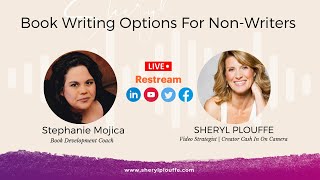
In this interview on Cash In On Camera, host Sheryl Plouffe talks with award‑winning journalist and book development coach Stephanie Mojica about how people who consider themselves "non‑writers" can successfully write and publish a book to boost credibility and grow their business. They discuss why the "non‑writer" label is limiting, the shift toward more diverse voices in publishing, and how a book serves as a powerful marketing and back‑end sales tool. Stephanie outlines a step‑by‑step strategy: make a firm decision to write, schedule regular writing sessions (even as little as 20 minutes), and choose a format that avoids heavy typing—such as repurposing existing audio/video content, using dictation and transcription services, or combining both. She emphasizes realistic word‑count goals (20,000‑40,000 words, roughly 100‑150 pages) and suggests breaking the work into blog‑post‑sized chunks or timed storytelling (e.g., 5‑minute stories). The conversation also covers monetization, noting that most revenue comes from leveraging the book to attract coaching or consulting clients rather than book sales alone. Stephanie promotes a free five‑day "Book Business Blueprint Challenge" starting December 6, 2021, which guides participants through title selection, audience definition, and initial writing. Finally, she shares a marketing tip that Instagram carousel posts have been especially effective for attracting new clients.
Chapters
You write a book, but you consider yourself to be a non-writer. You're in the right place because Stephanie Mojica is a book development coach, and she's here to share with us how you can leverage book writing even if you feel that you're a non-writer. And I'm interested to get into this with you, Stephanie. Thank you so much for coming in on Cash In—
Cash—
or coming up on Cash In On Camera today, because— and let me start with this. I think that this idea of being a non-writer sometimes is a conversation that people are making up in their own heads. What is your feeling about this label that we sometimes give ourselves about being non-writers? Is it a valid label or not?
It's funny, 'cause I was actually speaking about this the other day at an online event. So, and I've talked to several other people in my field, and people who say they're non-writers actually tend to write really interesting books. Once they get down to it because they're not sitting around overthinking. Like, I went to school for writing. I've been around writing my entire life, so I can be pretty picky. I'm obviously not the average person. So it's like when people— and my coach talks about this all the time— write your, you know, crappy— that's not the word she says— first draft, you know, uh, and it's not gonna be as crappy as you think, because really it's all about getting your story out there, sharing your expertise. There are ways to get around actually writing it, which we can talk about, but really it's not like literature writing, etc., has changed. You know, people's attention spans are shorter now. A lot of people have become journalists and such by going online, you know, content creation, blogging. It's not like it was when I was I was growing up and, you know, and going to college in the '90s. And I think some of us, especially from my generation and beyond, still have that idea that you need to go to school for writing. You need to write like Shakespeare or Tolstoy or Stephen King. Right.
Well, it's interesting because you mentioned your experience, 17 years in journalism. You're an award-winning journalist. Your work has been published in USA Today and other publications. And I think a lot of people who would, again, label themselves non-writers compare their writing ability to someone like you, and then they go, well, it's out of my league. I can't possibly write a book because I don't have the kind of experience that is really expected of me. But what I heard you say in that last segment was that we have more creative license now to be able to create and write in ways that maybe would not have been really appropriate 25 years ago. Is that what I'm hearing you say?
Yes, and I don't want to add that there is, you know, science change. I don't want to get political, but I feel like I do have to say a couple things that are totally related to this. You know, we want to hear, you know, the general population— I can't speak for everybody— wants to hear from more diverse voices, you know, wants to hear from more women, people of color, people with disabilities, people who aren't traditional, because unfortunately like, you know, what's considered great American literature. I know I'm from the United States, but it's like, you know, great American literature has been predominantly white males with a certain level of education. And so now we're living in a society where many members don't want that anymore. They want to hear from other people.
I love that. I love it. So let's talk about how a person, whether, you know, a non-writer, whether you are or consider yourself to be a non-writer, how you can leverage book writing to grow your business or to grow your enterprise. Why is it important to consider book writing in order to do that today?
Well, I think it's really important to consider book writing because it's a great credibility builder. I have clients who come to me and they're speakers, they're on the speaker circuit, so to speak, attended, and they said they're tired of see an author of in everybody else's bio. There's a credibility builder that happens. And I think it's especially important if you're a consultant because there were a million people on LinkedIn before to pan— sell as a coach. Now there's over 7 million. So it's, there's more in every profession online on social media. Algorithms change daily, it seems, whether you're Instagram, Facebook, Twitter, LinkedIn. I remember I was an early adopter of Facebook and LinkedIn and it used to be like almost everybody would see my posts and now it seems a very small fraction of folks see my posts and even that too. I've had members of my family, oh, you're not working at a newspaper anymore? I saw something on YouTube about you talking about books. I mean, I always did books as a side hustle, but you know what I mean? It's just like, it can be very difficult to get your content seen. When you have a book, you know, you not only have the physical product you can carry around with you— I've had clients like sell $5,000 of books in one night at an event— you have a physical product you can carry around with you, or one that can be ordered on Amazon. You have digital products. I mean, it just really— I could go on for hours. It really just increases your visibility and credibility. And you know, you do need to promote your book. I don't want to fool people and make them think, oh, if you go on Amazon or whatever platform, you get a bunch of sales. But it's gonna be a lot to get that book into people's hands than your various social media posts. Yeah.
And I think especially in the entrepreneurial space and the coaching consulting space, like you said, a credibility play. And you use the book as a marketing tool. It's not the book itself that you're selling as the product that's going to earn you a living. You can, but it's more often the case where you're using the book to open a door so that you have the opportunity to sell your products and services, you know, on the back end. And but obviously very, very powerful to open those doors. And so let's dive into the strategy. If you feel like you're a non-writer, Stephanie's going to share with us the strategy today on how we can get into book writing. So over to you, Stephanie. What is the strategy to share today?
Before I do that, I do want to comment on the back end. Yes, that you just mentioned, that's actually a huge thing that I teach, so I want people to understand it a little better. So yes, you can make, you know, money on book sales, and some people make $5,000, $10,000, even $100,000. But really, it's how you write that book and how you, you know, weave your offer in a non-sleazy way to get puts people in contact with you. And I won't bore you with all the statistics I have. I definitely have a video up on YouTube where I get deeper into them, but you could easily make $30,000, $50,000, even $100,000+ from selling coaching consulting packages to the readers of your book. And that's something I go deeper into in my work with people. So the first strategy is Obviously make a decision to write the book and you don't have to necessarily sit down and type it at the computer. So I'm going to talk a little bit about that, but it's important, I think, to make that decision. I can't tell you how many times I sales call with people and they're still like, ah, maybe one day. It's important to decide to ebook whether you want to do it with support or not. So decide. If you can do it, if you don't want to do it this year, that's fine. You could say I'll do it in 2023, but I think it's important to not get into decision fatigue about it because that's just a drain. So make a decision and then do. Definitely want to schedule your writing time. My clients have all done very successful in meeting their goal. The ones who had it fastest were the ones who actually put it on their calendar, like Tuesday, 6 to 7 PM writing time, or like Wednesday, 4 to 5 AM. I have clients who get up very early to write their book. Some stay up late. Some will dictate their book, which I'm going to talk about more in a second, in between like soccer games with their children. So I think it's important to make that decision and then schedule it. Schedule a time. You don't have to schedule hours a week. I mean, many people can do, but I encourage folks to schedule even 20 minutes to an hour a week to really just start writing. And so I want to talk about options if you really, really, really, really, really don't want to sit at the computer and type. I have a lot of fun. You know, there are people like Cheryl who are great at like telling stories and talking on camera and things like that. So you, if you don't have, you might have existing content already. I'm working with a podcast host who has tons of existing content. You can have that transcribed either by a professional transcriptionist or use like otter.ai. You can have that transcribed, have it edited. I also do provide editing services. And use that for part or all of your book. So existing content, video, audio form can be great, especially if it's aligned with your business and your message. Another option which has become popular among 3 of my current clients is to literally dictate your stories. Some will just use the notes function on their phone. Some will use, I don't remember now off the top of my head, but there are like services where you can sit at your computer and start talking and it will transcribe. These are free services. So you can like either do voice to text or like make a video audio and then have it transcribed. There's two routes to do that. I hope that's clear. So yes, make that decision, schedule the time, And some clients will use both. Some will write some of their stories and some will speak them. And then just start creating your content. And then another thing is don't think it has to be a really, really, really long book. This is another thing I think folks get hung up on. If you have 20,000 to 40,000 words, you're gonna have at least 100 pages of a print book, and it could be more depending on the size of the COVID that you choose at the end of the day. But really, you don't have to write 100,000, 200,000 words, and I think that really gets people hung up thinking that they have to write the Great American Novel.
Now, I, you know what I love about the, the words, right? 20,000 to 40,000 words. That if you were to, like you said, make the decision and then schedule that time, you could even just say to yourself, listen, I'm gonna write 500 words or 1,000 words, which is, I guess, typical blog post length, I would think. You know, could you break it up that way? Could you just say to yourself, I'm not gonna— I'm not gonna overburden myself with the thought that this is a book, but so much as I'm going to attack this Mentally, from the perspective of I'm going to write a blog post and I'm going to do that consistently on schedule so that I end up with enough words that can become a book. Is that a great way to think about this? So, because I think about the intimidation factor for people who are non-writers, they might just like the idea of a book. It seems like, whoo, it's such a big, big, right, uh, to, to bite off. But if you trick yourself into thinking about it a different way, it might help. What do you think?
Yeah, I think that's a great strategy. I mean, I talk to people in my one-on-one and group programs about like, you know, have 8 to 12 chapters, which really could be, you know, I've had one client, she like turned a couple of blog posts into a chapter. So yes, most people who write blogs, they do anywhere from 500 to 2,000 words. Also, most people speak about an average of 100 to 150 words a minute. So you could tell yourself, I'm going to tell a story for 5 minutes. That's 750, 500 to 750 words. Or this week I'll tell 4 stories for 5 minutes each. So it really can add up quickly.
When I was on television, I think my read speed was 130, if memory serves me. I think it was 130. So I was in, but I mean, it was a bit of a different situation in that I was reading, you know, say a newscast or something like that. But this idea of, you know, words per minute can really be helpful, you know, to be able to plan that out and say to yourself, okay, well, if I reverse engineer this and if I were to schedule this out, I could really write my book in said number of days, weeks, or months, depending on how much you schedule. But what I hear you say here, Stephanie, is really, you know, just kind of looking at this and going, okay, Just step by step, you know, break it down into those actionable baby steps that need to be taken in order to get the end big result that you want. This is true of really any goal that people set for themselves, and a book is a huge goal and can really open a lot of doors for you and for your business. But you need to chunk it down into doable steps. Did you ever struggle with this? I mean, you've been in the industry in journalism for a long, long time, but do you remember a time when you kind of struggled with this as well?
I would say when I wrote my first book, which is now out of print, uh, back in 2008, I did struggle with it and I did wind up working with a coach, uh, a book writing coach. And so yeah, it was like overwhelming, but like what I did was literally just broke it down into subjects and just acted like I was writing a number of articles. So I, I think every Everybody struggles with any kind of overwhelming project.
Yeah, for sure. Well, these are great tips and a great strategy to help people really take those steps that are necessary to get to the end result. And we now know that writing a book is a great credibility play and can really open a lot of doors. So thank you so much for sharing that. And I know you have an event coming up. I'd love for you to tell the audience about it.
Sure. So I have a book Business Book Blueprint Challenge. It's totally free. It starts December 6th. It's a 5-day challenge. It'll take you less than an hour a day to complete. And really, I'm gonna walk you step by step through choosing your title, literally starting to write your book, planning some topics, like just really helping you get clear and showing you that you can do this, that it is possible. I mean, I've done like workshops sort of like this before and the, like, the amount of things people can get done even like in 30 minutes, hour, hour and a half with the right support are amazing. So yes, day 1, we're getting really clear on what you're doing. Day 2, we're going to pick your book idea. 3, identify your ideal reader, which is also another fancy term for ideal client because you want to write that book to your ideal client. So she, he, they will get in touch with you. And I go deeper into those strategies in other programs. And then day 4, we're going to pick your unforgettable title. And day 5, you're actually going to start writing. So it's totally free. It's this book blueprint challenge. It's mybizbookblueprint.com. My biz, B-I-Z, bookblueprint.com. It starts December 6th. And runs for 5 days.
Awesome! Well, thanks so much for sharing that, Stephanie. And that's December 6th, 2021, for those who are watching the replay in the future. Yes. And so, if you're watching this in a replay, you can always reach out to Stephanie and she'd be happy to set you up with what she's got currently going on. But I love that you've shared that. One thing that we do on Cashing on Camera, Steph, is we do a segment called Stop Marketing Like It's $19.99. And I'd love for you to share what's working for you. It could be a tip, a tool, a tactic, technique that's really working for you in marketing yourself as a book development coach?
Funny is everybody talks about the video, the power of podcasting, etc. And believe me, they've all been helpful, but I have been amazed that Instagram carousel has been extremely helpful to me in my business recently. My coach, I am a coach who has a coach, She's my business coach, tells me she thinks it's because obviously I'm reaching out to people who are probably readers. I mean, most people who are thinking about writing a book probably do some kind of reading. So like, you know, the carousels are one of those new, newish trends going on. So yes, Instagram carousels have been doing really, really well. I've actually gotten a couple of new clients, just somebody like, I've been following you for months. I saw this last carousel. I'm ready to work with you.
I love that. I've heard that, and I haven't done a lot of carousels on Instagram. I've heard other people talk about them. Is something that's on my list when I get to doing that. I'm going to give that a try as well because I've heard really good things about carousels. So you're not the first I've heard that from. So there may be something there that we all need to take away.
Love that. Exactly. Yeah, I have a graphic designer design mine, and she works actually for $4 an hour. So if anybody is like, oh, how does she get those beautiful carousels? I obviously write the text but then she designs them because I'm just not— a lot of people are great with Canva. I just do not like it. So I just outsource it.
Very good. Well, thank you so much for sharing that. And thank you for coming on Cash In On Camera today to share your book writing and publishing expertise. And I love that you've broken that down into baby steps so that this big, big goal can be broken down into something doable for people who consider themselves to be non-writers. Thank you so much, Stephanie, for coming on today.
Thank you. Have a great day. Take care.
More from Sheryl



From 'agreeable' to 'ruthless mentor' to 'strategic sparring partner' #substack #shorts







