Build Stronger Employee Relationships with Guy Cooper
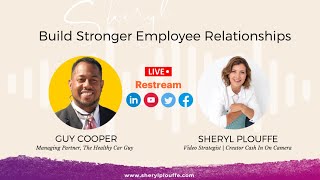
Guy Cooper, a productivity consultant, built a five-stage system to fix employee engagement after his auto-service company suffered 15 years of high turnover. His clients typically add $150k+ in annual revenue by shifting how leaders talk about work and systematically surfacing what frustrates staff.
Chapters
on camera today because he, over the course of 35 years, has started and run multiple companies. He is known for productivity. He is known for being able to really help understand how to build stronger employee relationships and so much more. Guy, so great to have you here today on the show. Why is it important for us to know how to build strong employee relationships?
Well, Cheryl, first off, thank you so much for having me on the show. It's an honor and privilege even to be here with you and actually to be able to serve as well. And so typically, I like to start with how executives call me in. They usually call me in to actually— because their team is not as efficient as they need to be. They're not as effective or as productive as they need to be. The leader may want to hit reset. And they're like, "Hey, I need you to come in and fix my team." And what we identify is we identify the problems that the leader or executive has and the actions they've taken and maybe some innovations that they've moved in and challenges that they may have faced in that process. And with that, they've already usually involved everybody else that they feel like should be involved in that process. Well, almost always when I go to evaluate that type of situation where we figure out what's going on, we almost always— I find that invariably whatever concerns the leader has, the team has the converse of those concerns. So the team has problems or concerns that they're dealing with and actions that they've taken and sometimes even innovations, sometimes even trying to lead the company or culture. And with that, they've run into challenges as well. And it's frustrating on both sides. And so what we get to is truthfully show who's in whose way. You in their way or are they in your way in that process? And so when we really get to what I call facing the ugly truth, get to the bottom line, then we can figure out how we get them in shape so that everybody can go forward and we can soar and take off.
Guy, how did you become an expert in this particular topic?
Great question. Through great pain. So, in 1986, I saw people getting ripped off in auto repair. They weren't sure they were ripped off in auto repair, and I said, "I can resolve that." And so, I had the bright idea to start an auto service company to help clients ask the right questions, recognize the right answers, and control the outcome in auto repair. I was 21, so really didn't have any business experience, didn't have much mechanical experience at all either.. But I just had belief and passion and went to do that and did that really well. And company scale— my company scaled over and over as it was bootstrapped in the beginning in that process. That's what I did well. What I didn't do well at all, what I did horribly, Cheryl, was I treated my staff like I treated myself. I didn't treat them like I wanted them to treat my end user. And so I had a lot of employee turnover, high employee turnover.. And I used to have a buddy that came to me and he said, hey, it's guys wear the highway. I hated it, hated it, but it was so true and I didn't know what to do about it. And it took me about 15 years of being in business to be able to crack that code and figure out how to get my employees on board. And when I did that, I showed other business owners how to do that as well. They loved it. Um, I had a radio show where I was a consumer advocate called the Healthy Car Guy, um, where I help consumers but serve But business owners wanted the same thing. And they really wanted to know how to get their employees and their clients on board. And I realized I was on to something that could really make a difference and serve others at the highest level.
You know, I think all of us see videos on social media of, you know, people working in the fast food drive-through and people are treating them with disrespect. And then the employees get bitter. And like, we've seen all those videos, people throwing drinks at people. They're just vile. Vile things that are going on online with regard to how we treat employees. And I'm talking about customers to employees, not to mention what's happening internally in the back end, right? And I want to know from your— in your opinion, like, is that a— like, what is the real problem? Is it culture? Is it because people are not paid what they think they ought to be paid? Is it because of minimum wage? Is it because of policy? Like, what is the problem that's really going on?
Sure. Woo! That's a, that's a heavy-loaded question there, but let's unpack that. So, my program has 5 stages and I want to— and those stages aren't just there. They're there because they're what make a difference. And the first is a vertical stage. And it's basically where, as a business owner, the first thing we have to develop and design out is our playbook. As business owners, we can easily talk about why we do what we do. And how we deliver it and what we deliver and who a right fit employee is. But where the wheels start to fall off the bus is when we talk about non-negotiables. Like, what's, you know, what are our standards? Who is a wrong fit employee? And we're really, we can do that, but it's usually reactive. When we have an employee where it's not working and we need to deal with it, I'm going to deal with this and set policies and procedures and never have to do this again. What we need to do is we need to, I believe we should be proactive in this process and look at who is a wrong fit employee and set those standards and how we conduct and do business. And with that stated, what I would say when you go to hire somebody, most, most times we hire them to do a job and we give them a job description to do the job. But what I teach my clients is they're not just doing a job. You're hiring them to manage a set of tasks. And the day they can't manage those tasks, it's not personal. I'm going to find somebody to manage those tasks.. And those tasks have measures of performance, meaning that they're measures where if you can't manage these tasks at a certain depth or rate, you know, or outcome or scope, then at that point, then again, as I stated, you have to find somebody that can manage those. And if you don't know what those measures of performance are, sure, what I would say to start, when you go to hire someone, you typically put them on a 90-day probation. Would you agree?
Yes, we hear about that all the time, right? The 90-day probation, which I— just the word probation. I just don't know if that's the right word we should be using.
Sure, sure.
Right? Because now, as the employee, you're like, I'm on probation. It doesn't— I'd love your opinion on that. Is that the right thing to start the relationship on? I don't know.
If I could, let me share. I want to share why I even brought it up in the first place. But when you have them on that 90-day probation, I love what you said. Right? And I don't know if today in this time period, if we'll have the time to unpack how we should term that. But what happens on that 90-day probationary period, right, there are measures of performance that that employee has to move within. There are tasks that they can do or things they can do where it's like, ah, it's not that big a deal if they didn't— if you assign them to a certain task and they misunderstood and they did another task. Thinking that was the task. You may not really have such a concern with that. But if they are supposed to be there at 9:00 AM in the morning and at 10:00 AM they're calling to tell you that they're not going to be there until 11:00 AM and they do the same thing the next day, I dare say that's a measure of performance where it's like they probably wouldn't exist any longer in that company. The bottom line is there are measures that you actually assess and assign right there. We start with those. If you don't have measures of performance, we start with the 90-day probationary period measures to be able to move forward with the client. And so the other thing that I would say needs to happen is they, they should have authority for the actions that they take and the actions that they don't take. I can't tell you how many companies where I've coached and they have laid out, you know, what actions they need to take. But what about the actions that they didn't take that impacted the company, impacted the client, right? Impacted their team. We need to address those actions as well. So I have a whole process where we lay out these measures of performance where they know what tasks they're managing in that process.
It's interesting because just that simple tweak of saying, OK, going from a job to managing tasks and just changing the, the terminology of that and how that's being positioned. Now, all of a sudden, if you have employees that are, let's say, at minimum wage, you know, whatever that might be in your company, it gives that person a lot more uh, say, authority, but also it positions them a little bit more highly in terms of their own feeling about their role in that particular position. I'm managing tasks rather than I'm doing a job. It's more about I am managing. Just the word— using, using the word managing, I think, puts it at a different level. It's a really interesting tweak, but it's a really important one, I think.
That distinction makes a really big difference. And that's just the title, managing tasks. When you see the tasks that they actually manage, that's what makes the real difference. And with that stated, you know, I talked about the vertical. I call that the playbook. And what I'd like to do is just give you an analogy of football. So in football, you know, if you have a high school player that's a superstar and they go to college and they become a superstar in that process, the only way they could go into the NFL and play professional football is to know the rulebook. They have to know the rules. You know, where is the first down? Where is offsides? Where, you know, where do I stand? What are the rules of engagement to be able to play this game? Well, so often, as I stated, we don't have those standards clearly laid out and what our non-negotiables are. So if an employee comes in and they come in below the mark, we can say, hey, that's a red flag, but tell them why that's a concern and help them. Our goal is to educate them up to our standard. And some people don't want to come up to the standard, but those who do, to have such a standard where we can educate people up to that. And as I talk about that in football, the other thing that you were sharing just now, in football, um, there's a KPI that matters more than anything, and it's a score on the scoreboard. And it's high enough where everybody can see it. The players, managers, concession workers even know how they drive the score on the board. In the sense that they'll quiet down the fans when the, when the, the home offense is on the team, on the court, on the field, and they'll rile everybody up when the home, when the offending, um, offense is on the field so that the quarterback, um, is not hurt by the players. So they know how they drive that score on the board. I'd say, do we know, do our employees know how they drive the KPI, the key performance indicator, the main component that matters the most to us— revenue, revenue growth, profitability, client retention, satisfaction. Do they know how they drive that score on the board doing their job? And so often, Kate, the answer is no.
And your point about the playbook, I think, is a great one as well. And maybe part of the reason why those playbooks are not shared is because the playbook doesn't exist. Do you find that in the work that you do?
100%. 100%. I have a 10-step fulfillment process. And just to give you a couple of the steps. So a client walks in the door. So let's talk about my, my auto service. So because that's where that came from many years ago, a client walked in the door and when clients come in the door of an auto service, it's an antagonistic relationship for the most part, because so often you may feel like the service provider is trying to get over or rip me off. Right? So when the client comes in the door, they have to share what's going on with their vehicle with that service advisor, the person behind the counter. And, and today what I'm going to share with you is everywhere. But in '86, you know, when I did this for the 25 years, this doesn't exist. This didn't exist. What happens is the service— the, the customer tells the service provider what's going on. The service— what did the service provider understand? What did that service advisor, you know, what is he saying? What is he thinking in that process? Or she, right? What are they writing down? Right? And once they write that information down and document it, now they get it to the next person in line, which is a technician, right? Do the technician and the service advisor even get along? Are they having communications concerns? Is there friction there? Is the service advisor saying, hey, the client just wanted to have their brakes checked.. And the, and the technician goes to look at it and he's like, are they squeaking? Are they grinding? Are they making noise? What am I checking? If I pull the wheels off, am I gonna see anything? What's there? I just told you 3 places of incredible friction out of 10 places in a fulfillment process. And you, we need to dial those places in. And I'm gonna tell you, so what happens when I go into, that's phase 2. That's, that's a major component of the playbook. In my program. And by the time we get to stage 2, my clients are making a lot more revenue in that process. My clients typically make 7 figures, usually from $3 to about $12 million in gross revenue. And by the time they get to that stage, they're usually making about $150,000 more in gross revenue just implementing that infrastructure and system.
I love it, Guy. This is so fascinating. I love your framework. I love your concepts. It makes a lot of sense. And we don't see enough of this in business. And so what do you think if we— to encapsulate and to wrap this up, what do you think is the ultimate key, the ultimate key to employee relationships and building stronger employee relationships? Can you encapsulate it into a sentence?
Absolutely. Yeah. I call it the momentum accelerator. And basically what happens is we so often As employees and leaders, we look at what's happened in the past and we're mad about certain things that have happened that cause us to complain and not take action. Not just the employees, but everyone. What we really need to get to the bottom of is where are we now? But the only way that that's possible is for us to share. And I started this by stating that leaders typically call me in to fix their team at some level. And what we really need to do is we need to find out What your players, your team, whether it's 3 people or 3,000 people, what are their concerns? And they need to have a voice to be able to speak and share their concerns. And not just so you can call out who did that, but we need to boil that down into the 3 to 5 things that really exist in the company. And then when, if the leader is able to take that and own those concerns, everybody in the company's mouths are going to drop open, their eyes are going to get big, like, "I can't believe that they even shared that." And some people, you know, and the goal of that is really to share with everybody, hey, we need to hear where you are in the right way, in a professional, you know, responsible way. We're not complaining and take action, right? So we can find out what's going on. Once the owner owns their part, they'll have control, right? And then we start dealing with the team and share with them, hey, you're in the way just as much. Let's find out what's in the way here. And that's where we are now. The last component— I know this is a long sentence.
No, it's good. It's good. It makes sense.
Yep. And so the next component, after we figure out where we are now— and I, I'd say this, Cheryl, I'd say that it's not— it wouldn't be easy for somebody that's in leadership that has a subordinate to be able to go to kind of extract this information, because the subordinates are going to feel like there's going to be retribu— there could be retribution. And it would be hard for it not to be retribution, whether it's even a parent or child or an employer or an employee, to not be retribution if they bring something that's hurtful or something that, you know, right immediately you're like, what? You know, until you sleep on it and come back the next day and it's like, you know, there's some truth there, right? It'd be hard for it not to be retribution. And so really a third party needs to extract this data in this process. But once that's done and you do that, What happens is you get to the place with the next step is, you know, how do we get in shape? Now that we know the 3 to 5 concerns that we're really dealing with, what do we do to get in shape? And I have a process that we move in really to get in shape, and it'll— and the goal of that is really to get everybody on board where they're empowered and you can get all you can out of all you got, right? And the intention is really to move in, you You know, who really wants this and fits and who doesn't. And I'll tell you, as a leader, you won't have to deal with the employees in that when you have a company that's moving in that you won't have to deal with the employees that don't want to be there and don't fit. Your champions of the cause will love that because they're like, I've never had an owner or leader that has owned this to this level. And once this, right, I would love to work with a company like this, right? They're going to help to deal with the naysayers and those who want to complain continually and not take action.
I love it, Guy. This is fascinating. I think it's very apparent that that is why you've been so successful in business over the last 35 years, multiple companies, and obviously helping people get better results and increase their revenue. And I'd love for you to share how people can get in touch with you if they want to stay connected or even book a session with you.
Absolutely. Yep. Thank you, Cheryl. So if you enjoyed this session, the link that Cheryl has there right now, very simple link, just sign up. There's no fluff here. I only send content that will really make a difference with my programs. It's not much marketing to move to try to sell. Actually, you wouldn't— you'd have a hard time moving to buy even this program. You have to actually qualify for my services. And once you qualify, then I'd award you the service where you could actually pay for it then because we have to be right fit for each other.. And one of the first things that has to happen is you'd have to be willing to what I call face the ugly truth and be honest and straight so that we can move forward. So I would say fill out this form right here. Um, and again, there's no fluff. I'm not— nothing is sold. Uh, you're only going to get the meat and not the noise from me in that process.
Awesome. Thank you so much, Guy, for sharing your insights and being here on Cash In On Camera today. We really appreciate your insights. And before we end today's episode, I also want to remind you that if you want to connect with me, you can. If you're watching the video, you can take a picture of the QR code on your screen and connect with me to my signature card, which has all of my updated links on how you can connect with me and some of the resources that I'm offering, trainings and workshops and those sorts of things. If you're listening to the podcast, because Cashing on Camera is a repurposed podcast from video to audio, If you're listening to the show, we really appreciate your listenership. And you can, of course, find me on social media @SherylPlouffe. You'll find the same link in the LinkedIn bio. Thank you so much for being here today, and I look forward to seeing you on the next episode.
More from Sheryl



From 'agreeable' to 'ruthless mentor' to 'strategic sparring partner' #substack #shorts







