Choosing The Right CRM
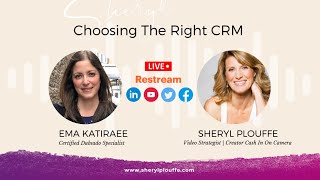
Sheryl Plouffe and Emma Ketirae discuss choosing a CRM for service providers. Dubsado handles proposals, contracts, and invoices automatically; Kajabi is easier to use but lacks multi-currency support. Map your client workflow before picking a platform, and avoid switching CRMs constantly.
Chapters
Right. If you want to scale, if you want to grow your business, you're going to have to at some point look at customer relationship management systems. But there are a lot of them out there. I'm going to share some of my own viewpoints around CRMs, the ones that I use. Emma Cattirelli is with us here today as well. She's a certified Dubsado specialist, which is in and of itself a CRM, and it is one that I use. The thing I love about Dubsado is that it's especially great for creatives. So people who want to have, you know, maybe you have customized proposals that you need to be sending and it does a lot of automation around contracts and things of that nature. That's especially great for creatives. So we're going to dive into it today. Well, of course, we'll be talking, Kate, Emma, around, you know, Dubsado since that is your specialty. But I myself am a big Kajabi user, which is also another type of CRM. And you know, so we'll talk about it from the lens of maybe both of those since we're both most familiar with them. The important thing is here to have a conversation around choosing the right CRM. And that's our focus today. So, welcome to Cash In On Camera. Do you find that for most, let's say, solopreneurs, coach-consultant entrepreneur types, that most of them really don't have their CRM side of their business dialed in or what are you seeing in the marketplace right now with the people that you deal with?
Right. So first of all, thanks for having me. It's great to be here. And what I'm finding, what I am learning as I speak to a lot of coaches and one-on-one service providers is that some of them are using systems. They might be using something like Dubsado, but they're doing everything manually. And the thing that is, I find the most powerful feature of Dubsado is being able to automate a lot of these tasks. Like with one click you trigger things to start to flow automatically, and that allows them to free up a lot of time. So I speak to a lot of creative service providers that are feeling frustrated because they're finding that so much of their time is spent on these backend tasks when they would much rather be working one-on-one with their clients, spending time finding clients or working with even more clients if they could free up their time. So that's where something like Dubsado can really, really help them because it can free up their time and mental space, I find as well.
Yeah, I agree. I think that piece around automation is especially important when you get to the point where you really want to— when you really want to scale and when you really want to grow. Like, some of these tasks can be, I suppose, maybe more manual when you have a very small group of clients, like maybe you're in the earliest stages, right? You're just starting out and you have 5 clients that you're working with. It's manageable at that point, right, with 5. But you start getting up into 15, 25, 40 plus, you know, 50 plus clients, let's say, and you're growing, it gets really complicated to start having to work, to continue to do all those things manually.
Exactly.
Give me some examples again through the lens of Dubsado, since that's what you specialize in. What would be some common automations that would really help a coach, consultant, entrepreneur out and take some of those things off their plates? I mean, I think I know which ones they are, but I would love to hear from you.
Yeah. So, um, there are different workflows. So I break up workflows into like stages. So having like an inquiry workflow where people fill out a lead capture form on your website, or they book a call on your website, and then things can start to flow automatically. Like an email saying, you know, thanks for reaching out, I'll get back to you in like 24 or 48 hours so that you have time to look at their form. Then sending them a link to book a call with you and then sending them reminders so that they don't forget. And then creating like to-dos after that conversation happens to remind you to trigger like the next workflow. Are they a good fit? Are they not a good fit? Do you want to send them a proposal? Then you can automate actually sending them the proposal with the contract, with the invoice. Like that, I think is one of the favorite features of people is that ability to automate those 3 tasks, proposal, contract, and invoice, and then set up like automated payment reminders. That's for me, I'm the kind of person I don't like to chase after people and ask them for payment. The system does it for you. So that is so helpful.
I love that.
It's so true.
I think that— and so this is where I'm going to share my story. So I have— I use two CRMs and I know people are saying, why do you have two CRMs? Okay, well, because I have really two branches of my business.
Right.
And the one side of my business is more the consultancy, the agency side of what I do, which is predominantly where I use Dubsado. Because those services that I provide are more customized, right? They're not necessarily as cookie cutter, if you will, right, than maybe other things. Um, I wouldn't say cookie cutter, that's a bad word to use, but like, um, you know, standardized, shall we say. Okay. And so on this side, I used Dubsado, and partly because one of the features I love about it is that it allows me to charge people in Canadian— like, I have two brand accounts under Dubsado, one is Canadian, one's US, because I have clients all over North America. And so I can charge in, and I've never found found another CRM that allows me to choose between both. So that's why I stick with that for that side of my business, the agency side. Now, on the other side of things, which is more my educational side, I love Kajabi because it is more standardized in the sense that it's more digital product driven, and there's lots of— and it's more of an all-in-one marketing system. I've been using it since 2018. I absolutely love it. It would take a lot to, to convince me to go elsewhere because I absolutely love it, but it doesn't have the ability for me to charge in different currencies. It also does not necessarily work in the world of, again, proposals, contracts necessarily, because it's not really for that. It's serving a different purpose. Why I say all of that, because again, the purpose of our conversation today is choosing the right CRM. For me, it meant having a different CRM for both of those sides of my businesses because each of them is unique in and of themselves. Emma, is that the right approach, or should I be figuring out how to use only one CRM to appease both sides of my business.
Right. So like you have two different types of services. Like one is one-on-one and one is a group like program. So what I find is that for people who are scaling from one-on-one to like group programs, they find themselves in like a transition period where they're using two systems, like you're using Dubsado and Kajabi. And then eventually, like, if they stop doing one-on-one services, which is what I find, then it's almost like you can stop using Dubsado at a certain point in time and go all in with Kajabi. Yeah, I have clients who have both one-on-one programs, group programs, and what they sometimes do is that they do their proposal, contract, invoice inside of Dubsado for that group program, and then they transition, like, the delivery the, the videos, like all these certain things that you're offering to Kajabi and provide them access to Kajabi. And then kind of like transition the program from, or that client from like Dubsado to Kajabi at that point in time, once they've signed up. So that's another way to do it.
Yeah. That's a really good point. And I think from an accounting perspective, if I'm thinking kind of on the back end of that, if all of the in, you know, the revenue is being driven through one CRM. I can imagine maybe, maybe from a bookkeeping perspective that keeps things cleaner. Cleaner, yeah. Um, but I love that. And, uh, so payment reminders, I mean, that can be done both through, obviously through, uh, Kajabi as well as Dubsado, but I do love that feature. And then you mentioned about workflows. I think that's where we start to talk about efficiency. So if you are doing something and you have, again, choosing the right CRM might to be dependent on looking at what is your own workflow, what is the service you're providing, is it a product, is it a service, how are you providing that, does there need to be some type of contractual thing, is that a standardized thing or is it unique to each person. That's when workflows can really start to, to come into play. And what do you recommend in terms of deciding whether or not you need workflows or not?
So when people reach that point that we were talking about where they're kind of working with more clients and they wanna find efficiencies to free up their time, that's when workflows are really helpful. And especially if you have a client process that is clear, you are repeating the same sort of steps. Maybe they're not identical, but for the most part, you're following the same client process with, you know, for each service that you provide, 'cause there can be, You can have multiple workflows depending on what services people sign up for, but, and then it allows you to free up your time because those things can be triggered automatically, sending out forms, sending out emails, um, appointment schedulers, these sorts of things. So it's a lot easier for business owners because they don't have to track so many different little details for each client that they're working with.
That client process. Is one that it can, you know, if you really sit down and you start to map out the client process, you might even discover that your client process is convoluted, complicated. Yeah. You know, and it isn't as clear. And, and that can be really, I think, a process of discovery of how are you actually conducting business? How are you doing fulfillment? Because you might, through that process of doing that, realize, oh, wait a minute, I actually have 3 steps in there that are unnecessary. Maybe I need to reevaluate. How can I make this simpler for my client, for my customer to be able to work with me? Yeah. Could be a really interesting process of discovery, I think.
Don't you? Yeah, no, absolutely. Like to build workflows, the initial step is you need to map out your client process. And I tell people, just grab a piece of paper and a pen. You can do it on a Google Doc. Just start listing out all the different things that you do with each client, 'cause odds are you are following a repeatable process even if you don't think you are. And you'll find, you'll discover a lot of things about your client process, like you were saying, that maybe there's things that you wanna do that you're not doing. Maybe there's things that you're doing that maybe you're like, eh, I don't really wanna be doing that anymore. It's not necessary. And then that allows you to build an efficient, workflow inside of Dubsado. It's what I do with my clients before doing anything. Like, that's the initial step, is talking through what those steps are and finding what their ideal client process is.
And I think too, for coaches, consultants, entrepreneurs who are working, you know, in a process, it's all just up in their head. That's like, it's just bottled up in here. They're the only person who knows how it actually works. So, think about this from the perspective of team as well. If you can get your client process out of your head, you're the only one who knows it, and get it out into a client, a clear process, you not only open up the opportunity to possibly use a CRM, choose a CRM, and use a CRM, then create workflows. But it also allows you to move to the next step of efficiency, which is developing standard operating procedures, right? SOPs. For your team to be able to understand the thing that's in your head, which you're the only person who has the key right now. And getting that out and saying, okay, now those are all scalable processes that start to make your life easier, essentially. Absolutely. You know, you mentioned emails and I wanted to just ask about your opinion with canned emails. Sometimes people are afraid to use them because they seem impersonal. Talk to me about what you think about canned emails or templated emails within a CRM.
I love them. Like, I get that some people find that they're impersonal, but like, they can be tweaked so much to sound like you, you know, certain things that you say, like, you can put those in the email. And I've honestly never had any— I don't, I don't think my clients realize that they're canned emails sometimes. Like, they think that I'm responding to them personally. So I'm all for it. Like, I'm all for efficiency. And I will go back every now and then and tweak them. Like, as time goes by, I'm like, ah, you know, I want to change this one. And then I just put it in my workflow and continue to use it.
I love them. Yeah. And they can be personalized. It doesn't mean that it has to be impersonal, but can be personalized. And I love that. You have a background in engineering. You worked for a Fortune 500 company. You R&D, project management. And specifically around project management, I think that experience unto itself, I mean, it makes perfect sense that you would be doing what you're doing now since you were a project manager, right? That you were in that. How important is it for us to think about a CRM as like, are they the same? Is a CRM really a project management tool or are, in your estimation, are they really different things?
They're, in my opinion, they're different things. Like Dubsado does have, like can generate to-dos and like reminders for those to-dos. But like for people who have complex systems or have teams, especially like a project management tool is really, really helpful. I've seen a lot of people use things like ClickUp, Asana, Trello. There are so many different options, but yeah, I wouldn't, like in my opinion, Dubsado is not a project management tool.
Right. Which of, so I use Trello for project management and So while there may be some aspects of a CRM in maybe Dubsado or Kajabi that have hints of project management within them, they themselves are not really project management tools. Do you like Dubsado? Does it play nice with Trello, Asana, and others? Or is there a particular one that you think works best with Dubsado?
I like Asana. I guess because of my corporate experience, it reminds me a little bit more of what I used to use. Mm-hmm. But yeah, you can, using a tool like Zapier, you can trigger things to go from like, if this happens in Dubsado, have this happen in ClickUp, Asana, Trello. So there are those options for people who do need both of those systems in place. Not everyone does, but for some people it is necessary.
Yeah. And Zapier is, is great because you can set up any number. You're connecting apps from one to another. So if this then hap— if this happens, then this happens. And so you connect your Dubsado or your Kajabi to your Google Drive, and then the Google Drive goes to the, you know, the Trello and all those things. And it— when you start going down that rabbit hole, it's game over because like there's so much you can do and your mind is— it's phenomenal what can happen with technology. So I think what we're hearing here is that choosing the right CRM is dependent on your client process. Start with understanding what is your client process and making that as clear as possible, which will then help you to, to, to determine what CRM might be the best for you to use. And maybe you talk to me about Kajabi, maybe you talk to Emma about Dubsado, um, and see which one is the right tool. Because the fact is, there are, there are lots of CRMs. They're all amazing. They're all great, but the, the key is doing some research and figuring out which is going to be the right one for you. But I think it does stem from what is the process for your client, what is the experience that you take people through. Exactly.
Yeah. And what do you want to see happen? Like, do you want, do you want things to be automated? Then maybe you lean towards Dubsado. Does that not matter? Then you may have a lot more like options available. So yeah, and And I would say to a lot of people, like, there are a lot of forums out there that say, oh, you should be using this, you should be using that. And I always say, you know, just trial a couple, see what is a good fit for you, and just stick with that.
That's been my experience too, is that I used to, I used to be, I think, more likely to want to jump ship, you know. And you see a lot of, and I do now for the last 5 years, I've seen a lot of people just the jumping ship thing and the shiny object syndrome of and then making lateral moves and they end up spending 8 months going from one CRM to another where they really fundamentally have no difference in terms of functionality. And it's a waste of time. Right? So, it's better to talk to some people. Talk to Emma. Talk to me. Talk to people and get firsthand accounts of like and honest accounts of like what would be the best. I'm sure both of us would be willing to say, 'Hey, you know what? Just because I'm a fan of these things doesn't mean that that's the right thing for you. Here, I think you should go check this thing out because that would help you out better because of your client process. I'm sure you'd be the same.
Yeah. I've had people come to me. They're like, oh, I'm in this program. They said I should be using Dubsado. And after I have a conversation with them, I'm like, you're really early on in your business. You don't have a clear offer, clear process. Like, wait, like, that's my advice to you is like, you don't need a CRM yet. Like wait and figure out if this is actually something you want to do in the long run, or if this offer is something that you want to continue to share 6 months from now before deciding if a CRM, you know, Dubsado or any other really. Or there are people who are like, maybe they're not comfortable with technology, so I won't recommend Dubsado to them, for instance. So yeah, I agree.
I think knowing both of them, I can definitely say Dubsado, there's is more intricate. Yeah, there, there is a lot more. I think you, for most people, they would want to get help with it. I think for now, Kajabi, one could argue that you could get help, but I think it's more user-friendly in the sense that it's simpler to navigate and you can figure stuff out probably more easily. And it gets— that's a generalization, depends obviously 100% on your, you know, how you feel about technology. But they're, they are different. Um, and so I'd love to, to share your website, tell people how they can get in touch with you, Emma, if they're interested to know more about Dubsado.
Absolutely. Um, so you can go to emmaketirae.com and at the top you'll see there's a link that says book a call. On my website you can learn about the different services that I offer, but if you are interested in talking to me and seeing if Dubsado is a good fit for you, If a Dubsado setup is a good fit for you, you can book a call and we can chat and talk about your business. And, you know, if a Dubsado setup is right.
Awesome. I love it. And, you know, listen, for my audience, if you get in touch with Emma, tell her that you saw her on Cash In On Camera. She'll take good care of you, I promise. And then on the reverse side of that, I would say, you know, again, if you want to talk about Kajabi, reach out to me. I'm happy to get on a quick call and give you my opinion. About what's going on for you. But either or, you need to make a decision about whether you, A, do you need a CRM? To Emma's point, you might not need it yet. Find out if you need one, if you're at that stage. And then secondly, we hope that we've given you some tips on helping to choose the right CRM based on what your client process is. Emma, last thing I want to ask you is what is a tip, tool, tactic, or technique that's helping you to market yourself for today?
Yeah. So collaborations are big for me. Um, I actually did one with Dubsado about a month and a half ago and I actually came very close to not doing it because I was fearful. I was second-guessing myself, but I did it. And so that had a tremendous impact. That's how I met you actually.
It is.
So, um, my advice is if you have these opportunities, don't let fear stop you and just go for it.
That's great advice. And it also helps to support my theory too about getting out there, right? About networking and meeting people that you never know where that will lead, right? So Emma and I met through that situation, and here you are, right? Able to share this message with more people. So I love that. Katie, think— or rather, Emma, I want to call you Katie because I have my phonetics written down on my page here to make sure that I got Katie Raye pronounced properly. Um, but thank you, Emma, for being on the show. We really appreciate your time today and look forward to chatting with you again soon.
Yeah, thanks for having me. It's great to be here.
More from Sheryl



From 'agreeable' to 'ruthless mentor' to 'strategic sparring partner' #substack #shorts







