Confidence For Introverts
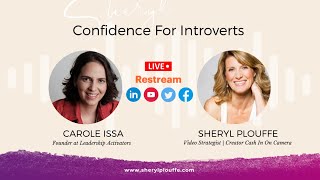
Carol Issa, a former sound engineer turned communication coach, says success is only 30% technical skill and 70% psychology. She teaches introverts meditation, opening lines, and a three-pillar framework for emotional intelligence, powerful communication, and trust-building, without trying to turn them into extroverts.
Chapters
Introvert?
If you do, then you're in the right place because Carol Issa is here with us today to talk about how you as an introvert can really build enough confidence to get out there and into the world and increase your communication skills, build influence, and build impact with your business. So Carol, great to have you here on Cash In On Camera. Just a pleasure because we've had conversations before and I just love your message around this idea of being an introvert. And I'd love for you to tell us a little bit about the story of how you came to be working in leadership and communications as a self-professed and self-confessed introvert yourself. So tell us a little bit about your story of how this came to be.
Hi, Sheryl. First of all, thank you so much for having me. I'm absolutely thrilled to be joining you on your podcast. And I'm so looking forward to sharing with your listeners the latest and greatest tools that I've been using for over a decade now to stand up on stage, to coach, to lead, and to build a powerful message to help others do the same. So a little bit of my, my story is that I used to be a sound engineer and very good at what I did. But the problem was that I always was pushing through to get better and better at my hard skills. So certificate after certificate, very comfortable behind the screen. Let's put it this way. I love to hang out with my cables, my microphones, my computer, and all of that. And I never realized that there was a whole new level to, to be a professional human being. And very quickly, I got promoted to manage a recording studio by the age of 25. By the age of 26, I was invited to partner up with a business owner in the Middle East to start a training center for sound engineers and to manage it. But the problem is that because I had to very quickly start to lead others, it started to become very challenging and I had no idea what was missing. Plus, I didn't really have any leaders in my environment to model or to learn from. And pretty much I was failing over and over again. And I kept wondering what's wrong with people. What's wrong with them? Yeah, absolutely. It's like pointing at them, not me. I'm good at what I'm doing. So anyway, and I remember one day I was in San Francisco for one of my yearly trainings. So I used to travel every single year to San Francisco and London to get the latest and greatest tools, again, access to that. And I was about to set up the recording studio and then the studio manager was walking past the studio. Studio and he looked at me and he said, Carol, are you okay? I said, well, I'm a bit nervous. I really want to nail this. I think it was Sting or like a big artist that was going to walk into the studio at the time. And he's like, Carol, you don't need to be really nervous. You know what? Success is only 30% technical skills and 70% psychology. You see all the fancy equipment here. None of this really matters. So at the time I didn't get it. I was like, what is he talking about? And, uh, but for some reason it stayed with me for years and it was only years later, like 15 or so, that it actually made sense to me. And, um, so yeah, so fast forward 20 years later, here I am, uh, coaching very much on the other side of the spectrum. So it's no longer about hard skills, I completely transformed into honing my skills and helping people develop their emotional intelligence, their leadership skills, their communication skills, everything that has to do with being a professional human being.
I want to dig in a little bit on that, in that you said the journey, you know, the difference between what you just described in that era of your life to now is a, you know, 20 years difference. So if we have people watching right now, business owners, right, who will consider themselves to be shy, introverted. They want to keep to themselves. They don't necessarily like the idea of being in the spotlight, being seen, which as a video strategist, I can tell you there are a lot of people who just really don't love the idea of being out there. But we know that being out there to some degree is paramount if you want to build a business because you can't build a business in isolation. You have to build your network. And that is one of the conundrums that I think introverted people have. My question is, will it take someone watching or listening to this podcast 20 years to get from the point you were at to where you are today, which is a radically different situation?
Yeah, yeah, it's massive. I can tell you that. I like looking back. I'm like, ooh, look where I was. I can't even recognize myself. So yeah, I love your question. Thank you for asking this. No, it's not going to take 20 years. So here's the thing I keep telling and sharing with my clients and the audiences that come to my workshops and keynote speeches that I wish I had someone who could guide me at the time. Because really, I had to figure it out on my own. I never really had access at the time to mentors, coaches, and like I shared earlier, leaders who were successful in developing their soft skills. So I really had to figure it out on my own. And this is really what took a lot of time. So this is part of the equation. So getting access to the right tools, to the right structures that could help me get from where I was to where I wanted to be. And the other side of the spectrum, which was very much an internal game, is once I had access to the tools, which I think this is what people would want to focus on once they have access to the right tools and structures, is overcoming their fear. So the role of a coach and a mentor, and I'll talk about the distinction between both because I come across a lot of people who mix up both and start to, yeah, not to be very clear on the difference because it's important, is number one, to give access to the right tools to the person that is adapted to their style, that's saying, aka introvert or extrovert, because I work also a lot with extroverts that are looking to learn more about how to be grounded, how to come across as being certain, compelling, consistent, convincing, all of that, which is a completely different ballgame. So for introverts, there are specific tools and structures that they need to learn that work for them. And also the coach will help them overcome the fear of stepping out of their comfort zone and starting to stretch and taking one step at a time to get from where they are to building ultimately the confidence so that they can have more influence and impact. So it's important to get access to the tools. And also to have access to a coach and mentor to help them overcoming the hurdles and challenges that they will come across along the way.
I often talk about the difference between coaching and consulting when I'm talking to people in my network. But to be honest with you, I think of coaching and mentorship as one and the same. I have a feeling that your answer to that is different based on your your response a moment ago. I'd love to go back and ask you, what is the difference in your estimation between coach and mentor? Because I do see them as similar to each other.
Beautiful. Love it. So coaching mainly is someone who's going to, through questions, guide you to find out for yourself what's the best way moving forward. So it's guiding, supporting. It's not giving you necessarily the answers. So a coach has an idea on how is it that they're going to pull you towards what the best answer is for you. So in other words, they are looking to create in you this muscle of self-reliance so that you become self-guided. Whereas a mentor, they have already achieved the results that you're after specifically. So let's say if you were to talk about someone who has built a million-dollar business and you want the exact same thing, let's go dig deeper into the more specific, someone who's built a million-dollar business around, let's say, running a restaurant or a training center or a coffee shop. So this is someone who's going to mentor you if you're looking specifically to drive this result, because they're going to give you the answer. So how do I go from A to B? They're going to be, do this, do that. They're going to just tell you what to do based on their experience. So, and I believe that the reason why most people mix up both, because A lot of times when someone comes to a coach, they are looking for answers. And it's, yeah, and the coach usually has already achieved some of the results or all of the results that their clients are looking for, which is why they're coming to them. And the art is for the coach to mix the right percentage between coaching and mentoring so that they start to get the client to develop their self-reliance muscle over, you period of time because they're not going to be around all the time. And you don't want your client to start being dependent on you because it's not resourceful for them. It's not going to help on the long run. They really need to start to learn how to make their own decisions based on their own way of thinking. So creating this, this shift is massively important. I mean, in my world, this is how I see it.
Yes, I think that mentorship and consulting are, you know, similar in, in your description. So yeah, I'm totally on board with you, and that's That's exactly how I think of the difference between those two. What's interesting about your point though is that when you are helping someone, let's say an introvert, to build that level of confidence, that mixture and understanding the mixture that you really need in order for them to become self-reliant is important. And I love that. I want to go back to what you talked about regarding tools and structure. You mentioned about getting over fear. People who are introverted, maybe shy, quiet, you can call it various descriptions, don't love the idea of getting out there. How do you go about, or what are some tips that you could share that are maybe actionable today to help someone who feels that way get into— it doesn't have to be a massive transformation of going from A to Z, but how do we get them to C? How do we get them from A to C? Just to start taking some steps toward that paradise, if you will, of being able to communicate effectively and the things that you teach.
Love it. Wow. This can take days to walk you through it. I'm going to try as much as possible to make it manageable here. Like you said, some actionable steps. So funny enough, I keep coming across tips that are very how-to straight away. So you have either the people who, let's say you're trying to learn how to swim, they just throw it in the water and you figure it out. Yeah, you swallow water, you might be sinking, and that's how you do it. And not my style. And I don't believe that this works for people who are self-professed introverts, let's put it this way, which I love to call silent movers and shakers. I'm not a big fan of the word introvert. So the idea is that there is something that has to be done in the background, slowly and gently, all the way up until the person is ready to go into a public setup. To start to voice their opinion and to deliver their message. And what we need to look at, number one, is to silence the chitter chatter up here. So something that is specifically very well known and that all introverts experience, at least the one that I have worked with, including myself, is the ongoing chitter chatter that is happening up here. So they're usually big thinkers and and they spend a lot of time in their head, which is why in a way they seem to be self-absorbed or disconnected from others or not being able to be connected because they are actually processing constantly data. It's like a computer analyzing every single bit out there, which doesn't give enough room or capacity to create connection with the external world. So I would say the biggest hurdle or the biggest challenge that I work on with my clients is number one, to learn how to navigate and manage the chitter chatter inside their head. And it might be completely counterintuitive, but meditation is one of the key tools that I share with my clients. And mainly what is the meditation focusing on is, first of all, we have a look at what's going on in their mind. What is the chitter chatter what is the conversation that is happening? And based on this, we match what needs to happen with the meditation to start helping changing this focus point. So this is the very first one that we work on. The other thing, once this starts to take off, so this is the tiny first step, is to start learning how to focus outwards. So There is this tendency, even with extroverted, by the way, when we go up on stage or when we have to stand up and share a message with the room. And I believe that most of the times people who come to me have a big challenge when they are caught off guard, like, Carol, would love to hear like speech, or they're like, whoa, I wasn't prepared for this. So it's about learning how to have a menu of different starting point. So, um, because also introverts usually work in menus, like they have like some sort of menus in their mind, like, okay, if I'm caught off guard, what do I do? Click. And if they haven't learned the structures until then, click, empty, nothing, which creates this fear, right? It's like, oops, I'm looking through the menu, but I don't see anything there. So yeah, the second piece of the puzzle would be to start developing this menu of options, how to start. Like if you're in a meeting and you're caught off guard, let's say, what to say to catch yourself because you need to think, to put your thoughts together before you start. So for example, one of the key click open options that I teach my clients is to thank the audience or thank the person who's just giving them the opportunity to speak. This gives the opportunity to the brain to move out of fear and starting the connection process with the room. So it's very important to start doing that. There are so many different tips and tricks on how to do that, but this one pretty much works anywhere. So thanking either the person who gave you the opportunity to speak, sorry about say something, or the room for being here. So this gives a little bit of time for the brain to catch up calm down, for the emotional dust to settle so that now I can connect even better with the room and start.
And what I love about that too is this idea of having a menu of starting points is that, and let's say, for example, using the thank you as the way to get out of fear, but it's also getting you into action immediately, getting you into action. And then you can progress. Like you said, it gives your brain time to be able to think about what the the next step is, but you just don't have time to be in fear at that point in that scenario if someone put you on the spot. The thing that I love about the meditation is this idea of quieting the mind, right? And being like— because that I think is a— I think that's a common experience between probably most people in the world, uh, now in the post-pandemic world, where there's so much chatter. I can speak to that with experience, you know. I feel like I'm having all kinds of conversations with myself in the course of a day, and I don't really consider myself to be an introvert. So this idea of the chatter, but using meditation to be able to quiet the mind and to be able to take that space, I think is really wonderful that you're sharing that. Um, I want to talk about— you mentioned earlier about 30% technology and the epiphany that you had at that moment, uh, 20 years ago, or or so. 30% tech, 70% psychology, which is so interesting. What is it that introverts could do? Are there, are there books? Are there, you know, I know you have a lot of different courses and things that, that you provide, or mentorship and coaching, to be able to help people through this transition and getting the psychology right. What is it that we're trying to do though? Do we want introverts to transform themselves or are we trying to teach them a way to still be an introvert, but still be themselves, but be introvert in the world that is so highly connected?
Beautiful. Love it. Wow. Okay. So let's make it also manageable here. So it's funny because there are a lot of books out there and a lot of resources out there and I've come across a lot of them. And my obsession for the past decade was to actually make it manageable and understandable in a way that it's actionable. Because most of the times when you read books, it takes a lot of effort to go to the actual cream of what the message is and make it actionable. So you lose patience by the time you're halfway through and you move to the next one. So what I found gathering different tools, ideas that I have tested myself, so battle-tested wisdom, let's call it this way, is that what we're really looking to develop are 3 key pillars, whether we are introverted or extroverted, doesn't matter really. But in the context of introversion, number 1 is emotional intelligence, which I usually call being emotionally smart. Smart. Number 2 is powerful communication. So how to communicate in a way that it's powerful, where the message is going to land. And number 3, how is it that we're going to be a trust builder? So those are the 3 key pillars that I work on with my clients to help them develop the soft skill side of the spectrum. I'll go, I'll go back in a second to how to do that. What are the different accelerators that we use there? To answer the other part of your questions first is that no, we're not looking to change introverts to become extroverts or more extrovert, however you want to frame it. On the contrary, what I love to do with my clients is to help them love where they're at, love who they're being. And there is a book that I read a long time ago and I absolutely love the title, which I use. I tell them, love yourself as if your life depends on it. So it's all about embracing fully their introversion and learning how to be a resourceful introvert. So in other words, look at how is it that sometimes they might be overusing their introversion and start to look at how is it that they kind of flex themselves into other areas that are within themselves. It doesn't mean that if I am an introvert that I don't know how to connect with others, that I don't know how to create a vibe or energy around me. It's there. The thing is that I haven't been shown yet how to tap into this because in my original wiring at around the age of 7, I have been going to the shortcut, the thing that is easier for me in the way my brain is being wired. And no one has ever really given me the opportunity to share with me how is it that I can into the other areas of my brain. So let's put it this way. If introversion is a highway in my brain and logical pathway, extroversion is a small side street, or maybe, maybe I can't even see it yet. So it's all about starting to flexing this muscle. So when I need to go there, because this is what the world around me needs right now from me, I know now how to do it and I can do it. It doesn't mean that I've suddenly transformed into an extroverted person. It means that I've developed the flexibility to go there when I need to, knowing that my strengths lie in being introverted and everything and all the goodies that come with it. So this is usually my approach. Going back to the 3 key pillars and the accelerator. So how is it that I develop emotional intelligence and where is it that I'm looking to develop the smarts in being emotionally intelligent? So it all lies in the fact that we want to learn about ourselves, knowing ourselves. So knowing our map, learning about our strengths and the key ones that we want to leverage, and then looking at our stretches. So the flexibility on where is it that we're going to start to tap into developing the most relevant ones. So with a business owner, I would work with specific stretches. With a team leader or manager, I would work with other ones. With high performance, depending on the context, I would do other things. So depending on what the most relevant ones are, we need to find them because you're not going to work on all of them. So my philosophy is to leverage your strength and stretch yourself where the gaps are. So this is the very first key pillar. Now that we know how this works for us, we're much better equipped to start connecting with others to help them do the same for themselves, because the more we work on ourselves, the better we are equipped to help others. Funny enough, a lot of people come to me and say, hey, I want to be like you. I want to do what you do. Can I take a quick course, like whatever, a 2-month or 3-month course, and then help others? And usually I say, well, here's the thing. The longer you take to develop yourself and the more serious and dedicated you are to dig deeper in you, the most likely you are to help others and drive the results for others. It's It's not an in-out thing. It's not a shortcut. It's not a certification. It's an ongoing journey. The other key pillar is powerful communication. So it's about learning how to build connection with others. And I started to talk about this when we're talking about leaving the chitter chatter and starting to focus on others. So this is one of the tools that we learn. Then developing the flexibility of communicating with people the way they like to hear the message. Because the very first thing that I find with introverts is that they share with others their message based on how they like to hear it, and they wonder why it's not landing. Right. So the flexibility is important. How to do that? The third one is developing the consistency in the way we communicate. So something that I come across a lot is depending on which side of the bed people wake up on, they become like different with the way they communicate. Today they're very happy, they joyful, and they've spread this energy and they're cool and yippee-yay, and it's motivational and inspiring. And everyone's like, yeah. And the next morning they wake up on the wrong side of the bed and it's like gloomy day. And like everyone is sucked into this vortex. And no, you cannot afford to be this way. You gotta find a way to keep this consistency going on. How is it that you show up when you are communicating? So this is the third accelerator in the Powerful Communication pillar. The last pillar, which is Trust Building, is developing your values, but based on knowing your purpose. And knowing your purpose is a big one here. A lot of people think that they need to know their purpose, otherwise they won't be able to function. It's not that way. It's all about discovering your purpose as you go. As you move forward in life, it evolves, it grows with you. It's going to be on the same pathway, but it's going to evolve and grow with you. So it's about stretching yourself on keeping on upgrading your purpose. And usually it starts with you and then it starts to expand with others. And being clear on the values that are being the foundational pillar of this purpose to hold it while you're moving so that you can stay the course. And ultimately being committed to living your values and being on purpose. Every time you fall off track, knowing that you are, hop back on and keep on going. So those are the 9 accelerators for the 3 key pillars.
Carol, thank you so much for sharing that. I think that what you've shared in this episode is going to be so helpful because you've given us ideas and strategies and a framework. I mean, really has been phenomenal. And I know that you work with leaders. And you have a quiz that people can partake in. And I'd love for you to share what that is.
Yeah, beautiful. So if you're interested to learn more about what type of leader you are, you can take this free test, free quiz on the link below that you can see on the screen. And we will send you a free report that will give you insights around your key strengths, your key stretches, and some recommendations on how is it that you can kickstart to start your journey to develop your leadership skills.
That's awesome. And you at Leadership Activators are all about helping people with their confidence and impact and influence. And people can get in touch with you there as well, correct?
Yes, correct. Absolutely. Awesome.
You have your programs, podcasts, a blog, testimonials, everything is all there. So that's fantastic. And I want to just thank you so much for coming on the show and really sharing these tips, because I think anyone who would consider themselves to be introverted might feel alone. You know, they might feel like they're the only ones who feel this, which is not true at all. And that's evident from the work that you do. I would love for you to share on the show here as we end, what is a tip, a tool, a tactic, or technique that's helping you to market for the year that we live in now? Like what's really working for you to market your, to market Leadership Activators?
Yeah, it might be a bit of a counterintuitive answer here is to be what I preach. So I think this is the most effective marketing tool that I have found has been working ever since I've started this business is to be what I preach. I think that the market today, I'm not sure about you, but what I'm sensing is that trust is being lost and people are tired of the last day before you jump, 50%, that sort of thing. And people are not trusting anymore the marketing message because there's this massive discrepancy between how the actual person is showing up in the world. Like there is the social media front stage, the mask, and the backstage. So to me, the most powerful marketing tool at this stage is to be what I preach and to be exactly the same way I am front stage and backstage.
I agree with you. I think we're moving from an era of marketing that was very direct response, act now, the bonuses are going away, you know, those like all of that scarcity and things like that. And while there's there can still be maybe a little bit of that. I think it's the approach that we're starting to see maybe eroding a little bit, and maybe thankfully so. What I heard you say there is really live in integrity. I think that's exactly what you do by being an example. And I think your story obviously really helps because you came from the place by which, you know, you— the people that you help today are who you were all those years ago.
Yes.
And what could be more, um, in integrity than that? So Carol, thank you so much for coming on the show today and sharing these tips. I am really glad to be connected with you. We had a great conversation off air and we're having a great conversation on air. I really appreciate you being part of the show today.
Thank you so much, Cheryl, for having me. It's been an absolute pleasure having this conversation with you.
So go and check out leadershipactivators.com.au. Carol's in Australia. And then, you can also go to alifpreneur.com/leadership to learn more about Carol's work. Thank you so much for being here on Cash In On Camera!
More from Sheryl



From 'agreeable' to 'ruthless mentor' to 'strategic sparring partner' #substack #shorts







