Content Marketing: Quality vs. Quantity
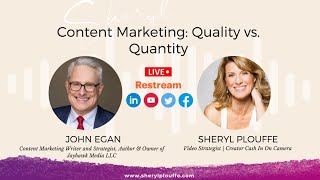
Sheryl Plouffe and John Egan discuss whether content creators should focus on quality or quantity. They argue that consistent posting matters more than chasing every format, that good writing is foundational to all media, and that knowing your audience's pain points and where they actually consume content beats guessing.
Chapters
But there are some things you want to consider when it comes to content marketing, namely whether you should go for quantity or whether you should go for quality. And that's what we're going to talk about today with John Egan. He is here on Cash In On Camera to talk about content marketing. You've been in the content marketing sphere for quite some time, John, and now have written a book, obviously, The Stripped Down Guide to Content Marketing behind you, which I have read. And we're going to talk a little bit more about some sections of it. In this conversation, what is it that you overall want entrepreneurs, coaches, and consultants to know about content marketing?
One thing I love to tell people is if you're going to do it, do it with a cadence. You know, if you— if, for instance, you post blog posts on every Tuesday, do it every Tuesday. Keep up with that. Too many people are all gung-ho about doing content marketing and then, oops, we forgot to post something. And then your audience kind of doesn't understand. I thought you were doing these every Tuesday. Where are they? So consistency is very important and don't stretch yourself too thin. Don't try to do every kind of content. Do what works best for your team, you and your team, and also what works best for the people who will be consuming the content.
This is one of the— I've done it both ways. I've done it in the past where it's been like every Thursday, 2:00 PM, da da da. Now I'm doing the podcast actually more regularly, certainly every week. But the schedule is a little bit different. It's from time, you know, it's different times based on what amazing guests like you book and what I make available. Which of those paths do you think is more beneficial Because I'm certainly on board with the consistency thing. I think it's more about for the creator to be consistent because it's so easy for you to get distracted with other things. And next thing you know, a month has gone by. It's like going to the gym. You're gung-ho, you go to the gym, and 2 weeks goes by and all of a sudden you haven't been to the gym for 4 months.
Right, right.
Is it more important, the consistency piece, because of the creator's schedule and their attempt to stay consistent? Or is it more about, like, say, algorithms and SEO and other technical issues.
Well, the algorithms and SEO are a component of that, but I think you touched on something that's very important. You're being consistent. You just maybe aren't doing it at the exact same time every day. And I think as long as you're consistently putting out content and doing it, like, if you do it once a month, if you do it once a week, keep doing that. And you may decide that you need to change the regularity of your content because you're overloaded. So maybe you need to do every 2 weeks instead of every week, but experiment with it and see what works. But don't give up on it. You know, it, it, it's important to keep with it because your audience— if you produce good content, quality content, then your audience is going to come to expect that and they'll share it and it just snowballs from there.
So I know that you are someone who believes in needing more quality writing in the world, which leads me to a discussion around blogging. And you mentioned just a moment ago different kinds of content. You don't need to be doing every different type of content. So let's speak to writing. And does that definitively need to be a part of someone's overall content marketing strategy?
One word, yes. It— that good writing is never going to go out of style. I don't care what anybody says. Uh, we all need to be good communicators, and the foundation of that is good writing. And the quality aspect goes to everything. It is your social media posts, the graphics that go with those posts, the videos that you produce, the podcasts that you produce. Do they meet the test of is this good and do I want to share it? Do I want people to see it? Do I want people to consume this content? And if in your head you're like, eh, this isn't so great, then probably shouldn't post it and let the world see it. And maybe try something different. You know, I can't tell you how many times I've started over and over again on an article because I just didn't like the way it sounded. Or a blog post or any sort of content. And it's— some of it's just trial and error.
You and I both have journalism backgrounds, and I think you in newspaper, mine in TV broadcasting. And you mentioned in the book how content marketing does have a tinge of journalism to it. I wonder if you can speak to that.
Well, I think it's important when you are putting content out there that it is factually accurate, that it has a perspective. And yes, you can express your opinions, you can, you know, tell a story, whatever it may be, but it's important to know that you're being judged against all the other content out there. And so if you want your content to stand the test of time, whether it's today, this week, or the next few years, it needs to have the bedrock of accuracy, no typos, that, that sort of thing. And again, it all goes back to quality. I think, you know, if you look at what journalists try to do, they try to produce quality content, and you should have the same mindset when you're creating content for your brand. Whether it's written content, visual content, or audio content.
Is there a proper— you mentioned cadence earlier about consistency, but is there a proper mix of modalities or types of content that you would subscribe to someone, again, a coach or consultant, let's say a six-figure person who's selling products and programs and they want to get to seven figures? What is the right mix of different types of content that they should be taking into consideration? Writing is obviously one that you believe in, and that might include blogging or it could be writing of various descriptions. What other types of content do they need to keep in mind?
Well, I'm always a big believer in video and, you know, you would agree with that, I'm sure. I think most people don't realize that some of the largest video platforms are some of the largest search engines in the world. Google is a search engine that's huge. Everybody is aware of that. But Google owns YouTube, which also is a huge search engine. Amazon is a search engine. TikTok is a search engine. So, you know, it's important to remember that when you're, when you're creating content, and that is where can it be found. And so there's no right or wrong answer as to what kinds of content you should put into the mix. I think what's best is where's your audience looking for content and what kind of content are you noticing really resonates with them, and then stick to that. If, if they really love blog posts, then create blog posts. You can supplement that with video, but you need to figure out how are they best going to consume your content and you obviously want eyeballs on your content. So, and or ears if it's a podcast or some sort of audiobook or something like that. You have to figure out, you have to meet them where they are.
Yeah. And it's tough, I think, in recent years because organic reach has gone down and it's a different game really that the big tech companies are playing now. Right. And it's, we've heard the term pay to play and things like that over the course of, of time. But I don't think that should prevent someone from utilizing those social platforms in order to leverage them as distribution channels. And I know in Chapter 8 of your book, you talk about how to kill it in content promotion. So it's not just production, it's about promotion. And you give some good tips here. I don't want to give them all away because people want to get the book and read it. But you talk about how realizing that success goes hand in hand with failure. This is something that I personally see as someone who does teach people with podcasting and scalable businesses, etc., that they, they don't want to fail. They just don't want to fail. They just want to have that home run hit right out of the gate. But there is a certain amount of this that is experimental.
And if you can't experiment and not fail, I mean, it's just not possible. And so you have to be comfortable with failure. And that is something that I talk about in the book. And I talk about this all the time. You know, you have to get up there and try. You have to, you have to put yourself out there and try. And if you don't, then you're not going to know what works and what doesn't. And that's the end game there is what's going to resonate with my audience? What are they going to like? And are you putting it in the right place for them to find it?
Yeah, and knowing your audience, I think, is really a key component to this as well. Because if you don't know— and I find, I don't know if you find this, John, in your work, but I find when I talk to people, they often really don't know who it is that they're trying to talk to. So it's difficult to make great content, quality or quantity, either or, when you don't know who it is that you're really making it for. How can people know better who they should be creating this for?
Well, I think it's like a dating app. I mean, if you get on a dating app, you kind of have to know what person you're looking for. You know, you can't just dive into the pool and be like, oh, well, I like that one and that one and that one. And it doesn't work that way. You know, you have to have in your mind the qualities of the person you're looking at on a dating app. And the same is true for the content creation and content production and content promotion parts of things is, you know, it's just important to make sure you are aware of who your audience is, what their demographics are, what kinds of questions do they have about your product or service. And that'll come through time. And again, experiment, experiment, experiment. And fail quickly. If you fail quickly, then you can move on to something else that perhaps will yield much better results.
When I talk to people, they often are looking for a roadmap. They want the answer. They want the definitive, like, just tell me how many posts I need to make. I want success and I need to know the exact number. And I see you nodding your head because you know where I'm going with this as we talk about the question between quality and quantity. And let's just talk about quantity. Is there a definitive number that people should adhere to?
No, no, no. And again, you have to figure that out on your own. Yes, you can get— I mean, I've done research recently on when's the best time to post on LinkedIn, when's the best time to post on Facebook. Do you realize how many theories there are about the best times to post on those platforms? You have to try those and see, okay, 9 AM on a Tuesday, is that going to work? But there's no right or wrong answer. It is basically putting the content out there and knowing that you may need to adjust the schedule. You know, if you're putting content on LinkedIn, is Friday at 5 o'clock the best time? Probably not, because most people are checked out for the weekend. So use some common sense and use those various things you find online as guideposts, but don't, don't look at them as a Bible for I have to do this.
One of the tools that I love, it's called Metricool and it's a social scheduling tool app. And within that tool, it gives you algorithmically, it's telling you and giving you some suggestions on when to post, you know, when to post on LinkedIn, when to post on Instagram. And it specifically is doing that based on your content, you have to take it with a grain of salt, right? It's like, yes, that can be a guidepost to help you make a decision, um, but my feeling is that I would rather see people creating content, putting it out there at a schedule that suits them, just so that they know that they're actually doing it, rather than staying stuck in a box of like, well, if the best time for me to post or go live is Sunday at whatever time, but I have other commitments that I'm doing. I'm just not going to do the content. It's find ways to make that work for you.
Yeah. And I think one of the things you mentioned is tools that can help you post at certain times on social media. I use one of those tools as well. It's not as sophisticated, apparently, as what you're using, but I use it to schedule social media posts because who wants to sit around all day at the exact time that you want to post something and then click post it. Scheduling social media posts is so important if you have even the slightest amount of content that you're putting out because you can drive yourself crazy trying to figure out, okay, it's 9 a.m., I need to be on LinkedIn so I can post this at that time. It, you know, your time's more valuable than that, right?
I think that's the, the hamster wheel of social media that I'm railing against now, right? It's like being on that hamster wheel is not necessarily the most conducive to your business. You should be focused, I think, on more business building activities. Now, content marketing plays into that. To your point, writing quality content, having a schedule, being consistent, and going out there and doing that are things that will help benefit your brand and your visibility and, and get clients and awareness. But it has to fit within the confines of your other business building activities.
And you have to promote it. You can't just post content and assume that everybody's going to see it. Yeah, you know, it's not— it— people aren't running around going, gee, which B2B blog post can I discover today? They want you to tell them, hey, check out this blog post that gives you 10 tips on building your content marketing strategy and making more money. Hey, that sounds interesting. I'll click on that.
Yeah. And I like repurposing clips for that reason. Like if you take your long-form macro, like this interview, for example, you know, we'll go back and we'll take snippets of some of the smart things that you've said today and create other things that would help drive traffic back to the original. If you want to listen or watch the whole thing, here's where to go. So I think repurposing plays a part in that as well. So here's where we get to this, like the quality versus quantity question, which, John, if we had to choose, would we be wanting to go toward more the quality or more of the quantity?
I think, you know, my answer to this, and that is quality. Yes, quality is going to beat quantity every day of the week. You can put out one killer blog post or one killer video every week, and that's going to yield more results than doing really junky 5 blog posts or horribly produced videos, you know, every single day. I think you, you're better off from a standpoint of gaining more traction, of building your brand by focusing on the quality. I mean, do you really care when you go to a restaurant that they— like McDonald's used to talk about billions served or whatever? Well, that's great, but how's the food? You know, what's the quality of the food? The quantity of the food doesn't matter as much as the quality of the food.
Yeah. And that's to be debated about McDonald's.
Well, I just— that came to mind because they always used to have that on their signs about billions served. It's like, okay, great, fine. You've, you know, it's like Starbucks saying we've served billions of cups of coffee. Well, yes, you have, but how is it—
what is my cup of coffee going to taste like? Yeah, exactly. No, it makes perfect sense. And I, I like that you mentioned this. You talk about this in the book about the idea of quality. And you give really good examples in here of quality content that you've created.
And we talk about—
you talk about pillar posts and pillar content, and you give some really great examples and anecdotes of your own personal experience with it and some of the results that you've gotten for people. I know you've worked with clients like Experian and Forbes Advisor and Bankrate, and so you've done some really great stuff in the content marketing space. I want to give people an opportunity to learn more about your book and how to access it. John?
So they can go to johnegan.net. That's my website, and there is a tab on there called John's Book, and you can learn more about the book there. And hey, you can also read it on Kindle or buy a paper copy of the book.
Perfect. John, this has been so much fun. I really appreciate you coming on Cash In On Camera today to share your insights on content marketing and and guiding us more toward the quality end of the content. And I do love this idea of adding that journalistic twist, right, which, which really is in line with the idea of quality over quantity and how people can have success with that. So thank you so much for coming on the show today.
We really appreciate it.
Quick thing I want to ask you before you leave is what is a tip, tool, tactic, or technique that you'd like to share for your own, or that's working for you to help you market yourself today in your book?
Okay. The first thing I thought of when I realized you're going to ask me this is Canva. Do you know about Canva?
I love Canva.
I do too.
I've been using it for years.
I love it. I randomly ran into somebody who I've known for years at Starbucks yesterday, and I mentioned Canva and he uses it too. And we were both talking about how we're not designers, but you can design great stuff with Canva and it doesn't cost that much and you can actually do some free stuff on there. But I would suggest bumping it up to a subscription so you have better access to more tools and more templates and that, those sorts of things. I mean, the stuff I create with Canva is just amazing. And another, another one I'll mention real quick is called Looka, L-O-O-K-A. I've created logos on that site that would rival, I think, anything anybody any person could design. Now, should you use it for every logo? No, but it's, it's AI-powered and it gives you lots of flexibility in terms of color choices and font choices and those sorts of things. And I'm a huge fan. I'm not a paid spokesperson for either one of those brands, but Canva and Looka are definitely worth looking into.
Fantastic, John. Thank you so much. I've not heard of that one, so I'll be looking that one up. But I've been a Canva Pro user for years. It owes me nothing. I mean, I just, I've used it for so many things and something I recommend to my podcast clients as well and students.
So I appreciate it. And if I can do it, anybody can do it.
I'm in the same boat.
I agree with you.
John, this has been great. Thank you so much for being here.
More from Sheryl



From 'agreeable' to 'ruthless mentor' to 'strategic sparring partner' #substack #shorts







