Create A Bigger Vision For Your Business
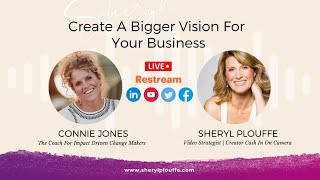
In this episode of "Cashing On Camera," host Sheryl Plouffe interviews Connie Jones, a therapist‑turned business coach, about why many online entrepreneurs lose sight of their original vision. They discuss how the early "scrappy" stage—juggling cash flow, offers, and marketing—can lead to overwhelm, reactive work, and a diminished sense of purpose. Connie emphasizes the importance of seeking external help, such as coaching or therapy, to uncover blind spots and reconnect with one’s heart. She introduces her "Whole Self CEO" framework, which addresses three areas of capacity expansion: limiting mindsets, entrenched behavior patterns, and skill gaps. The conversation explores unconscious blocks, the health and stress consequences of misalignment, and the need to align business with personal values. Connie shares practical, alignment‑driven marketing tactics—live video, community‑building events, and relationship‑centered outreach—and describes her free monthly "Changemaker" gathering for purpose‑driven CEOs. Throughout, the dialogue underscores that sustainable growth comes from inner alignment before external systems, and that asking for help is a vital step toward expanding one’s capacity and vision.
Chapters
I talk to a lot of those conversations. I'll ask someone to tell me your vision. What is it you're looking to build? And sometimes people can't answer that question, Connie. That's why you're here to talk about this on Cashing On Camera today. So I'm excited to have you on the show. But I often talk to people who just, they don't have a vision. I'll ask them, well, what's your dream? And they'll say, well, I just want to do this. Like they play it they downplay it. I'm just want to do this. They don't come out with a grand vision or a big dream around what they want to do. And it often breaks my heart because that person has the ability.
You can—
I can tell that they have the ability to do it. It's just that they themselves don't believe in it. So today we're going to explore this topic of creating a bigger version, you know, and vision of yourself and your vision for your business. And it really is about dreaming and so much more, which is obviously your area of expertise. So, so tell me a little bit about the work that you do and one of the biggest problems that you're seeing in the entrepreneurial, entrepreneurial world as far as vision casting.
Yeah, and thanks for having me. I'm excited to be here and I am so passionate about this too. And, and I love working with high achieving, passion, Passion-fueled people. I mean, you know, that's what it, we're changing the world. We're impacting the world in all kinds of ways that are transformational. And so, you know, but what I see that happens is we get in, so many entrepreneurs get in a rut and they start out with the dream, with a vision for what they want to create. Sometimes it's really aligned with their purpose and they're excited about it. And then sometimes it's kind of out of a necessity. It's what they know how to do and what they feel they're talented and gifted to do. And they, but, but what happens somewhere along the way is the vision, they lose sight of the vision or they, they move into this reactivity place. They, they get into overwhelm and overwork and they get into the have-tos and they lose that, they lose the dream, they lose their sight, they lose the vision for where they're headed and what they're doing and they end up being caught up in the day-to-day of the business. And instead of working on the business and being the visionary, seeing it from the dreaming visionary, seeing it from the 30,000-foot view and stepping back from it and staying excited and passionate about it, what happens is they get down in it and then, and they forget, they, they either never learn how to be the CEO of their business, or they, they stop being this, they stop being in that role of the CEO of their business, and they, um, they get stuck. They get stuck in a rut, and they play small. They get, they get frustrated, they get exhausted, um, and then they wonder, how did I get here? This was not what at all what I had thought it was going to be.
And, and we'll, and, and we'll certainly talk about this from the perspective of an entrepreneur, right? An online entrepreneur, predominantly what our, who our audience are, are, are people that are looking to build something of their own. And it can be challenging, you know, when you're first starting out as an online entrepreneur, you're often in that scrappy mode where you have to be all the things because it's important for you to understand all the functions of a business in order to then later on be able to grow and scale by outsourcing and delegating to other team members once you get to that stage. The problem is getting up to that stage can be, it sounds to me like the place where you can lose yourself because you're in that, you're in that busy mode of just trying to like make it all work and you have cash flow issues and, you know, all these different things come up because you might not be 100% solid on your offer. You might not have a marketing strategy. So—
That's exactly right.
Right? And so what can someone do who's in that scrappy mode, who's trying to make it all happen, but feels like they're losing sight of themselves or their vision or their dream?
Yeah, that's where— and asking for help. When you're in that place, there is nothing— you're not doing anything wrong. You're completely normal. It's part of the process and it's about regrouping. It's about just stepping back and it's hard to, you know, and I had to ask for help too when I was in that place. And that's why I love, that's why I love the work that I do because that was my story. I was there, I was stuck and I had to have help to get out, to get the breakthrough that I needed and to be able to see it differently. You know, I say it's kind of like it's when you're in your own fishbowl, it's hard to see your way out. And so you need someone to help you see the things that you can't see for yourself. And those are our blind spots. Those are the things that we, you know, we're not supposed to see. We can't figure it out all by ourselves. And so there's nothing wrong with asking for help to, to, in taking the time to step back. And, you know, everybody works differently. What I would say is what I would love to do with that, that entrepreneur is, you know, have some time with them to help them get quiet and still and reconnect to their heart and reconnect to the vision, because oftentimes when we're running, you know, and we're in the overwhelm and the overwork and we're just reacting every day, we don't even, we're usually burned out or we're just, you know, we're tired and we don't make great decisions when we're tired either. We can't see out of it when we're in it. And so it's great to be able to take a little bit of time, even if it's a half a day, a few hours, whatever, to connect, to take that time to listen and to reconnect to the wisest part of ourselves and have someone ask us the right questions to be able to lead us back home, back to the place where we, where those answers, that inner wisdom inside of us is available to us, but we've lost touch with it. And so that's, you can't go wrong there by just asking someone to walk it out with you, to help you, help lead you in the first step of that journey back to you.
And I think that's the value of coaching because we can't see it for ourselves because we're so close to it and we are in the weeds, especially in that early stage, you know, where you're trying to get to the place where you can start reinvesting in yourself and get a team and delegate and build in that space for yourself to be the visionary of your business. But I see that time and time again, getting to that point can be challenging. But to your point, yes, reach out for help is a great way to do that.
And so when it comes— I'm sorry, go ahead. I was just going to— Crazy. We're passionate about this.
We're on the same wavelength. That's why.
Yeah, I know, right? We are actually finishing each other's sentences. That's what— or saying the same exact thing. Let me just say this real quick. So I just had another thought. Another thing that I see with entrepreneurs that is so normal and is so common, and I struggled with this too, is that we come into our business oftentimes being able, being great at what we do, but we, we can't see what we can't see. And we are, we hit the level. It's really a good thing if we, we hit that place because what we're doing is that we're expanding. We've hit the limits of our capacity. And when we hit the limits of our capacity, then we have to take a look at 3 things. I say, one, what are the mindsets that are limiting my capacity? What are the mindsets that have allowed me to survive and succeed up to this point in my life? And they've allowed me to do very well and get to this point of success. However, they're not allowing me to thrive at this point. What the third— the second thing is, what are the patterns of behavior that I have learned to survive and succeed at this point? But at this point, they may not be able to carry me further than I am going on my own. And then thirdly, what have I been able to do on my own, but I've hit my capacity, and now I need to— what do I need to learn in order to expand my capacity? And sometimes that's learning something new, sometimes it's opening to something new, sometimes it's, um, you know, challenging a mindset or a pattern, and sometimes it's learning how to do a new skill or learning how to be good at something that maybe we haven't— we are challenged and we haven't learned yet. And so oftentimes I think— I know this was the case for me and I see this with entrepreneurs all the time— is that we think that we are failing. We think that we're doing something wrong. We think that this is a horrible place to be and that we should have figured it out. And that's not the case. It's just that we've hit the level of our limited capacity and we've got to do something different to allow our capacity to be expanded. And that's growth. That's just normal growth. We don't have to have all the answers. We just have to be willing to grow. And so, you know, it's— but that's a challenge for a lot of people who are who like to be in control, who are high achievers, they've always been able to be successful, and we wouldn't be up here if we weren't that way, right? But it's that part of ourselves that we have to kind of remove, uh, within ourselves. Well, I don't know how to do this any differently, or I know how to do this, I know textbook how this should look, but I don't know how to get from where I am currently in my reality to where I want to be. And that's the biggest thing, and that is, that is That's the essence of what I do. I close the gap. I help close the gap between where they are and where they want to be in their business and in their life.
So that leads me to the discussion around our unconscious blocks, you know, the things that we're not even aware that we put up in front of ourselves. How do we become more cognizant of what our blocks are if we're just doing it unconsciously?
Yeah, well, that's where it takes someone else to help us see what we can't see for ourselves. It's a block for a reason. It's a blind spot. It's a, you know, and we're not supposed to be able to, um, to be able to see all of that. So, you know, there is that, there's the growth, and that's why I call, um, that I have 3 parts to my program. One part of my program is the, the, um, the Whole Self CEO, and it's really working on the wholeness of and the wholeness and the growth and the freedom of the person. I see so much focused on the business and we do all the nuts and bolts of the business and all the work on the business also. That's so important. But if you are bringing a limited being in to run a business, then it doesn't matter how much you know about business or what you try to put in place. If you're limited in your being and you're blocked in your being, then all of the doing that you do is going to be out of the wrong being. And it's going to undo the doing. I know that was a lot, but like, that's what I see all the time, is we are doing all this doing, but we're doing it out of a being that is not— that is blocked. And then we're going to— it's going to be sabotaging, and we're not going to see it. We're only going to see the result, which is not effective, it's not working. And then at that point, when we're seeing things aren't working, then we have to, you know, swallow our pride and we— and, and you know, and not judge ourselves and give ourselves grace and compassion and go, okay, you know what, I need someone who's been here to show me how to get to the next step. I need someone to help me get out of my own way. And that's not a bad thing. It's again, just growing and understanding, seeing from a different perspective and having someone who, well, I call myself the master of breakthrough. So I see those blocks subconsciously or consciously. Sometimes people know their blocks, they know what's not working for them, but they don't know how to change it. Sometimes they don't know what's not working for them because it's something subconscious or energetic or unconscious. And so regardless of what it is, that's where, um, you know, it helps being a 20-year therapist too, to, in addition to the coaching, to be able to go underneath all of that and say Okay, I see what's going on. Here's what's happening, and here's, I think, where you're getting stuck, and this is what we've got to— this is what we've got to work on. This is what we've got to shift. And then, you know, that's where— I mean, you— not everybody knows, you know, how to invest their money unless they study. You know, that's where you need a professional, and I just happen to be a professional at breaking through people's blocks. Um, and it's just what I've studied all my life and it's what I was gifted to do. And, um, and it's, it's amazing to be able to help people to freedom from those blocks.
Your, your professional experience, obviously, um, and profession in therapy is what a lot of entrepreneurs need. I mean, I've always said, and you know, that starting your own business is the, the deepest form of self-development and self-awareness that you'll ever put yourself through. It's kind of like a meat grinder in some ways. It is.
It is difficult. It's hard work. I say that about business. I say that it pulls everything out of you and challenges everything in you. And if there is no deeper work that a person does than when they start a business, and it requires that of us, we have to grow and develop and look at those really hard things because our business is an expression of our heart. It's an expression of who we are. And so it's a living, breathing entity, energetic expression of us. And so it is putting— we're seeing the manifestation of ourselves in our business. And so if something isn't working or isn't effective or isn't working in the way that we want it to, then it's because it's a reflection of something going on inside of us. And that's what we have to understand and kind of get over ourselves. I don't mean that to I don't want to sound not compassionate and caring because I am and very loving. But we've got to get over the fact that we're going to have all the answers. We're not. And that we're going to be able to figure it all out. We're not. And if we're feeling stuck, then asking for help is the best thing to do and starting that work. And there's nothing better.
If your business is an extension of who you are in your heart, as you've described, Sometimes we see people that are, you know, doing things or they've built their business in such a way where there's misalignment. And so what I mean by that is, let's say the thing that they do, the offer that they have crafted or whatever, is misaligned to who they are in their heart and maybe even energetically. So sometimes people are desperate because they're like, I desperately need cash flow. I gotta just do this for the money. I need to make this thing 'So I'm gonna do this even though I don't really love this, or I don't believe in this, and these are against my values, but I gotta do it anyway.' And so they kind of sometimes do that out of desperation, I think. So talk to us about the challenge of that and how you would help maybe mitigate that. Or should we mitigate, or is that okay? Is it like, 'You know what, that might be the season you're in, do what you have to do,' or is it, 'No, you should really never be out of alignment with who you are'?
No, I totally agree because it is, and I've spent years out of alignment and that's, you know, and it leads nowhere except stress and dis-ease in your body. And literally you, it will cause health problems. It causes stress, it causes misery, it causes relationship issues. It causes lack in our business because it's a product of misalignment. All of these struggles and the stress and the, And the striving, that strife in our business is a product of misalignment. And it's because we don't trust ourselves. We're not listening to who we are and what matters most to us because we think, we believe that, well, I have to, I have to keep doing this even though it no longer is lighting, it doesn't light me on fire anymore, or I have to do this to I have to pay the bills, or I have to make this work, or such and such coaching program, or such and such strategy that I read about, or this other business owner does it like this, or my clients expect me to do it like this because this is what they're used to, but it's no longer working for me. And we continue to stay in it to the point where we get stuck, stale, stagnant, and just flat out stressed to the max, and then we get sick. And, um, and I, and I see so many people staying in that when really we were not created to live that way. We were not created to work that way. We were created to be in alignment. And out of our alignment with our values and our purpose and our passion and our joy and freedom comes the greatest amount of success. It— that's where abundance is unlocked. That's where more opportunity is unlocked. That's where connections are unlocked or flowing in that we could have never— this is where opportunities and possibilities present themselves that we could never even understand. We couldn't begin to create for ourselves. And that's the magic part that our logical brain doesn't understand. And that's where we want business. And there is a great logical part of business. But if it's all logical and you're not using your heart and you're not understanding the magic of business too, then you're limiting yourself in business and it's going to be a very stressful, not fulfilling, unfulfilling. That's the better word. Unfulfilling business. It's going to not be a great experience.
Right. I'd love for you to share your website. I'll put it on the screen and walk us through your website and what people can get if they visit you there.
Yes. Okay. So it's Connie Jones Coach. And I have, right, the screen that you're showing right there is the free monthly gathering. It's a community that I'm creating that we join or we meet up once a month. And it's for business owners, purpose-driven business owners, mission-driven, heart-led business owners who want to make more impact and want to, to develop into that, you know, that, that freedom-loving CEO that they want to be with the success and the impact that they really want and the abundance they want in their business. And so that's what that page is. But there is information about— when you go to my website, there's information about me personally, there's information about the work that I do, there's information about the, um, all kind of the different experiences I have, the different programs. But, um, that, that page in particular was for that Changemaker Monthly Gathering, which is this Thursday if anybody wants to join. It's this Thursday from 12 to 1:15 Eastern time. And we do this every single month and it's completely free. It's a great networking mixer. In addition to, I teach some strategies that will, that are, that will change the game in your business on each, on each, during each gathering.
So fantastic. Another thing I want to ask you, we I always like to ask, what is a tool, a tip, a tactic, a technique that's helping you to market yourself for the year we live in? So, you know, we have a little thing we— I don't know if you know Prince, but like he has a song called 1999. Do you remember that?
Oh my gosh, the '80s.
Okay, it was a great song. So I have a thing I do called stop marketing like it's 1999.
I love it.
Market for the year we live in. So yeah, what is something that's working for you that you'd like to share? It could be something related to this or unrelated this.
Yeah, alignment, alignment. I cannot tell you, I see so many people trying to market out of alignment. They're doing, they're making themselves do things because it's the trend and it's what they're supposed to do rather than what, rather than letting the true nature and essence of them come out in their marketing. And so, you know, there's all kinds of stuff out there about what we're supposed to do. But what brings you joy? What feels easy and enjoyable to you? And when I ask myself that question, live video, always video, live and in-person events feel exciting. And that's exactly why I started the monthly gathering, the networking. I wanna build community. I am a connector. I love community. I love real authentic relationships and people coming together and lifting each other up and bettering each other. And I think there's nothing more transformative informational than doing that in community. And so that's how I choose to market. I choose to— of course I'll post on social media and I love that and I'll do live video because I also love that. But, you know, I, I do it in a way I ask myself, what would feel— what would feel really fun to me right now? And then what I believe is that when you're doing something that's fun to you and enjoyable and easeful to you, then you're going to draw your people to you. Because they're going to feel that. They're going to go, oh, I would love that. That sounds fun to me too. And those are your people. And then they gather together and there's your community. And then that's relations— it's relationship-centered marketing.
That's great. And those are great examples of some tactical things that you're doing to market yourself that feel in alignment to you because you gravitate toward those modalities or that way of communicating, whereas A lot of people, I think of TikTok just as an example. I see a lot of business owners who are like, well, I don't want to do the dancing. And it's like, well, maybe that's not your jam and that's okay, right? It's going to be the jam for somebody else, but it might not be your jam and that's perfectly fine. Connie, this is great. I really appreciate you coming on the show today and sharing your insights on creating a bigger vision for your business. And what I really got from this is that it starts with you.. It starts with what are you, how is the, how is your business aligned to you, your values, your intuition, your purpose, you know, is there an alignment there? Because that will help you to then develop the bigger vision for your business to help you grow and expand what's possible.
That's it. Yes, because we can't expand beyond what's inside of us, you know, and so we're going to hit our capacity in our business until we expand. Inside. And oftentimes so many business programs and coaches and coaching programs and coaches sometimes even— it's not their fault, they're not doing it wrong, it's just that they don't— they go from the outside in instead of from the inside out. And I just, you know, I believe that we've got to deal with the, the, the person first and, and simultaneously deal with the team and simultaneously deal with the systems and the procedures and the the structure. And so I just have a triangle, you know, the whole self CEO, the team, and the systems. And it just works. And the system and strategy, I would say. And yeah, it's just a holistic picture of a beautiful business and an enjoyable, easeful business.
Yeah, I love it. Thank you so much for being on the show today. Really appreciate it. And I'm sure we'll have many more conversations.
Thank you so much.
Bye, Connie.
Bye.
More from Sheryl



From 'agreeable' to 'ruthless mentor' to 'strategic sparring partner' #substack #shorts







