Customer Interviews Are the Missing Link In Your Marketing
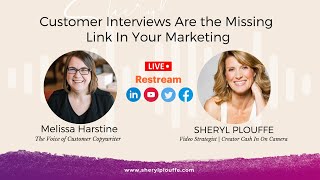
Melissa Harstein, a former journalist turned customer-research specialist, explains how 30-minute customer interviews reveal what your ideal clients actually want. A gardening course doubled enrollments after using interview insights to rewrite its sales page, especially addressing seasonal concerns. Most marketers skip this step and guess instead.
Chapters
for you. If you could get into the minds of your ideal clients and customers, do you think you might be able to create better content, to be able to write better words, to attract them into your tribe and into your audience? You should all be shaking your heads yes right now. So yes, it is true that if you can get into their minds, this is a huge benefit for you and a real leg up and competitive edge. That you can have in your business. And Melissa Harstein is here today to talk about the idea of customer interviews, right? And how can we use and leverage case studies, customer interviews to really better our marketing. So, Melissa, I know you've been at this for like a long time. You've worked with Pulitzer Prize-winning journalists. You know, you have like 15 years experience in this area. Why do you think that it's so important for entrepreneurs and business owners to really leverage customer interviews to their benefit?
I think the main reason is just that when we're creating content or marketing strategies from our own perspective, we're just guessing. We don't actually know what's going to convert. We don't know what our customers really want, what they care about. And when we can get inside of their heads by going straight to the source, asking them those questions, you know, why did you start searching for a product or service like mine? What made you hesitate or kind of slow down before you made that purchase? That type of data and insight are so valuable and can increase the number of inquiries, the number of projects booked, because again, we're not just guessing, we're not just operating off of assumptions, but we know with confidence who we're speaking to, what they need to hear, what their hangups are, what their fears are, their emotions. And it just makes everything that we do as, as business owners more effective.
Do you, do you think that part of the reason why not as many people do this is because they're afraid of what they might hear?
I definitely think so. Sometimes it's like, you know, feels like they're going to give you a report card or a grade, right? But I think there's also benefit too in having an outsider, whether it's another member of your team if you're a business owner or hiring another strategist, another interviewer to do those interviews for you because it puts a little bit of distance there and it doesn't feel quite so personal. But yet it also sometimes leads to better and deeper insights than you might get yourself because you just maybe have a little bit of a blind spot, you know, if you're looking at it from your own business because you already have this background knowledge available to you.
So we're talking about, about interviews. Paint a picture for us about what kind of interview this is. What are these customer interviews? Are they done on video? Is it on the phone? How long are they? How deep does it go? If you can paint a picture about like, what, what are we really talking about here in these interviews?
Yeah, I typically recommend about a 30-minute interview on Zoom, and that gives you enough time to kind of dig in and cover the entire customer journey. So I typically recommend asking kind of 3 sets of interview questions. The first set is about, you know, what was going on in your life or your business before you started searching for a product or solution like mine? The middle set of questions is about the experience with that course or that program or that service. What surprised you? What were you expecting? What was the biggest, most valuable takeaway that made this entire investment worth it? And then the last set of questions is like, what is your life like now after we've worked together? What are some of the measurable, tangible outcomes you've had? What are some quality of life type things? Are you less stressed? Are you able to Pick up your kids after school now because you have more time in your calendar? Like, what has changed? What is that transformation like?
And yeah, and I was just gonna say, like, when with a 30-minute interview, you are gaining so much intelligence. Yeah, leverage that intelligence to your benefit. And I cut you off there. Was there more that you wanted to say about phase 3?
No, I was just gonna say, you know, once you have that data, like you said, there's so much intelligence that you can pull from it. And so I always recommend taking that Zoom recording and turning it into a written transcript so that you can go through it and like, you know, in a Google Doc or whatever, just highlight, you know, here's a pain point, here's a benefit, here's a really compelling, unique, memorable quote, and start to really take that interview and then pull out the little pieces that you can apply on your website headline, for example, your website FAQ page, um, as you're building out your content strategy for the next quarter.
Do you have to incentivize a potential interviewee in this case? Because listen, you know, life is busy. People, 30 minutes to be interviewed. A lot of people might say, I just don't have the time for that. So do you advise that people incentivize interviewees in order to get that intelligence from them?
Yeah, I think it just depends on your audience. Some people are just happy to do it without an incentive. I've seen some of my clients offer anything from like, you know, a $10 Starbucks gift card to a recent— I recently actually participated on, I was being interviewed and received a $45 gift card. I was kind of surprised by that for a 35-minute interview. I've also seen people just offer to enter people into a prize drawing. So if you give me your time, I'm going to give away a free strategy session for my services. I'm going to give away some other prize package. And so there's still that little bit of element of chance, but you still get compensated for your time.
I want to go back to something you said earlier about having this kind of like third party conduct these interviews on your behalf because it might be too personal, too high touch for you as the business owner yourself to conduct the interview. And I know that that's a service that you provide. Like, you're the third party who does conduct those interviews. So, speak to the importance of that. But also, I think the optics of that. I can't help but to think that if you have someone doing this on your behalf, it really makes your business look more big time. I've got a team, you know, and it might look like from an optics perspective that, you know, I have people working for me. And so, there's a lot of benefit I think to that kind of arm's length approach. Are there any other benefits that I'm not aware of in having that person do those interviews for you?
Yeah, I totally agree with those benefits you just shared. And I think another benefit is I think people are more willing to open up to a third party, you know, even if it's someone who's on your team, but it isn't the person directly providing the service, like the person the client has constantly interacted with. Um, there's just a little bit more conversational tone, a little bit more ease. And anytime you can just help people put their guard down, that's when they're going to share the really deep, really valuable insights. The things that you aren't going to get anywhere else that can really help you improve your marketing content and your conversions.
So let's talk, and I don't know if we can really relate this directly to a finite amount of money necessarily, but I think a lot of people may wonder, okay, well, I don't understand how this correlates to me making money in my business. And I heard you say things like copywriting and other things that that do ultimately lead to you making more money in your business. Because if your marketing is better, there's less friction and you have a clear path to getting the clients and customers that you need. Is there any way that you can identify or correlate, you know, that doing these interviews can result in X increase in customers or X conversion rate or something tangible?
Yeah, I don't know that I can give a precise number off the top of my head, but I can share a story from a project that I worked on this summer. So I was doing customer research for a sales page for a gardening course. It actually was a course about how to turn your love of gardening into a thriving, profitable business. And so this woman had launched her course before and had seen a pretty good success rate. But by us coming in and doing this research interviews, we were able to completely redo— my copywriting partner that I work with, um, she— we were able to completely rewrite the headline and the information at the top of the page, that thing that pulls you in and grabs your attention, we were able to write that to really speak to the conversation that was already going on in the reader's head, like the things that they were questioning, they were wondering about, they were wanting. Is it really even possible? Is garden coaching a thing? Is it even a profitable thing? Right? That phrase came up over and over and over as I was doing this research. I didn't even know this is a thing when I first heard about this course. So we were able to put that in the sales page headline to grab people and pull them in and then sprinkle that research throughout the entire page. But my favorite part was actually the FAQ section. Now that may seem like an unusual place to say that's my favorite part of the page, but what we were able to do is we found out that one of the main reasons that people were hesitant to join this course is because they lived in the mountains. They lived in the northern United States where it was cold. And they're like, if I'm going to leave my teaching career to start a coaching, like a garden coaching business, am I going to be able to make money 12 months a year or only when, like, you know, things are green and growing outside? And because of this research, because we identified that as a key hesitation, we were able to address that in the FAQ page very thoroughly. And that alone, I know, helped increase the number of people that enrolled in this course.
Well, that's a blind spot because you would not, or in this case, she would not have even probably thought that that would be an issue. And so, she doesn't have the intelligence to be able to identify that that's a roadblock to getting people to enroll in the thing that she's selling.
Exactly.
Yeah. That's amazing. That's such a great example. And I can't help it. I'm like you. I think FAQs is one of the best paid, you know, parts of a sales page, because that's really, really where you get into the kind of the nitty-gritty and get into people's minds and see like examples of things that other people are asking. Chances are if someone else is asking it, you know, if you're asking it, chances are someone else is asking it too. Um, yeah, I love that. And so I'm guessing that as a result of discovering this, she would have increased the enrollments.
Exactly. And I know she did. I wish I had looked up those numbers before to give you the specific numbers, but I know, I'm pretty sure she actually doubled enrollment.
Nice. I love that. I want to ask you about, I know you focus really on like customer relations of these, these interviews and case studies. Are case studies in your world different than these customer interviews that we're focusing on today?
They are a little bit. So the customer research interviews are really geared towards getting intel around your, your product, your service, getting that feedback and using it to improve your messaging or your content. Case studies are this exact same interview skill, the same types of questions you might even ask, but there's a little bit different application. So with case studies, I typically write like a long form, maybe 1,000 to 1,200 word story about the entire customer journey. Again, those same types of questions like before, during, after. What was it like before we started working together? What led you to start searching for a solution like mine? What was the experience like in the middle? And what's going on now? What are the tangible results and outcomes? But that story, you know, I think there's a statistic that says stories are 22 times more memorable than facts alone. And so I think that's what another really great benefit of attracting more of your ideal clients and converting prospects into customers is when you can share the story about someone who's very relatable, very similar to the reader, and make it compelling, address the head and the heart, emotion and logic. That can just be a game changer in terms of boosting sales for your course or your program or your service.
And so you do these these interviews and then you transcribe that. And then is your role there then done as far as the service that you provide where you then give the transcription to, you know, either the business owner or the marketing team or the person who's putting this together, the sales page, and say, okay, here's our research. Now it goes on to the next step of how they apply that. Or do you actually— do you and your team actually do the copywriting and create the content, written content, let's say, and then give that to them in a finished format?
So it's actually a little bit in between those two things. So I take the transcripts and I analyze the data and I try to look for those trends, those patterns, those messages, those sticky messages I was talking about earlier. And then I have a handful of copywriters that I partner with in kind of a collaborative relationship where it's like, I know this person's really great at launch, at sales copy for Coaches, for example, this person is really great at website copy for tech companies. And so we'll get on a call and talk through my findings together, what I learned through the research and the report. And at that point I hand it off to them to actually implement it and write the copy and come up with the content strategy.
I love it. And how did you get into this specific niche, like getting into this specific area of marketing? So it's so unique and so niched down.
Yeah, it was about a 5-year journey when I, after I started my writing business, but I actually spent about a decade in journalism and nonprofit communications before that. But I, I knew that I wanted to be a specialist. I love diving deep and really getting to know people. But it was really just learning that my research skills, my interview skills that I learned during my time as a journalist could really help people in the marketplace. And so when I realized, I didn't even know at first that this is something I could do. But once I discovered it, I was just so excited to offer this valuable service to others. And as you just had up on the screen, Cheryl, I do have a resource on my website that is a list of 15 questions that you can ask during customer research interviews, along with just some interview tips that I learned as a journalist, ways to kind of put people at ease, how you should prepare your questions. Um, the, the thing that I always recommend that you ask at the end of every single interview to get some really great insights, All of those are available on my website at melissaharstein.com/customerresearch.
I love it. You and I have a lot in common in the sense that we both have journalism backgrounds. I happen to take my experience and go into the video marketing field, and you went more into the customer research, marketing content copywriting side. So, you are a woman after my own heart because I think many of us saw that there was so much value in these, all of these different skills that we gained in journalism that can be transferable to marketing. So, so glad to be with you in this, you know, arm in arm on behalf of all the, you know, really the business owners and entrepreneurs who need help to grow their businesses. One of the things that we do, Melissa, on the show is we have a fun segment that we call Stop Marketing Like It's 1999. So I'd love for you to share a tip, a tool, a tactic, or a technique that's working for you right now to help you market yourself? And that is, you know, again, Stop Marketing Like It's 1999. The concept is to stop marketing like the old days and to market for the year that we live in now. So, what is something you'd love to share?
Yeah, something that's worked really well for me is attending online networking events. Now, this is not the old school, you know, Chamber of Commerce, show up in person, hand out your business card like probably never talk to someone again. But I'm going to events where I know that my peers are gonna be, um, people that provide like-minded complementary services. And I go into it with an intention of like, I wanna meet one person at this event who I can set up a coffee chat or a connection call with afterwards and get to know them better and just learn how can we support one another. And that's been incredibly effective for me. To meet some different types of business owners that I maybe couldn't connect with just putting something out on social media, not knowing who's watching it. It's very, very intentional and has allowed me to scale my business very quickly.
Yeah, I love that tip. And the key thing that you said there is intentionality, right? It's like going into it as opposed to just kind of showing up and just kind of chit-chatting, that you're going into it with intention, which I think is a really, really big tip. Melissa, this has been very enlightening. Thank you so much for coming on. I just want to give one more plug to your free giveaway. So tell us again where we can get that.
Yeah, you can get that at melissaharstein.com/customerresearch. And this guide has 15 questions that you can ask during your customer research interviews, along with some interview tips to kind of help you relax and not feel so nervous, like, hey, this person's going to give me a report card, but just really like conduct a great interview.
Fantastic. Thank you so much for coming on Cash In On Camera today. We really appreciate it.
Thank you, Cheryl. It's been so great to be here.
More from Sheryl



From 'agreeable' to 'ruthless mentor' to 'strategic sparring partner' #substack #shorts







