Deliver Results by First Understanding How Clients Measure Them
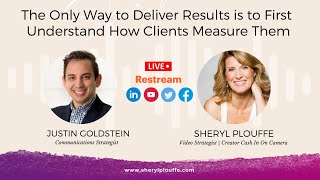
PR strategist Justin Goldstein explains why understanding how clients measure success protects relationships and prevents lost business. He breaks down quantitative metrics like media placements and social reach alongside qualitative goals like brand perception, then maps them to sales outcomes. Under-promise and over-deliver, he says, and educate clients constantly on what's realistic in today's pay-to-play social environment.
Chapters
With investing in yourself, investing in your business, and investing in your marketing, you want to make sure that you're getting an ROI, a return on your investment, when you go to market yourself. Justin Goldstein is here with us today on Cash In On Camera. He's an award-winning PR and marketing expert to talk about results, right? Results in your business. You have to understand how your clients are measuring results in order for you to understand which direction you should go in. So Justin, so great to have you here on the show to talk about this. I have an idea of what I think results that people want are, but I'd love for you to start off and tell us why is this such an important topic?
Yeah, thank you so much for having me. So, you know, I think it's really important because it really sets the tone and expectations for the program that you're going to be working on with the customer or client, whether you're in a service industry or more, um, more of a customer-based industry, um, because if the expectations are inflated in terms of what those results are going to be and you don't meet those expectations, it just damages the relationship and, you know, ultimately can lead to losing the business. So I think that's why it's critical to really understand what the expectations are from a quantitative and qualitative perspective, because ultimately I think in a client's mind or a customer's mind, sometimes it goes beyond the numbers and it's really about how it's going to make them feel and whether or not the ROI is a bit more descriptive than just hitting a certain number. So, you know, again, it's, it's really important to set that at the outset and then move from there.
Do you think that business owners inflate or exaggerate what the results might be for said program because they're trying to make the sale?
Oh, absolutely, 100%. I mean, there are a ton of businesses out there, large and small, that will inflate expectations just to win the business without factoring in, or maybe they do factor in and just disregard it, that ultimately that can really hurt you in the end. And so when I have conversations with clients at the outset, my goal is to say, and I do say this, that I'm more of a conservative expectation setter where I like to beat expectations and, you know, give a little bit of a preview of what the opportunity is to beat those expectations. There's a bit more optimism involved, but just giving an understanding of what the baseline should be so that nobody's surprised. But yeah, absolutely, there are tons of businesses out there that will inflate expectations just to bring in the cash flow and, you know, sign a client or a customer.
So we often hear, you know, overpromise— or sorry, yeah, underpromise and overdeliver. Actually, I've heard it both ways. So which of those is the way that you would approach it if you're a business owner? Is it better to underpromise?
Well, I think the two kind of go hand in hand. So I mean, if you're underpromising and you— well, I should say you can underpromise and connect that to overdelivering, of course, because if you say, hey, we're gonna get, in my world, 4 pieces of media coverage, which maybe, you know, internally is a bit low, but you're setting that expectation to protect yourself and you get 6, then you've achieved both goals. And at the worst case, if you underpromise, but, you know, meet the expectation of what you were supposed to do, then you're meeting your expectation and satisfying that. So I think the two kind of go hand in hand. For me, I do agree with the underpromising mindset in a way, because it's always good, again, in my view, to beat expectations. But, you know, listen, if you feel really confident in the metric that's a bit higher that you want to set, go ahead and set it. Just know that you have to meet it. That's all.
I know that the work that you do— actually, first, let's start by Why don't you explain what Press Record Communications does?
I mean, I know you do a lot of media relations.
You were just hinting at it. You do content development and other things. Um, tell us a little bit about the company that you run.
Sure. So we are in the public relations marketing space. Uh, the bread and butter of what we do is we help clients to be featured in the media, much like I'm doing right now. Um, or we help them to deliver or develop content that can be used for media outreach, but also for their website, social media, whatever the case may be. So. That could be long form or articles, social posts. It just really depends.
So when it comes to results, a lot of the work that you're doing, and I know you work with a lot of agencies, a lot of that work could be subjective, right? So tell us about how we can go about providing, you know, results or ideas or expectations about, about results that you can achieve when a lot of the content, especially I'm thinking about content development, can be such a subjective thing.
Yeah, I think it's, um, one of the reasons why we win the business that we do is because we clearly outline again what those subjective or qualitative metrics are. So for example, with content— or I should actually say a better example is with media outreach and media placements. I always tell clients, it's what you do with those media placements that's really going to move the needle. Nobody should expect that just because you get featured in the Wall Street Journal, you're going to get 10 new business calls the next day. It's just, it's rare that that happens, or at least From my experience, it's rare. So what will help you to do that though is if you use that Wall Street Journal placement to develop social posts, post on your website to generate traffic, use it to get speaking opportunities, whatever the case may be. So just guiding clients on how to actually use the results that we're getting them, I think, is what helps to, um, satisfy that more subjective qualitative metric.
So it could be a lot of the prep that you do with your clients could also tie into the maybe second-tier results that you might help them get. Exactly. Yeah. So education and coaching and, you know, kind of really helping to tee that up.
Yeah. And a lot of clients I do find need the coaching because, and I don't know if it's really just segmented out for PR and marketing, but I just think a lot of them aren't very familiar with how this process works. And so if you don't have that conversation upfront, it just, I think, causes a little bit more stress during the campaign because they don't understand the ins and outs and how you're thinking and you might get frustrated because you're like, "Why doesn't this client or person understand this?" Because it comes so natural to you, but it may not come so natural to somebody else, which I'm sure happens to a lot of people. So that's why if you have those conversations and you reiterate your feedback over and over as much as you can, hopefully it drills that into the client's head or customer's head and they understand.
Yeah, I love that. I want to talk a little bit more about what the results, you know, understanding, because that's the theme here is understanding. First, understanding how clients measure results so that you then, as the business owner, can help them achieve that. I personally think the definition of results has expanded, especially in the last many years. You know, we think about where things are going. I would love to know from you, is results in your world strictly about selling the product or selling the service, right, that people want to— it's really directly tied to sales. Or is it something more along the lines of, well, results could be measured in different ways. It could be the number of connections that you make, for example.
Yeah. Well, I think for our industry specifically, there's a lot of pressure to connect it back to sales because ultimately, you know, organizations, individuals, whoever it might be, they're spending money at the end of the day, so they want to see a return on their investment financially. Um, but I think that goes back to the education conversation, which is that if they understand the various ways in which they can use that as a support system to generate sales in the future, they'll feel more comfortable investing in what you're doing. Um, you know, I always tell people, PR marketing, it's not necessarily going to tie back to sales, especially the PR end of things, but it will certainly support it. So as long as you give a roadmap on how to create that support, I think you'll be for the most part okay.
Yeah, so the— so it really is, it should always be tied to sales in some way, but it might be a multi-tiered approach to reaching that sale.
Yeah, absolutely. And it really depends on the industry. I mean, again, that's just for us. I, I would never tie anything that we do to sales in terms of saying, hey, you're going to have to see a 10% increase, whatever it might be, in your sales, your revenue.. But I will say you will absolutely see an increase in your social, your article, whatever it is, just an increased support system to help bring in those leads that maybe you didn't have before, or we've made some tweaks to make it better.
Yeah, I'd love to just dig a little bit into the social media since you just mentioned it. And social media has changed a lot in the last many years and a lot of pay-to-play and that sort of thing. I wonder what you would recommend, let's say an agency or someone who's promising someone to get X number of views or leads or whatever from social media specifically. Do we need to tailor our expectations around that because it's a pay-to-play world now?
Yeah, it's a good question. Um, you know, I still think, um, there's no harm in goal setting. But you're right, it has to be realistic, especially if it's someone, for example, you brought up social, that isn't active on social at all and you're coming in to help boost that. Yeah, right.
From fresh, you know?
Yeah, they can't expect that they're going to have 500,000 followers in 2 months, right? And there's a lot of stuff in that world that you can do, a lot of tactics you can take that don't require payment, that could just be organic, like posting on LinkedIn for free. But that takes time and so does the pay for play work 'cause I've seen clients that have spent money to let's say boost their LinkedIn posts and have seen a good amount of traffic increase but maybe not so many people actually following their accounts, right? So like all these things take time. There's never one sure way of doing something that's definitely gonna bring that direct impact but you should be doing it in this world because in today's digital world because you need it to just even have a fundamental chance of success.
Yeah, I agree. It's just changed. The landscape has changed so much, and I think that what we're going to see in the future is going to change even further. Are you, um, what are you anticipating in terms of changes that we might see as it pertains to results that people might want to achieve on social media going forward?
I think there's only going to be even more intensified pressure on, um, on sales, uh, like we talked about. That's really going to be the key. Especially with an economy that's a bit on shaky ground right now. It's really, really important. And, you know, PR marketing I view as critical, but some organizations view it as a nice to have. So, you know, when they're making cuts and they have really tough decisions to make, that's sometimes, you know, sometimes PR and marketing are the first things to go. So, you know, it's really, really important that whatever industry you're in, that you really take the time for the right cadence to showcase the results that you're getting. You know, I, I share not necessarily from a metrics or a numbers perspective too detailed, but I, I do share end-of-week updates with all my clients so they understand where we're headed, where we are. Um, you know, I share quarterly reports, um, that recap our success for that quarter so they have a good understanding of what we've done. Just that constant communication is, is really, really important because it keeps it at the top of their mind. And ultimately, the thing to keep in mind is that Often if you're dealing with someone below the C-suite or the managerial level, they're reporting to someone else. So you're not just talking to them, you're talking to their boss or whoever it might be. So it's really, really important that you keep that communication in mind. And that's what's going to, I think, put people over the top. And probably that's where the biggest change is going to come, is that mindset shift.
Yeah, I'm glad you touched on analytics as well, and that you gave a sense of that at least quarterly you're touching base, but you're staying in constant communication. As well.
Absolutely. Yeah. I mean, you have to do it the right way where you don't want to annoy somebody too much. But I think people for the most part appreciate it and a cadence of once per week and then the plus update calls is usually good enough for most people.
That's great. Well, I'd love for you to share a little bit more about Press Record Communications. I'll show it on the screen here so that people can connect with you if they you, uh, see fit. But, uh, tell us about— you have an agency partner program, it looks like you have a blog and other services related to public relations, content, and broadcast media tours, which is interesting too.
Yeah, so, well, thank you for the opportunity. So we do a little bit of a mixture of PR and content development. So in addition to media relations, we help with analyst relations, um, you know, speaking opportunities, thought leadership. And then the content side, we help with audio, video, and the written word content development as well. So everything from audio and video elements for social and web to writing LinkedIn articles, we can help with. And then the broadcast media tour is easy way to understand that is it's a series of back-to-back interviews with TV and radio networks and stations on a given day or normally week at this point. So it's a really, really good way, especially if you're looking to reach a local TV or radio audience to do that. But that's the crux of what we do in addition to things like media trading.
That's great. And so the URL again is pressrecord.co, correct? Correct. Okay, great. And one thing that we do here on Cash In On Camera, Justin, is we do a fun little thing we call Stop Marketing Like It's 1999. Do you know the reference to Prince?
I'm sorry, can you repeat that one more time?
Stop Marketing Like It's 1999. Do you remember, you know, the reference to the song?
Of course. Yes, of course. Okay. All right.
I'm a huge fan. That's why. So, Stop Marketing Like It's $19.99. I'd love for you to share a tip, a tool, a tactic, or a technique that's really helping you and your company to, for yourselves to get out there and market yourselves as well. What's something that you'd like to share? It could be like, oh, I just discovered this amazing app, or oh, this is something we've tried and it's working really well for us right now.
Well, doing what I'm doing right now is helpful, so thank you. That's very helpful. I think also newsletters are really the way for a lot of people to go because ultimately social is very important, but people live in their email these days. So newsletters have also been beneficial for us. And I would say those are probably the two techniques. I mean, there's also just good old-fashioned organic reaching out to people, which I find is still the best way to go. Great. Old outreach. Or warm outreach, yeah. But I've also been, I guess you could say in a way, trained to do that because being in PR, we pitch the media all the time, so it comes a little bit more naturally to me. But it's something that I think if people are willing to just even send a message on LinkedIn, it's really, really important. And LinkedIn is, the platform hasn't been overrun with too much saturation yet, so there's a great opportunity for people to leverage it to network.
I love it. Those are great tips. Thank you so much, Justin, for coming on the show today. I really appreciate your time all the way from New York. And congratulations on the new home, by the way.
Thank you. Thank you very much.
Welcome. Thanks so much for coming on Cash In On Camera and sharing all of your insights today.
Thank you for having me.
Cheers.
Bye.
More from Sheryl



From 'agreeable' to 'ruthless mentor' to 'strategic sparring partner' #substack #shorts







