Demystifying Digital Marketing
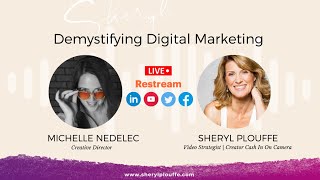
Michelle Nedelec explains how to size marketing funnels for 6- and 7-figure businesses. A simple high-ticket coaching model needs just a phone and merchant account, while multiple products require segmentation and automation to avoid over-marketing. The biggest mistake is building overly complex systems when your business stage doesn't demand it.
Chapters
Having a marketing, successful, and profitable digital marketing strategy or funnel can really be advantageous for your business. But the question really becomes, how much of a funnel do I actually need? And that's what we have brought Michelle Nedelec in to talk about today because she is an expert. She works with big companies. But today we're gonna really bring it down to the level of, you know, 6-figure, 7-figure entrepreneur who really needs to demystify digital marketing. So Michelle, so great to have you here. I know you normally work with a lot of big companies and you're an Infusionsoft expert and you do really complex stuff. Um, how complex do these systems really need to be for a 6 or 7-figure earner?
Well, it really depends on how their business is set up. So if somebody has a coaching business and they want to have 10 clients at $10,000 each, that is an awesome way to run a business and to have a lifestyle. You can do it from anywhere. It's definitely the laptop lifestyle that a lot of people are looking for, and that's fantastic and awesome. The real issue is when you have a special level of craziness like me and you go, hey, I want to have more complicated business, I want to have 50 employees, I want to rule the world, uh, then it— there becomes a time when you need to have more complex systems because if you don't, your clientele gets out over-marketed and they get too many emails, too many that aren't pertinent to them. And you really want to nurture that relationship that you're having with your prospects all the way up to your raving fans so that they're getting the information that they want when they want it. And, and that's where kind of this complexity comes into a business.
So when you say that, it makes me think of segmentation. Is that what we're talking about here? Is the idea that you can through a digital marketing strategy, you can segment certain people, be communicating with them and nurturing them in a specific way? And, and if so, how many of those segmentations is too many?
Oh, that's a great question. And again, it totally depends on how complex somebody's business is. So when somebody's just starting out and they have a, like, a narrow— we'll call it a ladder of ascension on their products. So somebody gets an opt-in, they go to a tripwire, maybe a $50 product, then they go to a $200 product, a $2,000 product, a $10,000 product, a $40,000 product. If they align, you know, really nicely and they just keep consuming, they go, I like this, I'm gonna love the next one, and you have that clear ladder of ascension, then you tend to have a more simple business. The issue is when you have multiple products, multiple streams where people can be coming in, you really want to make sure that you're getting those people where they're at. One of the examples I love to use is for an event planner that's bringing in a band. As soon as somebody buys a ticket for that event, you really don't want to be promoting the event per se to them. What you want to be promoting is the VIP tickets, the box seats, the, the VIP luxury, you know, all-inclusive limo ride and backstage passes, and you want to be able to take them through their journey and not be bombarding them with other emails that aren't pertinent to them anymore because they've already told you that they're interested in this through their actions, already giving you money. And that's really when you want to start making sure that you're nurturing that relationship in a way that makes sense to them.
Yeah, so the customer journey and understanding what stage they're at in the digital marketing funnel, if you will, is important to know because then you can start to say push. I don't know, I don't know if I like the word push, but for lack of a better term, to the— wherever it is that you want them to go. Um, but, um, if you have— to your point earlier— if you have a simple business, right, you have— you want 10 clients at $10K each, and that's your business model. Do you really need to have, let's say, a digital marketing funnel that would do that, or would you be able to manage, let's say, segmentation or tagging.
You wouldn't need tagging, you wouldn't need anything. You need a cell phone, some networking contacts, and a merchant account where you can accept. And maybe not even that if you're, if you're doing it with PayPal. I wouldn't recommend doing it with PayPal. I would recommend getting a cell phone and a merchant account in that case. And you can totally run a business on a cell phone and a merchant account. In fact, I have clients and I know other people who have run a million-dollar business with themselves, their spouse, and a virtual assistant. Depending on the way that the business is set up, you can absolutely do that. And when it comes to having a different kind of format to your business, as soon as you're doing live events, as soon as you're doing online challenges, as soon as you're having some level of complexity— so it's kind of like if you were to throw an event and you had all of your prospects and all of your clients in the room can you manage that kind of by yourself? As soon as you have 400 people in the room, obviously that's not accessible. As soon as you start segregating people and saying, hey, these people have seats down, um, right in front of the stage, these people have seats up in the balcony, now you have a level of complexity in your communication that if automated has to follow that kind of flow of communication because nobody wants to walk into a room of 400 people and and just all be herded. Nobody likes to be herded, and that's what you want to make sure that you're avoiding in your digital marketing, is to make sure that people aren't being pushed into certain areas. They're being guided, they're being allowed in. This is your next logical step. Hey, if you don't like this logical step, then, you know, come into this community and we'll take care of you. So it's more like having the red velvet guidelines for people so that they know how to kind of get around the crowd and figure out where they want to be within your products and services.
You made a good, a great point actually about how you can have a successful million-dollar business with just, you know, you, maybe one other person and a VA. Like, that's actually very, very doable so long as you are charging what you're worth. You, you know, maybe have a high-ticket product or service that, you know, I think that's a totally viable path. But yet in the experience that I have had in working with people who want to or aspire to have like a 7-figure business, Michelle, one of the problems that they have is that they get mired in, they get dragged into this complexity of creating funnels when it's not really what they need to be doing. Do you see that as well?
Absolutely. And I think a lot of people, marketers in particular, have a vested interest in marketing their products. So it's kind of, you really have to be aware of that and they're going to be really good at selling their products and services. So for example, we have a client that started out, she was doing sales for another company and she was making them millions. She was a very good salesperson, and she decided she wanted to start her own training company and do her own thing, which is great. And she didn't have a list, she didn't have a following, she had nothing. She was starting from scratch, but she knew that she didn't want to take care of the tech. So we sat down together and looked at her plan, went, yes, this is sound, this is viable, this will work online, let's get started. And within 2 months, she did her first 3-day event and she made $40,000 at that event. A year later, she had her third 3-day event and she made $100,000 at that event. So she is right on track for her plans and getting where she wants to go. But she knows that she wants nothing to do with the tech piece. She's smart enough, she could do it, she is capable of doing it, but she just knew that that wasn't what was going to get her to where she wanted to be if she was caught up in that mire. If, on the other hand, you're trying to figure out how to write out an email and how to send it and how to set up the tags and how to— all of that becomes a total mess that I personally didn't want anything to do with. So I didn't have anything to do with it. Yeah, that wasn't my route in the entrepreneurial world.
There's something to be said for self-awareness and for understanding your strengths and your weaknesses as an entrepreneur so that you can— and maybe it isn't immediately. I mean, maybe you need to bootstrap at some point in your business when you're first, first starting. But when you are at a point where you can start to you have decent cash flow and you can start reinvesting in yourself. I think it's one of the smartest things that you can do because you can then start really growing when you're not in the weeds of every single technical thing that's going on. And it can get complicated. Um, I want to just ask you, because that's the majority of the work that you're doing— I mean, you're an Infusionsoft expert, need I say more? If anyone is out there listening, watching, who knows anything about Infusionsoft, it can get really complex, right?
It is a fantastically robust system, and it's still one of the best in the systems in that when somebody says, hey, can you do this, we can make it happen with it. So the issue when you simplify systems is that you're also limiting those systems, right? It's kind of like if you walked into a house and it's got 4 rooms and a door, you have a very simple room, it's easy to navigate, you know exactly what's going on where. As soon as you start putting up walls and doors and windows and machinery and appliances You're creating complexity within your house. Now, most of us are, you know, have the wherewithal to add a piece of furniture at a time, get used to it, add another piece, get used to it, and we kind of operate that way. In business, if you have a plan that you want to lay out and you're like, here's the shop, there's 28 rooms, and each one has different furniture, and they all have this, that, and the other thing, that's when you start looking at it as, okay, I'm going to need some help bringing in movers. I'm going to need some help figuring out how to use these appliances. The same thing is happening in your business when you're having things like the email campaigns that are going out to prospects and clients and veterans of your business and suppliers all at the same time. They're not going to get the same messages, and you want to know when you can start to cross-market those people, upsell, downsell, all that kind of fun stuff. Are you going to bring in affiliates? That's a huge other.
That's a whole other—
that's a whole other herding cats, but it can be very lucrative if it's done right.
Absolutely. And that is something that we support here. The thing I do is profitable podcasting and teach people how to do that, how to get clients, referrals, and speaking engagements by leveraging a podcast. And in those three arenas, clients, referrals, and speaking engagements, There's a kind of a level of complexity within each of those different buckets. But coming back to what you were saying earlier about, you know, you might— it can get really complicated. Is there any way definitively to know or for a person to identify what stage of business they're in and what kind of funnel that they actually need? What is it that they need to examine? Is it that they should start with, well, I need to look at my offers, or I should look at my customer journey, or I should understand my Ascension model? Like, is there any one definitive way that we can help people say, you know, look at this first and then determine what kind of funnel you need, if, if you need one at all?
Yeah, and a fun way to do that is to use the analogy of a house or of an office and go, how complex is my business? If my business was a house, how simple or complex is it? How many people am I bringing into it? How often am I bringing them into it? Can I maintain you know, being the good host when people are knocking at the door and, and I'm greeting them and I'm bringing them in. As long as you can maintain that kind of visual aspect, if you will, of your business, then you're doing great. There's, again, there's super simplistic ways of keeping track of your time, your schedule, right? Some people are still on paper and going on, I have an appointment with so-and-so, it's in pencil, they erase it when they don't show up, they put somebody else's name in it. And if that works for you, awesome. I am all for what works for you. But again, when it comes to a certain complexity, you'll notice if you have a Google online calendar, right, you can start color coding things. You can start putting things as busy or as free time or as, you know, it's a task that needs to be done or something I need to delegate. That's when our brains start to go, ah, it's all too much for me. I can't do this. We need to have somebody, one, that can organize and understand, say, Google calendars and be able to show us kind of what do we really need to get a hold of based on how our business works. Likewise, when it comes to our CRM or databases, the software that we're using for our clientele, it's how complex is it. If I have a course and I just give people the course, that's pretty easy. I can give people videos. As soon as I want to start watching who has access to those courses, who doesn't have access, do they have it on a monthly membership, do they have to pay those memberships in order to continue to get access to those courses, do I want to give some people free access to those courses based on other packages that they may have bought, or do I want to give away chapter 1 for free as an opt-in? Now those are all levels of complexity that technology is really good at being able to manage. People, not so much. People are not very good at managing a whole ton of things. So as soon as we start feeling like we got too many plates spinning, that's about the right time to start looking at, hey, somebody else knows how to do this way quicker, easier, faster than I do, and I don't have to worry about that. I still create the products and services, but now we're managing together so that people are getting access to the things that they want when they want them.
So in the work that you do then, Michelle, are you, are you guiding people to like any one specific type of technology or platform, or you kind of like platform agnostic and just choose and recommend things that maybe vary from person to person, or are you going to more partial to one specific stream or tool?
Yeah, great question. So when, uh, later on I have a gift for your audience and it's a super awesome gift. And if they want clarity on how that all works, they get the option of being able to book a discovery call with me. In that discovery call, all I care about is them getting the answers that they need for where they're at in their business, and more importantly, what the goals are in their business. And that is absolutely just subjective. I have objective, I guess, completely objective, and I just want them to be able to get the answers to help them to know what their next steps are and how they can run their business more effectively and easily than before. Our clients, on the other hand, have to have a certain level of complexity, and they have to want to get those problems solved. So we don't work with all software. We only work with Infusionsoft-based clients and all the peripheral software that can go along with that.
Yeah, so awarenessstrategies.com/website-audit is where we can go to get the free audit valued at over $497, correct?
Yes, absolutely. And it's a fantastic report that will help with looking at your website of what's getting traffic, which is great, what's not getting traffic because the Google gods will stop all traffic from going to your site if it doesn't comply by certain things. And then there's the yellow lights of things that you can fix in order to be able to make your website more attractive for your potential clients, helping you get more opt-ins and more conversions.
What is the biggest misconception that 6 and 7-figure earners have about digital marketing?
Um, that it's terrifying, that it doesn't work, that there's a whole lot going on. And I think it comes down to kind of what I love to call Frankenware. And we got in that trap too. So we were taking masterminds and figuring out what are other people doing. Oh, we use this software, we need that, we need a shopping cart, we need Merch account, we need this stuff. We put it all together and tried to pump life into the software and make it all work together. And unfortunately, somebody has an update here or there and, and it doesn't work. There's fantastical things that happen behind the scenes that websites just don't work all of a sudden and you have no idea why. And it always involves a lot of acronyms for some reason. And unless you understand those acronyms and what they are, calling support and sitting on hold for 2 hours, it doesn't help your frustration in your business. Those are brutal. So we take care of all of those. One, because the techies understand, you know, the acronyms that the other person's using and they know what they're looking for. For the most part, they know how to problem solve because that's their world. That's That's what they swim in. And the rest of us that want to be able to get on stage, get on podcasts, talk to people, connect with other people, it's just not our jam for the most part. So, you know, we want to get out of this.
Yeah. I mean, there's something to be said for, again, you know, coming, going back to basics and just looking at, you know, the foundational things that, that you need to do to be, to be successful.
And so, yeah, it's, it's like a podcast. I mean, if people just really wanted to go kind of bare bones on a podcast, technically they could just go on Facebook Live and do a Facebook Live and call it podcast. But then there's those of us that are special, kind of crazy, go, no, we want a little more production, we want more fun, we want better sound. And, and then we start bringing all the fun things in. And yes, there's definitely a temperament to it because you can always outspend what you, what you need to. That is And I think that's just in business, we have to be aware of those things, that that is always a possibility. And, and do we really need it? What is the end goal? And again, it comes back to your lifestyle. What are you actually wanting to create? Can you live a lifestyle where you just get to go on podcasts and interview people around the world, speak on stages, sell your coaching programs that are group coaching that you show up to once a month and they get a ton of online content? That can be really easy to maintain. Yeah, it really can.
Yeah, it doesn't have to be so complex. And I think you and I both agree that we've probably seen too many people who are so in the weeds trying to create this perfect complex funnel when without taking into consideration what their business actually is, or more importantly, to your point, what kind of business they want, because that's where you have to start. There's no point in painting yourself into a corner in a business that you hate in 3 years from now and want to pull your hair out.
Exactly. Wow. So there's, and there's kind of a fine line there because sometimes people get themselves into business and they go, oh my God, I'm not loving my life right now. This is not how I intended to do it. And sometimes it's because they're doing the wrong things altogether in the business. That's not getting them to where they want to go, but they're living on a different premise. They're still kind of in that employee mindset of I listen to my clients, my clients are always right, and I want to deliver the best for them and it's got to be perfect. All of those will kill you in the entrepreneurial world. Done is the new perfect. You get to decide who your clients are, you get to decide who you want to work with in a day, and you get to decide what you want to delegate to somebody else. And usually, just for the record, accounting is first, email's probably second, tech is probably third. But yeah, there's a good point. Unless you're an accountant, I don't know anybody that really likes doing that.
Yeah, no. Uh, what is a tip, tool, tactic, or technique that's really something that's really helping you to market yourself or to market, um, at awareness strategies? Something that's working for you for the year that we live in right now. It might be related to digital or technology or not.
I think one of the biggest things right now is honing in on your ideal clients. Problems that you want to solve. And instead of focusing on the thing that you want to sell or the product or service that you have and how shiny and nice it is, is to really understand and get into the minds of your potential clients, find out where they are, and speak to them directly. Because a lot of what I've noticed is the more people can hone in on that specific, very targeted market and be themselves and have fun doing it, that becomes kind of the magic sauce right now, is There's no expectations you have to live up to, and there's no group that is best to sell to, but figure out who those are for yourself, and then you become a beacon to them.
Yeah, I totally agree. And, and that's, and that's really coming back again, back to basics. Like, talk to people, talk to people, have conversations. And, and that's a really, that's really great advice. Michelle, thank you so much for coming on. This has been really a fun conversation. I think you've helped us to, you know, demystify digital marketing Consider the customer journey, consider the complexity of your business, understand who you are and what kind of business you want to build. Those would all be great steps to start with before you start running around purchasing every SaaS product under the sun and trying to cobble them all together and causing yourself a lot of grief. And then the last thing I will say is take— I mean, listen, I mean, what you're doing here, the audit, is fantastic. So go and take advantage of Michelle's free audit valued at over $497. And you can go and find that at awarenessstrategies.com/website-audit. Thank you so much for being here, Michelle. This has been really fun.
Thanks for having me,
More from Sheryl



From 'agreeable' to 'ruthless mentor' to 'strategic sparring partner' #substack #shorts







