Design Your Life With This Truth
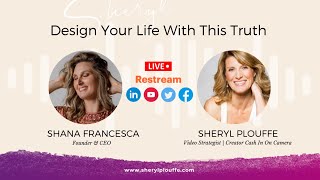
Shana Francesca, founder of Consonate, grew up in a restrictive religious cult and used her bedroom as a vision-boarding space to escape. She now helps entrepreneurs design home offices with color, scent, and plants to align their physical spaces with mental well-being and business goals.
Chapters
business in the first place was because you have a desire to want to design your own life, do what you want to do on your own schedule, make the money you want to make, impact the people's lives that you want to impact. And so today we're going to talk about life design with Shana Francesca, who is here and has a really interesting backstory, one that is rooted in trauma, uh, as so many people can relate to that, and how she really rose like a phoenix and is here today to talk about this from a very different perspective. So Shayna, so great to have you here on Cashin' On Camera. Oh, thanks for having me. Yeah, grateful-isotope-isotope. Yeah, great to chat with you about this. I want to kind of go back a little bit. Let's talk about how you came to this place. It wasn't, it wasn't a great journey, but it did bring you to this place today. So without— you can go into as much of this as you want to go into or as little as you want to go into. But I think it's important context for people to understand why you're the expert to talk about this.
Yeah, absolutely. I grew up in an extremely religious, um, cult, and, um, that understanding— and it became more and more intense the older I got, the more entrenched my family was in it. And it was— I lived in an abusive household, and I went to school and church, you know, within this— it was encompassed my entire life. Um, and so home wasn't safe and outside of home wasn't safe because it was all very curated, um, uh, within my life. And so there was really no one in my life whose life I wanted, right? Like, I looked around and I didn't see anybody who I'm like, yes, I want that life. And none of it felt authentic to who I was, and there was no allowance for me to question, to be curious, to, you know, because if I question, it was like you're going against God, right? And, and you're gonna go to hell. You know, there was this very strict, this is how you behave or you're going to hell, um, and this is what you do or you will be abused. Um, and, and so, you know, it, it crafted my reality in a way that I felt this very deep need to, to feel reflected in my own life. And so I started crafting my bedroom as my safe space. And I started to recognize that there was this powerful connection between my mental health and how I felt about myself, and that's— and how I felt within that safe space. Um, it became my touchstone, and, and I started using the walls as what we now call vision board, right? So I would, I would take the JCPenney catalog that we would get in the mail, right, like those big thick ones that you used to get back in the day and I would dog ear, I would circle all the things that I wanted to be a part of my life, this new life that I was crafting for myself, that was my rules, my way. And I would dog ear the pages and I would flip through it. And then at doctor's offices, when my parents would bring us with them, I would sit in the waiting room and I would slowly tear out the pages, right? 'Cause if you got caught, you'd get in trouble. So I would slowly tear out the pages and I would paste them up all over my walls. And I would write down quotes on index cards from books that I read. And tape them up all over my walls. And books became— the authors of books and the people and the stories of the books I read, they became mentors, they became friends, they became a view, a window into what was possible and into imagining a reality that didn't exist for me. And it became the beginning of what I now understand to be life design, right? It's this foundation of getting curious understanding what's possible, seeking out knowledge and, and understanding and mentors and, and beautiful friendships and finding connection in the ways that I had access to.
You are the founder and CEO of Consonate, and I'd love for you to give us the— what, what is that? Is it coaching? Do you help people now? Does design their lives? And do they have to have come through a traumatic or traumatic experiences in their childhood to take advantage of the work you do today?
I think— great questions. Number one, Consonate is a life design company, right? So I started out my career as an interior designer, and, and when it comes to our happiness, there are three main factors. Number one is our mental health. Number two is our home. Number three is our physical health. When we understand, and I truly believe that number one and number two, our mental health and our home are in fact indelibly tied because I've seen it change people's lives when they feel truly reflected, heard, understood, their authentic self being represented in their home. Those two things are— it's the first, you know, our bedroom is and our home is the first thing we see when we open our eyes and the last thing we close our eyes to at night. It's a vision board for our life if we let it be. And so Consonate is a life design company. I also work with clients as an interior designer. Those two things are, are completely tied together for me, um, and part of it is doing workshops and group coaching around life design. I've conducted workshops, group coaching and workshops for the last 4 years, and, and also do public speaking around the topic, really wanting to impact more people's lives. Not everybody wants to hire an interior designer, but everybody, every single one of us can sit back and question the ways in which we've been taught that we are allowed to connect with one another and we are allowed to connect with ourselves. Because I don't know about you, but it's not working. So many of us feel very lonely, very isolated, even though we may have friends and so on and so forth. The way we're taught to connect with one another isn't— is not— it's not actually beneficial, right? We're not being able to show up as our true authentic selves. And so working together, especially in a group coaching atmosphere. That's my favorite. One-on-one, sure, we can do that, but group coaching is my favorite because, A, we build connection, we build community, and we get to hear how one another interprets what we're all hearing together, right? We get more insight and we get more understanding. We get to learn from each other, and I absolutely adore that. Um, so Consonate is, it is a life design company that also, you know, we do, we do several things.
So when you talk about life design, is it about connection to self in addition to connection with other people? Is it the totality of that? Yeah, it's really looking at connection with life.
Yes, it's, it's looking at— and I love how Mia Birdsong in her book How We Show Up talks about it— it's about how we show up. It's about how we show up for ourselves. It's about how we show up for one another. It's about questioning those assumptions. It's about questioning the concepts around the nuclear family, around, you know, your, your partner or spouse or whatever being everything to you. But that's just not a healthy way to be, and it's not possible. We're seeing divorce at such crazy rates. We're seeing people choosing to be single at such enormous rates because it's too much to be the the main person, the only person, the always go-to in another person's life when we've got so much going on for ourselves. We really need to, to get to a place where we recognize that it does take a village, not just for children but for all of us throughout our entire life. It's about building community and doing it authentically and doing it in a way that, that feels unique to who we are and the people we're connecting with.
I want to go back to what you said earlier about in your childhood when you started using your bedroom as a place to really have a forward vision or a vision for what the future could be, or a different life than the traumatic one that you were enduring at that point. And how do we relate that to, let's say, entrepreneurship, business owners today who are, let's say, in my case, right, this is a bedroom, uh, for those who are watching on video. This is a bedroom turned into an office, right? This is a physical space that I have put a few personal things that you can't see on camera, but it makes me happy to look at those things. I think about, again, other rooms in our house, like in the bedroom, for example. I have different tools like for meditation and things like that. Let's just talk about the physical nature of entrepreneurship. As many people are working from home, what do we know or what should we be taking into consideration about our physical environment?
Number 1, we underestimate the power of scent in our lives. Yeah, so scent is our most powerful connection to memory and emotion. So, so, so for, for some entrepreneurs, you might be, you know, working from a studio, right? And everything's all in one room. Well, how do you differentiate between when I'm working and when I'm not working? You can use scent. Right? You can, you can burn a specific candle or spray the room with essential oils or put essential oils on your own body, right? That while you're working, I'm smelling this particular scent, or when I'm not working, I'm smelling this particular scent, or change between the two. We can trigger specific emotions. The thing to keep in mind is that once we associate a specific memory or emotion with a scent, it cannot be changed. It is virtually impossible to change it unless there's some significant trauma that occurs. So you want to make sure that either using a scent that's completely unfamiliar and create an association, or one that already has a beautiful association. And the way that I try to connect this to people's understanding is when I say to you your grandmother's house or your favorite aunt's house, you not only think of that person, but you think of their home and the way it smells, right? Specifically when I say your grandmother, your thoughts probably immediately went to her house and the way it smelled and how you felt in it, right? And so it's interesting for us to recognize that when we think of people, when we've been inside of their home, we also think of their home and we think about the way that all of it smells. We can use that as a very powerful tool in our own life, even when we don't have the resources to necessarily have separate spaces to work in. It's really important to create differentiation for our brain so we don't have overwhelm, because as entrepreneurs, I'm sure you know this, we work all the time and it's really hard to stop ourselves sometimes, and those lines get blurred, and we get burnt out because we can't stop working.
So we have to— well, this is one of the— this is one of the things, the misconceptions about entrepreneurship. People think, I'm going to become an entrepreneur so I can work less. Well, you work in a different way. It's really what it is. You're working in a different way. And yes, if you, you know, get to a certain point, you have more freedom to be able to choose, but you're not— you're still working. But I love this idea of using scent, and I think about my own environment here. There isn't—
there is no—
there are no candles, there are no essential oils, but yet I have them. I'm just not utilizing them. Yeah. So this is— but you have created—
to, to your point, you've created a different association, right? So I happen to know from our initial conversation that, that your home, the rest of your home, is painted in a lighter color, in a much lighter color than this room.
Yes, it is.
So this room is completely different from the rest. It's dark. It's, it's a little bit moody. It's a little bit fun. You know, it's all— so you've created it as a separate feeling, right? That's another powerful way with it, with a different paint color or bright colors or maybe plants or things like that. There's lots of ways that we can create associations with our brain and we can take care of— we can take advantage of a whole variety of them. The reason why I bring up scent is because it's so neglected. But there are lots of other ways to bring that association of separation, you know, into our lives.
I love that. Scent, paint color, plants— those are physical things that we could put in an environment to create these associations. You mentioned also this idea of vision boarding, or that you as a child were doing a version what you later learned to be vision boarding because you were putting inspirational things on, on the walls of your bedroom. Is that something that we as entrepreneurs should do? Or let's talk about vision boarding. I don't particularly do that, but I will sometimes have a Pinterest board. Like, if I really want it, I'll look at Pinterest and then I might put in some things in there that help a picture of what's possible. So let's just talk about that. Do you believe in vision boarding?
I think that the thing about vision boarding that is powerful is that we cannot achieve something we cannot imagine. Right? We can't— we don't see any map for, we don't see any pathway to. If we cannot imagine it, it cannot happen. We learn through story, we learn through metaphor. So I think the powerful thing is creating that, that understanding or that visual representation, or some representation for you, whether it's journaling, whether it's a vision board, whether it's a Pinterest board, whatever it happens to be. Creating that remembrance, that association, that anchor point to your why, right? Because when we, when we're talking about any of those things, we're creating imagery. When we're, when we're creating a vision board, what it really comes down to is why, right? We're, we're using images to, to remember, to evoke a specific emotion, right? Like when I want to say I want to travel more, well, it's not just because I want to see other places, it's because I want to connect to a different understanding of the world. I want to understand different cultures. There's the root of it is joy. I want to experience more joy through new experiences, right? And so I think anything that can help us to remember why we're doing something and can bring us back to that is an anchor point, a calm in the storm that is entrepreneurship.
Yes, entrepreneurship is wonderful. I mean, I couldn't— I, I think I'm unemployable at this point, right? Like, I wouldn't be able to go and be an employee. I just couldn't do it.
It's been a long time that I've been on my own, and I have I absolutely love it, and I want this for so many people.
Like, I want— but it comes with its own set of challenges in that you are the boss now. You don't have someone dictating what is on the walls, and what you get to choose what those things are. And while there's a freedom around that, there can also be some confusion about that. You know, it's like, what should I do? What shouldn't I do? And I think that is essentially the work that you help people to do.
Yeah, exactly.
So tell us a little bit about your website, how people learn more about the work that you're doing.
Yeah, so, um, on my website there is lots of resources. There's me as a speaker and a writer. There's workshops and group coaching. Um, I launch a new group coaching, so I have a 1-day workshop. We're doing it virtually on December 5th. That's on there. I also offer 1-on-1 coaching, but I really encourage people to invest in the group coaching. Number 1, it's less expensive. Number 2, I think it's more powerful. And so I launched more, uh, launched 2 new sessions of group coaching, um, Mondays and Wednesdays starting January 30th. Uh, you can pick between which session, uh, you would choose, whether Mondays or Wednesdays work better for you. And just creating a respectful environment for us to learn how to do life better together, right, for ourselves and together.
So consonate.world.
Did consonate.world— yes, that's exactly it. Yep.
The last thing I want to ask you about— this has been fascinating and it's really gotten me thinking more about my space, even though I have painted the walls darker, but I do want to incorporate scent. I think that's just a brilliant point that you brought up and so many other ways that we can really design our perfect life and bring more joy into our lives. But what is a tip, a tool, a tactic or technique that you could leave the audience with today that helps them build their businesses and move toward more joy?
I think number one, getting curious. Getting curious about what's possible, constantly, constantly examining our assumptions, right, and where they've come from and who's formed them and why they've stuck. Getting curious and staying curious. Curiosity did not kill the cat, right? I think that's a terrible saying. Curiosity is necessary for us to grow and learn, and it, and it and helps us develop courage and opens up possibility. And, and when we do those things, we find better connection, we find mentors, we find all these beautiful things that we didn't know existed. And I think that's really key, especially like you were saying earlier, when someone's making that transition from working for someone to working for themselves. Get curious. That's the perfect time to get very curious and to find mentorship.
Shayna, thank you so much for coming on the show today. This has been very insightful and you've got me rethinking my physical environment. And also, we didn't even really dive too deep into the mental aspects of it, the physical aspects. But there are— there's so much to explore in the realm of life design, which is your specialty. And we appreciate you giving your insights today. Thank you.
More from Sheryl



From 'agreeable' to 'ruthless mentor' to 'strategic sparring partner' #substack #shorts







