Do You Really Need A Funnel?
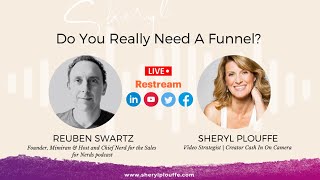
Sheryl Plouffe and Ruben Schwartz discuss whether sales funnels are necessary, arguing that they work only when they preserve human interaction. High-ticket coaches and consultants need personal conversations to qualify clients, not automation. Schwartz built Mimrun, a lightweight tool for solo consultants that automates proposals but prompts outreach to keep the process service-oriented.
Chapters
Not that F word. We're talking about funnels. We're going to talk about funnels in depth today on Cash In On Camera because we really want to explore whether you need one or not. Ruben Schwartz is here with us today to talk about this on Cash In On Camera. Ruben, so great to have you here. I think some people might consider funnel to be a bad word depending on their viewpoint of it. So let's kind of start there.
What—
when we talk about a funnel, we're talking about it through the lens of sales and marketing. But what— how do you describe what a funnel is to other people who ask?
Well, that's a great question. And maybe, Cheryl, I was about to thank you for having me on, but maybe I should not because it is kind of an F-word in a lot of situations. I think it's a term that's been popularized by a lot of internet marketers who basically say, hey, you have a big funnel at the top, you kind of attract some people who are interested. And then you do a bunch of stuff to make them more and more interested until they buy, and then money comes out the bottom. That's the basic idea. And it sounds kind of industrial and, and not very authentic. And most of us have been on the receiving end of some of these funnels and had kind of an icky experience. And the other thing I would say is we've probably also been on the receiving end of some of those funnels and not had an icky experience and not realized we were going through a funnel because we just felt like we were walking down the path that was made for us. So it really is a lot about Are you doing something that's going to really benefit the person buying? Then it doesn't feel gross. Or are you doing it to kind of trick people into buying who maybe aren't the right fit? And then it feels gross and it feels like an F word. Yeah.
Well, a funnel— I personally don't love the word funnel when it relates to what I essentially would say is a sales process. I mean, that's how I see it. A funnel is a sales process. And everyone's sales process might be different depending on what it is you do, who you serve, how you serve them. And a funnel, I think, also has this thing where it feels like everything is automated in the funnel.
Yes.
And there's a lot of heavy automation. I think that the more automation there is, really the more potential there is for something to go wrong and crash the whole funnel. What do you think about that? Is, is a funnel always something that's automated?
Well, it depends on who you ask, but I, the way I like to think of it is I think more along the lines of how you think of it, where a funnel is just a way of sort of attracting the right people, trying to figure out if they're in the right spot, and if they are, helping them to pay you basically and get the benefit that you offer. But also if they're not in the right spot, to send them to the right spot. Think of it as you walk into the hospital you might meet with the first doctor. That doctor might treat you, or they might send you down the hall to a different doctor. But hopefully they're not going to try to talk you into surgery just because it makes them a bunch of money. Sometimes we kind of get that feeling when we're part of someone's funnel, right? And we get all these emails, and I just, I hate that. I like the idea of a funnel that is quasi-automated. So you've got to do some things to make the funnel work for you while you're busy doing other things. But depending on what business you're in, you've got to have that human touch too. So I'm talking specifically here to the folks who need to have that human conversation to figure out, is this the right person? Is this a good fit? Do we get along together? Well, what are the problems? What is the customized solution I'm going to propose for this person, etc., to set up a successful project? Now, if I'm selling coffee mugs, I don't need to do all that. I can have a fully automated funnel. But I think what happens is a lot of folks in the service world see this funnel as a magic bullet that's going to get them out of selling because they have all these hangups about selling, which I did too. And so they're like, great, I'm going to have a funnel. I'm not going to have to do selling. And instead it just makes everything worse.
Yeah, I totally agree. I think that they're using funnels as a way to avoid the thing that scares them about sales when sales is a necessary function of a business. And so, there's this thing that's going around where people are trying to ignore the thing that scares them. But yet, listen, you're not in business if you're not selling something. You have to get over that fear of selling in order for you to have a viable business. I like what you said about being quasi-automated. And I want to talk about the funnel now from the perspective of a specific person, a coach, a consultant, someone who's in the knowledge industry. They're packaging up their IP into programs, courses, masterminds, memberships. It's something that really is of their own. It's really their knowledge that they're selling to other people, right? So a 6-figure coach, a 7-figure coach, does that person need to have a funnel? Do they have to— do they need to have a quasi-automated funnel?
Well, and again, we're talking terminology here, and I think the terminology is important, but Like, let's, let's be clear. Every business has some way of getting new customers or they don't have a business for very long. Now, for a lot of folks, that way is I pray for a referral. It's not a very good way, but there's a way, right? Otherwise you'd be out of business already. And so what we want to do with the funnel is just make the process of getting more business more and more efficient. And I think this is really important for these coaches and consultants who typically don't like selling. It should be more and more fun. If you're having fun with it because you're talking to the right people and you're not feeling like you're trying to like trick someone into buying, you're going to do more of it and people are going to have a better experience with you and they're going to tell more people. And lo and behold, you're going to get more referrals. The referral channel is going to become a more efficient channel along the way. But you've also got to have a proactive way of getting new business in. And I— we can call that a funnel if you like. I don't like to call it that because I get those icky hang-ups that I get about automated funnels. And I see coaches and consultants doing this all the time. It's like, I've got this funnel and it's gonna lead to my $25 ebook. And I'm like, you help giant corporations for 5 and 6-figure projects. How many ebooks did you sell last month? Well, I did a campaign and I sold 20 of them. I'm like, it's not even worth your time. Like, it's just a distraction. So get rid of that whole automated funnel to sell sell the $300 of eBooks or whatever, and let's go get you your next amazing client that really lights you up. And later maybe you write a book or you have some offering for somebody who's got an audience of a million people. Let them automate that funnel. But you, your genius is not in funnels. It is in helping your specific ideal prospect to achieve the amazing gains that you give them.
Ruben, you bring up a really good point. I talk to people all the time who have, let's say, a high-ticket thing that they sell or aspire to sell. They're not selling enough of it because they're so consumed with building this automated funnel that they're not seeing the forest for the trees, right? They're, they're so focused on, I gotta create this automatic funnel, I've got to create this process that I'm as hands-off it's running itself. I'm on a beach with a laptop, money is rolling in, or at least that's the dream, right? And I don't have to talk to people, you know, it's— everything's passive. No, you have— let's say, let's say you have a high-ticket thing that actually requires that you have conversations with people. Again, coming back to fear, people don't want to do the things that, that they should be doing, which is getting on the phone or talking to people or being on Zoom or whatever it is. And having those conversations, maybe even multiple conversations. If you're selling a $50,000 package, it might require a couple of calls to discuss, are we a fit, what we do, how we help, etc. And it happens a lot where someone will have a high-ticket offer and then I'll say, well, how are you marketing that? Because usually that's one of the questions I ask. Well, how are you marketing to sell that thing? And they'll say, oh, right now I'm I'm redesigning, I'm rebranding my website, I'm working on my ebook, I am automating this to the other thing. And I have to ask more questions about that. Well, why are you doing that if the thing you want to sell is this? You see this all the time too, right? Can you speak to that?
Yeah. And I think it goes to what you said earlier. These people don't like selling. I know because I still don't like selling. And Bob Burg was on my podcast. He said, Ruben, You don't dislike selling. You dislike what you mistakenly think selling is, which is perfectly accurate. But for me, it's just easier to think of it as I'm just not going to sell anybody. I'm going to help people because I'm an engineer. I like solving problems. I like helping people. Most of us in the service industry, we're there because we like helping people. And sales, if done wrong, is about coercing someone to do something that's a benefit to the seller, not necessarily to the buyer. If it's done right, as Steve Rossman was saying on your show, it's a service to the buyer, right? We've all had those experiences where we had a crappy sales experience and we're like, ick. This felt like the always be closing guy from Gary Glenn Ross. And we've also had lots and lots of experiences where we bought something with a really helpful salesperson that we don't, we don't even put in the mental category of we got sold. They just made it easy for us to buy what we needed. And that's what we want to be doing for our ideal clients. Now, the other thing that happens with a funnel, when you start getting into people and gurus and software and all that, that talks about funnels, you always have this like funnel. It's really wide at the top and it gets narrower. And the idea is to slurp in as many people at the top of the funnel as possible. And this is a ginormous mistake because it's like, you know, if you're a knee doctor and you try to talk to every single patient walking in the hospital and convince them to get a knee procedure, that's not gonna go very well. That's the equivalent of what sort of the, and I'm not saying everyone in the funnel space does it this way, but there's a lot of this kind of mindset out there, right? You got to get as many people in, and then you'll, you'll email them until they buy something. No, not everyone needs a knee procedure, right? Only talk to the people who, who have knee problems. That's a start. So instead of thinking it was a funnel, I like to think of it almost more like a pipe. Like, you want to, you want to make it selective for the right people to come into your world so that those people are likely to— they need knee help, right? There's a good chance they're going to want to buy what you're offering. And even if you can't help them right now, you can send them to exactly the person who's gonna help them. And you're not gonna waste a ton of time with a bunch of tire kickers and wonder why folks aren't buying or why they're objecting to price, et cetera, et cetera, because you're wasting 90% of your time on people who don't belong in your quote unquote funnel to begin with.
Right. And I think a lot of people try, they think that I need to have quantity, right? I have to have a huge number of people. That's why We've seen for the last decade at least or more, people striving to get a million followers on their Instagram and all these likes on the Facebook and all these vanity metrics that people chase down, or I want things to go viral. We're talking about quantity of people, but the truth is, especially if you're selling something that's high ticket, you don't need a million people to buy your thing in order to have a very viable business that does really well, that affords you to have the lifestyle that you want. So what is the point then of having a million followers on Instagram, faceless people that you don't know, who will never get to know you, who you don't even know if they're your ideal people. So I think we're going away from this vanity metric world that we've been so indoctrinated into, and we're going to go more toward the high touch. And I would prefer to have fewer people, but know that I can actually have an impact, that I can serve those people. Really well and have fewer people in my world than to have a million people following me on Instagram. So I'd love your opinion about that.
Well, I would just say amen is pretty much what I would say to that. And I think some of it comes down to what we are exposed to. Kind of like the whole notion of people think we need to have these really broad funnels. People can always pull up that experience with the sleazy salesperson. We can all look when we think about Instagram or YouTube or LinkedIn or whatever, we think about the influencers who have a gazillion followers. We don't know about the vastly more numerous people who are under the radar because we're not part of their circle of raving fans. But they might be living on a beach somewhere doing great projects, changing the world for that set of raving fans. And we want to be more like them, not those generic— not that there's anything wrong necessarily with having a million followers on Instagram. Like, great if that's your thing, but it's not necessarily the path for one. It's kind of like when I was a consultant, I was working for Fortune 500 companies, and I thought I was supposed to behave like a Fortune 500 company when I had like 5 people. It was crazy and ridiculous looking back on it, but we kind of absorbed that, oh, this is how it's supposed to be done, versus this is the right way to do things for me that not only lets me be— lets me show up authentically as myself, but actually makes my life so much easier and better. Right? I don't need 500 leads if I can only service 3 clients at a time, right? That's the last thing I want. If I can only service 3 clients at a time, I want 5 really qualified leads. So let me make it really exclusive. Let me make it very laser focused. And I think I've been thinking about this a lot because we all struggle with it. Everyone says, oh, you got to focus, you got to have an ideal client profile, and blah blah blah blah. And everyone's great at giving that advice to someone else. And we all have trouble when we try to apply it to ourselves because we're like, there are so many people I could help and I don't want to turn anyone away and blah, blah, blah, blah. And I'm convinced we're wired by evolution to almost think of it as like we're omnivorous creatures as humans. And we take some of that wiring into business somehow, even though we don't really need it anymore. And so the way that I found is really helpful, if you're struggling with this as you listen, thinking, gosh, yes, that all makes sense, but I just can't get over the hump. Instead of thinking of it as a large market versus a small market, think of it, do I want sales and marketing to be easy or hard? Do I want to offer knee surgery to the person who desperately needs a new knee so they can walk, or do I want to try to sell knee surgery to every person walking in the hospital? Yeah, most of us want sales and marketing to be as easy as possible, but we go out and we make it hard for ourselves, and then we complain that it's hard.
Yeah, yeah, I think you're absolutely right. And I like how you said that if you really know your product or service and you know your numbers, I think that's really what I'm hearing you say. Like, you have to know your numbers, you have to project, you have to have a goal. And if you reverse engineer that goal back and you determine that you really need, let's say you need 3 clients a month to make whatever it is your goal is, then there really isn't any point trying to squirrel around incessantly doing all kinds of things and creating these complicated funnels to drive in 500 leads per month if you really don't need that many for what your goal is. It really comes back to understanding who— what it is you do, what your products are, you know, what they're priced at, crunching those numbers and understanding what your unique roadmap ought to be. I want to segue into the anti-CRM. Which I'm so intrigued by how you market Mimrun. So tell us a little bit about why you created the anti-CRM.
Well, first of all, I would love to say that I saw a need in the market like I'm some brilliant visionary and I went out and filled it. But really, I had no intention of ever doing this. I think it was completely insane. But what happened was I was trying to do some things to make my life a little easier, plugging into some of the enterprise CRMs that I was trying to use that my clients were using and wondering why they were so hard and frustrating.. And then I would build some things so I could like automate proposals and know when people were reading them. And I was telling some folks about this and they said, well, gosh, I'd like to know when people are reading my proposals. And so I turned my little tool into an app and I still wasn't thinking of it as like, this is gonna be my thing. It was just kind of for fun to make, make some of the project work easier, right? Because I wanted to do as little sales and marketing as possible and as much focusing on the, the project work as I could. And then people said, hey, this is great, this is amazing. The end of my sales cycle is so, so much easier now. What can I do to get people in the front of my funnel?. And this is where it kind of ties into this whole subject of do you, should you have a funnel? Because I saw there were two types of tools. There were things that were designed for e-commerce funnels, right? Where you get an email address and you do a bunch of marketing automation until someone clicks add to cart, or you have sort of like your HubSpots of the world where you grab a white paper and then the sales team calls you until you have a conversation. And neither of those really work well for folks like me, like the independent consultants who we only need a small volume of leads. But each one could be really valuable if we could actually have a conversation with them. And the whole like send them a PDF just doesn't work well because you don't know what they do with it after they get it. So really hard to systematically follow up. And I thought, well, if I could let people know when someone's reading their lead magnet again next week and call and have a conversation, that would be really helpful. So then people are saying, hey, Ruben, this is great. I'm finally getting leads off my website. This is amazing. And I put them in my CRM, which I hate, by the way. And then if they want a proposal, I automate the proposal with Membran. This is awesome. But could you just make Membran do the CRM piece? And I was like, no, the world doesn't need another CRM. That would be crazy. But there's too many of them already. And I'm trying all these different tools. Like, there's got to be one out there that thinks the way I think, that works the way I want to work. And I want to track my referrals. I want to focus on having good conversations with the right people. And I don't have a sales team to manage. And look, again, it all makes sense when you look back on it because the traditional CRM is built for the VP of sales to keep tabs on the sales team. Not for an individual sales rep to nurture their relationships, which is why most of the sales reps have their own spreadsheet. So the AntiCRM is designed for us independent folks who really don't like selling, we don't like marketing, but we want to help as many people as we can. So we've got a lead management capability to let folks teach instead of market, and that's kind of the front of the funnel, if you will. And then we've got that ability to reach out and have a conversation, and this is really the key thing. Like they're not gonna pick up the phone and call us most of the time, but we can reach out and have a conversation. And it's gonna be about the thing that they really wanna talk about, 'cause they're struggling with it, that we're an expert in. So it doesn't have to be a sales call. It's more like a doctor's consult. And we don't have to have any stress about, do I have to close this person? Because I know I've got a line of people that I've also gotta talk to. So I'm just gonna make the right diagnosis, have a good time. So it's really easy to stay in service mode the whole time. You never have to go into sales mode.. And then there's a bunch of other cool stuff in there to make it easier to nurture those relationships. So no one just disappears. Uh, one of my favorite features is call mode. So I just say, okay, I need to talk to my prospects. Who's the first one I need to talk to? Instead of staring at a list and thinking, gosh, who should I talk to next? And overanalyzing it as I'm wont to do, just like, okay, time to talk to Cheryl. And then I had just have a conversation, no stress. And as an introvert, this is so crazy because This stuff used to give me neck pain, back stress from just like the worry of it. And now it's like, this is really fun. I'm talking to awesome people all day. Who knew? So it's been a really wonderful adventure and I'm glad that I finally got smart enough to listen to my customers who said, hey, Ruben, can you make this replace my CRM that I hate?
Isn't that always how it happens though? You figure something out on your own And then it starts to pick up steam because it really happens quite organically. Next thing you know, there you are and you've created Mimrun, the anti-CRM. It's really a fascinating story and I just love it. And I love the specificity, right, for solo consultants. So many consultants, again, back to our point earlier, typically are going to be serving fewer people, maybe at a slightly higher price point. And they don't necessarily need all of the distractions that come with these really big complex funnels that have a lot of features within them that don't apply to a solo consultant. That's what you now do and specialize in. I just think that's brilliant. Uh, okay, so here we are, we're nearing the end of the episode. The question is, do you really need a funnel Yes or no?
Yes, you do. But it shouldn't be this fully automated, one-size-fits-all, or even like multi-pronged, you know, different email paths funnel. It should be a way for you to systematically attract your ideal clients and have conversations with them and figure out what to do next. And it should happen in a way that feeds into your natural energy the stuff you enjoy doing and talking about and that your ideal clients need.
Ruben, this has been great. I'd love to finish with what is a tip, tool, tactic, or technique that's helping you to market yourself, maybe personally or Mimrun, up to you. Maybe it's a different tool or something that you've learned recently. It could be a book, anything that you'd like to share.
Well, I think the really important thing is to not think of marketing as doing marketing and sales. And like we were talking about at the beginning, we all want the silver bullet so we don't have to talk to anybody. I was definitely guilty of that. But what we want to do is use our marketing, our lead magnets, our funnels, our social media, our mailing list, whatever it is, as a way to facilitate, not replace, actual conversations. And if we can do that, and we're going to be proactive about it, it's on us to have those conversations. Business is going to go much better. Clients are going to love you. Even the folks you can't help by serving them directly, you can refer them to the right place. And before you know it, you're going to actually say, hey, wait a second, this doesn't suck at all. This is actually a lot of fun.
You heard it here. You heard it here. Ruben and I both agree, and, and others agree, you know, you have to get— you have to have conversations. Talk to people. Ruben, thank you so much for coming on the show today. We really appreciate your insights. And I'm sure we're going to be in touch again because I think there's a lot more to explore. You also have a podcast called Sales for Nerds Podcast, which I love the title.
And maybe we'll have to have you come on Sales for Nerds.
You know what? I would love to do that. Maybe we'll chat about it here as we end this live stream. Great to chat with you. Awesome.
More from Sheryl



From 'agreeable' to 'ruthless mentor' to 'strategic sparring partner' #substack #shorts







