Don't Make These 3 Networking Mistakes
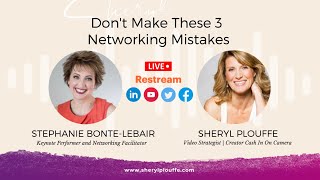
In this episode of the Cash In On Camera podcast, host Sheryl Plouffe interviews networking expert Stephanie Bonty‑Laubert about common pitfalls service‑based business owners make when networking and how to fix them. Stephanie explains that many entrepreneurs treat networking as a direct client‑hunting activity, which leads to awkward, sales‑y interactions. She outlines three core mistakes: (1) approaching networking solely to find clients instead of seeking partnership‑building relationships; (2) lacking a clear, captivating message and a compelling call‑to‑action tailored to the networking context; and (3) failing to schedule dedicated follow‑up time after events, which wastes the connections made. For each mistake she offers practical tactics – targeting partnership prospects, crafting concise 60‑second introductions that highlight transformation and a value‑based CTA (e.g., free audit, specific referral request), and blocking calendar time for post‑event follow‑up. Stephanie also shares additional strategies such as setting clear intent before each event, selecting events with 20‑30+ attendees, leveraging LinkedIn to invite contacts to events, and using one’s personal voice (her background as a singer/performer) to create memorable presence. The conversation concludes with resources (empoweryourvoice.com) and a reminder that mastering networking can dramatically increase ROI while reducing reliance on other marketing channels.
Chapters
But did you know that you could be doing it in the wrong way? Yes, you could be making mistakes. And Stephanie Bonty-Laubert is here with us today to talk about the mistakes that you probably are making with networking and how to fix it. Stephanie, great to have you here all the way from Maryland. Um, excited to chat with you about this topic because I think you and I both probably agree, uh, networking is important.
Yes, well, thanks for having me, Cheryl. I'm really excited to share these tips.
So let's get started with, um, your background and, and really your beliefs around networking. Why is it that we ought to really pay close attention to how we're networking as business owners?
Well, for service-based business owners, I find that networking can be your number one way to grow your business. It's better than a website or opt-ins or social media or any of the other bells and whistles that people think are important, and they are important in some ways, but But when you are talking to people face-to-face or on Zoom networking, that is how you develop relationships that lead to clients. So mastering how to do networking well can help you save time and money on your marketing efforts and allow you to really develop, uh, the kind of business that you want to, that's relationship-driven.
Why do you think so many business owners get caught in the trap of creating the perfect funnel and focusing so much on non-business-generating activities, shall we say?
Well, I think that a lot of business owners got into business because they're passionate about what they do, but they didn't necessarily get the training of how to be a really great entrepreneur, right? There was no manual that we received when we decided we wanted to start the business. And so we are inundated with all this information from all these different sources on this is what you know, strong businesses have in place in order to be successful. And I think that tends to give us that shiny penny syndrome where we think we need this thing and we need that tool and we need this thing that's going to help us make $100,000 in 30 days, or this coach, or, or whatever that is. And it's a little overwhelming and we can get kind of lost. And so that's why I believe networking kind of brings us back to the basics, because honestly, you don't really need all of that to be a successful business owner.
At the end of the day, I think it is coming back to this back-to-basics thing, right? If you really think— and I think about my own journey, it's like, what has worked, right? Let's do more of the things that work and less of the things that don't work. What has worked is building relationships, it's meeting people, it's talking to people. That never goes wrong unless you do it wrong, which is why you're here. So that's right, because no, but there are some mistakes that we can make And I think that you being someone, you have the Empowered Business Network, you run the Empowered Business Networking, which is an international networking group, and your business is The Empowered Voice. You know about networking. This is what you do. So I'd love for us to dive in and kind of break down what the mistakes are that people are making when it comes to networking. So I'm going to tee you up for tip number 1.
Yeah, so tip number 1 is that most people approach networking from the position of, this is going to help me find clients. And networking really isn't about finding clients, as backwards as that may seem. Networking is actually about finding partnerships. So finding people in the room who want to do business with you, not buy your stuff or your services or your products, but they actually want to be your cheerleader in the marketplace on your behalf, helping expose expose you to more people. If that is your primary goal, you're immediately going to have more success in a networking environment. Because some of the biggest complaints that I hear from people with networking is that they feel like they're just being sold to all the time, right? Like they meet somebody in the room and the next thing you know they're having a one-on-one call with them and the— what the person's pulling up a slideshow about their product or service, or they are, you know, telling them about the deal they have this month, you know. And all of that feels icky and salesy. And that's why some people don't enjoy networking, because they feel like they're on the defense all the time trying to figure out who's going to sell to me, who isn't.
Okay, so let's unpack that a little bit, because the truth is that if you're doing networking for business, it's because you want business. So there has to be a happy medium. There has to be a way to leverage the networking so that you can get clients. Is that a process? Is it a time span?
What— It is, yeah.
Because we have to make sales.
Yeah, obviously.
How do we use networking to do that?
Yes, ultimately we want to grow our business through networking. And if you're focusing on building partnerships, you're going to find more clients in a shorter amount of time. So you could go to a networking event and somebody could be in the room who is your client, who is your ideal client avatar, let's say, and you schedule a call with them. And you put them through your sales funnel and they eventually say yes to buying whatever it is you have to offer. That can happen. But when you find a partner in the room who's like, I really like you, I really love your, your service, it's complimentary to mine in fact, why don't we do something together where we cross-promote each other, where maybe we do a webinar together, where maybe we, um, you know, share our email lists with each other to do an event, something like that that can be collaborative. Suddenly you have the potential to bring in dozens or more clients from developing that one relationship. And that's really where the focus for networking is going to bring you a much higher return on investment.
Stephanie, can we break it down in terms of percentages, right? So looking at networking and saying to yourself, is there a percentage it should be that, you know, like you might only get 10% of the people that you network with might actually become clients directly become clients, they themselves, but 80 to 90% are going to be your referral partners, your affiliate partners, and those types of— is— can you break it down into like a percentage that we should be looking at? With—
I don't know if I've actually— yeah, I don't know if I've actually done that for my own business. What I do know is that when I network, I always find 3 to 4 people at any given networking event who are either potential clients of mine or great potential collaborators. And so if I'm attending 2 or 3 networking events a month, that's a dozen people a month that I could potentially be leveraging in some way to grow my business. And if you're not experiencing a similar result to that, then you want to take a look at, you You know, what is it I'm doing when I'm showing up? Yeah, exactly.
Well, those are some great parameters. It might not be broken down into a percentage of, think of it this way, for the number of clients, or— but you did give us some, some parameters by which to, to approach that. So point number 1 is you're not necessarily using networking to find, directly find clients. Focus more on finding partnerships with people through networking. Exactly. What is point number 2?
Point number 2, a big mistake people make is that they don't have a clear message. They show up to that event, they talk about themselves in such a way that either we're confused by what they do, we still aren't clear, or we've been turned off in some way because they position themselves as selling in their introduction, right? So it's not captivating enough, we're not— it's not grabbing our attention, it's not making us want to have that follow-up call because either we're like, yeah, sounds like every financial services advisor I've ever seen at a networking event. Or it's like, yeah, I can see if I get on a call with you, you're just going to sell me your stuff. So you have to have a message that's clear and captivating. And captivating in such a way that if you're focused on partnerships as your ultimate top number one goal and clients as a secondary goal, you're actually going to get a lot of people who inquire with you and say, hey, I think we should have a one-on-one conversation. Let's talk about how we can support each other. Um, and so, you know, that's what I teach is like, how do you create that captivating message? And that usually means that you've got to talk about yourself, like, from a how-do-you-stand-out perspective. And then you really have to share that transformation that you provide for your clients. Like, what is the pain that they have? And then the vision that they have with you when they work with you, because then when you can really clearly describe that transformation, then people want more information. They can raise their hand and be like, that's me, or that's my client too. My client has a similar transformation that they need to have, so maybe we could work together in some way.
And your clear and captivating message might need to change if your focus is less— with, with regard to networking, less on getting clients and more on partnerships. Is it advisable to have different versions of your marketing message, one that you would use in networking and one that you would use in other stages or on other stages?
Absolutely. I have different ways of introducing myself depending on the group I'm in front of. And the one way you can also clearly delineate a different, a different way of addressing people is in your call to action. So part of having that captivating message is, do you have a call to action? Are you inviting people to, to connect with you after the meeting is over? Because if you're not, you're wasting your time at that networking event, right? Because you're not going to get to learn everything about each other with a 60-second introduction, or even in a breakout room if they give you 5 minutes to chat with somebody. You're not going to learn everything you need to know. So are you saying enough, and are you giving a captivating call to action that people want to take advantage of it? They actually want to connect with you. They want to opt in for whatever gift maybe that you're giving. Or that call to action can and be, listen, I'm looking to connect with these kinds of specific people. Do you know people like this? Right. And not necessarily from a client perspective, but it could be a referral perspective, like my best referral partners. Let's say you have a CPA and a CPA might have a great referral partnership with a bookkeeper, for example. So she may be at a networking event. She might say, I'm really looking for a bookkeeper in the Atlanta area. Does anybody know a good one? That can be a great call to action because someone— there's no pressure there. Someone can say, oh yeah, I actually do know a great bookkeeper in Atlanta. Why don't, you know, let me hand you this name. And then you can say, maybe we should have a chat and see how else we can support each other. So whatever that looks like, you find a way to create that captivating presence in your 60 seconds from how you describe yourself, how you describe your ideal transformation that you provide your client, and then what are you asking people to do?
A little bit more I want to ask about the call to action. When it comes to networking, is it better to provide a call to action that leads people to a lead magnet, or is it better to have a call to action that is a book a call? And again, I'm speaking about service-based entrepreneurs, you know, typically people who have higher priced, uh, price points on their products and services.
I find that in the times that we're living in now, whenever someone offers a consult or a discovery call, That is code for sales, sales call. Like, people just, they don't see the value in that. So instead, I, if you are going to offer a call, it has to have mutual benefit. It has to have value. So either you're calling it something where you are actually providing some kind of value, like maybe you're auditing someone's website, right? So you could offer a free website audit. That's valued at $100, and you have 3 spots left in your calendar this month to anybody who types the word "audit" in the chat box of the Zoom networking call. That is a captivating call to action because there's value there, it's limited, it has a dollar value, and it's really simple to opt in. So that's an example of a really great freebie, uh, that leads to a conversation on the phone. Um, but unless you have something that kind of meaty, I avoid it. And I would rather say, do you have like a a free gift like a PDF or, you know, something tangible that they can just, you know, give your name and email address and then they get on your list. So that's, that would be the next level for a freebie. Or, you know, you can just say, hey, I want to network with someone with this skill set. If you're in the room, let's talk because I'd like to see how we can support each other, right? You can be also very, very basic and just say, I would like to have a call. It just depends on your goal. Like, what's your goal when you come into that networking event? I always ask myself, A couple questions I'm— I always ask: how do I want to feel when I'm at this networking event? How do I want other people to feel when they interact with me at the networking event? And then what's my primary goal? Is my primary goal to build my list? Is my primary goal to get 3 prospects on the phone with me? Is my primary goal to find a referral partner who has this, you know, specific type of service so we can have a discovery call to see how we could support each other? Like, What's your goal? Because that should inform that call to action.
It's all about intent. It's understanding what is the intent here, what is my goal for participating in this networking event. And what you've been sharing with us are strategies that would allow you to make the most of that networking opportunity. Exactly. I'd love to ask you what your third tip is. What's the third mistake that people are making?
The third mistake people make is they don't book time in their calendar for follow-up. So they'll find time in their calendar for networking events. And I know people that'll go to networking events 3, 4 times a week, but then they don't have any time in their calendar to do the follow-up that's necessary to leverage all the connections that they made that week. So I have a rule. When I look at a networking event, I ask myself, is my ideal client or my ideal referral partner likely to be in the room? That's number one. Number 2, what's the size of the event? Because I tend to look for events that are going to have at least 20 to 30 people. I'm not really interested in going to networking events that maybe have 5 or 6. I need a little bit more diversity in there. So I'm like, are they established networking? Do they have like a decent number of people that are coming? And then the 3rd piece, you know, is, is really around, you know, can I— well, I also have one that's like, do I have the mic? You know, because I like to go to networking and be the featured speaker. That's how I really leverage myself. But then, do I have time? Do I have time either after the event or within 24 hours? So the next day, am I blocking like an hour just for follow-up on that event? And if I do have the time, then it's a yes. If I don't have the time, even if the event is perfect for me, even if it's the exact people I want to connect with, but I have no time because I'm so busy, I, I pause. I'm like, maybe next month. Maybe next month I'll go.
So, you know, one of the things I love about having a podcast and bringing smart people like you on is because I learned something in the process too. This is a real learning opportunity for me, and this is the area— as soon as you said that, it hit a nerve with me.
I went, that's me.
I don't do a very good job at that, but I will improve that. I don't do a good enough job of looking at those networking opportunities and then carving up the time and making sure that I have carved out the time to do the follow-up. I'm, I'm a definitely more, oh, here are the people I want to connect with, and I just try to jam it into the existing busy schedule that I have. I should do a better job of that. So thank you for prompting me on that one. And, and yeah, our listeners and viewers, I think this is, uh, a really key thing. So just to recap, don't use networking to find clients necessarily directly. Use it to find partnerships. Number 2, Have a clear message, a clear and captivating message. You might even want to tailor that message for your networking opportunities and carve out time for follow-up. Make sure that you've done that.
Exactly. If you do those 3 things, your networking return on investment is going to go through the roof. In fact, you're going to be constantly booking follow-up time because you're going to have so many calls that you want to book and so many people that you want to follow up with and connect on their social media. It's going to start to create momentum, and, and then you don't need to do a lot of the other marketing things that people think you need to do.
This is a full circle moment because this is what we're really talking about here, are these are income-generating activities. Exactly. And we see, at least maybe I'm speaking for you, but I think we both see a lot of people who are not They're caught up in the weeds. They're in the weeds of all the things they think they ought to be doing that they think are income-generating activities. And they might be in an indirect way. What we're talking about here are direct income-generating activities. The fact is, if you're a service provider, you know, you have high-ticket programs and things that you need to sell, you need to be talking to people.
Yes, using your voice, people. Right. And that's where my background as a professional singer and stage performer is. I found clients when I used my voice. That's how I did my marketing, is I would stand on a stage in a show and I would sing and act, and then people would come up to me after the show was over and they say, do you teach voice lessons? And I said, as a matter of fact, I did. I do, because my original business was as a singing teacher. The more I use my voice, the more clients I had in my studio. So it's the same thing for business owners. If you go to networking, you're using your voice. And the more you use your voice and use your voice well and effectively with intention, the more people are going to raise their hand and say, ooh, let's talk about your services. I want to learn more about you. And that is so much more important. Like, hire people to do your social media or your website or whatever you need, those little tools that help, you know, establish you as a real business in the marketplace. But take your time, your personal time, to use your voice. 100%.
I love it. Something that we advocate around here as well, and in, in terms of what I do with Profitable Podcasting, is the same thing. You know, it's getting out. You should have your own platform and you should get on other people's platforms. Exactly. You need to be speaking. You need to be using your voice and, uh, using your empowered voice to use your branding.
So that's right.
All right, so Stephanie, I would love to ask you One more thing, which is what is a tip, tool, tactic, or technique that's helping you to market, uh, empower your voice, or, or you personally, that's really working for you today?
Well, besides networking, which is the number one thing that works for me building my business, I would say I'm really leveraging LinkedIn really, really well, especially since the pandemic hit. LinkedIn has been a huge source of, uh, virtual networking or electronic networking, and I am leveraging it by inviting people to networking. So a great— and anyone can do this. I don't care if you— I mean, I run a networking organization, but that doesn't mean you can't do this too. I'm sure everyone has a networking group that they visit, and when you invite someone to get to know them and you say, I have a ticket to an upcoming networking event, or I have this great organization that's full of people that you should know, would you like to be my guest and come with me? That is a fantastic way to connect with people on LinkedIn in a non-threatening, non-salesy, value-add, win-win for everyone. And then you can explore the possibilities going forward. And I love that. Um, it has actually brought me a lot of clients, to be quite frank. I've had over a dozen clients come into my business in 2022 because of that strategy with LinkedIn.
It's the non-salesy approach. I think we're going to see more and hear more about this in the years to come as we progress and move from Web 2 into Web 3. I think it's going to be predicated on community and database and networking and the people you know and who you have access to, and less about all of the, the vanity metrics of social media and trying to like scramble to get a million people on Instagram and all that. I don't think it's really going to matter as much anymore going forward. It's going to be about who do you know, who do you have access to, and approach that you just shared about LinkedIn is right in line with that.
Yeah.
Where can people learn about you?
So my website is empoweryourvoice.com, and you can see all of the different facets of my business, including my networking group. It's on the menu. But I, um, love to help people with their communication and, and feeling good in front of others and being able to use their voice powerfully, whether it's podcasting or video or standing on a stage in front of people or creating Zoom environments where you can use your voice. So, uh, I love to support in several different ways.
Stephanie, so great to have you here on Cash In On Camera to share your insights on the, the mistakes that we are making with networking, and you've given us some really great solutions today. So thank you so much for being here. Really, we really appreciate it.
Thanks so much for having me, Cheryl. It's been a pleasure.
More from Sheryl



From 'agreeable' to 'ruthless mentor' to 'strategic sparring partner' #substack #shorts







