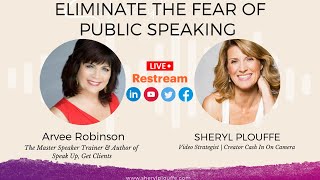
In this live interview, host Sheryl Plouffe and guest Arvie Robinson discuss why people fear public speaking and how to overcome it. Arvie explains that fear stems from the unknown and the body's fight‑or‑flight response, sharing a personal story of a disastrous first speaking engagement that taught her the need for training. The conversation introduces practical, actionable steps: visualizing success, focusing on the importance of the speaker’s message, and reframing fear as energy (the FEAR acronym is redefined as Fatal Expectations Altering Reality). Arvie also recommends starting with a strong attention‑grabber to channel adrenaline. The dialogue promotes the upcoming virtual Million Dollar Speaker Summit (Sept 23‑25) as a three‑day training to become a high‑earning speaker. Finally, both hosts emphasize modern marketing through video—consistent, message‑driven speaking on platforms like TikTok—as a powerful way to reach audiences. Throughout, they encourage listeners to take imperfect action, acknowledge fear, and use it to improve their speaking and business impact.
Chapters
Public speaking is the key to helping you get in front of more people. So, here's a question I would love for you to pose or to post the answer in the chat wherever you're watching this from, whether it's YouTube, LinkedIn, Facebook, Twitter. I want to know, what would you rather do? Jump off of a mountain versus public speaking. So, you know I'm speaking to all of you who are afraid of public speaking. And I've brought on the perfect guest today. Arvie Robinson is the Master Speaker Trainer. She's an international she's a speaker herself and she is the author of Speak Up, Get Clients. And we're going to talk today about eliminating the fear of public speaking. So those of you who are afraid to get up in front of other people, take note. And Arvie, great to have you on the show. Why are people so afraid of public speaking?
Hi Cheryl, so good to be here with you. They are afraid because it's the unknown. That's what most people are really afraid of. They think they're afraid of public speaking, but it's something that they haven't done. Perhaps they have not been trained for it. They have not prepared for it. And so, yeah, it's very scary that if you step on stage without training or preparation. So it's really the unknown. But that feeling that people get, that anxiety is really just, and adrenaline, because it's that fight or flight. It's a natural reaction to something that, again, we're unfamiliar with, that we're a little fearful of. I mean, even if you bungee jumped, the first time you're probably gonna be more fearful. The second, third, fourth, fifth time, once you learn how to do it and you have that experience, the fear will dissipate. So it's really just the unknown.
Arvie, tell me when was the first time you ever spoke in front of an audience and how did you feel?
Okay, that was in corporate America, probably 30 years ago. And back then I thought just because I could flap my jaw that I could get out and speak. I stepped on stage, there's over 200 people in there, mostly men, because I was speaking about accounting software. And I was really doing a pitch for the brand that I liked, even though I was working for a CPA firm at the time. It was a CPA firm named Deloitte, one of the international CPA firms. And so I stepped on stage with my packet of notes, right? Handwritten back then because we didn't have individual computers. I don't even think I got a typewriter back then. So handwritten notes and I stepped on stage. I started pitching, started, of course, I didn't know anything about grabbing your audience's attention or personal story or any of that. So it was all technical. And then I came to a point where I lost my place. And it was like deer in the headlights. Look, I was frantically looking through all my papers and I couldn't find my place. So I just said, "Thank you." And I waddled off the stage in total embarrassment and humiliation. And from that day on, I learned an important lesson that I needed to get trained.
I remember some of the first times that I got on stage, I was still a teenager at the time, and I remember feeling this hot feeling, like flushed feeling, as if the blood was all just surging up into my cheeks, and there was this burning sensation. And the thought of having everyone's eyes on me did not sit well with me at that time, at a time when I really felt very shy about speaking in front of others, let alone the fact that I didn't really know what I was maybe even talking about at that point. But same with you, you know, 30-some-odd years ago is really when this journey began. So, I think that between us, we bring a lot of experience of public speaking to this arena and to this conversation. So, if you are watching this live right now on any of our channels, please take this opportunity to ask questions. Leave them in the comments. Arvie and I will go back and make sure that we answer any and all questions. We can also bring specific questions up on on the screen to answer them for you through this conversation. So, eliminating the fear of public speaking. I know there's a lot to it, Arby, and there are multiple steps. I know you write about that. You speak about that. But if we can kind of drill down on maybe 1 to 3 key things that people can do, maybe even more immediately. Like what is something that someone could do right now to take action? I know we're both big proponents of taking imperfect action. Let's get out there and do it. Is there something that we can do today to eliminate that fear of public Absolutely.
So there are techniques. So, you know, maybe you're a trained speaker and you're still a little bit nervous. And I do want to just talk about the acronym FEAR for a second because a lot of people have learned that FEAR, you know, stands for False Evidence Appearing Real. But in my book, Speak Up, Get Clients, I take it a step further and say it's FATAL, right? It's Fatal Expectations Altering reality. Fatal expectations altering reality. So you step on stage just expecting something bad to happen, and guess what? It will. So the first step is don't expect anything bad, but instead visualize your success on stage. Visualize everyone clapping and cheering and having a good time. So that's step number one, and that's what you want to do when you prepare— visualize your success. Number two, remember that your message matters. That you're there to deliver your message to this audience, and they are waiting for that message. They're counting on you. They want you to succeed. They don't want you to be nervous and fail. They already expect you to succeed. And again, remember, that message is so important. You're the only one that can deliver it, and it will heal somebody in your audience that is troubled or that's having difficulty. That's how important it is. When we focus on that and just go, wow, I've got— why Lives I've got to change today, then whatever we're feeling really doesn't matter. See, it has to be— that cause has to be greater, that outcome has to be greater than that fear. Let me give you a quick example, Cheryl. So one, one time years ago, about 20 years ago, my husband took me snorkeling in Hawaii, and I'd never been snorkeling. I didn't know anything about it, and I had to wear this tube, and I guess A fear that I didn't know I had was the fear of not being able to breathe right underwater. So I had the snorkeling gear on and I was scared. I even broke out in hives. And now I'm an— I was an adult, but I've never done it before. It was the unknown. Then I went underwater and all of a sudden I saw this most beautiful fish that I've never seen before. Yellow and blue, they were incredible. And I had to make a decision at that moment that the beauty that I was seeing was more important than the fear I was feeling. And once I made that decision, Cheryl, boom, I was able to snorkel and I've been snorkeling ever since. So that's another way that you eliminate the fear.
You know, and I can't help but to think that with your first tip about really visualizing it, I can't help but to think of athletes who also use similar methods in order to visualize their success and to get on the podium or to reach that time or that personal best. You know, we as entrepreneurs, as business owners, maybe would benefit from thinking of ourselves as athletes of our own business. And that visualizing that end could be a great way of achieving it. And then, your second point is absolutely true. You know, you have to really dig deep as, you know, into your why. Why are you doing this? And if that vision and mission and passion is bigger than your fear, then you're going to be okay with facing the fear. One thing that I've always said too is that, you know, let's not try to eliminate the fear of necessarily, you know, because it's going to be there, I think. But it's more like adapting to the fact that the fear is probably very real. You know, so hey, like, you know, to step into that and go, I am fearful. You know what? I am nervous. I am this way and say, okay, I'm gonna go out there and I'm gonna do it anyway.
I'm gonna use it. You can use that fear as juice because remember, really adrenaline. So one of the things you can do to use it is start with an attention grabber, something really powerful that you start with and you put it out to the audience, right? And let that adrenaline propel you, propel those words. Then now it's out to the audience and it comes back. To you as energy.
Yeah, I love that, Arvee. You know, these are great tips, obviously, to help people eliminate the fear of public speaking. And you have an event, the Million Dollar Speaker Summit. Can you tell us a little bit about that?
Absolutely. So it's a 3-day public speaking training event where you learn how to become a million-dollar speaker, how to create millions, and how to reach millions with your message. Because that's really what we want to do as speakers, is to reach more people and make an impact and make a difference. Public speaking has been around for a very, very long time. Yes, it is. And it is because it's one of the most profitable, uh, industries on the planet. But not just for profit, it's one of the most life-changing as well. And if you're like me, you want to change lives for a living, then the best way to do it is learn how to do it, get the fear under control. And you could do that by coming to the Million Dollar Speaker Summit, which is right around the corner. It is Virtual this year. It's my last year doing virtual. I did it virtual last year and this year. Next year we will be live. So this is your opportunity to get this training virtually without leaving your home. And it's on September 23rd, 24th, 25th. And we are gonna talk more about how to eliminate fear. And I'm gonna give you more tips on that as well.
I can say personally for me, public speaking is really what transformed the path of my entire life. Personally and professionally. So, public speaking is really key. And I would say that video is a form of public speaking. Absolutely. Public speaking to an inanimate object, as it were. So, Arvie, thank you so much for being on the show. Before we go though, we have a fun little segment. You know I'm a big Prince fan. So, I have a segment called Stop Marketing Like It's 1999. So, what is a modern marketing tool, tip, tactic, or technique that you're using in your business to grow your, your enterprise?
Well, it's exactly what you teach, Cheryl, and that's video. That's speaking on video. And it doesn't mean just doing a video. It means doing a video properly. So having a message, having a beginning, middle, and end, having that, you know, attention grabber, that story. So it's really practicing your video, becoming good with it, and Getting it out there as many places as you can. And even video on your phone, video messaging, uh, you know, it's just so powerful. Everyone will watch it. It— I think the open rate for videos when you send a message to somebody on a phone, I don't know what it is, that's your expertise, but isn't it like 90, 99%? I know texts are. So it's like, be creative, get out there and speak every single place you can. Speak on video, speak on your phone, speak on TikTok. Yes, TikTok will work too if it's consistent. Speaking as a marketing strategy works, whatever medium you're comfortable with, if you're consistent. That means do it every day, do it every week, do it consistently. You can't dabble in public speaking and expect it to be a great marketing strategy. It's only a great marketing strategy because you're committed and do it consistently.
I'm a big fan of commitment. I'm also a big fan of consistency and messaging, as we both are, Arvie. So thank you so much for being on Catching on Camera today. Really appreciate the time that you've taken out of your busy schedule to share those tips with us. And just for the record, I have had personal videos that I've sent to people with open rates as high as 93%. So yes, it definitely does work. Thank you so much, Arvie, for being on the show today. Appreciate it.