Emotional Strategies To Stand Out
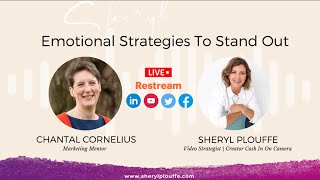
In this episode of Cashing on Camera, host Sheryl Plouffe interviews UK‑based marketing strategist Chantal Cornelius about how coaches, consultants and experts can differentiate themselves through emotional marketing. Chantal explains that the most successful practitioners focus first on strategic foundations – clarifying their current position, ideal client values, and the unique outcomes they deliver – before selecting tactics. She introduces a practical 4:1 "you"‑to‑"I" writing ratio that forces copy to centre on the client’s experience, and stresses that genuine emotional connections arise from listening to how clients want to feel. By asking clients directly about their desired emotional experience, Chantal discovered that her audience values safety, simplicity and personal care over flashy, motivational language, prompting her to reshape her messaging. She advocates "dialing down" flashy promotion in favor of authentic, high‑quality content, and highlights the power of personal phone or video calls to rebuild relationships with past clients. Chantal also mentions upcoming resources – a forthcoming book, a five‑strategy emotional framework, and an online test that analyses client language to suggest the best emotional strategy. Throughout, she offers concrete, down‑to‑earth advice for marketers seeking to stand out by prioritising empathy, clarity and strategic planning over noisy tactics.
Chapters
As a coach, consultant, or expert to grow your business, then you're in the right place. Welcome to Cashing on Camera. I'm your host Cheryl Plouffe, and today we have Chantal Cornelius here all the way from the UK. Chantal, so great to have you here to talk about emotional strategies to stand out. And I think that the practicality of that is very much evident in the work that you've been doing since the year 2000. So, I'd love for you to tell us a little bit more about the work that you do to set up this episode today.
Okay, great. Well, firstly, thank you so much for having me on, on your show today, Cheryl. It's great, great to be here. I set my business up in 2000. I started out as a, as a copywriter. I was writing words for, for other businesses because I wanted to help them to stand out more. And I still do a bit of that, but I now do a lot more mentoring with clients. So very practical, very down to earth, giving my clients advice on what is the best marketing for them to do rather than worrying too much about latest fads and fashions and jargon. It's looking at what makes them stand out and how best to actually explain it. The area that I'm working on as well, that I'm sort of moving into, that I've been researching for the last 6 or 7 years is around the emotional strategies. So it's all about building emotional connections with our clients and how that helps us to stand out even more.
So you've been, you've been at this for a long time. Have you seen an evolution of coaches and consultants with regard to the emotional connection that they're making with their clients and prospects? Is it more? Is it less? Is it not enough? Where does it stand?
The, the good ones make more of a connection and make more of that connection. The the— I don't want to say the bad coaches, but the coaches who struggle will use traditional marketing, or they'll use an awful lot of social media, and they're just churning out more and more information saying, I'm a coach, I do this, I do that. There's nothing— coaching particularly is a really competitive industry. There are hundreds of thousands of coaches around the world, and if you're going to find the clients you want to work with, you've got to be really clear on what makes you stand out. And therefore how to make that emotional connection with your clients. So yeah, the, the ones who are finding it easier are making much stronger emotional connections with their clients and through their marketing.
You hit on something interesting where you talked about promotion, and so we see that a lot in the coaching space where people are promoting themselves, and rightly so. I mean, you have to find a way to put yourself out there. You do have to be visible. You have to promote what it is that you do. But I think to your point, there might be a fine line as to how much, or maybe things are out of proportion with how much promotional pieces of content that people are doing or promotional strategies or tactics. Maybe we can even dive into the difference between strategies and tactics. Like, where is the balance? How can we find the right balance between I gotta promote myself, but I don't want to do it at the risk of not being able to build that emotional connection?
Yeah, the way, the way I suggest all of my clients that they do is that they focus first on the strategic elements. So that's around where are you now in your business and what makes you stand out? Where do you want to get to? What are the strategies that you're going to use? Are you going to go after new clients or existing clients? Are you going to sell your existing services? Are you going to look for new ones? And then also getting really clear on who your ideal clients are in terms of their beliefs and values. Once you've got those strategic elements, it actually becomes much easier to work out what tactics to use. Where I see coaches struggle is where they go tactical. They think, oh, I must put material out on social media, I must launch a podcast, I must go networking. They're not clear on the strategy or on their message. So what they're then churning out sounds exactly the same as everyone else, and they start every sentence with I. Many years ago, I learned a really useful ratio of 4 to 1. So every time you write— let me get this the right way around— every time you write the word 'I,' 'me,' 'our,' you need to write 'you' 4 times. So in any marketing material that you're producing, when you're writing on your website, and anything that is written, 4 to 1. And it's actually quite difficult to do. But it's a really good exercise. So, you know, write, write something. Go look at your LinkedIn profile, count up the number of times it says I, me, us, our, and then try to switch it round. What that does is it puts the emphasis on your clients. So rather than saying I do this, you're saying you as my client, you are struggling with, you are looking for. And this leads really nicely into the emotional connections because what I've discovered over the last few years is it's, it's not what it's It's not about us. It's not about how we feel. It's about how our clients feel and how they want to feel when they work with us.
I love that exercise, and I think that we can all benefit from doing that, whether we look at our LinkedIn profile or any of our social profiles. I'm thinking of my YouTube channel. There's an About section there. That's a great exercise to do, and I would encourage everyone watching and listening to go ahead and take a look at that and, and use that ratio to better be able to structure your content in such a way that is about the other people. And I feel like you've touched on something so important, which is the foundational, the foundation of your message. And I talk to people all the time who struggle with this and have been struggling with it in some cases for years. And it's easy for us to sit here and say, oh, we're going to figure it out. But that process can take a long time for some people because they feel conflicted about all the choices and all the different directions that they could go in. I know that your specialty, and with regard to the marketing that you do, is about practicality, and you just gave us a really good example of that with that exercise. What is a practical way that we can move through that painful decision-making process in order to get us to the point where we can really start making those emotional connections with, with the people that we want to talk to?
Yeah, the, the best, the absolute best way of doing this is to go to your clients and ask them, how do you feel when you work with me? And listen, really listen to what they say. So I'll give you an example. Quite a few years ago, I, I used to have a, a team of staff here. I had a bunch of great people working with me. They were all a lot younger. They were all really into, into social media and blogs and YouTube and videos. And I used to think that people came to work with us because they were excited about marketing, because they wanted to grow their businesses and they wanted inspiration and motivation to get going and do more with their businesses. Things started going a bit wrong with the business, and one of the things that I really focused on was speaking to my clients and saying, what do you actually want from us? What— how do you want to feel when you work with us? And it really surprised me because they said, we want a safe pair of hands, we, we want to feel looked after. We want people who are not going to confuse us with jargon, but who are going to explain to us in really simple terms what we need to do. And that completely switched around the marketing that I did for my business. So instead of going, yeah, motivation and growth, it was like, we'll look after you. It's not exciting and sexy at all, but it's what I've used to promote my business ever since, and it, and it works. So it comes from saying to your clients, 'How do you want to feel when you work with me?' And asking a simple question and you having the aptitude and foresight to listen.
I mean, this is the thing. You can ask lots of questions. But if you're not willing to listen and truly comprehend and listen to what people are saying and then act on that. So, you changed your marketing message and had maybe some better results as a result of that. There are other components to that, ask questions, but then be willing to listen and act upon that.
Yeah, definitely. And you, you might, you might not like what you hear, because for me, when, when at first I didn't like what I was hearing, I was thinking, oh, but marketing is fun and exciting, and all of my clients are going, no, it isn't, and you're never going to excite us. So yeah, you, you may not like what you hear, but you do have to listen out. The, the other aspect is, is listening to— I'm, I'm working on writing my third book about all of this emotional strategies. And I've been looking a lot into the language that people use depending on how they want to feel. So the 5 strategies that I've come up with, they all have different words, feelings, emotions that go with them. And I can, I can share that with, with people in due course. But it's about listening out for particular words that will make you think, okay, that's that's how they want to feel. Those are groups of words that go together that will help you to work out what the best strategy is for your business that makes you stand out and be different.
And so the standing out part and the emotional strategies that we're talking about here might not be the ones that you have set yourself in stone to follow. Like, what I think sometimes happens is we get— we stick our feet in and we say, you know what, I'm going down this path and no one's gonna beat me and I'm gonna do it no matter what. And we are very rigid around that. And we're not willing to listen to other opinions or do things differently because we've been told, be resilient, be persistent. But at some point, if it isn't working for you, then you need something different. You need to switch it up. And I think that that's exactly what I heard you just say as well.
Yeah, absolutely. And, and in some sense, I switched it down because all of the marketing we were doing was shouting about how fabulous marketing was. I still think marketing's fabulous, obviously, but my clients didn't want to hear that. They— and, and they still don't. And, and even when I'm out speaking and being paid to speak, I still have clients who say, we want you to turn up and deliver what you say you're going to deliver in a nice, careful, measured way without confusing us with jargon. So I've had to almost dial down the marketing that I do, but it's made it so much easier and it makes me stand out from, you know, I have clients who come to me who say, oh, I was really confused by the last marketing consultant I worked with. They were trying to persuade me to do XYZ and I didn't understand it. And I just go, yeah, don't do that, do this.
Chantal, I wonder what your opinion is about the, the lay of the land in terms of where marketing is at today as we transition here from Web 2, Web 3. We're going into this place, I believe, where we're seeing almost a rebellion against the photoshopped Lamborghini bro marketing type of environment that we've been living in in the last 10 years and going to something much more real and authentic and And so when it comes to standing out, what might be, or what I suspect could be happening, is that if you dial things down, you'll stand out because everybody else is still— a lot of them are still doing all the bling, right?
Yeah, absolutely.
Yeah.
And it's about, it's about the quality, the quality of what you're putting out rather than the quantity. Coaches and consultants and speakers who I see struggling think that the more they churn out, the more they'll get, the more business they'll get. It just doesn't work because you end up bombarding people and annoying them with all the messages you put out. Whereas if you— one of my favorite marketing tactics is, I, I did this recently, I was at a networking event and we were all asked to stand up for a minute and say what we do and what sort of help we're looking for. And I said, I'm not looking for any help, I don't need any new clients at the moment, I'm too busy, I want to take a break over the summer. They all laughed, and then some of them came up to me afterwards and said, could you help me with my marketing, please?
Because they want to be in the position where they could actually go to a meeting and say those things.
Exactly. And I'm very fussy about who I'll work with, and I've set up some meetings as a result. But yeah, it's about, it's about kind of calming down and being really clear on what you stand for and who you want to work with. And like I said, I'm very fussy. I will turn business away If somebody wants something done tomorrow, it's like, no, that's, that's not how I do it.
So yeah, I like, I like the idea of dialing it down, right? And, and maybe going in a very different direction than what you've been taught to do, or what you've been emulating and imitating from other people that you've been following. Is dialing it down, I think, is such a brilliant approach. And I think a lot of coaches, consultants, and experts would benefit from this concept that you're sharing with us today.
I think I might have to write a newsletter about it.
I like that. Yes, please do. And please let us know in the Cash In On Camera community. We'd love to read it. I will. I would love to know what is a, speaking of tactics, a tactic, a tip, a tool, a technique that's really working for you today. It may be the one you've just shared, or if you can think of another that you can share with us that's really helping you to market yourself and your company.
I, I have, I have one of these. It's a telephone. And you know what I use this for? Making phone calls.
It's brilliant, Chantal.
It is brilliant. It's, it's a— I love, I love my smartphone, and I do spend a lot of time mucking around on social media and chatting to friends on it. But it is such a powerful tool to just pick up the phone and have a conversation with somebody. It's, it's not about— I was speaking at an event recently and I said to the audience, right, here's what I want you to do. Write down— and for anyone who's listened to this now, the recording— write down the names of 3 clients to whom you have not spoken in a while. They may have gone off your radar, you may not have worked with them for a while. Write down 3 names. And then put time in the diary to actually pick up the phone and speak to them. You are not allowed to hide behind emails. You are not allowed to send them a message on social media. You're not allowed to just comment on a post of theirs on LinkedIn. It's get on the phone, do it that way, because that's about that. You can't get the emotional connection unless you're on the phone to somebody or face to face. And this is not a sales call. This is a call where you say, 'Hi, how are you?' It's as simple as that. If they don't have time to talk, that's fine, you book a time when they can. But it's really lovely when somebody phones and just goes, 'How are you? We haven't spoken for a while. Fancy a catch-up?' And that's when, again, you need to listen. Because one of my clients did this brilliantly a little while ago. He's a, he's a coach, and he phoned one of his clients and just said, 'How's it going?' Because he knew things were a bit rough for this client. And an hour later, the client eventually kind of breathed a sigh of relief and went, 'Oh, thank you so much for listening to me,' and then said to him, 'I think I probably need to book you for some serious coaching sessions, don't I?' Result.
That's brilliant because there— it's not a sales call, it's not a pitch, it's not all the marketing stuff that people are told that they need to do. What it really is, and this is a perfect wrap-up for this conversation is that's an emotional connection. Exactly. That's it. Care about other people.
Care about them. Care about them and listen to what they're saying. It's not about asking lots and lots of questions. It's certainly not about having the next question ready. It's just listen to what they're saying. And even if you just get, hmm, oh, okay, or tell me more about that, and they will really feel listened to and heard. That's when you build that connection with them. That's when they stay with you as clients and recommend you to other people. Pick up the phone.
Pick up the phone. And I love— I have to admit, I don't use the phone as much as I use Zoom to connect because I find that I don't have most people's phone numbers, but I have, you know, email, or I'll set up calls in advance. But to your point, I should do more of an effort of actually phoning. But I love those calls because not only is it, hey, let's connect, and understanding and caring about what other, what other things are going on in other people's lives, but I always come away from those calls feeling and learning something from the process for my own self. Yeah, I learned something in the process.
Yeah, and you, you can't do that if you're having an email conversation with somebody. And, and you're absolutely right, using, using tools like Zoom are great because you know, I'm in the UK, you're in Canada, to do this over a phone call wouldn't really work. But so I will send people emails or messages saying, let's have a Zoom conversation.
That's what I like to do.
Get it offline effectively as quickly as you can. So if you, if you're not in the same country and you can't call them, book a, book up some sort of face-to-face like, like we're doing now.
Definitely.
Yeah, I love that.
Chantal, how do people get in touch with you? I'll show your website on the screen for those watching the video, and if you are on audio and listening to this then you can go to chantalcornelius.com.
That's the one, C-H-A-N-T-A-L-C-O-R-N-E-L-I-U-S dot com. If you go there, it's got my UK phone number on it, but also there is a big button on the right-hand side of that screen that says, 'What's your standout strategy? Take the test.' I'm developing an online test which basically looks at all the— we talked earlier about the language, about the words that that people use. It's not fully functional yet, but if you click that, it will send me an email and I can then send you a slightly more manual version. And it's, it's a fun tool to go through because it's about asking your clients, how do you want to feel? Listen to the language, and it gives you lists of words to listen out for that will then help you to work out which is, which is one of the 5 strategies that you can, you can use. And I'm on LinkedIn as well. If you, if you search for Chantal Cornelius in the UK, I think I'm the only one, so I think I'm fairly easy to find. So connect with me that way.
That's great. Thank you so much, Chantal. We really appreciate your insights today on emotional strategies to stand out. I think this is brilliant, and I really think that people who are watching this on any of my social channels, including YouTube, or listening, will benefit from the ideas and concepts that you've shared today. So we thank you so much for being here. You're welcome. Thanks for having me.
Thank you.
And if you are interested in knowing more about this show or have suggestions for future guests who could come on the show and share marketing expertise, we'd love to connect with you. You can find me on, on any of the social platforms @SherylPlouffe. You can go to SherylPlouffe.com as well. And if you are on YouTube, certainly leave a comment below the video. We'd love to be able to connect with you. I do have a signature card on all of my social platforms so you can find out where I'm speaking next. Some of the projects, paid and free resources and events that are coming up in my world. So we would love to be able to see you there. Thank you so much for watching and listening today to Cash In On Camera, and we'll see you in the next episode.
More from Sheryl



From 'agreeable' to 'ruthless mentor' to 'strategic sparring partner' #substack #shorts







