Finding And Keeping Good People
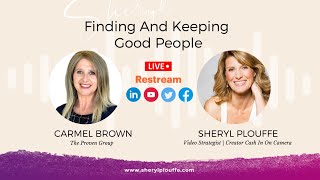
Carmel Thomas from The Proven Group explains how small businesses can recruit and keep good people after the great resignation. Post job openings on Mondays or Tuesdays, use video ads, and hunt for talent on LinkedIn instead of waiting for applications. Culture, clear roles, and fair pay matter most for keeping people around.
Chapters
business, it's important to find the right people. Yes, we all know that, but it can also be challenging. It can be challenging to find people who understand your voice, who understand your business, and that are really going to be able to not be a burden to you but to be an actual support to your business. So Carmel Brown is here today on Cashing On Camera from The Proven Group. She is an HR specialist, has a lot of experience in this space, And today, we're going to talk specifically about how you can find and more importantly, keep really good people on your team, whatever definition of team that is for you. Carmel, so great to have you here on Cash In On Camera. I think this is a struggle that a lot of coaches and consultants and entrepreneurs face when they want to grow. They know they can't do it alone. They're going to need a team. But finding people that really can support them is challenging. What has been your experience in terms of seeing entrepreneurs trying to grow their teams and the challenges that they face? What comes to the forefront for you?
Yeah, sure. Well, good afternoon or good morning from where I'm from in Australia. Thank you very much for having me again, Sheryl, on the show. It's great to be here. Probably in this space, one thing we hear all of the time, and that is, "Staff drive me crazy." And so much so, I hear it that I actually decided to write a book about this. And it's the first chapter of the book, which we'll talk about a little bit later. So I'm not sure if you've heard of the old saying that business would be easy if it wasn't for the customers. And many, many owners feel that managing staff would be easy if it wasn't for the staff. So managing and motivating the team that you already have, it needs to start start there and even how to even just retain your staff. But we can come back, um, to that. But as far as recruiting and retaining your staff at the moment, finding good people is the hardest at the moment for all business owners. And we've actually had to— we call it turn it on its head. So even the way that we recruit now is pre-COVID, we did not recruit the way that we do. So I'm happy to share a few tips of what we're doing at the moment and what's actually working for us I would love to have a very— yeah, having a very high success rate because it's never been a candidate's market, and at the moment it is, and it doesn't seem to be really changing at the moment, um, to revert back to the employer market.
So increase— Carmel, is the reason that it's not the same as it was before because of COVID because of the great resignation?
Yeah. Definitely. And it's also that increasingly people or candidates, people, employees, they're looking for work that fits with their lifestyle. It's always been about the employer. And I think with COVID as well, it's proved that not only that we can work from home, but I think a lot of people's lives and the way they looked at life changed. It's like, oh my gosh, is this pandemic going to end? Is life going to end? So now it's about me and actually what I want and what's important to me. So finding good people, you need to take a proactive approach. So if employers out there are writing job ads and putting them on Seek or Indeed— I think is your number one online job board over there— if you're— if that's all you're doing, you're wasting your time and money because there's too much noise, there's too many jobs. You fall behind, you fall in the background. And the thing is as well, when you advertise jobs on an online job board, the only people that visit them are people people that are looking for work. 35% of people that we're actually hiring at the moment for other employers has been as a result of a proactive talent search. You can call it headhunting, you can call it poaching, you can call it proactive talent search, you can call it what you like. However, it's all about approaching, um, other— through LinkedIn has been, um, a really great success. That's another platform, um, that I'll share with you. But it's about casually, warmly just tapping them on the shoulder. Hi, how you going? Are you happy in what you're doing? Are you looking for anything else? And then apart from that, feel quite complimented.
And what I find interesting about that strategy is that it— you're— what you're suggesting is to find great people who can join your team. You're not even really necessarily suggesting that we go to people who are actively looking for jobs, meaning that they're people who are not currently employed. You're saying go for people who are employed, they're just not employed with you yet.
That's exactly right, yes. So you might still write your job ad, we still write the job ad and put it on Seek for those that are looking. However, we just don't leave it at that. So it's all about as well, enticing other candidates or employees from other companies. They might be very, very happy where they are, and that's fantastic. But a lot don't know what they don't know. Some get quite comfortable and too scared to move because they're thinking, oh, what if, you know, the pandemic comes back? But when the security is offered to them, plus also too in the job ad, or we actually do a 60-90-second video, sell the job. Employing a candidate is all about selling. A job. Tell them what's so great about working there. Is there a free gym with free parking, fish and chip Friday, or something like that? What is in it for them? Not all about that the business has been around for 100 years and all about them. They're not interested in that. What can you do for them? So important.
So Carmel, that's really about culture though. That is about not necessarily— to use a marketing analogy, it's not about the features as much as it is about the benefits.
Yep, that is exactly right, and it is all about culture. So, so important. As I always say to my clients, you may have a happy team, but it doesn't mean you've got a good culture. And when you don't have a good culture, that's where you'll see your staff are not engaged. They're not productive. They just turn up. They're not motivated. They just do what they do and then go home. It's the ones that stand out when you know you've got a good culture, the ones that are really motivated, that push put in, that, you know, the blood, sweat, and tears type of. But that's, you know, can go into another conversation of, you know, the values in a vision and values in an organization. If organizations do not have a good vision and values that's been put together by yourself and the whole team, you just don't sit there and say, oh, let's just make up some words like customer service and teamwork and accountability and innovation and just pop them on the team room wall and let's hope that, you know, the team actually read them. If you If you don't do it together, it's got no value. It's got to even resonate with personal values of the team. That's how you get their buy-in.
You have to embody those values. And then you also need to be living by those values. It's not just words that you put up on a mission statement on a placard in the cafeteria, right? It is something that you live by. And it is about values and doing what you say you do. And what's interesting about that is that that's the pre-work that you need to do before you start applying some of these strategies that you're talking about, where you're finding candidates maybe from LinkedIn who are not actively seeking other employment opportunities right now, be it, you know, whatever you want to call that, poaching or, you know, um, yeah, proactive talent search. I like that, I like that a lot. But you have to also make sure as the business owner that you've done the work to identify what your culture is and how you can communicate that and express that so that you can then communicate to those people and entice them to want to learn more or have a meeting or come to an interview. And so from the finding process of finding good people, you mentioned LinkedIn. Are there any other places where we can find good people?
Yeah, sure. Um, there is. So for example, uh, we use Seek. Um, that's— we still use Indeed and Jora. They're the other two, um, job online job boards. But Seek's one of the, um, top ones here in Australia. And the— they actually have a talent search built in to Seek as well. So you can actually, um, look through there. Anything that is public on the web anything. So you can actually even Google and find people, because if their information's on the internet, that means it's public. So that is another way to actually find, um, candidates as well. It's all about SEOs, it's all about typing in keywords. So if anybody has got a profile anywhere, whatever that looks like, on any platform, if they've got the keywords there, they will be found by typing in keywords. Might find someone on Facebook, you just don't know.
And you have to know what kind of person it is that you're looking— what position you're looking to seek to fill so that you know how to type that into a search bar. I was reading recently, there was an article that came up on my phone about a millennial-aged person who was applying for a job and was put off by the fact that someone actually reached out to her to invite her to an interview. And an in-person interview. And so this millennial, right, gets on a bus and a train and whatever and begrudgingly goes to this in-person interview, which is 45 minutes away, to a— what she would probably describe as a cattle call interview where the employer was interviewing, and from our generation, rightly so, multiple candidates. Okay, this millennial, actually a really interesting article where she was so put off by this process that was degrading to her that she ended up just up and up leaving. The point is, I want to ask this question of you. Is this an age thing where millennials think about jobs very differently than people who are of my generation, let's say in their 50s? You know, to me, that opportunity that came her way was absolutely what I grew up doing, is going on, you know, in my case television, going on auditions and, and being in situations with maybe 100 other candidates. And nothing about that was unusual. But things have changed a lot.
Yes.
So, you know, so I guess my question is, is it young and old alike who are all looking for something more in their jobs and in their future careers? Or is there any kind of age, uh, thing that we need to take into consideration?
Uh, yeah, so a lot has changed, and for everybody it really is about them and their lifestyle, and that's what's important to them. But to go back to the millennials, um, it is quite— I always have a little bit of a chuckle when you said that because, yeah, they do think totally different to us. We're of similar age, so I totally get what you're saying. We, and we were always brought up with that we live to work. That's our age group. But the millennials, they work to live, and that's the difference. And they're, and for them, and it's even when we're advertising as well, we'll even have, especially in that age group, or if it's a lot more of a junior role, we'll actually ask them how would they like to be contacted, whether it be email, email, text, and even Messenger, like on Facebook. It's about— because for them to turn— for that person to turn up to an interview with all of these people and face to face, like, really? Who does face to face? It should be on a screen, shouldn't it?
Yeah, and that was the point of this article. I thought, okay, that's the world we live in now, where to do something in person seems so non-ordinary.
That's right. And even like, yeah, and millennials as well, as you know, like they even pre-COVID, they communicated on text. They could be sitting in the lounge room together and they'll talk to each other on text. Um, so text and screens is all that, that they, they're comfortable with, let alone then COVID, then all the screens. And now they're like, yeah, this 'How we've always lived. What's with all these people not knowing screens?' sort of thing. So, and they FaceTime and yeah.
So finding good candidates, finding good people, it is about not necessarily just relying on people who are actively job seeking, but looking for people who are currently employed and starting conversations with them to intrigue them and frankly entice them into a beginning conversation, a relationship, So it's not a quick win, but it's something that you invest some time and energy into developing a relationship with someone. And that would be a great way to find people. LinkedIn or some of those job-seeking platforms, depending on what continent you live on, would be some great ways to find good people. And then the second to that is— how are you keeping— oh, sorry, go ahead.
So I was just going to say it's an interesting tip as well that I wanted to share, is that once upon a time you'd always post a job on a Friday thinking, you know, everyone's going to have a look on the weekend for their favorite job or where they want to go to. But we've been trying it— post on a Monday or a Tuesday. Post on the days that where someone doesn't want to go back to work. Fridays, they're like, yeah, it's Friday, it's the weekend, gonna go and do what I want to do. Post on a Monday or Tuesday and see how much that changes the interest.
That is a great tip because that's probably— those are the days that they're likely the least happy because they're starting their work week.
That's right because they're like, 'I don't want to go to work. What else is there? What else can I be doing?' Right.
And so, transitioning to the next part of the equation, which is then the keeping good people. Let's say you find these amazing people.
You have conversations.
You're bringing those people in. What are some things that an employer, a coach, a consultant who's bringing on, let's say, a person to help and support them, how do they keep those good people? I suspect you're going to talk about culture, but I may be wrong.
Definitely the culture. It's first and foremost, definitely the culture. It's all about investing in your team. Always invest in your team, whether that be through, um, like we do a lot of leadership and management training for organizations. So first of all, the managers and leaders even know the difference between their roles, who's supposed to be leading the team, who's supposed to be leading the business. But also upskilling the team. And if you invest in them, they feel valued. So that word value will always come around, whether it's culture or actually how the team actually feels. So if you value your team and you invest in your team, and also too, when you're looking to employ others or looking for higher positions, look internally first. Look at who you have on your team. Can you internally promote them? They've already been a part of your business. They already know what you do. So the biggest key there is to invest. And even like money, for example, that probably comes in sometimes third and fourth on somebody's wish list. It's always about the culture and flexibility first, and then it might be money. But even though it comes in a little bit as not the first priority anymore, you still need to pay your staff when I say what they're worth, but a lot of paying above the award to actually keep them as well.
Yeah, I think, yeah, the pay scale needs to be there. It needs to be accurate and up to date for the world that we live in today. And people obviously want to have a specific kind of lifestyle, but to your point, the culture and how you value those members of your team is paramount. And so do you mean by value, do you mean having regular communication? Is it meetings? Is it bonuses? Is it fish and chip Friday? Those types of things.
That's it. That's right. And communication, that is a really key point. Like all the organizations we've worked with over the years, we have never been told that we get it like from the staff. We get told everything, the communication's great here, because it's not. Everywhere you go, communication is normally the biggest breakdown in any organization. And the reason it's the biggest breakdown is because when you hear a message from the top, by the time it does get down to the bottom, it's, that 80% actually gets lost. So investing in your staff, and what I mean by that is definitely around the leading and managing your teams, training them. If you train them in what they're actually doing— and also too, the difference as well, what we always see is that you have an employee and you have an employer. What also needs to be understood is that they both look at the business very differently to each other. Employees look at the business totally different to how the employer does. It doesn't mean that either is wrong, It's just fundamentally different. So, and then employers sometimes will think, oh, we're all adults, doesn't everybody just know what to do or know just how to get along? No, we're people and we're complex beings and we need training. We need to be invested in. And yeah, bonuses can help too, but it's all about being involved. And being involved is being communicated with as well.
Yeah, I think communication is, is one of the key things. I've also often heard that a business owner is so invested in their business, but you can never expect an employee to be as invested as you. It's your business. And that's— I think when I heard that, I thought, yeah, that's actually right. We can't expect our team members to be as invested as us as the business owner because this is our business. But communication can really help as well as some of the other things that you've mentioned.
So, and also on that's really important as well, just one last point on that. Like, at The Proven Group, we actually describe it as getting the right people on the bus, making sure they're all on the right seats, and keeping them on board. And what that means in simple terms is role clarity. Make sure somebody is clear about their role. Don't just give them a position description, say, "Read that, off you go." Actually see if they understand what is involved in their role and is the environment around them set up properly. So if, for example, somebody's got a desk job, and how— where is their computer sitting at? How is the lighting? Is the programs that they're using— have they even been trained to use those programs? So it's all about role clarity, and the physical environment will also affect how somebody works.
Because that makes someone feel supported in their role, and that makes, that makes sense. I love that. I would love for you to share, Carmel, where we can learn more about your book, and I'll show it on the screen as you tell us about it.
Yes, absolutely. Thank you. So you can find a copy of my book that I've written recently. It's at, um, www.carmenthomas.com.au.
Theprovinggroup.com/book.
The reason I wrote this book was to actually give back. This book is— jump online, grab a copy of the book, it's free, it's a complimentary copy. I wrote it to give back to the business community in wherever you are in the whole world, purely because when we all started our business, none of us started our business because we wanted to manage teams, we wanted to deal with conflict, we wanted to learn all this legislation and be client. We started our business because we wanted to give back— uh, sorry, because we wanted to give to our clients and customers a product or a service that we wanted to sell. So by reading this book, it's the top 10 challenges that every business owner faces, and you're not on your own. And I think that's what's really, really important, just to know that you're not on your own.
I love that. Well, thank you for writing that book and to make it so accessible to so many business owners, because that will be super helpful. And one of the things that we do on the show is we have a segment called Stop Marketing Like It's $19.99. So I would love to know, Carmel, for The Proven Group or for yourself even personally, what is something that you're doing marketing-wise that's really working for you today?
Well, as a result of writing the book and having that vision, I suppose, of why I wanted to write it, it actually— it worked. We've been overwhelmed with a response., from readers saying, wow, I actually thought I was on my own. Um, so with the marketing of the book, and you're also available, you're also able to have a free consultation with me, um, just for half an hour. Just jump on a call with me, book it in so we can step through what HR challenges or issues are you facing or grappling with at the moment. Let's just have a chat about it, because quite often just having a chat going through the process and having a question answered, then you can move on with what you do best and outsource the rest and have a chat to someone like myself.
That's fantastic. Well, this has been really helpful, and thank you so much for coming on the show. We really appreciate your appearance on Cash In On Camera today to help better understand how we can find and retain and keep good people on our teams. No matter what size of team that is. It can be small or it can be large, but these are fundamental strategies that I think will really help our audience. So thank you so much for coming on the show today, all the way from Australia.
All the way from Australia. And thank you so very much for having me, Cheryl. It was great to be here.
Cheers.
More from Sheryl



From 'agreeable' to 'ruthless mentor' to 'strategic sparring partner' #substack #shorts







