Finding Balance: How to Delegate Effectively as an Entrepreneur
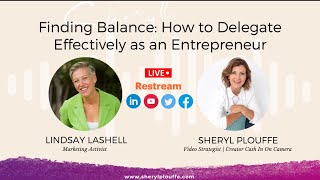
Lindsay Lachelle, a marketing activist, tells entrepreneurs to focus only on work only they can do and delegate the rest, even if it's 80-90% as good. She emphasizes clear communication through playbooks and Loom videos, and warns that delegation is harder for women and people of color due to power dynamics.
Chapters
is off of your plate. There comes a time in the development of your business when you will want and need to delegate tasks to others. Lindsay Lachelle is here with us today on Cash In On Camera to talk about how do we delegate effectively as entrepreneurs. And Lindsay, you know, I just want to start by saying that you're the first person we've had on the show who calls themselves a marketing activist.
Yeah.
And I love that. And I know we discussed this in our pre-call. I'd love for you to explain, well, why don't you call yourself a marketing strategist, a consultant? Why activist?
It's— I think marketing is just a tool. It's just, it's like everything else. It's not good. It's not bad. It's not evil. It's not holy. It's just a tool. And I chose the title marketing activist because I am an activist. I am an advocate. I am an ally. I'm an anti-racist. I feel very strongly about these things. And I'm using the tool of marketing to advance those values. So I don't work with every organization that comes my way. I only work with organizations that I can tell are moving the needle in either their purpose or in their leadership and who they empower. So yeah, I mean, that's—
It's like finding the right values and really being discerning of who it is that you're practically partnering up with, Yeah. From a marketing perspective.
Yeah. The truth is that like I have a lot of power with my marketing expertise and I want to make sure that that power is used to advance the organizations that I want to see be successful. So.
Speaking of advancing the, the cause, advancing the business. Yeah. Obviously, marketing is a key function in doing so, as are many other steps. But there comes a time when we really have to understand the power of delegation. I don't know about you, but I feel like women sometimes struggle with this quite a bit because they feel like, I can do it all, I'm Superwoman, I can do all the things. And they do all the things for far too long.
Yeah, that's absolutely—
how do we know? How do we know that it's time to delegate?
Oh, that is such a juicy question. I love it. My answer is it's always time to delegate. There is never a moment where there isn't something that we are doing that is better served by somebody else doing it. And so the, the like overarching philosophy of that is highest and best use. When you think about your capabilities and what you can do as an entrepreneur, Or when you think about your staff or your team or your 7-year-old, when you think about what they are capable of, what is the highest and best use of their skills and what is the highest and best use of your skills? And you should be delegating to make sure that everybody is doing exactly the most compelling, interesting, challenging, useful, effective thing that they can do with their own time.
It starts by understanding the value of your time. That's right. And so is when we say the value of your time, is it best to look at that from a monetary perspective? Like, my time is valued at, like, per hour, or is it deeper than that?
Yeah, I think that can help if you have a little bit of imposter syndrome and you're not quite sure where, where it is your job and where it's not your job. I don't think of it necessarily as monetary value. I think of it more as like capability. Like where, like what is it that only you can do and how can we maximize the amount of time that you are doing your, your particular zone of genius, right? Your particular expertise should be used as much as possible. And if that means that like triaging your email inbox or responding to DMs or something like that is something that you can have someone else do, and get not even 100% of the benefit out of it. I look at when I'm outsourcing stuff, if it can get done to like 80, 85, 90% of what it would be when I do it myself, that's good enough because it's absolutely worth it to me to free up my expertise instead of spending my time doing things that don't require my expertise.
And that's a really good point because you have a, you know, if you could bring that up to let's say 80 to 90% of how you would do it, it's not 100%. And that's where I think it falls off because I don't know about you, but I mean, I like to have control over certain things. I like control over certain things in my life and business. And if somebody else can't do it 100%, then I'll do it myself. Obviously playing devil's advocate here, but like, yeah, it's, it's, um, I think one of the things that people struggle with and are challenged by, it's like, well, how am I going to find someone to replace me and to do it 100% the way that I do? That doesn't sound to be the goal.
No, you can't. And that expectation is unreasonable. And it's sort of like, I'll, I'll jump in, like one of the core sort of important understandings about the way that I teach delegation is that the, the asker has a certain amount of power and the doer has a certain amount of power, right? And the asker gets to ask for what and gets input on when. And the doer gets to decide how. And we, and as askers, we need to let go of that how. Because if they are clear on the expectation of delivery, what is it that we're actually after, then we should not have to care about the how, right? And so this is the thing of like, when you start to think about how as the expert, as the, you know, whoever, whoever the entrepreneur is that is the, the leader of the organization, how their time can be most valuable. Absolutely. There are things I set up systems for my assistant where it's like, this is the script, this is the model, follow it every time. And then she does and we're done, right? Like we don't have to talk about it. So when it's absolutely fine to to be like super, super specific about stuff like that. But the other side of like letting go of that, and again, very much focusing this message on women and people of color and queer folks who struggle with imposter syndrome more than your average cishet white dude, right? These, this, like, we have this idea, and it's often true, but it's still, I don't think, that important that like we're being nitpicked and examined, and, and like every single detail has to be perfect and flawless. And as somebody who writes for the internet for a living, I'm here to tell you nobody reads. Like, it doesn't matter. We don't have to be that perfect. We get to repeat ourselves. We get to make mistakes. We get to be human on the internet, and it actually helps. It doesn't hurt. And so that 8— that 20% that I'm talking about, that like fleshy bit that happens when somebody with a different brain tries to sound like you on the internet.
It's fine, but there's a difference too. I mean, I think, you know, we certainly support people who want to and should be positioning themselves as authorities of what they do, as subject matter experts at what they do, having thought leadership, meaning that you have ideas and maybe even possibly polarizing ideas to other people in your industry. Like, those are things that are singularly yours. They're your thoughts, your ideas, your insights. No one can have your experience and knowledge and stories. Those are things you cannot hire someone else out to do.
Sure.
Right. And so sometimes I think that there is a gray area, especially when it comes to content. They'll say, okay, well, I'm going to hire a copywriter to write in my voice.
Yes.
And then they expect that person to have formulate all their ideas for them.
Yes.
You can't do that. You have to have your own thought leadership. And then delegate tasks to someone else who can then take that and run with it.
Absolutely. And there's two, I use two really great hacks for handling that situation. So option one is a simple content brief, right? The person who generates the ideas, it's like, it can be as complicated as an outline. It can be as simple as a content brief. I'll give you, this is not supposed to be a marketing conversation, but I'll give you my like five, my content briefs. Answer 5 questions. Who's it for? Which is the audience member, right? Where are they in their journey that they are receiving this information? What do they care about as a result of being who they are in that place, right? What is my offer to them? And what is the call to action? And if you just answer all those questions, then hand it to somebody who has read and consumed a whole bunch of your content, a skilled content, a skilled copywriter can turn that into thought leadership, right? The other thing I do, and I love this, is like, if you are a thought leader who has a good body of work, send your copywriter out into your body of work and have them just go pull ideas and rewrite them and pull, pull quotes and turn them into social media posts. And like, if you've got a body of work to draw from, reuse it. The worst thing that happens is that you present yourself very consistently. Right? I know. It's like, ah, but I already posted that one story that one time 5 years ago. Nobody remembers it. You get to post it at least 10 more times this year.
I have a client this morning, we were having a call and she has recently hired her, I believe this is her first VA, certainly the first VA within the construct of the business that she's building. And so we get on the call today and she was It's amazing. She said, you, you delegate things to this person and they actually like turn it around and it's there the next day. I know, isn't it amazing? Yes. And she was like, wow. It was as if she'd, you know, she was walking into a whole new world. And she is. She's walking into a whole new world. And I was so happy for her. Not everyone feels that they're at that stage where they can do that, where they should do that and hire that person. But to your point earlier, the best time to hire and delegate out is really anytime, like right away.
Yeah.
What are some of the key first things you should delegate and get off your plate?
That's a great question. You know, I always start with the, the, the smallest, most core, most repeatable things. Like, my management style in general is like, I will give someone this much to do and be like, I don't care how you do it. This is your, this is your realm. Get it done. Right? And then as they show success, then it expands and expands and expands. And so I would always start with something that is easy to set explicit expectations for. I would start with something that is easy to turn into a playbook or a script or a method, right? I use Loom videos a lot personally when there's— when it's like something that I do all the time and all of a sudden I'm like, why am I doing this? I will like do a Loom video of me doing it and then send it to my EA and be like, now this is your job. You have to do it 3 times a week or whatever, right? And so, but the thing that I love about that tool and the thing that is, I think, really important in a new EA relationship is really explicit expectations. This is one of the things that we don't learn about delegating as, as managers or as managees, right? Nobody knows what are the— like, if you are asking me to do a new task for the first time, I don't know what I don't know. And so the answer is, so like the way to make it better is first of all, as much context as is needed. What are the contingencies? Where does this request come from? Why is it important? What is the timeline? All of the context helps to inform how and when it gets done. And then you have this really explicit checklist. What is the thing? Size and shape, budget, time limitations. Is it a Google Doc? Is it a Word doc? Like all— as explicit as possible, because that way it— there's no question about you, you as the delegator, right, as the asker, you stop like setting up a system that reinforces your incorrect belief that if you want something done right, you have to do it yourself. That is a lie. The reason why we believe that is because we don't know how to tell people what we want.
That's the key. That's the key. It's a communication— it's a communication issue. It is, right? And so if you shore up your communication skills and you can effectively convey your ideas, your desires, your wants, your— the steps, the tasks that need to be done, that's right, it's a communication issue.
That's right. And so that— but the other piece of that is if the doer doesn't have the power to say no, then their yes doesn't matter, right? They need to— the other thing about it is like, yes, communication, but like proactively and throughout the process because the doer needs to— both, both the asker and the doer need to understand that renegotiation is a part of the process. I started this thing and now I see I didn't understand these 5 steps and it's going to take me way longer. I said I would have it on Tuesday. Now it's going to be Wednesday, right? Or no, I've got to go pick up my kid from work. I can't do it right now. Or I can do it instead of this other task you gave me. Right. The doer has to manage their workload because the, the, the one of the really important things for me is that the doer commits to the delivery timeline. The doer has to be the one to say, You will have it by this time because that helps them. I mean, literally, like from the simplest things, like, I mean, I do this with my stepdaughter, right? When is your room going to be clean? You have between now and when you go to sleep on Sunday night. And I don't care when in that window, but before you go to sleep on Sunday night, you know, the expectation of what it looks like when your room is clean. You tell me when you're going to do it.
You're giving them, you're giving autonomy in the sense of, you know, here's the, here's the frame. Time frame in which it needs to be accomplished. You're giving them autonomy to decide how and when and the details of how they're going to get it done and when within the construct of that time frame. And to your point earlier that it's not about telling them, 'You've got to do it my way or the highway.' It's more about, 'This is what I want the end result to be. You can choose to get it done however you see fit.' I find that challenging with technology because I nerd out with technology. I love certain tools and I'm like, oh, but I would highly recommend that you use this tool. That's something I struggle with. Like, I need to pull back and just be like, I have my own tools that are my favorites and that's fine, but I have to be more willing to be open-minded to— they might have their own tools that they'd like to use, and frankly, they might know tools that are better than even the ones that I know, and be open to that possibility.
Yeah, absolutely. And it, like, I think part of the trick there, this is, this is where, like, you know, leadership is about making choices, right? And so part of, part of the thing that I think makes that work is knowing when you are making a choice that, that, that affects them, right? Like, I literally had this conversation this morning with somebody I'm supervising that it's like, I, we are going to use Trello for the editorial calendar, period. I don't care what else you've worked with. I don't care what else you like. There are reasons why I have made that choice and this is the framework we're going to use. And now it's up to you to go fill in all of the things that we know that we need. What's that?
Is it the, is the better approach then as the asker, is the better approach to be just like, hey, these are the tools we use and, and that's, there's no arguing it. It's like, we're going to use Trello. We're going to use Restream. We're going to use whatever. And you're going to have to adapt to using it.
And you live with it. Yeah, I maybe— I think it really depends on what the output is. It really depends on what the output is. Like, so for me, it's like, if you're writing a thing for me, I don't care what you do, but I want you to deliver it to me in a Google Doc. Okay, that's, that's right. So it's like, what do you use? Whatever tool you want, but when I get it, it has to be a Google Doc. And so that, so like, that sort of can do that. But, you know, there's, as an organization, there's reasons why, you know, we use Slack or we use Trello or whatever these things are. If you're not using them, if you're not engaged with them, then it just gets harder and more complicated. So I think there are moments where you're like, this is how, these are the tools. But within that, and certainly outside of that, you gotta let it go.
Go for it. Yep. So Lindsay, in wrapping up, the conversation around how to delegate effectively as an entrepreneur. What does it really come down to? How can we be most effective in delegation? What is the key thing that we need to keep in mind?
It really is that it's that communication piece. When you start thinking about what you're asking somebody to do when it's a new task, a new, a new thing. You've, you've never asked somebody to do it before, and they've never done it before. It is so hard to really understand everything that is needed, everything that needs to go in there. And so thinking it through incredibly explicitly, envisioning your ex— your output, envisioning your deliverable, and then naming everything about it that you can. Yes, timeline, but also scope and also, right, like all of these, all of these different things. And then you got to think through the contingencies. Do I need passwords in order to execute that? Do I need other materials? Like all of these things, like we just spend a minute going through. I, and I have a checklist pitch, right? I have a, my, my delegation course includes a script and a checklist that makes sure if we get alignment on the what, Right. And we are proactive communicating when something goes sideways. Right. That's basically unlocks the whole, that unlocks the whole system. I have a lot more to say about power and why this is hard for women.
Right. I know that's a whole other conversation.
We need to be honest about like, we aren't, we are, we are taught to yield soft power and passive power, and that is actually a really horrible tool in, in delegation, right? It does not help us at all. In fact, it really hurts relationships. And so being proactive and being, um, being honest with what kind of power is in the relationship and how it's distributed just solves so many problems.
How do people get in touch with you? I know you have a newsletter people can subscribe to it. Tell us a little bit about that.
Yep. So you can go check out my offerings at open-lines.co. As we talked about, like, I'm a marketer. The delegation is just a sort of a side passion that I have because of the types of entrepreneurs that I work with. This is a really relevant topic. But honestly, I would just say just like follow me on LinkedIn, sign up for notifications. Starting next week, I'm going to be publishing like a bunch of short videos with all kinds of tips and insights on delegation. That's like the thing I'm talking about for the rest of the summer. So, um, yeah, just find me on LinkedIn, and you already have if you're here.
So I'm all about LinkedIn. I'm loving that platform right now, so that's great. Speaking of that, I'd love to know what you think is really working in marketing as a marketing activist. Yes. What is a tip, a tool, a tactic, a technique that's really helping you to market Open Lines, to help market yourself personally? What works today?
Yes. Okay. So I'm going to share one of my very favorite. This is, this is, uh, another course I've got if you're interested. Yeah, but this one's, this one's, it's literally like a 25-minute course and there's a bunch, I have a bunch of LinkedIn content about it too. Um, I don't, except for LinkedIn, I don't publish, um, like content to the stream of Facebook, Twitter, Instagram. I instead have, um, I know most, most entrepreneurs, their solution to their like lack of time in this case is to just put the same thing on all the channels. Yeah. Right. And I say the same thing about that as I say about when you have like one newsletter that goes to all of your audiences, it's like, that's great. It's equally irrelevant for everybody.
Cool.
Right. Like not a good idea. The better choice in my opinion. And the thing I teach my clients is. To turn them into landing pages. So think about your Instagram as a place where someone who is on Instagram and is thinking about you wants to go learn more about you. Then how can you set up your Instagram in order to receive them and answer their questions and move them to the next step? Right? So for lots of organizations, that means like literally I updated my Instagram for open lines one time last year, like one time. It's a 3x3 grid. The very top square says, go find me on LinkedIn. Right? So what happens when somebody comes to look for me there? They get a good overview of my work and what I'm about based on the design I've chosen. They can validate whether or not my aesthetic is pleasing to them and they think they might like me and they know where to go to find me for their next step. And it's LinkedIn. And so I— the amount of time that I don't spend on Instagram because it's a rat race and a, and a, right? Like I, the, that it just, I call it the hamster wheel. It's a hamster wheel. And there's so many, the smaller your audience is, the harder the grind is to get any new exposure and any audience growth. And so getting, like, if you don't have ad dollars to spin up that audience, it's real tough going. And Facebook, I mean, it's all the same. So yeah, so my advice is don't spend your time on feeding the beast. Don't spend your time on social media channels that you are not sure are helping you to build your audience. If they're not moving the needle for your business, put them on ice, turn them into landing pages and reallocate that time towards things that are more productive.
Yeah, the turning it into landing pages, it's really intriguing. I like that idea a lot and I'm with you 100%. I'm not against social media. But I just think that in light of the changes that have happened and just the functionality of really what it's built to do is to keep people addicted and just kind of streaming through all the stuff, you know, it is, it is really challenging to make inroads there, especially as a smaller creator or someone who's, you know, growing a business. Uh, there are outliers and there are people who see great success and that's wonderful, but I don't think that's most people's experience. I would, I would rather see people focusing on building genuine relationships and putting their time and energy into high-touch activities at scale and work those things.
So yeah, yeah, absolutely. Yeah. I mean, that's, that's the, if you had a large audience before some recent, right? Like if you already had 10,000 people a year or two ago when the most recent algorithm updates started really suppressing organic reach, you're probably fine. But if you're under $10,000 and you don't have any ad budget, Yeah, tough. I don't feel like it's worth my time to spend to build my audience there, and I advise my clients to do— just be a little bit smarter about where you focus.
Yeah, it's, it's having a good strategy. Yeah. So I— this is great. Thank you so for coming— so much for coming on the show today and really for sharing your expertise and your insights. And, and I too am all about LinkedIn these days. I'm digging that platform. I think it's where business is happening. And so, um, just been really great to get your insights on how to delegate effectively as an entrepreneur. We really appreciate you being here.
Yeah, absolutely. Thanks for having me.
Thank you.
More from Sheryl



From 'agreeable' to 'ruthless mentor' to 'strategic sparring partner' #substack #shorts







