From Chaos to Clarity: Maintain Your Organized Space for Business Success
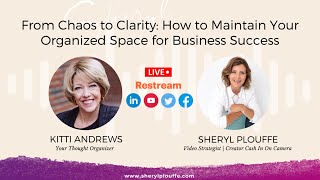
Professional organizer Kitty Andrews tells entrepreneurs how clutter erodes confidence and hurts business. She recommends color-coded binders, desk zones, and storing old journals elsewhere to clear physical space. Her "one-system, one-thing-at-a-time" method tackles mental clutter by focusing on a single category until it's done.
Chapters
If you're a business owner and you are feeling overwhelmed, it might not just be the sales and marketing. It might be something deeper that's going on in your physical space, in your mental space. And that's why we have Kitty Andrews here with us today on Cash In On Camera. Kitty, so glad that you're here to share your insights on how we can go from this place of overwhelm and chaos into a place of clarity which ties into organization and really decluttering. I don't think many of us understand fully the correlation between those things. I'd love for you to start there. Explain to us why it matters for us as business owners to know that clutter has a lot to do with the feelings that you're feeling in your business.
Oh, good heavens. And thank you for having me, Cheryl. I've been waiting for this for a long time. I'm honored. Thank you. When it comes to clutter in your business, the two things that you, that it's important to remember is that clutter, number one, by definition, of course, it's that which no longer serves you. And it's a distraction. It's a visual distraction. Ah, geez, I really should get to that. Yeah, okay, I'll get back to it. All right, back to work. Or, okay, so it's a distraction. Also, the way it's affecting you emotionally is important as well, because if you're feeling that you're not, that you're not accomplishing that clutter, or you're, or frankly, you're so cluttered that you come to a client call or a discovery call and you come on, you're frazzled. I've got your file here somewhere. Where are my pencils? That doesn't exactly exude confidence on your part, and the client feels that. And you may not get, get a new client, or you may not get the repeat business afterwards. So clutter can have very tangible effects on your bottom line.
Yeah, it can. And I think of Speaking of physical, because you just painted a good visualization there of the messy desk. And I don't think there's an entrepreneur out there who's being honest who is going to say that their desk is completely clean. I mean, it's chaotic. There are lots of moving parts.
Mm-hmm.
But what should we do? How should we— does it need to be absolutely clean and tidy, or does it just need to be pushed over to one side? Like, talk to us a little bit more about like how we can declutter that. So that it actually makes it realistic for us to actually work there too? Because, well, the fact is that, you know, there are a lot of things that we're doing in a day and it isn't all going to be neat and tidy all the time. How do we mitigate that?
Well, I can actually relate to that, to that personally, because last week I was doing a challenge and there were quite a few more papers than I would like to have. And one day I just went, said to myself, this is not good. All right. So all I did was I just stacked them neatly, and it wouldn't— weren't that many, but just stacked everything neatly, and I felt immediate calm. I felt immediate control. Like, okay, it's— yes, some things are buried, but it's not that much, and I will be able to find it. The left side of my desk never ever has paper. It's a, it's a rule. Paper does not go there. So all the paper is there. It's a category that you can— it's, it's manageable if it's all in one place. And then you might have your water on the other side or a couple or a couple of other things, but just basically having a place for it and you know that you will get to it even if you don't get to it till the weekend, which sometimes happens, right?
Yeah. Yeah. I like that example of just taking something and just a simple step of just stacking the papers. So the papers are there, But we're stacking them. And that simple process brings you even a little bit of calmness in that chaotic environment. You know, I think about my own office. I have a stack of— I wouldn't say they're papers, they're old journals, journals that I like. I write in these types of journals all the time and I have a lot of them and they're full, but I don't want to get rid of them because there could be important notes that I might want to review at some point. Anyway, I have a whole stack of them. This is embarrassing to admit, but I'm going to tell you and our listeners and viewers, it's been sitting there for like over a year easily. And it doesn't bother anyone. It's just sitting under the tripod in a little stack. It's not an organized stack, but every time I see it, I wonder if it's having some kind of impact on me that I'm not even realizing.
Hmm. Interesting. And I have an answer for that that might surprise you. And what that is, is those are your, your notes from the past, which are a good thing. However, from an energy or feng shui point of view, they are almost like ghosts from the past. And yeah, I told you, uh, so if you were to take— they, they're not hurting you, but are they helping you? Are they moving you forward, or are they keeping you ever so gently anchored in the past. So my first recommendation would be, if there's a place that you can put them and where you know that they're safe, but I would just, I would just try that. And I'd be, I would be curious as all get out to see how the energy around your desk would be, would be flowing without, without these things from the past. Just a thought.
It's a great idea and it's a great suggestion. I will do it and see if it has some type of impact on how I view the present and the future. Because to your point, those journals are indicative of the past. And my business, as do all of our businesses, yours included, like they evolve, they evolve over time and you do different things and you have different offers and you move in different directions. Those journals are not helping me. They could be hindering me by trying to pull me back into the past. And I know that those journals are not full of notes that pertain to where I'm at at the moment.
Yes.
So it's an interesting observation. I love that. Hmm. I want to ask you, which dovetails nicely into the mental clarity, the mental clutter that we all carry with us, and you sort of were alluding to it a moment ago, which is that there's energy around these things. These physical items that are around us carry energy because we're looking at them, like you said earlier, visually looking at these things. Talk to us about the mental clutter that we carry and how we can— is it the same process of decluttering the physical in order to have an impact on the mental?
I believe so. Now, entrepreneurs, we all by nature have busy brains. And I had to develop a system a few months ago because I was having a personal situation as well and business and just everything was all bubbling up. And I could feel that little iPhone battery mental energy going, yeah, after about 15 minutes at the beginning of the day of saying, okay, did I email that person? I better hunt it. Did I write down to phone this person? Yada yada. All of these things started bubbling up, and I get overwhelmed like any good ADHDer. Just too many things happening, and where am I going to start? Just like the declutter, physical decluttering, where do I, where do I begin? You know the song. And then I thought, okay, I'm only going to be able to do number one, my one system, one thing at a time. And I'm gonna break that down into categories. Well, should I do the phone calls or the email? Just choose one. And if you can make it about, does it affect a human being? Like my assistant needs certain things for me. Okay, well, let's look after the human being. Or the partner or the cat, whatever it is. Just pick a category, get that done, get that momentum, get that dopamine under, under your belt. And then you feel, okay, next.
Because you're right. I mean, your system, you call it, I think you call it the one system, right? It's one thing at a time. I think that's why, especially if you're, again, physical or mental clutter is so overwhelming and chaotic. We don't know where to start. But— to your point, just pick a place. There's no right or wrong. It's just starting, and it's just taking that action and getting it started.
Yeah, that's, that's— yeah, just the, the single— the, the journey beginning with the single step. But it happens every day. But you need to take that single step, otherwise you might as well just go back to bed, and, uh, you don't pay the rent that way.
So I want to go back since Entrepreneurs, business owners, we're always taking notes. At least we should be. You should be taking notes on strategy calls and sales calls. Like, we should be taking notes a lot. And I have a lot of— I like to write physically, write things down. But I wonder what your thoughts are on digital note-taking in order to keep ourselves organized. Because digital notes, obviously, you have to keep them. File management would be an important thing to do to keep things organized. But do you subscribe to that idea of doing digital notes instead of physical notes in order to keep the space tidy.
I envy anyone who can type that fast. If I'm doing notes during a meeting, it has to be with pencil and paper. And notice I said pencil. Because, well, number one, the physical act of writing, scientific fact, of course, that it cements it. More in your, more in your brain. Digital, I am, I'm getting better at organizing what is on the computer, but I find it is just as easy to have a piece of, a sheet of loose leaf with the client's information on it that will go in the color-coded binder, and there it is, and it's alphabetized, and it's easy. Now again, I'm old school. I have Great deal of respect for anyone who can do it digitally and, and keep it managed. And it takes time and patience, and God bless you if you have that. Me, pencil and paper is good. And I only have about 6 binders over there, but they're managed and I know where to find every— I know where to find your sheet.
Well, that's the thing, you have a system. And so regardless of whether you're doing digitally, you're doing it manually, that there has to be a management system there. You mentioned color coding. You mentioned alphabetizing, and that is indicative of having a system right from the get-go instead of it being kind of a willy-nilly kind of, oh, I'm just going to grab this blank piece, let me flip it over and just start writing things. I speak from experience, as you can tell. Yeah, but that's, that's the reality of where it is. It's just things are chaotic and then you're just trying to figure out. But if you have a system that is well established, before you get on that strategy call and taking the time to establish that system is what I'm hearing you say works the best.
Yes, exactly. And you're gonna tweak the system as you go a little bit, but if you, it, uh, but if you have something in place that you can rely on that your brain doesn't have to think about and use up mental energy so that you can devote that mental energy to what really matters, like serving the client or serving your family, whatever it is, but use as little mental energy as you can on the, on the mundane.
Exactly. Yes. And those are things that are preventable. I mean, you can establish a protocol or a system to save yourself that mental bandwidth before you get into that chaotic place, which I think is fantastic. I'd love for you to, Kitty, tell us a little bit about how did you get into this line of work? Like, tell us a little bit about the story of how this came to be. Your thing that you teach people to do?
Oh well, my first job, or one of my first jobs out of, out of school, was a file clerk for a bank in Toronto, and Canada Permanent, if anybody remembers that. And, um, I was promoted to the accounting department, and a couple months later, one of the ladies where I was filing, she came and said, would you consider are coming back and working for us part-time in the evenings because we can't find anything anymore.
This stems back, this stems back some time. Like, you've been decluttering space for, for quite a while, and then you applied what you did in terms of that professional experience into how you help entrepreneurs and business owners today. Yes, we, and we need a lot of help. We need a lot of help in this area because it is chaotic. And if you are on the path to success, you want it to be busy, right? You want there to be momentum and you want to be taking calls and doing all the things, but you have to have some sense of organization in that process and be organized in your space physically and mentally as well.
Yes, and if you don't have an assistant, then that's even more important. If you're a solopreneur that's been juggling too many hats, the better system you have in place, then you can, you can keep working until you can afford a team and they'll do it for you.
There you go. So for all the solopreneurs out there, I'd love for you, Katie, to tell us a little bit about your website.
Where do they go to access your, um, your downloadable, uh, decluttered, um, uh, declutterthebrain.com/declutter. And it The PDF guide is 7 Easy Steps to Conquer Your Physical and Mental Clutter. It's intended as a grounding tool for your declutter journey and beyond, because what's the point of doing it if you can't keep it that way? And it goes under the acronym of CONTROL, like control your chaos. I love that.
What is, Katie, something that is a tip, a tool, tactic, or technique that's helping you to market yourself these days, you know, as we are in this new era, this post-COVID era. And I'd love to know what's really working for you and pass that along to our viewership and listenership.
I love that question. And what I've been doing is shortening, shortening my, my, my texts. You know, we get, we all get marketing email that scrolls and scrolls and scrolls, and who has time to be reading all of that? So I've made mine shorter. And sweeter. And my open rate is, it's generally 33%. Just keeping it short because people have a very short attention span, less than that of a goldfish now, so they tell me.
Yes, I agree. That's great. I love that tip. And that is one that I think we can all relate to as we get a lot of emails in our inbox. We do see a lot of text messages, a lot of DMs, but just getting to the point, being brief and succinct and pithy with your, with your text messages and your communication in general. Yes. Awesome. Katie, is there any, any final thoughts? What do you want to leave our audience with today in terms of they're feeling chaotic, they're feeling overwhelmed in their business right now? What are the last words of advice to help them move away from that and into a place of feeling more organized?
Your clutter did not accumulate overnight, no matter what your clutter is. It didn't accumulate overnight. It's not going to go away overnight. So cut yourself some slack and take it, if you need to, one piece of paper at a time.
Kitty, thank you so much. Kitty Andrews, uh, thank you so much. Your Thought Organizer. Thank you for being on the show today. We really appreciate your insights here on Cashin' On Camera.
Thanks,
More from Sheryl



From 'agreeable' to 'ruthless mentor' to 'strategic sparring partner' #substack #shorts







