From Employee To Entrepreneur: What It Takes To Thrive
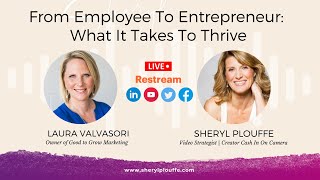
Laura Valvasori spent nine years transitioning from corporate marketer to solo consultant. She emphasizes the mindset shift required, not just logistics, and shares habits like phone-free mornings and a 30-day video challenge to overcome camera anxiety. Her book Good to Grow explores the entrepreneurial mindset people kept asking her about.
Chapters
The journey from employee to entrepreneur can be an exciting one. It can also be a confusing one because there's so much to learn. And Laura Valvasori is here with us today and she's going to tell us about her journey from employee to entrepreneur. I am in the same boat, followed the same path. And it can be confusing because there's just so many things that we have to— it's so different, Laura. Is so different than what we're accustomed to as employees. So let's start there. Let's start with what is your story, what is your journey, and why did you transition to being your own boss?
Absolutely. So my journey started 9 years ago when I left my corporate role to start my own business. I spent most of my career in professional services marketing, so I worked for accounting firms and law firms, and I had 2 children along the way of that journey. And I was spending my time commuting into the city, and I was excelling in my role, which sounded good, but I was finding myself getting further and further away from what it is I love doing and what I felt that I was good at doing. And I was starting to question my path. And at that time, I didn't really have any role models. I didn't have any friends that were entrepreneurs. I I didn't know anything about this world that existed. So for me, I didn't realize that there was another way and I didn't know what was possible. And then I slowly started to open up to the idea of entrepreneurship and I started having conversations with some of the clients that I was marketing to that were CEOs of private companies. And they were telling me that they needed some help with marketing, that they had a person they were doing a few things, but it became clear to me that they didn't have a big picture plan and they weren't investing in somebody full-time to do that, but they needed someone to guide them. So I made the decision to go out on my own. I took a leap of faith and I started my own consulting business. And that was 9 years ago. And, um, my business has grown and changed and shifted, and I've learned a lot along the way. And in the last couple of years, I've started to recognize as we've gone through the pandemic that, um, there are many people that are starting to choose entrepreneurship and the pandemic has made people reflect on their work life and they're starting their own businesses. And what I have learned myself is that there's a lot more to it than just the nuts and bolts of starting a business, of setting up the website and registering your business and all of those things. There's a really big shift that happens internally when you move from being an employee to being an entrepreneur. And you need to be aware of that and set yourself up for success by cultivating the right mindset and establishing the right habits so that you can thrive as an entrepreneur to be able to then build a thriving business.
My journey began around the same time, 2013. I just did the math in my head. I'm like, we have a lot in common. As you were describing your story, I thought, are you telling my story or are you telling your story? Because that is precisely my situation too. Around 9 years ago, same kind of thing. Just saw things shifting in the TV world. And I started to think about at that point, hmm, do I maybe want to start down this path? And you were already in marketing. I was in broadcasting, but I always felt that broadcasting was a natural progression to marketing because It's really the same thing. You're just marketing for someone else when you're working for a TV station, right? And if you're doing it for yourself, but I agree wholeheartedly, the shift in your mind is so big. I know for me, I was commuting as well, 2+ hours a day for 17 years to Oakville, which I think is—
yeah, yeah, that's where I am.
Yeah. And, uh, so I was in Kitchener traveling to Oakville every day and did that for 17 years. Um, that got tiring.
Yes.
But in the process, I got smart around 2013 and I started ditching the cyclical news radio cycle of negativity and replaced it with podcasts, replaced it with audiobooks, replaced it with things that would fill my mind and teach me, as opposed to just something that wasn't really going to improve my life. Let's talk about that. What kinds of things do you recommend that people do in order to change their mindset? Is it all about personal development? Is it about podcasts and books, or what other ways could people shift their mindset?
So it's really becoming self-aware of what is happening and being conscious about the thoughts that you're choosing. And as you say, what you're allowing into your brain. One of the most powerful things you can do is start your day in the right way. It is very common for people to kind of get up and get sucked into the busyness of life. You might be scrolling your phone, you might be having a conversation with someone, consuming news. That goes right into you. It is the first thing that you hear and you're focusing on in the morning, and that sets your energy and your tone for the day. So being very protective of that time and creating a little morning routine for yourself— it doesn't have to be a big, long, complex For me, I get up and I do 5 to 10 minutes of meditation. I do a bit of journaling and I read something positive. I do not touch my phone for the first hour, at least, that I'm awake. And that makes a massive difference in how you set yourself up for the day. So that's just one, one way.
I'm not as disciplined as you. I often grab my— because my, my alarm is on my phone.
That's the trick. You can't have the phone in the room, right?
I'm realizing that now.
Yeah, yeah, it's a problem. But these are the things that are the little things that create your mindset and your habits. So if you decide to get an alarm clock on your bedside table so that your phone can be out of the room on a charger, it sets you up to not touch it first thing in the morning. And then you can— I just sit up in bed, or I sit in a chair and meditate for the 5 minutes. And if the phone is not there, you're more likely to do the things that you have set out the intention to do in the morning.
I heard a saying recently where it talked about look at the sky before your screen.
Oh nice! I love that.
And I love that. I thought, oh yeah, sky before screen. That makes a lot of sense.
Yeah.
So, I know you're a strategist, a marketing strategist, you're a marketing mentor. And you have written a book, Good to Grow, which I'm really proud. And thank you so much for asking me to be an entrepreneurial insight within your book. I think I'm in chapter 20 or so.
You are. Thank you for contributing your wisdom.
Yeah, though I'm excited to be part of it. And what prompted you to want to write this book? Was it because you were seeing a big problem in the industry and in entrepreneurship in general, or What was the impetus for wanting to write that book?
So it started about a year ago, a little more than a year ago. And I had shared a post on LinkedIn saying that it was my 9-year anniversary of being in business. And I was flooded with messages from people who were saying, you know, what an accomplishment that was and how much that was inspiring. And I kind of realized we forget what we've accomplished ourselves when we're living our lives sometimes, and that there's people at the very beginning of that journey. And at the same time, I was starting to have more and more people reach out to me saying that they were thinking of leaving their jobs. They were thinking about going out on their own and could they pick my brain and ask me some questions. So I was having more and more of those conversations. And as I was having them, what I realized was it was less about the nuts and bolts of starting a business and the things to do. And a lot of it is about your mindset. And your habits. And, and in the last couple of years, I've spent a lot of time in personal development, in studying mindset, and it has made a dramatic shift for me in how I experience my life and my business. And so many of the tools that I have now, I wish that I had from day one in my business. And I was just thinking, man, if I knew all of this when I started out A lot of entrepreneurs figure this out several years into their business. If I could help accelerate that learning curve for someone and save them some of the time and tears that I went through, that would be amazing to be able to contribute that. So I've always said that I wanted to write a book. I always said I, I didn't know what it was though. And I started getting sort of some signs around that time around book writing. And I always thought it was a someday thing. And then I realized that with all these conversations happening with so many people choosing entrepreneurship, maybe this is the book I was meant to write. And here it is.
So, well, as of us having this discussion, I think it's on pre-order so people can go to pre-order it. Um, where do they go to do that?
So if you go to www.goodtogrowbook.ca, you'll get to this page and you can pre-order a Kindle copy right now. Or you can order your hard copy on September 20th. And as a special pre-order bonus, I'm— I've created a book club, and we are going to be reading the book together and going through it and having a mastermind type of meeting at the end of the month. And that'll happen over the month of November. So those are the details you're showing right there. If you pre-order, um, the book, you get access to that as a complimentary bonus as my way of saying thank you for helping me support my launch.
Awesome. And that's September 20th, 2022, for those who are watching this in the future. So yeah, fantastic stuff. And obviously once it's published, then you'll be able to get it no matter, you know, where and how.
So that's fantastic. Yeah, you're also able to download a free chapter. You're just on the link right there. You can download one of the chapters and, um, see what it's all about. If it entices you, you can buy the whole book.
I love it. I love it. Well, congratulations on the book. I think that's a big thing. You know, talking about the shift to really become the chief evangelist of your brand, I guess is the term, right? That when you're an entrepreneur and you're working for someone else, you're typically, well, I think not all. I mean, mine was certainly an in front of house type of position. But a lot of people are behind the scenes, right? They're in accounting. They're in a cubicle. They're in an office. That sort of thing. And they don't have— they have departments that are dedicated to all the things that entrepreneurs need to do. So it's like you just do the thing you do, but other departments are taking care of marketing or sales or all these other things. When you become an entrepreneur, especially in the early stages, you are everything. And that's a huge shift. It's a skill set, right? There's skills that you have to develop. What do you think are the main skill sets that that entrepreneurs need to develop in the earliest stages of building their own business coming away from corporate or from being an employee?
So, I think that when you talk about that shift that happens in your role, I think the first step is understanding the responsibility you have now. It's a different level of personal responsibility. And there's a great book that I reference in my book called The E Myth. That talks about a great mistake that most people make is believing that because they're good at something as a skill set, that they're gonna be a good business owner. And that if you don't take on all of the roles of a business owner from being the technician, so the thing you're good at, but also being the visionary and the manager of the business, you're not gonna be successful. So early on, I think number one, recognizing that you need to dedicate time to each of those roles. Or have people supporting you if they're not your strengths is important. I think being visible early on is important. I think a mistake that a lot of new entrepreneurs make is feeling like they're going to annoy people. So they announce their business once, they might do a LinkedIn post and talk about what they're doing, and then they go quiet because they think, well, I told people and I told them once, I told them once, and that network of, you You know, my Facebook network, those are just like my friends. That's not my business people, but everyone is in your network. So it's important to become comfortable with talking about what you're doing. And the more you talk about what you're doing to people in casual conversations, in social media marketing, in all of the different ways, the more likely you're going to be able to make connections. More, more opportunities are going to come. You're going to learn more. You need to be visible and vocal about your business in the early stages.
100%. You know, I see that a lot where people will post or make a one video. I'm a video strategist, so people will say, hey Cheryl, um, you know, what kind of, uh, you know, video do I need to make for my website? And they think that that's their video strategy, right? And then I always have to remind them that one video does not a video strategy make, right?
It's not right video, right?
Continuous. It's a— and that's why I love, you know, the thing that I teach, which is profitable podcasting. Here's an example of it, right? Is because you need to show up consistently, you know, and I have amazing guests like you on my show consistently to be able to get out there and talk about the things that matter to me. And, and so it's really important to have a strategy, and that might vary from person to person, but your point is well taken. You have to be speaking about your business and find an elegant way to do that on a consistent basis.
I love it. If you're talking about strategy, um, specifically, the other thing I wanted to mention on video is you need to take action as well. So you need their strategy, but you can't spend all your time planning which videos you're going to make and trying to make it all perfect. And that's usually a sign of your fear that's holding you back. And a lot of people are uncomfortable with creating video, but the reality is you just need to Start practicing. You're going to suck at your first few, but the more you do it, the more comfortable you get, the more natural it's going to be, and then it's going to start happening. So, so just starting and taking that initiative and not trying to make it perfect and getting stuck in your head about it being perfect and that letting that hold you back, I think that's really important to remind people of as well.
You said that you've been on this journey for about 9 years. At what point did you start doing video or start being more present and visible online? Do you recall?
I would say in the last 18 months, I actually did a video challenge. So for many years, I avoided cameras like the plague, and I wanted nothing to do with video. I was terrified. I thought it was terrible. And, um, some of that was based on past experiences of trying to like script a video and, and do something. And I recognized that I was at the point that I— this is a skill I needed to develop. So I joined a video challenge that was terrifying to me, to post, to post every day on my social platforms a video of some sort. And I remember the first few that I posted, I was writing down everything I was going to say. I was making sure my hair and makeup was perfect. I was, I was so nervous. I looked like a deer in the headlights. And then they got a little bit better. And by the end of 30 days, I was posting and just speaking off the cuff. I had no makeup on. It was— it felt more comfortable. And from there, it's actually become a tool I use in my business often in communicating with clients and doing things like this. Like, 18 months ago, you wouldn't have caught me doing this. And it's because of the openness to learn and willingness to embrace the suck of the learning and practicing and doing it. And then it just becomes more natural, more comfortable. And there's so many skills that you will need to learn as an entrepreneur that are going to feel like that. So if you're someone who is used to being good at things right away, or you get really frustrated when you're learning something, you're not good at it right away, that's an area to work on as an entrepreneur because There are so many of those situations and it's continually coming up and you just need to be open to learning and being in a growth mindset. Like my book is an example. I had no idea how to write a book and I went through the process and I found the resources and I found people to support me. I'm now looking at recording it as an audiobook. I have no idea how to do that, but I'm going to figure it out and I'm going to learn. So Everything is a learning journey when you're a business owner.
Yeah, I love it. Good to Grow: Cultivate Your Mindset and Habits to Thrive as an Entrepreneur. And you can go to get the pre-order on Kindle or buy the paperback copy. Be reminded to buy the paperback copy. So that's fantastic. I just love that. And you're absolutely right. I mean, I think that there are so many different skill sets that we need to learn. But we have to also park our perfectionist tendencies to the side, right? They're going to be— so you're going to fail forward. You're going to be— and not everything is going to work out. You're going to try some things that will fail. Just be ready for that. That's going to happen. But that is part of the process of being an entrepreneur. But here's the positive side. I don't know about you, but I could never go back to being an employee.
I joke that I am unemployable at this point. It is. It's just such a part of my life now, to have the flexibility and the freedom and the autonomy to do what I want and create what I want when I see a need in the market and there's something, some way that I see that I could serve. It just is very natural to me. So yeah, I couldn't go back at this point either.
Yeah, I too am unemployed— unemployable. Um, is that how you said that? Unemployable?
Yeah.
So one of the things we do on the show is, is a segment we call Stop Marketing Like It's $19.99, which I'd love to know, what is a tip, a tool, a tactic, or technique, Laura, that helps you to market yourself or Good to Grow Marketing? Something that's working for you. It doesn't have to be related necessarily to going from employee to entrepreneur, as was our conversation today. But what's working for you right now?
So one of my favorite tools is loom.com. So it's a video messaging platform that you can use to either record yourself on camera like this or to record your screen. I use it all the time in my business. Me too. In a few different ways. So a few ways that it helps, I, if I'm sending a proposal to a client, instead of sending a cover letter or written form, I will record a little video to go along with the proposal and it just creates a personal touch to the proposal. If I'm getting, giving feedback to a vendor on a website design as an example, I'll record my feedback. Um, if I am reaching out to somebody I haven't spoken to in a while as a touch base, I'll do a short video to send to them. I use it in so many different ways, and the reason I think it's so effective is it's efficient, number one. It's a lot more efficient than typing to grab a 2 or 3 minute video, but it creates a personal touch point in a way that people aren't used to receiving anymore because so much is automated and emails and texts. And just seeing your face on video helps build a relationship a lot. And hearing your voice and seeing your mannerisms and all of those things, it helps people connect in a way that we're losing connection in so many ways in the world. So I think that's why it's such a powerful tool.
I use it all the time in many of the same ways you've described. I also use it for team tutorials if I need to teach something or something needs to be done a certain way because you're able to share your screen. So, it's not just— or you have options to share your screen, don't share your screen, show yourself, not. And it's so easy to use. It's fantastic. I love Loom.
Yeah, Loom is definitely a tool that I couldn't do without at this point.
I agree. Laura, thank you so much for coming on Cash In On Camera. We really appreciate your insights on going from employee to entrepreneur and what it takes to thrive. I know your Good to Grow book is obviously going to fill in a lot of those gaps, and we hope that our audience will go out there and preorder it and get the paperback and get notified as you've described. So thank you so much for being on the show today. We appreciate it.
Thank you for having me. This was great.
More from Sheryl



From 'agreeable' to 'ruthless mentor' to 'strategic sparring partner' #substack #shorts







