From Introvert To In-Demand Show Host
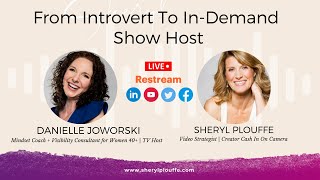
In this episode of Cash In On Camera, host Sheryl Plouffe interviews entrepreneur and TV show host Danielle Joworski about her transformation from a self‑identified introvert to a visible media personality. Danielle recounts early experiences as a shy high‑school “wallflower,” the fear and perfectionism that stalled her first entrepreneurial venture, and the pivotal mindset shift that led her to create and pitch a TV show focused on connecting women’s career challenges with women‑owned solutions. She describes practical strategies she used to overcome camera anxiety—starting with small, low‑stakes videos, reframing visibility as service to others, and managing the energy drain introverts feel when on camera. Danielle also shares how she now leverages partnerships, hires specialists, and builds a supportive environment for guests to feel safe, turning her visibility into a consulting and coaching business. The conversation concludes with actionable marketing advice (don’t go it alone; use relationships and partnerships) and details on how listeners can connect with Danielle via her website and social platforms. Throughout, both hosts emphasize that introverts can achieve visibility by shifting focus from self‑critique to impact, taking incremental steps, and honoring rest.
Chapters
Show of hand if you consider yourself to be an introvert. Show of hands on the screen. I want to see them. Well, I can't see them but you can see mine. Actually, you know what? In some ways, in some aspects of my life, I do feel kind of introverted somewhat. But Danielle Jaworski is someone who would describe herself as having been an introvert. Danielle, great to have you on Cashing On Camera. You are an award-winning business owner. You're an advocate. You're a TV show host. But it wasn't always that way. Really kind of did that whole journey from introvert to what you're doing now, which we're going to talk about during this episode. Do you still consider yourself to be an introvert today?
Absolutely, I do. You do? Absolutely, I do. Yeah. And I consider introvert really how I get that energy back, how I recoup and refresh myself almost in almost that natural kind of living state where I prefer to be by myself, quiet, alone, just with a glass of wine or a cup. A cup of chocolate. That's how I really prefer to present myself and how I recoup and get my energy back.
Yeah. And I think a lot of people who would be, would describe themselves as introvert, there seems to be for some reason some type of negative connotation with that. But I don't see it that way. What do you, what do you think about that idea that there sometimes is a negative connotation to the word introvert?
I definitely, for my life, so I, in high school, I was that high school dance wallflower, always looking in. It always seemed like being kind of more comfortable being alone, being by myself. I was always on the outside looking in, so I was afraid to put myself out there. And at that time, I didn't realize about introvert, extrovert and things like that. I just, I just knew that I liked being around people, but I didn't like being around people for a long period of time. And I was also very, very shy and putting myself out there was really hard because there was this fear of judgment from, again, those high school dances that I didn't look right dancing and I didn't, feel right? Or what if I did a move that wasn't cool? Just there was all those fears of judgment, which I think helped to just keep me on the sidelines and always feel like I was watching from the outside and looking in.
I think the concept of, well, the concept of this show, right, Cash In On Camera, the idea here is how do you grow your business? How do you grow your organization or enterprise by putting yourself out there through marketing that really works for the year that we live in? And that has a lot to do with visibility. But yet introverts often feel like, no, you know what? That whole visibility game is not for me. Did you have that feeling before you started to embark on things in a different way to grow your businesses and to really become now a TV show host?
Yes, absolutely. So I really share that I am actually a second time around entrepreneur. The first time I had my business, I started back in 2015, really no plan clarity around what I wanted to do. I knew kind of roughly what I wanted to do to help, but not, not in really, really clear terms. And I ended up returning after about 2 and a half years to the workforce because two huge barriers and challenges that I faced were, again, the clarity around what I wanted to do, how I wanted to help, and then putting myself out there, being visible. At the time, this is well before Zoom and Restream and all of this streaming technology. And I thought for me, it was It was hard just to get out to a networking event, to put myself out to an event where I really didn't know anybody or I only knew a few people. And then talking to people about who I am and what I did, that in itself and putting yourself out there, that was hard. That was challenging. Video. Oh my goodness. I would spend hours countless time. I'm sure a lot of your audience, a lot of people relate to that. Yes. Hours editing and filming and looking at the, oh, it's not perfect. Or my hair was a or I didn't say that exactly what I want, or I just felt, I didn't feel like I was carrying on an intelligent conversation. And I just felt I didn't have value. And what I had to say really wasn't going to be worthy of what people wanted to hear. I spent hours taping something to never post, or I would finally post something. And then at the same time, secretly hope that nobody would see it. Nobody would comment it. So it was this really kind of this like oxymoron where you, I knew I had to put myself out there, it was so challenging to do that. I had this fear of being, this idea that I had to be perfect. And then when I finally did find the courage and confidence to put myself out there, I was secretly hoping that no one would see it, no one would comment. So it was such a confusing time for me.
I want to fast forward a little bit to today because I want to give hope to people who are watching, who are like, oh, I can totally relate to that, Danielle, because I'm in that same boat. It's like I'm doing it, but I'm kind of secretly hoping it doesn't get seen. And then we fast forward to today, and I want you to share with the audience what it is that you're doing today. You're a TV show host.
Yes. How did that happen? Yes. So it was interesting because when I made that decision to return to the workforce again, because I couldn't get myself out there. It was so challenging. When I turned to the workforce, I saw that there were challenges that women were having in the workforce that I never had anymore. I did before and I didn't then. I started thinking, well, why? And I got to the root where it was because I had spent time in this entrepreneurial world, getting to meet and connect with these entrepreneurial women and actually using their services and connecting with them for support. I didn't, have those challenges anymore that I was seeing other women have. And I thought, how can I connect the challenges that women have with their careers, their business, to the solutions that women entrepreneurs provided? And at the same time, I was working full-time. I didn't want to deal with any tech. And the idea of a TV show had been kind of in the back of my mind for a while, which didn't make any sense because again, my fear of visibility, but it was this belief, in I didn't want other women to suffer. I didn't want other women to really want to do their businesses and want to build it, but not have the platforms when they had the courage to put themselves out there, to not have a platform to be seen, heard, found, and hired. So this belief in my ability to create the impact that I could, I could see and I could feel it. I knew that if I could just believe myself, enough that as long as the belief was greater than the fear, then I could take the step to put myself out there. Because at the end of the day, it wasn't about me. It's not about me and me going in front of the camera now and having this conversation. It's not about me. It's about how can I best help others to move past the obstacles that they're facing right now? How can I connect with people in a different way? And how can I connect people to each other that really need to see each other and to find each other.
And so you— there's a few things that you said there that really struck me. One is that you had this inner knowing and belief, and I think that my opinion on that is that when you are given those gifts of a thought, a creative idea, an instinct, it's really meant for you to be acting upon it. And, and I love that you did that. You were like, okay, I might not know exactly what the steps are, but I feel like I'm being called. And I think a lot of entrepreneurs feel that desire to want to help or contribute to society in some way. So A, I just wanted to congratulate you on following through on that. And then second to that is the idea that you had this idea and then you were like, well, I might not know the path here, but what could I do? And then which led you to, I think, the TV station, right?
Yes. Yes. Yes. And it was this idea. So I had an idea for a show, no idea how to pitch it, create a treatment and a TV pitch. I learned how to do that. I pitched it, I followed up on the pitch, and then it was when I got the phone call, the email from Rogers to say, yep, we're going to move forward with the C-suite. It was again secretly yay and oh no.
The old fears came creeping back. It's like, okay, now I have a TV show. What do I do now?
Yes, what do I do? But at the same point, it was no turning back. Once the pitch was sent in, it was okay, there's no turning back. Once it was accepted, it became, okay, there's no turning back now. So what do I need to do? Because this is happening. So what can I do to get myself feeling comfortable and confident and feeling more natural and just again, get that courage to get behind the camera and just be able to do and create the impact that I really believed I could do.
And just for the audience's awareness, that is actually, you know, I worked at this TV station that Danielle is has done her show and continues to do her new show at. So I'm familiar with Rogers. I think it's a great organization, and I'm proud of you for putting in the pitch, getting it. But then it progressed, and C-Suite was obviously— you won awards, I think, for C-Suite.
No, not yet. I'm gonna put it up there. Yeah, yeah, we will.
No, um, yeah, you, you— but you are an award-winning, uh, business owner, and so you had C-suite, and then that led you to new opportunities, right?
Absolutely. It, and from this, and again, when I started doing the show, it was just to connect the career challenges of women to the women entrepreneurs and their solutions. Through that whole process and journey, I would get a lot of feedback from guests when they came on the show. We would tape the, the episode, we would finish, and so often the responses were, wow, you made that so easy. So it got me thinking, so what am I doing that's helping other women to feel much more comfortable when they're coming on camera and just feel like they were having a conversation? Forget the fact that there is a TV camera or it was a Zoom camera when we went online, just the fact that it was just the other person and I, we were having a conversation that they felt more natural and they could speak more freely. And so I followed that and I got a lot of great feedback from my prior guests as to what I was doing And I realized that I had this natural skill, probably because I had my own previous fears around visibility and getting on camera, that I really use that to make sure that whenever guests come on the show, I'm creating that environment of safety, that support. I am their biggest supporter and their champion and cheerleader because I love what they're doing. And I remember, I know how hard it is to put yourself out there. So I think by creating that environment where people feel that they've got the support, They're not going to be on the tightrope by themselves with nothing to fall onto. I'm here for them. I think that's what I deliver. And that's from there, I figure, what else can I do to help women to feel much more comfortable and confident with who they are, what they have to say, and then put themselves out there in their business so that they can grow. They don't have to fail like I did. And that's where the mindset coaching and the visibility consulting came from.
Yeah, I love that. And I can relate to the idea of being fearful of the camera, even though some people may say, oh, well, 'Well, Sheryl, you're not afraid of the camera now.' No, I'm not now. But I do remember, well, first of all, even as a child, I mean, I was painfully shy as a child. I would cry if the teacher called on me in class. So there were certainly some issues there. And even through my teen years, I think I compensated for my awkwardness by trying to be a class clown and try to be a goofball and other things. So I certainly And I didn't have any experience with television or hosting my own show. I started hosting when I was 18 years old, is when I got my first show. I didn't know what I was doing the first time they put me in front of a camera. I, I just try, you know, I just tried. And lo and behold, 25 years later, you know, I've had a national television career. So I think it goes to show that, you know, you face the fear And then it can lead you to new places. It can lead you to new opportunities and new ways of looking at the world. But it really stems from this idea of facing the fears. What advice do you have to someone who's an introvert who's watching this right now and saying, but I'm there, I'm at that place where I have so much fear, I can't take that first step? What is— how do they overcome that?
Yeah. So for me, I go back to what really worked for me, which was understanding and putting it It's that belief in not just what I can do, it's what I'm going to solve, like the impact that's going to happen. So it's no longer about me. It's about what if I don't do this? What's going to happen? Women are going to continue suffering through challenges by themselves, through their career, their business. Women entrepreneurs are not going to be able to get themselves out there, position and promote themselves as the expert they are, and then get hired, which means they actually get to keep running their business, which is what they love to do. So it became not around me and this fear of, oh my gosh, what's going to happen if someone puts a mean post out there about me or says something not so nice and I'm not going to make everyone happy. It became, but what about it? What if I flip it around? What about, again, the other person, the other side, the one I want to impact? So I shifted that around and looked at also it became, what if this really does work out? What if I actually do enjoy it? And really looking at, again, not so much the negative against myself and for myself, but the positive aspects of it, the what if. And now it's not just, oh my gosh, I have to get on camera. It's, oh my gosh, I get to get on camera. This is what I get to do. It's no longer what I have to do. As a business owner, I have to put, yeah, I have to put out video. Because I'm told I should be doing that. It becomes, oh my gosh, look at what I get to do. I get to connect to my audience and share a little bit about myself in a really unique way. That's all me. Now the flaws, whatever, everything kind of comes out. So it's all those, just those little shifts about kind of shifting your mindset around what it means to get on camera, to put yourself out there, and then finding out a way of putting yourself out there on camera in a way that works for you, whether it be a 30-second— you can start with a 30-second, like, a story, or is it a 1-minute video, or is it something longer? Whatever works for you. Like, everyone is different. That's why there's— it's beautiful that there's so many different options and mediums that we can use now for putting yourself out there, especially on camera. It's finding what works for you. What are you most comfortable with? What are you aligned with?
And then starting small, and we have the ability now to start small. You don't have to go out there and again do like Danielle did and pitch a show and have a, you know, your own show and go whole hog right from the beginning, right? Like, you know, but you can post an Instagram story. It could be a 15-second Instagram story, and that could be the small step that you take to start putting yourself out there without it feeling like this gargantuan endeavor. And I like what you said too about the idea of shifting focus away from yourself into what kind of impact you can make.
Right?
If you take the pressure off of yourself and make it more about other people and kind of a service-minded approach to it, I think can really be beneficial. And then, this idea of opportunity cost is a huge concept as well. Because what is it costing you and the people you could impact if you don't face this fear and get out there? Yes, you can't make impact that way. And so I think ultimately, especially people who are, you know, maybe around middle age type of thing, when we start really thinking about the next phase of our life, I think a lot of people start looking at it and saying, What kind of impact and what, what can I do? How can I contribute better to society? Well, it's going to require putting yourself out there.
Yes. So yeah, figure out how it works for you. And I find even now, once I put myself out there, it's also celebrating, you know, what works for you to put yourself out there. And then how do you need to recoup from putting yourself out there? It takes a lot of energy. I, right now when I get on here, I feel alive. But there's so much energy behind it. It's almost like a, like a, like a, like a high sometimes. But the flip side of the high is that there's a low and there's the downside of it. So I've had to learn as well, putting myself out there, it takes a lot of energy to do that. And I love to do it, but on the flip side, I also then have to rest and find a way that actually, that I can rest in a way that works for me so that when I look at the camera again, it's not, oh, I have to be on camera again. It goes, no, I'm, I'm recharged, I'm recouped, I'm good to go. I get to be on camera again.
That's a really interesting concept for introverts who, you know, it does— they do expend a lot of energy. And because all of the mental capacity that is going to take, maybe the courage that you need to build up and all of that takes energy.
Yeah.
So what do you do after you finish your teaching, hosting your TV show? You must have a routine to wind down.
Yeah, pretty much. And I learned this the hard way after the first— it's probably just about 3, taping 3, 3 back-to-back episodes together. I would be in there, I'd be high. And then the next day, it almost feel like I was hungover for a couple of days. I was so tired physically. Are you tired? Because there's a lot of overwhelm because you're dealing with technology, you're dealing with how do you connect on camera? There's a lot happening. It's not just you staring at a camera, having a conversation. There's a lot happening. So really, really like honoring everyone, especially for introverts. It's like when you're putting yourself out there, there's a lot happening. That you're dealing with at one time, which can take, which takes energy. So for me, I learned like, one, I have to fuel myself. So I have to drink lots of water, especially days I'm getting on camera or I know I'm going to be on camera for a long time during the day. I'm hydrating. I make sure I eat my meals throughout the day. And then I rest as much as I can. And then afterwards I go out, I do the show, I tape, or if I'm on camera all day, I do it. And then that's it. I turn off my computer for the rest of the day. And it's minimal because I just need to step back and away from the camera. And I'll typically maybe go for a walk or I'll go and read a book or I'll just go and veg and watch TV. I love that. That's a great routine.
That sounds like something I'd like to do every day regardless of whether I'm on camera or not.
It is pretty good. But it's always doing something by myself. It's because you're connecting. I'm not around people and my family knows sometimes I'll close the office door and just, I need to just, feel like me again and connect with me, which is being alone. And that's how I get my energy back, is just by being alone, connecting with myself, and just being present.
Well, you are proof that you can go from introvert to becoming visible to putting yourself out there, even if you don't become an in-demand show, uh, show host, TV show host like Danielle. But maybe you're doing social media, maybe you're putting yourself out there and you're launching your own video podcast or whatever it is, whatever the tactic is for you. But the idea of visibility is very real, even for introverts. And so I love that you shared your story with us today. One of the things that we do on Cash In On Camera is we have a little segment called Stop Marketing Like It's $19.99. So we would love to know what is— and it could be related to what we've talked about or something else. What is a tip, tool, tactic, or technique that's working for you, Danielle, to help you market yourself today?
Absolutely. It's a great question, Sheryl. And really my tip for not marketing like it's 1999 is not having to do it by yourself. This is something again, I thought my failures from the first time around being an entrepreneur is I thought because I'm the sole, solo, I'm the solopreneur, I had to do everything solo, which meant I was everything. I was doing everything all by myself again. So you're spending a whole lot of energy trying to create a reach when it's just you. Something I've done differently this time around as a second time around entrepreneur is I'm leveraging the relationships that I have and asking for help, whether it be hiring a team who are specialists and experts in what it is that they do and they'd love to do it. It's not my favorite thing to do, they do. Or I have relationships, partnerships with people who will promote my events with me and for me, who just, who are aligned with me. So it's realizing for me, not— and for you, my tip is, so yes, you may be built, it's your own business and you're building up for yourself or by yourself, but it doesn't have to be done by yourself. So leveraging relationships, finding partnerships, which allows you to expand your reach, expand your network, and again, be seen, heard, hired, and found by a greater network.
Danielle, this is fantastic. Thank you so much for being on Cash in a Camera, but I'd love for people to be able to connect with you. So how can they reach out to you?
Absolutely. So thank you, Sheryl, for this opportunity to connect with you and share with your audience. So they can connect with me. Easiest place is you can head over to my website, DanielleJoworski.com. That's J-O-W-O-R-S-K-I. So DanielleJoworski.com, or you can find me on social media. LinkedIn is my favorite place to hang out. And after that, it's Instagram and Facebook.
Fantastic. Thank you so much for coming on the show today. We really appreciate your insights. Especially for those who describe themselves as introverts. Now there's hope. They see an example like yours, and I think that will help them to move forward in that space of visibility that's so important today. So thank you so much for sharing.
You're welcome, Sheryl. Thank you for having me.
More from Sheryl



From 'agreeable' to 'ruthless mentor' to 'strategic sparring partner' #substack #shorts







