Funerals Are Changing
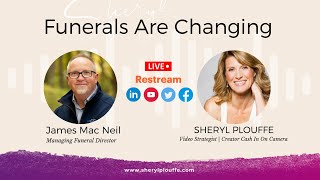
James runs Life Transitions Burial and Cremation Service in Chatham, Ontario, and is modernizing an industry stuck in the past. He ditched the somber funeral home model for a community plaza space, built trust through YouTube videos and social media, and now attracts clients who feel they already know his team before they call.
Chapters
Slow to change is with me today from Life Transitions right here in Chatham, Ontario. Both of our hometowns. You much longer than me.
A little bit longer. Few, few years on you.
Few years.
Yeah.
Okay. The funeral industry has been slow to change and James is here to talk about why that has been the case. Why Life Transitions is taking frankly quite a different approach than a lot of traditional funeral homes are. And you take a much more progressive approach. Why is it important for you to do that?
Well, I guess one, as, you know, as kind of the captain of the ship here, the company kind of matches my personality, which is kind of like that. My years in the traditional funeral industry, I never felt like I really, really 100% fit in with the really buttoned-down funeral directors, right? But wanted to serve like they did. And we're, we're not, we're not opposed or anti-traditional funeral home at all. They're wonderful places, but they're just one option. So, you know, we've talked many times about how the culture seems to be asking for different things. And if an industry, any industry, is slow to deliver that, they're going to find it somewhere else. So we just kind of been bobbing and weaving a bit quicker than the mass of industry.
When James says we've talked about this many times, what he's referring to is the fact that we've been actually working together on his digital strategy for, for a little while about now, many months. And I have been privy to a lot of the knowledge and insight that is inside this body. So, and his team, which are behind the scenes, behind those beautiful barn doors. There is so— it's so intriguing to me how you're taking this approach. Why, you know, when we talk about the, the funeral industry in terms of why it's been slow to change, you know, I think about these big monstrous funeral homes and very elaborate and intricate wood. You know, you have a different aesthetic here. You're not in a gigantic building. These are important questions and observations.
Yeah. Well, and as you guys know, if you're fans of this fine lady, she's a, she's at the top of her game. She's, she's an expert. Stick with her for sure. She's, she's a, she's a excellent heck of an expert in every— in all the categories of these things. But you're right, the— almost like the paradigm, we say, of the traditional funeral home are all those things. It's, you know, it's very somber, a lot of closed doors and doilies and things like that. Again, we're— I got to be careful of a traditional funeral home can seem kind of daunting and imposing and makes a lot of assumptions on what you want to do anyway. So our context alone, we're in a neighborhood plaza here. Where we've since 2016, if people have walked in, said, well, you know, I don't feel weird here. I don't feel like, you know, I should be on my guard or clutching something or whatever because we're just— we're very disarming. You know, our neighbors, Wine Kits, they're great people. People make wine next door. We have a pharmacy and a Chinese food. It's just— we're just the neighborhood. So at the core of everything that we're going to ever do is connected to, sadly, someone's passed away. So we're always stuck with that. But it's the idea that we're not stuck with that paradigm that has been expertly designed and built and maintained for generations, that when someone died, you went to a place like this and you did these things and it cost this much. That's it.
You know, is, is this a direction whose time has come? Oh, yeah. And how far behind do you think the industry is to what the public may have been demanding or asking for without much response.
Yeah, I wish I knew like the number of years, but I think it's literally years behind. And again, the analogy of the massive ship that has to turn, it does turn, but it just turns very slowly and efficiently, but it turns slowly where a smaller vessel like us, we're able to, we're more limber type of thing. I think of 20 years ago when I started as a funeral director, I remember just being the new guy, listening to the manager I was working for, and he was mad about— it was going to cost, I think, $1,700 that year for the Yellow Pages ad. That's how you found the funeral home, which you went to the Yellow Pages. That's called a phone book.
Remember that? Yeah, remember that.
And at the same time, there was a webpage for the funeral home that I worked for, and someone had really pushed to make that happen. I heard other older you know, wiser veterans of the funeral industry saying, who the heck needs a website? You know, why would anyone put an obituary online, whatever online means? And so like, that was 20 years ago, of course. So, and you can't curse people for not realizing that the internet wasn't a fad. It wasn't like the Pet Rock. It was the beginning of forever, I guess, really. So here we are all these years later. If you had, if you had a funeral home without a website, who's going to find you? Right. If you're not posting their obituaries online, people will be upset. You know, it's completely different there. But it took years for funeral homes to catch up on that. So now here we're live, our use of social media is we're speaking directly to you, the people, introducing ourselves to you, answering your questions without you even needing to drive across town and make an appointment and sit down in a room. And so it's, yeah, it's a lot freer.
And on the subject of questions, if you're watching this live because we're broadcasting to YouTube and Facebook and Twitter and LinkedIn all at the same time. If you have questions for James or want to ask, you know, about the industry and have a specific thing that you'd like to bring up, we can see your chat. We can see your questions and we can bring them up on the screen. Cool. If you would like to ask a question, it's a great opportunity to do that. Do you think it takes courage to be that outlier, to be taking that progressive approach? Because after all, This is a business.
That's right.
Yeah.
To be an outlier in the industry.
Yes.
Yes. Well, you know, I used to have funeral friends and, and I don't really anymore. Not, not because I'm a jerk. My wife and kids like me and our staff likes me.
But I like you too.
Yeah. And you like— you like that. That's, that's nice. I was warned when we first started, when I told a few small selected people that we were going to launch out with this new version of the funeral home. Some wise people said, you should probably say goodbye to your funeral friends now because no one is going to talk with you, like within the industry. Not because, you know, just because this is a different approach. Funeral homes know that the families of our nation are asking for different things, but it's hard to change quickly. And that prophecy was true. We received some real opposition initially. Which really freaked me out because I'm like you guys. You got 10 people in the room, 9 of them love you, but that one guy in the corner really hates you. You can't— all you can think about is that guy. So I'm like those people too. So it really bothered me. But then we had other people say, James, if long-established businesses are that threatened by your little company in a plaza, maybe you're on to something. So I kind of turned it around. Okay, we're on to something.
So I suspect that you are on to something because I know that you recently earned an award locally. I think you were unaware that the award was even going on. And then all of a sudden, surprise, you were listed as the first.
Yeah, well, I guess technically we were second, but there was something called platinum, but we were gold. Gold's better, isn't it?
Gold is good.
Gold's way better. Well, yeah, that was nice. We didn't have to sort of solicit people like, would you please click on this thing? People on their own said, well, if I had to choose, I'd pick that place as number one. And that was great. It's kind of a nice little You know, we're really like the Sally Field thing. You like us, you really like us.
That's right. Well, it's validation. Yeah. Of the direction. And you've been doing this since, in this capacity, since 2016.
Yeah, that's right.
And so what are the challenges that you face today in terms of communicating your vision for how it's, you know, funerals are conducted, cremations are conducted to the public out there?
Well, because of that, that Funeral paradigm is so strong that people, one, no one wants to think about death and dying and funerals anyway. So usually people have an experience, they log that away in their funeral file, that's it, it's a completed file. Even if there's some misunderstandings in there, that's their whole file. So a lot of people don't want to talk about death anyway, but then with us being such a different provider, to this day we have people say, oh, 'You only do cremation.' Just a misunderstanding. Our full name is Life Transitions Burial and Cremation Service, right in the name. But people just make the assumption, 'Well, you're not like a regular funeral home, so you must not do all the other stuff.' So that we're constantly trying to gently correct people, uh, with that. So the, the biggest thing is just kind of really, uh, explaining to people that we're like any other funeral home. We're just the most modern version of that. We do all the same things But people, I've been at a gravesite, a physical gravesite with a casket about to be buried and people saying, "So, are you just cremation?" I'm thinking, "You see the dirt, right?" We're right here. Yeah. So, it's a fierce thing for people to break out of that. So understandably, funerals have been done a certain way for a long time. Yeah. A long time.
How do you deal with the emotion that comes with, because you will have people, I presume that this room here could be a visitation room. And use it in that capacity. How do you deal then as a company with the high emotions that people bring to these life events?
Well, it's a lot of death events. Yeah, sure.
Well, it's both really.
It's a lot of practice really. It's, you can go to school and read every book that you can get your hand on. But until you're sitting across from someone whose mother just passed away and you're listening and you're looking in their eyes, it is the only way you can learn is by doing it. So, we've had a lot of practice Listening and active listening goes a long way. I don't need to be an expert when someone's telling about their heartache of just losing somebody. So often, just listening with someone, looking directly in their eyes, listening to the story, really, really hearing it. So when I see them next time, I could say, you know, were you able to get the dog out? Because I know you're really upset about the dog. And just really kind of connecting as a human being with other human beings. As opposed to this is just a business transaction. People see through that. I would see through it myself. So, you know, it's endless practice of dealing with every walk of life, which we do. And some people, you know, grief, you've been through grief where sometimes you're destroyed by it. Sometimes you're angry. Sometimes you're totally, nope, I'm good. You know, and you sort of get a sense of sort of reading people and reading the body language and the words. And sometimes there is no words. But you know, it's a lot of just giving people lots of space to do their thing. Sometimes the angry part, it spills out. Now they're angry at me. And you know, I can't react to that and say, "What? I'm just a funeral guy." So I just know, okay, yeah. And they usually apologize later. Family is a dynamic organism. You can sit down in a room full of family. And sometimes it's this wonderful Walton's kind of thing. And other times it is World War III. And so it's, you know, we, because we serve literally everybody, everyone is our client and every family is different. So practice, practice, practice.
I want to touch on values because family is obviously a huge value that you cherish in your company and you do a lot for the community and you're involved in the community. And you just gave a good example of, you know, seeing someone on the street and then being able to recall the situation that they were in and making note of that. What about the dog? Were you able to sort that out? Sure. How important is it to be cognizant and to do things like that, to recognize people on the street, acknowledge them? How does that impact the work that you do?
Well, I think it's a vital, you know, for lack of a better term, a tool. You know, it's a, it's a, it's a, it's a Yeah, it's a way of— I know I love to see someone that— we all do this. You see someone think, oh, Cheryl's so busy, she sees so many people, she's not going to remember me. And then you go, hey James, how's it going? How's your dog? Or whatever. I'm like, you remember me?
Right.
You heard and we connected. I love that. So I'm normal. I think most people are normal. So I know other people like that too, or little things like I meet someone and I'm remembering our conversation and I say, you know what, your son speaks very highly of you because they've told me how, what an awesome person that they are in the family. And receiving that third-party praise, you love that. I love that. So I think other people do too. So they're not deceptive or what's the word?
Manipulative.
Yeah, manipulative. Yeah, it's, I think like they're just simple human things, like old-world stuff where you, because I've heard you, And thankfully, right now at 52, my memory still works pretty good. God willing, it'll stay with me. But, you know, it's those little interactions where people say he's just a regular person. You know, I wasn't like, hey, file number 397, you haven't paid your bill yet. Like, that's not right.
So, yeah, that aspect of how you conduct business and how you connect with the community might be as traditional as it gets around here.
Sure. Yeah, I guess so.
Yeah, you know, and everything else seems so modern and progressive. Frankly, for me personally, comfortable. Oh, good, good. You know, when— and, and, and just so you know, this is the first time I'm physically in this building.
Yeah.
So when I came in, my immediate thought was it's an upscale home.
Oh, nice.
That was the impression that I got.
Okay, good.
And I think you can probably tell by the decor, but like, that made me feel really comfortable. Oh, good. And not at all like a funeral home.
Like creepy.
Right? Like not creepy.
Yeah, well, that's great. I appreciate knowing that. That's awesome.
So I want to ask you about your vision, like where things are going for your company as you, you know, in the next, say, 5 years, 10 years. Sure, sure. What challenges do you think you're going to face and how does it look?
Well, when we opened in 2016, we're in a plaza here, if you can imagine. And if you Google us, you'd see where we're at. We initially started off with a 1,000-foot-square space in a plaza, and we've now expanded to the second unit, so 2,000 square feet. So that, you know, incorporates our office and other things like that. And so we're— the plan is that we will just continue to expand, and not so much here in the plaza, because then we, you I mean, I'm not going to pay rent forever, but expansion is on our horizon. But so the challenges with that would be the expansion, like of any business, I guess, that we like the idea, the concept of running a debt-free company. And so we move slowly enough that we're not overextending ourselves. And in every category, sometimes our own schedules become so jammed with with folks that we wouldn't want our success to become the beginning of our demise. Right. Where suddenly people are like, yeah, he forgot my name. He didn't ask me about the dog. You know, there's been— this is a video I wanted to make, but I've been kind of chicken. I overbooked myself in the summertime and I dropped a ball. And, and it was, it was horrifying. The family forgave me. It was— I'm making it sound like it was, it was, it was just that it was a scheduling error. And we hold ourselves to this almost impossible level of perfection around here, which is really stressful. Probably my fault to do that to my staff. But we're so busy, I missed something. And the family, they were hurt. And I thought, oh my goodness, I've now been part of the problem. So, I'm really careful with that stuff.
But it shows the human side. It shows the human side of what you do in dealing with—
Sure.
All the complexity of the logistics of what you do.
That's right.
It's a huge endeavor. And like you said, holding yourself to a really high standard to make sure that, you know, but you're only human.
Yeah, that's true. And it's like you said, it's such a personal thing. Like you imagine when you go to a restaurant and you go into the bathroom and it's dirty, you're thinking like, well, this is the bathroom. What's the kitchen like? You know, like you put those things together. It's the same in our industry, sort of like, we're forgetting things or we missed some information or we're late or something. I think, how are you going to take care of my mom? Because you're not getting the basics. So that we're really conscious of that stuff.
So yeah, yeah, yeah. I want to talk about marketing. Cashing on Camera is all about helping businesses to, you know, utilize marketing and online business and social media to be visible and get out there. And you are very much a proponent of doing that. And I think have been for a long time, even before we started working together, you've been creating content for years. So, we have a little segment that we do on the show called Stop Marketing Like It's 1999. And I would love to know from you what is it that you've done that you think has helped you to stop marketing like it's 1999. In other words, ditching the old style, old traditional ways of marketing. What's the modern thing that you've been doing that's been working?
Well, it's funny. I was going to go one way. But now that you're saying that again, because of our use of social media, the very The first thing we ever even launched was a video. We had a great friend with skills help us film the video. And we're just kind of making, explaining our mission statement. And that was the first thing that we released. And people went like, wow, I've never heard anyone sort of like a funeral person talk like this. And so right from the beginning, we've been talking into our iPhones, explaining things, how do you put ashes in and just being like really like documenting how this works in a sensitive way. And that has really resonated with people where I can't count how many times people have come in the door because we have an appointment, we're going to meet with them, and they'll say, you know what, we feel like we know you because we've watched all your videos. And, uh, you know, wow, wow, you know, so we, we take that very, very serious that, uh, we're a little company, we don't have a massive, massive marketing budget. So, uh, to think that we can, if we're brave enough, we can just make our own videos, create our own branding and on and on and on. And it works. People seem to like that. Oh, these are just people. You know, sometimes the phone's not straight or, you know, or he stumbled a bit or whatever. I think the world resonates with that, that you don't always have to be the expert or not the super polished billion-dollar video. And I think we've had a great opportunity to encourage other small businesses to say, People say, who does your marketing? Like, we do. Who does your videos? We do. They're like, we can do it. You can do it. Yes, you can do it. Yeah, you just have to be brave. Take some great advice from a real expert here. How to talk on the camera, how to, you know, all that kind of stuff. And the tools, they're at your fingertips. A lot of them are free.
Yeah, a lot of them are free and a lot of them are inexpensive. And, you know, I'm thinking about the videos that I've helped, you know, work with you on. You know, some of them have been doing really well considering, you know, again, You have a YouTube channel, you have a very engaged Facebook community. Sure.
No doubt.
The YouTube, you've been growing that as well. It's just great to see a company like yours who is really falling in line with the vision of being progressive, not only as a company, but also online. Yeah, for sure. And in your marketing, and it does all tie together.
Yeah, it's great. Yeah, well, we, you know, it's the world is your oyster kind of a thing where, You know, it's there if you want to use it. But you just have to be a little brave to get pushed out of the boat.
You know, if you are in southwestern Ontario, because James and the Life Transitions team services all of southwestern Ontario, including Chatham, and you'll go up towards how far?
Well, because of what we do, there is kind of some limitations. Like, you know, we tell people we go from lake to lake, from Lake Erie to Lake Huron. So it's kind of like from You know, we serve Sarnia, all of Chatham-Kent, Sarnia-Lambton, which is a big area. So people say, will you come to Kitchener? Well, we can, but then there's other providers maybe similar to ours that are in that area and that are great. We got to charge your mileage.
Yeah, so southwestern Ontario is your terrain.
Yeah, the southern tip.
There you go. There you go. And if you want to find out more, you can go to lifetransitions.ca. Go and also check out their YouTube channel.
You should, you really should.
You know what, you've been creating some really high-quality content there. I know we're in the early stages of growing that channel as of the recording of this video, but you should check it out because you have just put down a lot of knowledge and insight and wisdom in those videos that really can help people make better decisions about, um, after-death care. So I really appreciate you being on today.
Awesome, this is great. Thanks for coming down.
Yeah, no thanks. And it's great to meet you in person finally. That's right. All right, thanks so much, James.
You take care, Cheryl.
More from Sheryl



From 'agreeable' to 'ruthless mentor' to 'strategic sparring partner' #substack #shorts







