Get 'Shook' With A Book
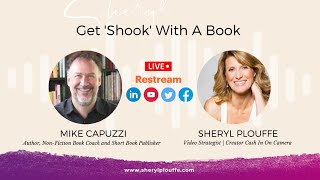
Mike Capuzzi explains SHOOKs, short business books of 12,000-15,000 words designed to be read in 1-2 hours. He's produced about 250 for clients as lead-generation tools and credibility boosters. Three focused books often outperform one 300-page volume, and the print-on-demand model takes 8-12 weeks to produce.
Chapters
I think you will. I think you will. Why? Because Mike Capuzzi is here today and he knows all about what it is to be shook. And we're going to explain what all of that is. We're talking about books today. We're talking about a very special kind of book. And Mike is here to share with us what these books are and really specifically how you can use it to shake up your business. So, Mike, great to have you here on Cash In On Camera. When I talked to you in the pre-interview, you had come up with this term, Shook. So explain to us what that vernacular means in your world.
Yeah. So first of all, thank you, Sheryl, for this opportunity. So a Shook is our brand, right? So if you think, God forbid, think fast food for a moment, you got McDonald's and Burger King. They have the Whopper and the Big Mac, right? Same kind of thing, but their own brand. So we needed a way to distinguish the types of books we help business owners, entrepreneurs, and corporate leaders publish. And we came up with this concept of a SHOOK, which stands for Short Helpful Book. So Short Helpful Book, the acronym is SHOOK. Some people love it, some people don't like it, but it is our brand. What's that?
I love it. And here's why I love it, because it just adds a little bit of fun to all of this. There's so much, I think, in the world of entrepreneurship and business, it tends to be pretty serious stuff. And I like that you've come up with this, this word shook, and it does very well represent what it is you're talking about. You're talking about short read books, right? Let's just talk and go a little bit in depth.
How short? Yeah. So they're short enough that just about anybody can create one and maybe should create one, right? So whereas a traditional business-oriented book, Cheryl, is let's say 250, 300 pages, maybe 100,000 words in the manuscript, are short, helpful books. And they are real books. I mean, they look like a real book. They have text on the spine. They sit on a bookshelf. But they're designed very intentionally, very specifically to be about a 1- to 2-hour read. Some people can read it in an hour. Some people a little longer. But it's intentional. They can sit down in one sitting, or maybe they're jumping on the plane in New York. By the time they land in Chicago, they have read the book cover to cover, which is good for a lot of reasons. So these books have about 12,000 to 15,000 words compared to the traditional length of a book. And while I'm not a, you know, I'm a fan of larger, more, you know, bigger books, for a lot of people, Cheryl, I would advise them to write 3 100-page books versus 1 300-page book. There's a lot of good reasons why that would be a smarter strategy for a lot of nonfiction book authors.
Okay, so let's dive into that a little bit more. Why is it more advantageous to have 3 100-page books rather than trying to write, you know, the large-form one?
A hyperbole, an encyclopedia, right? Well, I mean, so first of all, it's easier, right? If you can say, I'm going to sit down and write a 100-page book, and obviously it's going to take a lot less time than a 300-page book. So that's one thing. The smarter strategy behind it, Sheryl, is most of us these days are not completing a book. Most business books have a lot of bloat. You know, they're bloated, a lot of unnecessary information you gotta kind of wade through to get to the nuggets of information. So why not have a more focused, tighter book? So let's say, you know, someone's thinking about writing a book on email marketing. Well, you know, you could have a 300-page book on email marketing, but maybe you divide that book into 300— excuse me, 3 page— you know, 3 books. One focused on, you know, the design of email, how it looks, should look, maybe one on content. So it allows the readers to pick and choose which, what's more helpful for them, but it also allows you more marketing advantage. Now you have maybe 3 book funnels. You can now have 3 books on Amazon or online. They're very focused so that the title is gonna attract a certain reader, Whereas one book, you know, it might only attract one reader. Here you're basically expanding your opportunity to cast a wider net, but also serve the readers because they can get exactly what they want. Does that make sense?
And I love that you talked about funnels, even though I'm not a big fan of the word funnel because I think it conjures up this sort of like image of, I don't know, complication. And, but the truth is you have to have a sales process. You know, how are you generating leads? How are you nurturing people, leading them to sales, etc.? And so what you talked about there in terms of the funnels, it's really just helping you to expand your opportunities by going down different rabbit holes, so to speak, around, in your example, email marketing. What are the biggest advantages in terms of, aside from having a funnel and leading people to sales, but like what other advantages are there to having these short-form Ashore Books, these shooks, as you put them?
Well, I mean, you know, take one step back. Just being a published book author, Cheryl, even in today's day and age where a lot of stuff is digital, a lot of stuff's online, there's still a lot of power to be able to hand someone your book, whether you're speaking, whether it's a prospect meeting, whether you're at an event, whatever it might be. There's still something special when you can say, "Hey Cheryl, here's a copy of my book." You know, maybe I sign it for you, we get a picture of it. That's kind of hard to do with a PDF, you know, an email, stuff like that. So there's still a lot of advantage to being a published book author. A lot of people still put a higher level of respect. So if there's two business owners, they do the same exact thing. Let's say there are dentists in your town. One's a published author, one's not. More often than not, people are going to respect put a higher level of authority on the dentist who's written a specific book about dentistry, for example. So just being—
just being a published author raises your credibility instantly. Yeah. And in addition to having opportunities for, again, creating funnels or creating a sales process that you can— a customer journey. And then I wanted to ask you about these short-form, these quick-read books. Are they all hard— like, are there ever hardcover short-form books like this, or are they always—
that's a great question, and you're actually hitting a pain point of mine because I have yet to do one for myself hardcover. Here's— and here's the— so they could be, but here's the reason they're not. And again, I actually have an engineering degree, so I think things through very logically, very— I'm just way over, you know, way over-engineer stuff. These books, as a matter of fact, I've written a show called The Magic of Free Books. These are books that are meant to be lead generation books, which means rather than worrying about selling them, you wanna give 'em away. You want them out there as much as possible. The cost for a hardcover book, Cheryl, is probably 3 to 5 times the cost of a paperback book just to print it up. So for the kind of books that we're doing for the intentional use of them, we do not advise that those would be hardcover, which is why I haven't done my own hardcover. It's just, it's too expensive. It's, you know, so they are paperbacks. We do offer digital versions. There's no reason it couldn't be a hardcover. I've talked to a couple of clients about that. They have a different type of book, more of a thought leader book. But yeah, typically they're paperback, right?
Because if the cost is exponentially more for the hardcover and your point is giving them away. So let's just dig into that a little bit more. Are these books— these books are intended to open doors for you, right? It's like, yes, the funnel, the lead generation, etc. But then an opening doors, let's say, to press, to be able to get, you know, earned media and things of that nature. You want to give as many of these copies away. Does anyone who comes to you, you know, ever want to actually make this the business where they're selling these types of books, or they always— or you always recommend you give them away? People, you give them away?
Yeah, well, people who come to us, uh, already know because they've read my Shooks. They already know I've been very intentional. Who's— here's the kind of publisher we are for, and here's who we're not for. So yeah, if you're looking to be on a New York Times bestseller, you're looking to that kind of thing, yeah, we're not the right publisher for you. But if you're looking for a very specific type of marketing book, lead generation book, we have a pretty cool way of doing it, working with you and really creating something special. So they already know, Cheryl, ahead of time of the kind of books that we're talking about here. Yeah. It doesn't mean you can't sell your books. Right. We just— I just launched my own book just a couple of days ago on Veterans Day. And our goal is to raise money for a nonprofit with that book. So, yes, we want to sell that book. So there are reasons why. But most of the time it's about we want to, you know, the money to be made, Sheryl, is on the back end through your products and services in your business, not the $1 or $2 you're going to make selling a book.
Absolutely. And that's an important distinction. I think there still are people today who view books of any description, whether short or long, whether they're paperback or hardcover, and they think they're getting into the business of selling the book. Yeah. And it's like—
There are people that do it. There are people that do it.
There are people that do it. But for the average entrepreneur and small business owner, that's like winning the lottery. I think it's much wiser to leverage your book in different ways and to be able to actually open doors and opportunities, business opportunities for you, and especially lead generation, which is exactly what these books are for. Um, which I love. And so do you subscribe to the idea of, again, putting that out there almost as a self-liquidating offer, you know, because you have to pay for the books in advance, but you're generating those leads, right? And you do, you crunch those numbers and you do that math. Um, we often see people who are online and they're pitching their book, but they're saying just pay for the shipping, you know, just pay for the shipping and then we'll send the book. Uh, does Ashok play into that strategy?
Absolutely, 100%. Yeah, I mean, it's a matter of fact, I just had a call with one of our clients just before this interview where we've been doing this for 4 years in the legal space, and we have a series of shooks that are lead generation devices that are offered for free, but the end user, the consumer pays for shipping. And there's some reasons why you do that. But again, we're shipping a paperback book. You do want to have a self-liquidating offer if you can, so that you're covering at least your hard cost of the book and shipping. And it also gets some buy-in from the consumers. So there's, you know, a little bit of advantage to that too. But yeah, without a doubt, Cheryl, they make an ideal front end for an online or offline funnel.
How long does it take? How long? Let's say, let's say I like your idea of doing like 3 100-page books. Let's say, let's say I wanted to do that, right? How much time does it take? What's the process to go through to extract those nuggets of wisdom from me to then put them in a book?
Like this? So in our program, if everybody does their part, it's about— yeah, right. Well, if you've worked with business owners, you know how that goes. It's about 8 to 12 weeks.
That's really reasonable.
Our world record, by the way, 23 days.
Oh, I love that.
That was that individual. She had a keynote presentation and all of a sudden she's like, I got to have a book to give away at the keynote. So it was a rush job.
You made it happen. Yep. I love it. What are, what are some, how many books have you done? Like, I mean, how many are— Me?
For myself or for clients or?
Well, for clients. I mean, is it—
Yeah, we're up, I think we're up to almost 225, 250 over the years. 250 entrepreneurs, business. So we're very specific. Business owners, entrepreneurs, corporate leaders. That's all we serve. It's nonfiction, business-oriented. Um, that's, that's what we do.
I love it. What's the biggest mistake that you see people making who are going down this path? They want to, to write a book. I mean, I can think of examples of people that I talk to who— and I don't know if this is your experience, but I talk to people sometimes, they're like, working on the book for years.
Exactly.
Yes.
So I had someone on my podcast earlier this year. It took him 7 years to write his first book, and I'm interviewing him about his book. He caught wind of Ashok. He, in like 3 months, Cheryl, he's getting ready to launch it next week. I just got the email. I'm going to help him launch it as a partner. He wrote his second book, which is now a shorter book, in a matter of a few months. So from 7 years to a couple of months. So the first mistake is way over-engineering this. If your book never gets done because you never finished it, it's not going to help anybody. This is about helping people with your book first and foremost. So yeah, it's over-engineering it. It's also forgetting that these, a nonfiction business book in my opinion, Cheryl, should be conversation starters. So you need to give interested readers pathways to connect with you. Many, many nonfiction business authors do not do that. They just sort of write the book and then leave it on the own, puts the onus on the reader to figure out how can I get more from Mike? Those pathways need to be very clearly defined in your book.
So when you say those pathways clear in the book, are you meaning that you're actually including calls to action within the book?
Yes.
Yeah.
We typically have two types of an active call to action and a passive. Active is the number one thing you want readers who really want what you have to do. In my case, it's book a call with me. The passive is the one where they're not quite ready for that. So they opt in for some more bonuses and stuff like that. Now they're on our email nurture campaign.
So you'd have to really make sure that your calls to action are either generic enough and we know that they're not going to change over the long term if you're going to put them in a book. And the reason I say this is because I talk to a lot of people who are constantly changing domain names, constantly redoing their website. They're constantly redesigning, right? They're rebranding. Everyone's rebranding. You want to make sure that the calls to action that you— and obviously this is with the help, the help that you would provide for an author would be to make sure that it's going to stand the test of time, that call to action.
Yes, but not necessarily, Cheryl. Here's another interesting thing that we do. I do it every year. So every year, most of— most, not all of them, because there's some that are intentionally not on Amazon, but most of my shooks are on Amazon and we update them every year. So it gives us the opportunity to maybe change to a better performing offer, uh, you know, call to action if you will. So I'm always looking. I tend to update them once a year. Amazon makes that very simple. They don't charge for that. You just upload a new interior file, and as long as it's not too dramatically different, um, it's a nice little, you know, tip that I leverage, our clients leverage. So yes, you want it evergreen, but it doesn't, you know, all because it's in there doesn't mean it's stuck there for life.
Hmm, that's not the answer that I was expecting.
Yeah, yeah, we, we're always looking at things. As a matter of fact, our current offer in most of our shuks is really— it's outperformed pretty much everything we've done to date. So it's, uh, you know, you want to have that, be able to, to kind of, you know, shuck and jive, if you will, and, and really, you know, see what's working and then change to that, if that makes sense.
Is this, um, with, with a shuk, is it a print on demand, or does the author carry inventory Do I have 100 books here?
Well, that's— yeah, that's another great question because in the old days, my first book order when I published my first book in 2007, I bought 3,000 copies of it, um, to get the price point correct. Nowadays— and I apologize, I have my phone off, but that's an emergency call. That's okay. Um, it's, uh, it's my mom, but, um, mom gets to go through at any point in time.
You can bring mom on the show.
Yeah, she probably likes— you do good too, by the way. She was a teacher for 30-some-odd years. But anyway, um, so what was— oh my gosh, see, I got— what was the question?
Oh, um, you know, you were talking inventory, so yeah, you printed all these books, 3,000 books.
Yeah, no, it's print— it is print on demand. Amazon is print on demand, essentially. We typically, um, we either print the books for our clients or they use Amazon, depends. But maybe 100 at a time, Cheryl. So it's not like this big stack of books because, you know, you rather order them in small batches, go through them, and that way you don't have these boxes in your closet.
Yeah, my husband actually wrote his first book in 2008, and it was at a time when you would purchase large quantities, even, even if it was self-published or you went to a print-on-demand. Like, you would want to print a lot of them to bring down the cost. But I think that the, um, this industry has really evolved quite a bit in the last decade. So it does allow for there to be even customization, I think, of books as well now.
Absolutely. Yes, yes, yes.
Yeah. Mike, this is so much fun. Ashok, who knew that nonfiction business books, lead generation books could be so much fun to talk about? I love it. Tell us, what is a tip, tool, tactic, or technique that helps you to market Shooks to help you market yourself for the age that we're in. You know, social media is changing and undergoing a lot of changes. But what are some tips that you have to share with the audience to leave them with today?
Yeah, I don't know if there's sort of— I don't think it's going to be revolutionary here, Cheryl, but it is time-tested and proven. So the first thing is, you know, this and this has to do with just being in business in general, but being a book author. It's always about serving your ideal target first, right? So I always approach things, everything, about trying to serve first, serve the book reader, serve this person, whatever it might be. And if I just, by intentionally shifting that thought, it changes a lot of things. It ought to change a lot of things in a positive direction. So serve first. The other thing, and again, most people probably know this, but I'll just reiterate it, I was telling my daughter who's in college, her boyfriend who's an entrepreneur, and he asked me like, you know, he's 20-something, early 20s. He asked me like kind of my secrets. And I told, I gave him this advice. It's about being omnipresent, I believe. Meaning, as a business owner, entrepreneur, corporate leader, you want to be out there in as many ways as possible. Published author, you know, blog, podcast, book, whatever it may be. I think being omnipresent, being out there in as many ways as your ideal target is consuming, whether it's online, offline, that's the key. You want to be out there, you want to be seen, you want to be visible. And I think that's, you know, that's never going away, and it's only going to become more critical.
I agree. I think it's going to be even more critical as we move into the next evolution of the internet, which is upon us. You know, we're just at the— it's in its infancy stage right now. But I think that in the future, it's really going to be about Who do you know? Who do you have access to? Who's in your network? What's your database? Things of that nature. And moving away from this, like, sort of the vanity metrics of social media, which is obviously seeing lots of changes. Your book plays perfectly into that. The Shooks play perfectly into that as well, about having credibility and having a tool, really using the book as a tool to generate leads. That's what people need, and I just love it. So how do people get in touch with you? I'd love to share your website on the screen while you describe this magic kit.
I love it. Yeah, so again, we have something kind of cool for your, your followers. So I have 3 Shuks. You see it on the screen. Here's what they look like when they're printed, but you're going to get the digital versions. Um, there's 3 Shuks that I'm going to give you access to. Uh, they are the full book, the full Shuk that you can read online. So if you go to mikecapuzzi.com/magic, just let me know, you know, you heard me on Cheryl's show, we'll send you a link to read those 3 Shooks right online, Cheryl.
That's fantastic. Wonderful. Mike, thank you so much for coming on. Really appreciate your time sharing this with us on Shooks and how business owners can utilize these quick-read, 1 to 2 hour nonfiction books to generate leads and so many other benefits. Thank you so much for being on the show today.
Thank you, Cheryl.
More from Sheryl



From 'agreeable' to 'ruthless mentor' to 'strategic sparring partner' #substack #shorts







