Grow Your Network With Podcasting
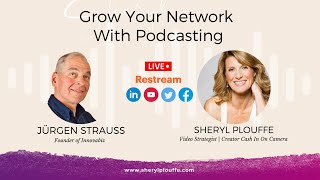
Jürgen Strauss, host of InnovaBuzz, describes his 12-step "podcasting flywheel" for turning podcast guests into referral sources and sales leads. He uses Notion to track prospects, sends personalized video messages on LinkedIn, and emphasizes conversation-first outreach as a networking strategy that works especially well for introverts.
Chapters
No two bigger fans of podcasting than Jurgen and me. We love podcasting, and that's why we've decided to dig into this topic together today and really talk about what is, we believe, a part of podcasting, a benefit of podcasting that can really benefit you and your business, and that is growing your network. Jurgen Strauss is joining us on Cash In On Camera today, all the way from near Melbourne, Australia. Jürgen, so great to have you on here today.
Thanks for having me on, Cheryl. It's a privilege to be here and to geek out on all things podcasting with you.
I love geeking out. It's one of my favorite things to do. So Jürgen, I know that you, uh, you have your own podcast, the Innova Buzz podcast. I'm going to be a guest on your podcast in the, in the coming, uh, weeks as well. So excited for that. But let's talk about your podcast journey real quick. What got you so interested and now really, and not only an ambassador and an aficionado of podcasting, but what got you on this journey in the first place?
Well, it goes back into my corporate world and there were two things that were pillars, I guess, of what later became my podcasting journey. The first one was I was always keen on learning, and one of my ways that I would learn was read books, but I would listen to audiobooks because I spent a lot of time traveling and commuting in the car and so on. And I would listen to audiobooks when they first came out on cassette tape, then on CD, later on MP3 players, and of course that naturally progressed into listening to some of the very early podcasts. The second thing was I did travel a lot, I did work with a lot of our customers one-on-one at very senior levels, and as a result, built a network of close contacts and people that I had relationships with at companies all around the world. When a mentor suggested that I start podcasting as a positioning and marketing exercise in, in my own business, um, that was back in 2014, uh, It immediately occurred to me that this was a way to reach back out to those contacts, that network of contacts that I had around the world, who in my small business I didn't really have a reason to professionally interact with them. So I reached out to a lot of those people and immediately had the first 15 or 20 guests for my podcast. And what I discovered very quickly was that they said, oh, you should speak to so-and-so, and they would introduce me to somebody else that I hadn't met before. And all of a sudden this thing just became a flywheel where I'd be getting introduced to people all over the world that were doing amazing things and that were teaching me amazing things on my podcast.
I, I, I'd like you— I'm a big fan of networking and building a network and really a, I guess, a connect— a connected group of people who are like-minded, who have each other's best interests at heart, who can, as you pointed out, refer you to new people. And so the growth continues from there. And, uh, I love that you said that the audiobooks is really one of the areas that kind of got you into podcasting. I'm— I have a similar journey, you know. I really got into podcasting because of audiobooks initially, and then it led me to podcasting. And I just love the audio format because it's so It's so, it's so personal, you know, and in many ways intimate in the sense that it's that person's voice literally in your head. And then you're able to share, you know, ideas, thoughts, insights, etc. Let's talk specifically now about the networking kind of part of it because I think that's where the biggest growth potential is for especially new and beginning podcasters, people who maybe aspire to do it but aren't quite there yet. Talk to me about the benefits that you've seen from a business perspective with EnovaBiz in terms of growing the network, and can you relate that to any examples that have led to business initiatives, biz dev, maybe even directly to sales?
Yeah, well, there's lots of examples. I mean, I've had guests come on the show who after the show have said to me, 'Hey, can we have another conversation just about the possibility of doing business? Because I love the way you work, I love the whole process you've taken me through. That's been an exceptional experience from the start to the finish.' And some of those guests have— were producing content, or even in some cases doing their own podcast, and weren't happy with the results. So they said, 'How can you help me bring this to another level. And so that's led directly to business. Then of course I've got connected, so people have said to me, I need to introduce you to so-and-so because they really need your help. And so I get business from that. But the more, more intangible, I suppose, long-term benefits are that I've been podcasting now for over 7 years. We've just reached episode 500, and in fact we're recording almost up to 510 now. And so I've got nearly 500 guests that I've kept in contact with over the time since their podcast, since their show recording, and I know that at any time I can reach out to them to continue our conversations. And if I'm thinking of doing something, I can reach out to people that have expertise in that area or could connect me with people in that area and ask them, what do you think of this idea? Or who should I be speaking to, to turn this into something concrete? And I'm going through that exercise again at the moment. We're looking at some things that we want to initiate and speaking to a lot of people, and I've been connected to people that could actually make that happen for me. So it's, it really is very powerful. And as somebody that, yeah, I just say as somebody that is actually a bit of an introvert and going to a big networking event in person tends to find it difficult to get into larger group conversations or even find the right people to talk to if I'm wanting to meet a certain person. Podcasting is just such an easy way to do that and having that, it is that personalized conversation that very, as you said earlier, it's kind of intimate from the conversation point of view but also for the listener because having the privilege to be in the listener's ear is very personal.
Yes, I love that you brought that up. In terms of for people who are introverted and feel like they don't want to necessarily be in the spotlight in a huge networking group. I've been part of global networking groups with hundreds and hundreds of people. Not everyone feels comfortable to be in that situation and to raise their hand. But when you have the control over your own show and your own podcast, that you can still find a way to build your network through this medium. But you did mention about keeping in touch, and I know that for us, when we started Cash In On Camera in this format, it was important for us to create the systems in the back end that would allow us to be able to keep track and to be able to follow up, and some automation in there, but some systems that we've created in order to do that. I'd love to know how you go about doing that. What are some systems and things you've set up maybe internally that you can share with us that help you keep in touch with your 500 guests you've had on your show?
Yeah, that's a really good question and we've built a complete system. I call it the flywheel now because it is this flywheel that is really hard to stop. We keep getting requests for appearances on the show. We keep of course being introduced to new people and then reaching out to people that we meet who we think would be a good fit for the show and for our audience. And we've built this into a complete system that is, um, there's about 12 steps in, in the system themselves, but it starts off with being really clear about why we're doing this. And then when we first approach potential guests, it, it's about having a conversation first and about getting to know them. We have a Notion database that keeps track of everything, keeps track of every step, where each potential guest is in the step of the process, what we have to do next. There is some automation in that in terms of the booking calendar and the reminders that go out and the reminders that go to me when I need to take an action step. When When we first identify a guest or they pitch to us to come on the show, the first step is we ask them to send us some background information and then I ask them to jump on a 15-minute call with me. So the purpose of that in some ways is to filter, are they an appropriate guest? Because I'm really protective of my audience and I want to make sure that I'm bringing on a guest that's going to add value and going to be really interesting. The second objective of that call is for the guest and I to just get to know one another, to become a bit comfortable in talking to one another. And I've found that that really helps when we get onto the show recording itself. It's kind of like, oh, hello Cheryl, we've had a conversation before. Let's just continue from there. And so that conversational process is really important and we continue that after the episode in the form of, I send an immediate audio message. So I actually have a templated email, but inside that templated email is a personalized audio message, which takes me 3 minutes to do typically. It might be 5 minutes if there's more to say. So whatever length that audio message is, that's how long it takes me to record. I pop it into that template, send it off. So there's a thank you. Then a few days later, I get a reminder to send them a personalized video message. So it's kind of another touchpoint, but really just thanking them for being on the show. I might remind them, hey, you mentioned this person as an ideal guest. Would you please introduce us? That would be amazing. Then we have inside of that Notion system— Notion's brilliant because you can put reminders inside of Notion. So we have reminders inside of each entry for each guest that just prompt me to follow up with them in some way. And that follow-up might be something like make a comment on their latest social media post. It might be send them a quick email if that's appropriate. So I That's, that's, I'm flexible around that. It's really what, what's appropriate to that person at the time. So it's very personalized, but the reminder is, is part of the process.
I love that. I love that. I've actually, I don't use Notion currently, but I'm aware of it and I've been looking into it, but we do a similar thing as well in that we have to have some systems and some automation set up and yes, even some pre-templated emails that we can then personalize. We have very similar systems or processes. But we might be using slightly different tools to do it. So, we'd like— you use Notion, we use Airtable. You know, whatever. But the important thing I think for our listeners and viewers to take away is that have systems. Have systems because your network and I was just It's funny, Jurgen. I was talking with someone yesterday, I think it was. And this is a person that had been doing some shows and some episodes and what have you. But did not have an appropriate system by which to follow up and did not have contact information. No way to get back in touch with those people and had done— I don't even remember what the number was. Maybe over 100 episodes but no contact information for any of those 100 people. And so, it's a shame because that is where there can be so many benefits as you just described. It could be referrals, it could be insights, it could be tapping that person's shoulder and saying, hey, I just need some help with something. There's so much benefit to it, but it's important to have systems.
Exactly right. Yeah. And as you say, there's many tools that can do this. It's really the process of following up and having those conversations. And I always emphasize this idea of conversations, even Even in our marketing process where we have similar steps and a similar process in place, but we talk about, you know, the first thing is have a conversation with somebody. It's really about starting a conversation and that conversation may be just a casual thing. I see you've just posted this article on LinkedIn.
I'm really curious why, why are you taking that, that view and Yeah, which leads us to the conversation about how do you even bring on a guest onto your show so that you can grow your network through podcasting. To your point, it could be something like you, you read or you saw an article and you reach out to that person and compliment them. You're not asking for any, just starting a conversation. I think sometimes we make this whole social media thing such a gargantuan thing that we forget that this is really just about building relationships. So how would you do that in person? Well, you might walk up to somebody and compliment them on something that you can compliment them on and start a conversation. It's exactly the same thing offline or online rather.
Yeah, that's right. I think people forget if it's because it's social media, it's different to proper human interaction. So I can just walk up to somebody on social media and say, hey, buy my stuff. You know, right? You don't know me, but buy my stuff.
Which, which really brings this conversation full circle in that podcasting is a huge benefit to your business, to your marketing, to your branding from the perspective of, I believe, first building your network so that you have the opportunity to get more sales and make more money in your business. But there's this step in between. It's not necessarily a directly a link between Here's the podcast, now buy my stuff. It's here's a podcast, here's value, and do you love this and do you want to come back for more? Build the trust in the relationship so that other things can come as a result. Do you believe in that process?
Absolutely, absolutely. I've had people come back to me years after they've been on the podcast and because we're continuing having the conversation, of course, some of that conversation is Here's what I'm doing, here's what they're doing, and at some point there may be a crossover. Either they're doing something that, oh, I need that, I've got that problem right now, can we have that conversation now, which is then a sales conversation. Or it might be the other way around, they might say, hey, I like what you're doing, I really need help with that right now, so then we have that sales conversation. But there's lots of conversations leading up to that and building and nurturing the relationship along the way. And also, I like to say that the intent of these conversations, I mean, the underlying intent, yes, is to grow your network and to connect with people that might become customers or might become referrers or might become partners in some way. But I like to say have the conversations with absolutely no expectation. Yes. And that way it's a little bit like your example where you bump into somebody on the street and you might have a conversation. I mean, an example, if I go out walking in the morning, for example, and there's other people out there walking their dog and I might say, wow, that's a well-behaved dog, or what sort of breed is that? That's a really interesting dog. So Immediately it starts a conversation. There's no expectation there other than we're just being friendly.
Yes, I agree 100% and we need more of that. I think if more people took that approach, they would benefit and it would benefit their business. But the problem I think that we have in this, in this world of instant gratification is that we want instant gratification.
That's right. Yeah, I think that's the big problem.
We're not willing to put in the work to produce the podcast for hundreds of episodes or months or years to reap the benefit of that because it is a longer-term sort of gain, if you will. But I 100% agree with you. One of the things that we do, Jurgen, on Cash In On Camera is we have a segment that we call, 'Stop marketing like it's $19.99.' And I would love to know what is a tip, tool, tactic, or technique that's working to help you market yourself today?
Yeah, well, we've talked about conversations a lot, and I think that's, that's the key thing overriding everything is, is just have conversations with people on social media. One thing that I do which I find really makes me stand out and people actually pay a lot more attention is I'll record a video. Let's say I see somebody on social media, usually I'm on LinkedIn, that I'm interested in, or I might see their post and I want to comment on that. If I'm really keen to connect with that person, I'll record a personalized video commenting either on that post or commenting on something on their profile. So I've got to do a little bit of work to read up about them, and it is social media, so they've got a profile, they've published something, and I can dig into what they're all about a little bit. And I then record that personalized video saying, hey Cheryl, I see you have a 'Cash In On Camera.' I listened to the recent episode and I was really fascinated by that conversation of building systems and I'd really love to have a further conversation about that if you're up for that or something along those lines. Yes. And I've found that people often come back with, 'Wow, you sent a personalized video, that's really cool and how did you do that?' And so they'll ask me about the video and immediately there's a conversation. Or they might respond to what I've, what conversation prompters I've given and we have that conversation.
I do that as well as much as I can. I will sometimes send videos. Sometimes if I, whatever reason I can't pull that off in the moment, I might do an audio, but I'm trying to look for a dynamic way and a more personalized approach to that initial reach out. Or follow-up, frankly. So, we both do a similar thing. We have a lot in common, Jurgen, which is great. I love it. Listen, I want to give you an opportunity to share. You mentioned it a couple of times in this episode, the Flywheel. Tell us a little bit more about how people can get that in their hands.
Yeah, well, we're actually giving away a full audio program that walks you through the entire process of our Podcasting Flywheel, and you can get that by going to innovabiz.co/flywheel. And it's, yeah, there's the audio program there on screen. So it goes through who the dream customer is, why are we podcasting, getting to know that dream listener, their interest, and then how to get guests on board, how to start those conversations, how to nurture that relationship. All about publishing, promoting, and producing the show and how we earn referrals. And then of course, the last step is all about the process itself, auditing the process, celebrating what, what you've achieved at that point. And, and one of the things I like to do, and I often reflect on it now, it took me a long time to get to this point, but I often reflect on it now when we have the debrief after the episode recording and I tell the guest when their episode's going to be published and I tell them what episode number it is. And of course now I'm saying it'll be episode 500 and something. And usually I get a pretty wow response and I have to stop for a moment and reflect on, wow, it is pretty amazing we've come that far. And really it might sound daunting when you're at episode 1 or episode 10, and say, wow, this person's got over 500 episodes. But all it is is we've been consistent week in, week out for just over 7 years.
Yes, and you have to start somewhere. So for the beginner and aspiring podcasters who are listening or watching this, because we are broadcasting this on all of my social platforms and also on a couple of your own social platforms since we're using Restream, um, whether you're watching, whether you're listening, Maybe you are an aspiring podcaster. We hope that this conversation about one of what we, Jürgen and I, believe are one of the biggest benefits, especially in the early stages, but all stages of podcasting, is growing your network. And it's, it's so true what they say, that your network is your net worth. And Jürgen, thank you so much for coming on and sharing your insights on, on how you go about growing your network through podcasting. Really appreciate it today.
Thanks, Cheryl. Thanks for having me on. And I really enjoyed our conversation.
More from Sheryl



From 'agreeable' to 'ruthless mentor' to 'strategic sparring partner' #substack #shorts







