How To Balance Multiple Passions And Stay Sane As An Entrepreneur
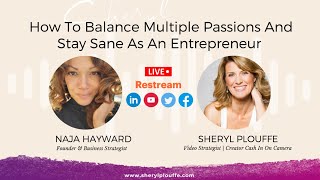
Entrepreneur Najah Hayward has built a tea company, consulting practice, and publishing house while working with a celebrity author. She says self-knowledge is the foundation for juggling ventures, and you need reliable teams, clear bandwidth limits, and strong networks to avoid burning out.
Chapters
Multi-passionate entrepreneur, meaning that you have various things that you're interested in. And can it be sometimes a bit confusing to know which path should I follow? That's what we're going to dig into today on Cash In On Camera. We have Najah Hayward with us today who is going to help us better understand how we can balance these things. How can we be multi-passionate and still stay sane as an entrepreneur? Naja, so great to have you here on Cash On Camera. Tell us a little bit about your story. I think that's going to set us up well for this conversation because you are someone who has accomplished a lot and has had your hand in a lot of different things over the years.
Yeah. Firstly, thank you for having me. And you're right, I am probably the epitome of the multi-passionate entrepreneur. I kind of like to think of myself as Michael Dell, right, from Dell Computers. So He considers himself a multi-passionate entrepreneur. He is not one who could go into the office every single day as the CEO. And even though he did for a while, but that's not his personality type. So the first thing that I say when we talk about being a multi-passionate entrepreneur, and I'm going to talk about me and kind of my story, is like, you have to know yourself because this way of being is not for everyone, right? It is very much my personality, which began Probably in my late 20s, early 30s. I was director of business relations. I was running a company for anyone who's ever heard of the movie Freedom Writers about the teacher. Hilary Swank played the teacher. So I ran that teacher's company and that teacher was speaking like 200, 200 days out of the year. It was insane. And so I was managing her speaking, her books. I was managing the whole thing. And I really, for the first time, was seeing a woman standing in her power. And so my multi-passionate interests didn't start with wanting to start all of these businesses. It was really wanted to— wanting to step out of being the woman who was so used to being behind the scenes and taking that and really knowing what I had. Like I had, you know, in my head I would have these dreams of being on Oprah's couch and Oprah interviewing me and I was the front person. But I had spent so much of my early career being the woman behind the the strength, behind the power, behind the celebrity. And I did that with all kinds of very big names. So it started with really this epiphany moment of where I said, I desire that. And I think we all start in that moment where we, we have this epiphany moment where we desire something different than where we are today. And so that started this idea of— we were traveling so much, we were in Boston, I saw— we went to a tea company. And when I walked into that tea company, I was like, this is it. This is it. I want to start the next— the Starbucks of tea. That's what I want to create is the Starbucks of tea. Then I started doing some research, still had my job, and realized, you know, to start the Starbucks of tea would have required much more capital than I had. And so I really started playing with my business brain, which I have an entrepreneurial grandmother, an entrepreneurial mother. So it is a little bit in my blood.. And I started playing with, well, how could I get this out there? So I decided to start a product, uh, to come up with a tea that I would sell in other locations, and then I would establish my brand. So then when we did end up having our brick and mortar, people would know who we were. So I ended up building this company. I had 9 people working for me. So I'm not multi-passionate yet. If you, if you like, if you're, if you're kind of listening right now, what I was doing was really focusing on one thing. And building it up to a certain point, always knowing my multi-passionate— there was going to be something else in the middle. I had 9 people working for me, and in the middle of that, I started having people ask me, you know, how do you do the branding? How do you do your marketing? How do you do— how are you doing this whole entrepreneurial thing? What are you doing? Help me. And so then I started coaching, right? And there's a whole story behind that which I won't go into now, but I started coaching, I started consulting, and I loved it. And I realized tea was really my passion, but this helping women bring their business to life and monetize their business and build profitable businesses was really my purpose. And so I'm doing both of these things, have a team building my tea business, and then I'm really focused on building the coaching. And so I'm— my multi-passionateness, if you will, was really in full effect at this time. But I was by no means— was I an expert of managing it, and it really took its toll in a whole lot of ways. Um, and so my tea business ended up— I ended up shutting my tea business down in 2015 and really focusing on my consulting because we were booming. Um, things happened, 2019 relaunched tea just before COVID I decided to go straight e-commerce because we originally were— we were wholesaling to spas and boutiques and all over the country. You know, we had some really big clients and really big customers. Um, but still doing my consulting. And so, long story short, life happened in that 2019, just before COVID hit. An engagement broke off. It was a lot of change in my life. I ended up being the caregiver for my grandmother who has Alzheimer's. She's going to be 94, and she's still with us, which is such a blessing. I was doing that, dealing with family stuff, and so there was a lot of change happening in my life at pivotal moment of relaunching my business and still having my consulting company. And so in this whole life happening, I made a, an interesting decision to, to pause, and I left the country for 15 months, and I traveled the world really documenting wellness around the world. But I was able to do this because I had a team of people and my tea business was running itself. I had people who run fulfillment. We still had our marketing machine going in the background. And then with my consulting, I had people who helped our clients. And so I could actually have the freedom to do this multi-passionate thing and to leave the country. And so people always ask me like, how did you do it? How did you afford it? How did you, you know, continue your businesses? And when you're a multi-passionate entrepreneur, there are a few things that I really say are important. One is you have to know yourself, like I said in the beginning. Beginning. I know myself that multi-passionate is in my soul, it's in my spirit, it's who I am. Two, you have to really know where to start. So tea, nausea tea, was my start. I wasn't trying to do 5 million things at once. I really established myself in an area which also established me as a brand, which also established a trust factor with people in my community. So we're always building our community, right? We're building our following, we're building our audience. All of those things are very, very critical to whatever ultimate business you end up delivering. Um, the next is really know that you can't do this alone. So again, I, I have this gift of delegating because I don't really like to work, if you ask me the truth.
And so the truth comes out, the truth comes out. Yeah, before you get to point number 3, I just want to dig back on something you said earlier, which I think is very poignant for people who have desires to have their hands in a lot of different things. Okay, so we're going to focus on, let's say, your coaching and the tea, since those were the predominant ones that were brought up. And I know you do so many other things, but at what point do you transition from one to the other? Because I think there's something to be said for the focus of, like you said, digging in and being like, tea, tea, tea, I'm building this up. But to what level before you start branching off into the next thing, which is coaching? Do you jump into that before you think you're ready? Is it a certain revenue level, a certain team that's in place? How do you know when it's time to bring on, let's say, the other passionate thing that you have in your heart?
Such a great question. I think it's a little bit of all of that, but ultimately it's a little bit of all of that because that defines how much of you is required. So I think ultimately it's how much of you is required to continue the day-to-day operations of that thing. So I have grown to a point where my tea business really didn't require a whole lot of me on the day-to-day. I had sales— I had 5 salespeople, I had a fulfillment person, I had an assistant who managed a lot of that. And so I could very well take 2 hours out of my day to focus on tea and then be working with clients, or, you know, always networking, right? And so what I always did, those— I positioned myself and my brand around being the tea lady. So when I got an interview, it was because people wanted to talk about tea. When people wanted to write about me, is they wanted to talk about my tea story. But invariably, that always would lead to, can you help me? And so the can you help me becomes absolutely, I can help you because I have a consulting company. I can help you because we have a digital agency. I can help you because— and so they come in. And here's the interesting thing is at a certain point of your career, and celebrities do this every single day. We look at celebrities and we, we don't put two and two together. But the very nature of what they do as a celebrity, they're multi-passionate entrepreneurs, right? They go in. In as actors or singers or whatever, but then they become ambassadors of a brand and then they create their own product line. And then they— so they end up doing all of these things. How do they do that? First, they establish themselves as a celebrity, as a public figure, as someone in the limelight. Then they have people who are saying, hey, we want to leverage that platform that you have and we want to create something else. But do they do it alone? Never. They almost never do it alone. Why? Because they know that, A, there's people who can do it much better than them. So we have to stop thinking that we can do it all, we have to do it all, and that we're the best at doing it all. I mean, I know, I know, I know you're really good at what you do, but just be good at what you do and let other people be really good at what they do that supports you in being good at what you do.
And so I've never heard of it compared to the celebrity world or to the entertainment world quite the way that you just described it. And it makes perfect sense. I love Jennifer Lopez, for example. And, you know, yeah, I just love J.Lo. And you see her doing a lot of different things, right? She's a singer, a dancer, you know, an entrepreneur, all these different things. But she became known as one thing to start, and then it branched off, and then it branched off and went into, into all these different things. Even though she would probably say, and has said in interviews, that she's always had this all inside of her all along. But it's a really interesting way to frame that.
One, which is to really know your bandwidth. So when it's in you, it's in you. This multi-passionate thing is not something that's generally like one day you just decide, hey, I'm going to be multi-passionate. It's always been us. If you had a lemonade stand when you were a kid, you're probably one of the multi-passionates, right? And so I agree with that. But she also had that— she's— I love J.Lo. I think people underestimate her as a very brilliant businesswoman. Woman. So I agree with what she said.
I agree. It's funny too, because there are some parallels to where I think I am in my own business. And I have had a bit of fear of branching out into the business advisory realm or into the coaching around business. And I've wanted to stay safely planted in my video marketing because that's where I started my business in 2017 and did that for many years pretty successfully. But after the pandemic and even more recently, and I mean more recently, like in the last year, there is something in my heart that's bubbling up around business advisory. But I have had some fear around doing that because again, I think we all suffer somewhat from, well, why, you know, who am I? And all of these different limiting beliefs and maybe, you know, not, I don't know, thinking about my own success and things that I've accomplished as being worthy. So, how do we know though that it's time to move into that next realm if your heart is calling you to go there?
Such a good question. And I think you're a brilliant example of what it is that we're talking about, right? You were able to pivot a very successful career as a television journalist. Is that correct? Is it television journalist? Yeah. You were to take everything that you, you went to school, I'm sure, for that you did on a daily basis, and you were to convert that into helping other people really take your skill set and to leverage that for themselves through video marketing, through all the work that you did. All it was was a shift. For you, it probably wasn't a whole lot of difference. You just had to maybe put some structure around it, right? And now your life and your business is calling you to do the same thing because it's a natural pivot to be in business advisory when you've been doing what you're doing. And so I think sometimes we have to listen to the natural pivot. The natural pivot. So for me, I have a publishing company, which is, I mean, exploded literally overnight. And here's why. So during my 15 months of traveling, I did something that I'd been telling myself I was going to do for a very long time. I wrote my first book. That first book gave me this trust in myself to do what I said I was going to do. I had been talking about for 10 years, and it also gave me a realization that it was so much easier than I realized. So my first became my second, became my third. What happened? People started asking me, how did you do that? Immediately I took the, the, what I created, created a curriculum, which was very step 1, step 2, step 3, because I did it myself. And, and created a retreat, had 240 people off of one post say, yes, I'm interested. Did an application process and basically just rinse and repeated what I had done for myself. And now that's, You know, that's my third business is Rainmaker Publishing and probably what I am most excited about because it takes everything that I love, my creative, my business, my, you know, I'm never doing the same thing in any given day. Yes, everybody has a story. And so, but, and the beautiful thing is if you think about it, it's not very disconnected from my business coaching and really not very disconnected from my tea company. And people are like, well, how are they all? One thing that I think we are afraid of is we don't want people to say you're all over the place, you know, because we've heard that before, because at some point we probably were all over the place. And, and no one wants to feel like, wow, they're judging me and they don't think I'm organized or they don't think that I really have it or that I can do it. The way that we can start to trust the process is to not be all over the place, right? And so sometimes we think being multi-passionate means I'm going to start one thing because I have this idea, because we're entrepreneurs, we do not suffer from a lack of ideas. No. And so we start that idea, then we stop, then we don't do anything else with that first thing. Then we jump to the second thing. That's not being multi-passionate. That is being at a level That, that can be one of two things. You're in exploratory phase, which I think is a beautiful phase and an important phase in the process, or you very well may be confused. And that's for you to identify. And I do some of that work with my consulting clients is let's identify really what's the thing that you truly want to focus on today. Because sometimes we say, I want to start a coaching business and we want to start it because people say you give really good advice and everybody else is coaching. So I should probably start a coaching business. And then you're like, Oh my gosh, you mean I actually have to like talk to people and then, you know, I have to do this. These are— oh my, I don't like that. And so you— so the more questions you ask yourself, know thyself, then the more success you can ultimately have once you start to truly become multi-passionate and organize that process so you can stay sane.
Absolutely. The balance piece of this about being multi-passionate And again, I think it is exactly what you said earlier, like rooted in self-awareness, that you have to understand who you are. And that sounds like an easy question to answer, but it isn't that easy to answer for a lot of people because we're so close to ourselves. It's difficult to see the forest for the trees. And then we can't look at ourselves maybe as objectively as maybe we would like to because we live with ourselves. And so then it gets confusing. Then you get into your own mind. Then you're, you know, you're overthinking things. And, but the self-awareness piece is the key crucial step, first step to understanding what are the passions, you know, and, and then, then you layer on top of that, the business and entrepreneur aspect of this, just because you're passionate about something doesn't necessarily mean that's a business.
Exactly. And I think to that point, I had, I, when I really started, not first started Najah T, I became a member of this community called Ladies Who Launch.. And I met some beautiful, beautiful women that we ended up having our own weekly cohort of supporters. One woman in, in the first 2 years started 12 businesses, but she wasn't really starting 12 businesses. And here's what the beauty of what she did. She was exploring where her passion lies. She was giving herself permission to fail and she was giving her— but she still had a full-time job. So she was testing these things that were things that she liked, that were her passion, that might have been her hobbies. And then she'd say, nope, not it. Nope. She got in. It was like she got in, she got out, she got in, she got out until she found the thing. And that was interior design. And if you met her, you'd be like, oh my gosh, this is you, right? She was an auditor at an insurance company, ends up starting her business. Now she has a multimillion dollar business because she found the passion, because she did the work. And the work is really You know, you don't get the key to the treasure box. You have to go and find the treasure box, right? But when you find that treasure box and you open it up, it's like, oh! And that's really what this journey is of entrepreneurship. We want the aha, and it takes, it takes exploration and curiosity and failure and, and not being afraid of those things and not making yourself wrong when you fail, just knowing it's a part of the process and it's okay.
Yes, and yes, absolutely agree with everything you've said. I don't know if I would have the stamina to do that 12 times and figure that out over 12 times, but I do feel like there has been a certain amount of throwing spaghetti at walls in the course of my own business in order to get it to a certain point, and I only feel like maybe more recently, and I would say like in maybe the last year, 2 years or so, that things are starting to become more clear to me because there's this aspect of me that is very driven and loves technology. And that wasn't always as prevalent for me in the first stage of my business. And now I feel very called to integrate that in. And so it's interesting, right? It's this whole process of understanding yourself and self-awareness. You mentioned about understanding where to start, which is so, so important, and also not going it alone. So the piece around team building that you get to a point where you're not going to build this entire business or businesses in isolation. If you want to travel for 15 months, if you want to go on the cruise in the Caribbean, you know, that I just went on recently, you want to do those things, you're going to have to have some team members in place who can hold down the fort for you. And that's probably part of a whole other conversation, Najah. So you're gonna have to come back so we can discuss team building.
I would love to come back. I would love to come back. And I think, you know, there's a level of— there's a thing that we as women do that makes us so good as entrepreneurs. And I think if we allow ourselves to embrace just a little bit of that masculine energy that men do— men think that they can do anything. They don't have to have a degree. They don't have to be good at it. You know, they, you, they'll just go in because they don't have that monkey mind playing in the back. And then this is a generalization. So I know this isn't all men, but in general, you don't have that monkey mind going on in the back of their head. That's like, yeah, but you've never done it. And who are you? And you know, and you don't have a degree in that. And all of those things, right. And. And I learned early on to embrace that masculine part of me, which allowed me to be the VP of a marketing department, to build out a marketing department when I had never built out a marketing department. And I had a company hire me to do this because they said, oh, you do marketing. We see, you know, we think you'd be great. And I was— there was not a level of no in me, right? This is the same woman who's like, someone said I made great crab cakes and they hired me to cater a party. Never catered in my life. So, you know, these are the things that we kind of have to know ourselves and embrace a little bit of that, like, fearlessness, I think, is helpful. Yes.
This has been a fabulous conversation. I really enjoyed chatting about this because I think it's important for a lot of people who feel drawn to a lot of different interests, maybe both personally and professionally, has been mostly what we've discussed here. On the episode today. The last thing I want to ask you, Najah, is, is what is a tip, a tool, a tactic or technique that's really helping you to market yourself personally, Najah T, your Rainmaker Publishing, any of the other endeavors that you have going on? What's something that's really working for you from a marketing perspective?
So there's two things. And first, I want to just acknowledge something about you that I think is amazing, which will help you in every single business. You have the most beautiful, systematic, structured approach to how you do your entire hire a business. And I've seen it in, in all of it. And so everyone should be hiring you, if for nothing, for the systematic piece. I'm just like, she's, she's a genius. Um, so I think that that is a great way to continue your marketing efforts. For me, I have made multi, multi-six figures through social media, and that is primarily how I make my money. I don't pay for ads, I don't do a whole lot of that, but I really nurture my community. I'm consistent. And so going live on social media, posting on social media, engaging on social media, allowing people into your world that you don't know. Stop making your stuff private. It's not private. You have a business. So open that up. And so that's one. And the second is networking the way you and I met, right? We did a mastermind together and here we are today. And who knows what else will come from this? You introduced me to a lovely woman who's going to be speaking at my next retreat. And so your network And this is— I know, I'm sure you've heard it— your network is your net worth. And I truly believe that. So those are the two things: go live, get social, and network, network, network.
You're speaking my language. You are speaking my language, and I agree with everything you've said. This has been fantastic. We will have to have you back on to talk about team building since we haven't had enough time to dig into that. That will be another 20-minute conversation easily because there's a lot to be said for that, the timing of that. How do you find people? You've done it yourself and would love to have you back to discuss. Thank you so much.
Thank you for having me today. Can't wait. I love it.
More from Sheryl



From 'agreeable' to 'ruthless mentor' to 'strategic sparring partner' #substack #shorts







