How to Build a Loyal Network Of Powerful Connections with Tyler Horsley
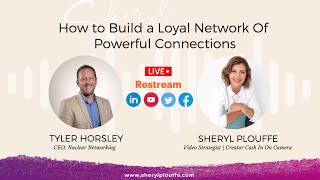
Tyler Horsley, CEO of Nuclear Networking, explains how to build a network that actually helps you. Start by finding mentors, not clients, through LinkedIn and groups like EO. Never ask them for money. Use confidentiality-bound mastermind groups to create real loyalty through honesty and vulnerability.
Chapters
We know the power of networking, but nuclear networking is an entirely different thing. And the perfect person to come in and talk about nuclear networking is Tyler Horsley because he's the CEO of Nuclear Networking. And we're going to talk about that today. How do you build a loyal network of powerful connections? Tyler, so great to have you here on Cash In On Camera today. I love the name of your company. Tell us what the history is and how you determined that that was the name that you're going to go with?
Yeah, thank you for having me. Looking forward to it. I worked with a futurist speaker out of Denver, Colorado named Tom Fry. I think he's still the most popular futurist speaker, uh, current to date. But we tried to encompass— and I know that you've heard this phrasing before, you know, network defines net worth, there's power in proximity— and so we were trying to put those two things together in a transactional world try to kind of tap into the relational side. And so that's networking, obviously, you know, hit the nail on the head there. And then just in terms of the most powerful version of that, we can, you know, nuclear is probably the most powerful thing I can think of.
So yeah. Yeah, I love that. And there's something to be said for alliteration too. So it makes it easier. So great to have you here. I think that where I would really like to start this conversation is around networking for our audience who are coaches, consultants. They're experts and speakers and authors. People that are really looking to grow their businesses and to scale their businesses from say, high five-figure to six-figure, multiple six-figure and beyond. Networking is a key piece of that equation. But yet, I think sometimes it eludes people because they don't really know, well, how many people should I be connecting with? Who are the right people? You mentioned proximity. How do— what is the best thing that we can advise people to do in terms of determining who are the best people to be connecting to?
Sure. I think one of the really important things, and this is how we would advise anyway, you know, moving through actual marketing. So I think the most important thing is for individuals to understand their why first. So before we go out and we determine I need to be a part of these crowds, these audiences, this group or, or provide A, B, and C, understanding if, if I did line you up with 5 other coaches, consultants, etc., on a stage in front of 50,000 prospects and only gave you 10 seconds to tell me why we should work with you instead of anyone else, what would you say? And if you can answer that question well, then we're ready to define your profile, your avatar, and what groups you should be a part of, right? Because even though you might collectively be able to consult or coach anyone, there might be a specific niche where you really have passion, you really have experience, uh, and qualifiers that might, might drive you towards that specific niche. Another thing that I recommend just in thinking about this is, is the niching down, because in a world where, you know, and I, I do advisory roles myself as well and coaching around marketing and leadership pieces. And if, you know, there's a lot of people who might write that on their LinkedIn profile, right? So it's understanding who your target audience is, is much easier when you understand yourself and what you provide. So starting there, if you have those niches, those specific niches will kind of determine what crowd, what audience, and more you can, you can join. Happy to go in further too, but I'll pause there. Hopefully that was helpful.
That is helpful. And it, it's so interesting because it does always seem to come back to know who it is that you want to talk to understand your message. But you made a really important point, which is how are you communicating that succinctly in a very brief, let's say, 10 seconds or a short sentence, right? And that is something that people need to work on, especially people who are starting their businesses off. And let's say they're, you know, at, let's say, $5,000 to $10,000 a month in revenue, the early stages. They've done something good, they're selling something, but they just haven't like grown to those bigger levels, um, yet they need to understand the message and they have to understand who they're talking to. So I guess the question is, for someone who might be in that position where they're starting out, is it— can they just— can they, or should they start networking before they have those pieces in place? Or is it like a one— is it this step, then this step, or can they be done at the same time?
I think, I think there's value in doing these things at the same time. So looking through the lens, a relational lens, not a transactional lens, there's always value in growing your network, right, your relationships. And what I typically try to advise folks is there's several different types of relationships. There's going to be your colleagues and peers, there's likely other coaches and consultants, etc., that are going through the same thing at the same time. But, um, the most important part of your network right out of the gate should be mentors. And so mentors— and this is just my personal golden rule— you never sell your mentor anything, and you never ask your mentor for money. Because it kind of, it ruins, um, the sacred nature of that relationship. So if you find somebody who's already done what you're looking to do really well, they can likely steer you away from hitting a brick wall. And one other piece that I kind of live by is you can either learn from experience or advice. And experience is painful and expensive usually, and advice is usually free. And so if you can take advice and learn and kind of start building that network around mentors, Uh, how do you do that? There's a lot of different channels that you can do that. Obviously you can do cold outreach on LinkedIn. That's a little bit more tough. Um, you, you can join qualified groups, right? Uh, there's certainly coaching and consulting groups, Facebook groups, LinkedIn meetups, and more. Um, I myself, when I moved, uh, to Denver, I ended up joining EO, Entrepreneurs Organization, and that has served me quite well. Met a lot of high achievers. And I think the whole perception here is— and I know entrepreneurs want to make money, obviously. However, just as any other company, leading with value, finding an objective-driven offer. Just think about that, like, you are the product, right? Genuinely, they're buying you, and they want to buy an outcome. And so what pain can you solve for them? It might be based on past experience other people that you've coached or consulted with, um, or it might be a specific KPI-driven, hey, if we do coaching, I guarantee your business will be 300 times bigger than it is today, or I'll reduce your churn by X, or I'll help implement Y and Z. And so really thinking about, again, the why, who you are, who you want to serve, and the offer will help you better build those networks, uh, congruently while you're still working on that other stuff that we talked about. Right out of the gate. And Tim Ferriss said this first, but it's like, offer free work. I know it's a bummer. We want paid. Our time is valuable. It certainly is. But if you're looking at niching down and doing this well, if you can get qualified case studies that we call social proof, and there's 17 other people behind you going, hey, you really need to work with this person, like, they've changed my life, they've changed my business or my perspective, that's going to make your sales process quite a bit easier.. And that really helps even in the beginning stages because you're a person being met at a party or a business event who's not trying to sell them something. You're like, hey, I'm here to offer you help. What can I do for you?
So I want to dive into that a little bit more because I think what you said is so poignant that you want to find mentorship and that's different than a client relationship. And so I think of masterminds and there are a variety of different kinds of masterminds where peers come together people who are, you know, maybe at similar levels or have similar interests, and they aren't selling to each other. It's a sales-free zone. But like, you sometimes you have to pay to be part of a mastermind, be part of a membership that is being run by someone. That's okay, right? That's what you're suggesting, is there might be opportunities for you to join something like that, but that within the group you're not selling to each other, your actual peers.
Sure, yeah, definitely. I mean, that would— that's, um, that's certainly a form of mentorship. That's kind of how EO is as well, right? We're, we're not supposed to solicit to each other, but I think the idea there, regardless of if it's paid, not paid, if it's one-on-one from a person you've reached out to, or it's a formal group, or a group you start yourself, I think the most important dynamic there is you need to have a solid foundation of qualified thought partnership.. And what that looks like is somebody who's not afraid to tell you, don't do that, you're going to mess it all up, or I wouldn't buy from you if you said this to me, or you just want brutal honesty. And when you can get the sales and all that stuff out of the way and actually just build tangible relationships with these people, hopefully brutal honesty is welcome. That's going to serve you most in your growth journey and your refinement. And then you can take what you've learned there and then go out to the public and look, look amazing, right?
Yeah. I think with that level of honesty amongst the groups that you participate in and that you're networking with or that you join or that you start, as you're— as you made that point, that you could also start a group of your own if you can't find a group of people to join, right? That in and of itself is where I think the loyalty piece really starts to surface. So let's talk about the loyalty and how you can actually build those loyal connections. What are some of the fundamental things that you have to really know or be cognizant of in order to build true, lasting, loyal relationships?
Yeah, so just from experience share, where I've been able to build loyal, uh, relationships is primarily, um, it's actually been mostly like the EO type of environments. And I know this sounds like a long pitch for EO, but, but what I really get out of that, like a forum experience— and I'm in two of these and one of them is not EO It's called CORE. But the premise there is it's a group of 5 to 8 people who have all made an agreement to vow confidentiality. And it is a live by and die by confidentiality. And essentially, we can share everything. And there's kind of a system to this. It's not just, hey, how was your week? In EO, as an example, you can only talk about the 5%. Top 5%, bottom 5%. Bottom 5%, my whole house burnt to the ground. Top 5, I just won $100 million. It's, it's not, how was your kid's baseball game? It's like, that's really interesting. Yeah, well, it— we're entrepreneurs, we can talk forever. Me specifically, right? So it's like, it really keeps it like to, to the very core of the most extremes of what's happening in somebody's life, and that creates what's called intimacy. Which is like instant intimacy. It's— you can very quickly learn somebody. It's like, whoa, you had 7 deaths in your family in a row, how can I support you? I just met you last week, this is intense. It is intense, but, but a lot of people don't have that in today's culture. And so outside of the business acumen, which should be one of your first vetting tools, primarily because you have family and friends that'll tell you what you want to hear, you have nice people in your life that can you know, they're your cheerleaders, and that's fine. But this group, this group should be sacred and have the ability to know everything about you, to be able to pull patterns out and tell you things that you don't want to hear. Like, that's really the point. And they can, they can cheer you on when you have big wins too, because if you do win $100 million, you're probably not going to tell all your friends. I wouldn't. So that's kind of a really quality, uh, framework you know, that I would recommend. And again, create your own group. I'm sure there's other people that want to join a mastermind that may not want to pay for it. But whatever that is, is if you can create that confidentiality bubble and then make that 5% rule, just rip off EO, you know, that's going to create some good conversations.
I love that idea of talking about the top 5% and the bottom 5% and the stuff in the middle we leave alone. So it's either going to be we're talking about celebrations and wins so that other people can learn from that. Or the challenges and the frustrations. And I think the other side of that part of the conversation is then your willingness to be honest with other people. Sometimes there's this layer of, I want to be liked, you know, I don't necessarily want to tell the truth or be as honest because what if it hurts someone's feelings and I'm trying to be liked? What about that? I mean, in a loyal relationship, a powerful connection relationship on this level, you have to be willing, you have to be able and willing to take it as much as you are able to then contribute that level of honesty. So let's just talk to the, the piece around being liked. How important is that in this type of relationship building?
Sure, it's important to listen to my entire answer here because what I'm going to say initially is not what you should live by, but it is an important piece. You will only get out of relationships what you put in. And so if you show up fake with a mask on and you're not willing to go deep, you're not going to get much out of it. And you're also setting a precedence for everyone else that they shouldn't go deep either. I've been in groups with people where 7 out of 8 people go deep, and then finally this person is able to talk, and huge sigh of relief. And they've been holding this stuff for years, and I'm like, why did you do that? Like, you're keeping yourself in a prison. You're, you're stunting your own growth by not listening to opposing viewpoints. There's a bigger message behind that, um, for our country specifically, but, um, The, the, the main piece that we exercise in these environments, because they are, um, I don't want to say sensitive, temperamental, not temperamental, fragile. They're fragile. You— we don't come out swinging, hey, you know what, I've seen you do this 7 other times, you're a terrible person. You don't— we have a rule in our forums that you only do use experience share, so S-H-O-U-L-D, should, right? You don't want to should all over people is what they say. You should do this, you should do that. What you want to do is, I had a similar experience to you, here's exactly what happened, here's how I handled it. And that's a really good starting point, maybe for the first 6 months to a year that you're with a group, building that trust. Just share experience, just share experience. And, and it also might be good practice to say Can I speak into that? Like, can I, can I respond? Can I share an experience? Is that okay? Because some people just want to be heard, right? Like, it's like, hey, I just went through major trauma. I just wanted to share that with you guys. Like, awesome, thank you for sharing that. We're here if you need anything. That's it. It's not, I want to fix you. And so I think just simple rules, you know, ask for permission, you know, before you, before you share any of your opinions. And try to stick to experience share because then they can learn from your experience and take what they need from that story.
Yeah, exactly. Well, Ryan just was reiterating what you said. You stopped shooting all over yourself.
Yeah.
Thank you, Ryan, for that. I think you make a great point in that there's a big difference between coaching, right? The coaching piece is you should do this, or consulting is here's the path forward and here's what you should do. What you were talking about here is building— there's maybe some level of reciprocity and building a loyal network of powerful connections is also vulnerability and being willing to be truthful. These are different. This is not about coaching at all. Right? And there's a difference. And so people who are watching this or listening to this, who are wanting to build truly powerful, loyal network connections and want to join groups ought to go in with this advice. I think that what you've shared is really powerful, Tyler. Thank you.
Yeah, thank you.
Yeah, I want to know a little bit more about the work that you do at Nuclear Networking. Tell us a little bit about how people can reach out to you.
Sure. Well, one of the benefits of being the founder is you can just email tyler@nuclearnetworking. I don't have any weird dashes or dots or extensions in my email, so— and ironically, there's no other person here named Tyler, so that works. So, um, LinkedIn's obviously a good spot. I will put a caveat, I don't, I don't check my inbox. I get pinged maybe 150 times a day of people trying to sell me marketing, oddly. So weird. But, um, yeah, so email would be the best. LinkedIn is more so where am I at, what am I doing, private equity level acquisition, business sales, which is another part of my life. And then Nuclear. So at Nuclear, just in general, core deliverables are a lot of the things that we're talking about here. Like, a lot of what I've learned in my life and a lot of those core principles of starting with the why— who are you and what value do you have to offer to the world? You know this about yourself. It doesn't matter if you went to a class and 28 of you became coaches and now you're out in the world on your own. Why did you join to begin with? Who do you think you can impact? What pain do you think you can solve? And try to find that niche. And then once you know yourself, um, and we have workshops for this kind of stuff, but Then we move into objective-driven campaigns. So it's like, man, if I am in front of, you know, 10 other coaches and 50,000 people have to choose one of us, why would they choose me? What can I offer to them for them to like really get— maybe it's a free session, or maybe it's a guarantee, or maybe it's access to your mastermind. If they, you know, there's all sorts of like value adds you can offer, but something to pierce through the noise to get the first yes. That's what you need. Um, it's going to serve you in two ways, obviously. One, you know, if they convert, great job, you have a client. But two, if they don't, ask why, because that free constructive consulting will polish and sharpen you and help you throughout your entire process get better. You don't want a room full of yes people. That's why I'm like, I like the encouragement from family and friends, but they're not the people you should be asking on how to better yourself. They're really not. Maybe, maybe if you've got an issue and they've been like, hey, this has been an issue for like 5 years, that's fine. But from a business perspective, you want criticism. You do. You want, you want to like, how can I get this better? How can I do this better? Um, and, and that's really the best way to grow. So creating those objective-driven campaigns, and then of course landing pages— we call them click funnels and more— but we would just basically go, here's your audience, demographically. Here's where they live. Here are their interests. Here's how much they make. Here's what industries they're in. Anything you could think of. And here's your awesome offer we came up with. Let's go out to the world. It's called outbound marketing. We're not waiting for them to search for you. They don't even know you exist. We're going to go introduce them to you against their will. Hey, I noticed that you love animals and that you live in Wash Park and blah blah blah, and I actually do X, Y, and Z. I'm a dog whisperer. I don't know, whatever. It's like, I'd love to meet your animal, right?
I love this because this is something that I've actually been speaking about for a little while now too, is this idea that a lot of people are just— their strategy is a hope strategy. They just hope they're going to get discovered. So that's not really the best strategy. And to your point, is having the foundation outlined and then being able and willing to go out there and find it. And doing that in a strategic way is, is the way to go.
Yeah.
What is something that's really working for you, whether it be to market yourself personally or to market nuclear networking, something— it could be networking or it could be something else, but what's really like a tip, a tool, a tactic or technique that's really working for you today?
Yeah, to sum, sum it all up, because there's certainly a lot of different channels, right? What I've been trying to focus on doing is just adding value to other people's lives. So it sounds extremely generic. No, I'm not taking groceries from, you know, a store and loading people up. But what I am doing is I am being strategic about the groups that I am surrounding myself with, specifically like business groups. Why am I being strategic? Well, in the beginning when I first started, I'm like, oh, I'm going to join everything, I got to meet everybody, really got to get this going off the ground. And it's like, I am— I have very limited bandwidth Like, I need to be really careful about how I allocate my time because you, you know, there's vampires out there, you guys will meet them, and there's half a week and you got nothing done and you're doing X, Y, and Z. And so I'm really specific about what business groups I join, mentioned a few already. And when I'm in those groups, I just ask questions of other people. I'm like, what are you doing? What are your pain points? What are your problems? Have you thought about this? And by doing that, people will always tell you about themselves. And as you start sharing value and experience, and it doesn't even need to be related to coaching, you know what I mean? I've coached a person like, you know, no, it's like, yeah, here's how to do A, B, and C. They're gonna look at you as a helpful person. And then they're gonna ask you like, what do you do? Honestly, I actually coach on this stuff. Like I do this professionally. Um, and since we're in a group together, like, if you ever want me to swing into your company and do this for like a free lunch and learn thing, I'm down to do that. We're in a group, like, we're good. So, um, and, and people— it's almost like a soft sell or a reverse sell, but it's just offering value, um, first. And that's what I've been doing, and it works quite well. And in a world of a lot of spam, you know, um, you, you don't even fall under that category because you're not coming out with a transactional mindset of, hey, buy from me. You know, it's— you can build relationships.
So I think that's— that makes a lot of sense, right? Care about people, be inquisitive, be helpful. And there's nothing simple about that answer, by the way. I mean, I think that that is actually a very deep answer and it's something that we don't see all the time. We see a lot of people pitching and promoting and selling, but how many people are actually out there putting in the work to help other people? And I think that's what I'm hearing you say, is that that is the key to helping you build these powerful connections into building a loyal network. And then I think it also fills your cup as well. When you know that you are doing good work and you're actually helping other people, it helps fill you up as well.
Yeah, it does. In, in your groups, should you join one of those or create one yourself, um, keeping those relationships sacred, you can ask the table like, hey, I'm really struggling with finding new leads. Do you, do do you have any recommendations or anybody that you think— I mean, when you have that dynamic and everybody's there to help each other, not sell each other, they will automatically— the rule of reciprocity— they're gonna go, man, yeah, I think I know like maybe 3 people, um, let me reach out to them and like see if I can get you an introduction. I mean, people will help you, you know what I mean? It's, it's all about positioning.
So I love that. This has been great. Thank you so much for coming on the show today and for sharing your insights with us. It's been really fantastic, and I'm sure we'll connect again. I'd love to you back on the show maybe another time and, and talk about other topics related to networking. Thank you so much.
Thanks for having me.
And thank you so much for watching and listening to Cash In On Camera today. If you want to know how to connect with me, you can— if you're watching the video, you can take a picture of the QR code on your screen, which will take you to my signature card, which I keep up to date with my speaking appearances and any resources that I'm offering, uh, you, the coach, the consultant, and the expert who wants to scale their business. And if you're listening to the show, you can connect with me @CherylPlouffe and you'll find that same signature card linked up in the bio link. Thank you so much for being here with Cash In On Camera today, and I look forward to seeing you in the next episode.
More from Sheryl



From 'agreeable' to 'ruthless mentor' to 'strategic sparring partner' #substack #shorts







