How to Build a Powerful and Unique Content Hub Strategy
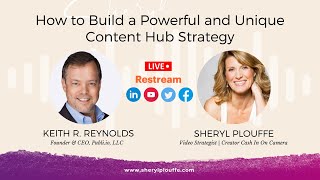
Keith Reynolds of Publio outlines a seven-step framework called the publisher's MO for turning content into measurable leads. The model covers everything from defining your value proposition to tracking ROI through a waterfall calculator that projects traffic to sales. It works for enterprises and solo founders alike.
Chapters
Is necessary if you want to get your message out to more people. So I think we're all on board with the idea that content is a thing. It's something that you really need to be focused on. But further to that is, is your content actually working to help you bring in leads and sales? That is the question of the day. And that's why we've brought Keith Reynolds on from Publio today to talk about really the concept of a content hub and how you can utilize a content hub to be able to help you grow your business. So Keith, great to have you on Cashing on Camera to talk about this. Why do you think a lot of people struggle in the content? You know, I don't like to call it a game. It's not really a game, but they struggle with content because they're not maybe always seeing the ROI. Is it that the ROI is there and they're just not seeing it, or is it truly that, no, you just really don't have a plan to make it have a return on investment.
Yeah, my experience is that there's a strategy, uh, that you can define to achieve a goal using media. Very much like a media company would put on a new television show, you'd have a content strategy for that show, and that would address an advertiser's need. Here we're looking at producing media that's going to produce the result of getting a lead. To your business and there's a dollar value to a lead. And so if we can design a system where we're creating media and we're, we have a content creation and a content distribution strategy, we should be able to get the feedback from our marketing automation that shows what's being watched. So, and you know, how does that lead to traffic and leads and then opportunities and sales? And whether you have a shopping cart business or a professional services business where it requires a salesperson to interact, you can design a system and a strategy to achieve goals. But you have to start from that perspective. You can't go buy some advertising and produce some Instagram and, you know, do it haphazardly. And that's what we do is work with clients to think all of the steps through and, um, and build yourself a system that can generate leads.
Um, and I, I like what you just said there because I think that that's often what we see is people just throwing things up for the sake of doing what they think they should be doing, which is I gotta create content, but there isn't really a plan or a strategy of like not only the creative of the content in terms of what is being said or how it's being produced and all of that, but further to that, a strategy in terms of the, um, the, the timeline or the order in which you do things. And so people are often putting cart before horse in that they're just kind of throwing a bunch of stuff on Instagram and kind of like, oh, hope this hap— hope this works. That isn't really gonna cut it. So I'd love for you to speak to this idea of following the, the steps but following them in the proper order.
Terrific. Well, and I think people spend an inordinate amount of time on social media platforms trying to get the interactivity, the engagement with customers, but without the right strategy, they get frustrated. And rather than stepping back, they just spend more time, and then that becomes frustrating. So we do have a formula or methodology if you want to pull that up. We call it the publisher's MO, and you know, when I started this project, I got a lot of pushback, oh, publishing is dead, and I am going to be a contrarian and say no, publishing is not dead. Ben Franklin invented the publishing model that's advertising supported. It lasted for 350 years, and then social media came along and put the tools that had previously existed in the, in the largest companies, the media companies, uh, to, to deliver content to people. Well, now we all have to do it. So let's look at what publishers have done for 350 years, but instead of going to get an advertising customer that's going to spend money to rent our audience, let's use our own audience to generate leads.
And so that success leaves clues, right? And I think you just hinted at that. I mean, publishing content is nothing new, but you do have to have— and I like how you have outlined this as what you call the publisher's MO in a 7-step process to be able to start and have things happen in the right order. I think that's really, you know, so starting with the North Star idea, you know, you don't start with the, with the sales model. You start where you need to start.
Very much. And, and so people understand your company through its people, its values, its culture, right? And so the North Star idea is exactly that. It can be the name of your blog, it can be the tagline of your company. I've had it where the CEO was building a coaching organization, and so the coach metaphor bled through everything that they did, even though they were a technology company. So the North Star idea is your value proposition. Sometimes it's captured in a metaphor, sometimes it's a very specific statement. But think about that person on the other side of the glass. You have 8 seconds or less to capture their attention, and you want it to— you want the lead things that people come away with from seeing your media, they understand at a very basic and quick level.
And so step 2 is the editorial strategy in your publisher's MO model, which I guess, and for the purpose of this conversation, Keith, that this is the content hub strategy that you're talking about, right? Correct. I want to make sure that we're clear that the content hub strategy is what Keith is talking about here. So editorial strategy. Briefly, what does that entail?
Yeah, so let me just really quick say about Content Hub, the idea of the internet itself is built on a hub and spoke model. It's almost— I, I've been lecturing on the internet for a long time. I've talked about if you took Tinker Toys and plugged all the spokes into the hubs and you, and you did that over and over and over, you could eventually create a ball. And the internet is like a great big ball of hubs and spokes, and that's the design point. So a content hub is a destination on the internet that you can direct people to. And then the editorial strategy is step number 2, is the content that will execute on your North Star idea. And so it's, you know, largely guided by market research, customer research, and SEO. And we combine all of that kind of research to come up with an editorial calendar. And we create headlines and we can, you know, have one content piece could be a video and a blog and some social media. But we put that on a calendar. And once we start doing that, we look at it as resources, right? So we can schedule it on a calendar. We can also assign it to people and treat it more like a management function than, oh my gosh, I've got a post. And we can assign a budget to it.
And the third part we start moving into is the actual producing, the publishing, the promotion, distribution of the content. Before we get into a little bit more detail on step 3, are you a proponent of, from a production perspective, you're actually going to create the content? Listen, I mean, that can run the gamut from doing this with your iPhone and kind of DIYing it on the inexpensive route, or you could go out and hire a video production company company, they'll charge you $5,000 per video. Where do we have to— where— how do we reconcile those different options?
Uh, I think it's a mix, right? And today you can have some very polished video. Um, we have a great interview with, um, Rob, uh, what— Rob Weiss, uh, video production guy. He's a sales guy, right? He's there to help make video sell. That's expensive, but if you put it on your calendar again, you can assign it to Rob and budget for it. Plus, part of being social today is showing you riding your bicycle as a CEO, right? Forbes magazine made it huge by focusing on what CEOs wear, where they go to dinner, where they vacation. They, they balloon, they parachute, they ride Harley-Davidsons, right? That was all about humanizing the executives in a company, and you need to do the same for your company. So it's a mix. And again, do it off of a calendar where it's tied to buying cycles, it's tied to holidays, it's tied to themes in your business. The calendar is the best way to execute your North Star idea.
Yeah, I love that. So step 3 is the publishing, promotion, and distribution of the, of the content. Um, is there anything you'd like to share on that before we move on to step number 4?
Real quick, that's what social networks you're using. It's also your email. So you produce content. Now you got to get eyeballs on it, whether it's written piece or, or video or an audio piece. How are you going to get people to consume it? So that can be planned. And for example, we focus on LinkedIn for our, our social media channel because that's really who we want to meet. And I'm not going to spend a lot of time on another one. So it's email and LinkedIn for us.
It's having the awareness too of where your ideal client is spending time. We— I see this, and you probably see this a lot too, Keith, is people who are, you know, doing stuff on a platform, but then you dig further and you find out their ideal client isn't even on that platform, or there's so few of them that it isn't really worth putting in the time and energy for it. So number 4 is community and events. What does— what, what do we need to know about step 4 of your content hub strategy?
Well, thank you. So I split community events away from publishing, promotion, and distribution a few years ago when I was writing my book because the community events has several dynamics that are different than just getting on social networking. First of all, 80% of most companies' business comes from getting out, shaking hands, exchanging business cards, prospecting, networking. Um, 20% might come over the transom on the internet. So while you're— it's helpful to write for Google and do great SEO and know that, that the publishing and distribution is on social networks, it also has to work on the ground. And the— in addition to being your most, um, your highest volume of, of new business, it's also a place for you to go find stories, right? So when you meet somebody, nobody wants to talk to a salesperson, but everybody wants to be on your blog, right? Or everyone wants to be interviewed on your podcast. So flip the switch and go out into that community. Not only are you looking for customers, but who could you interview, or what, what news can you find to share and build your brand?
Yeah, one of the things that we're passionate about here, you know, with what we do, which is we're teaching people about the Profitable Podcast Method, which is essentially, you know, this is an example of that, is that it is predicated on the building of relationships. It's the connections and network connections, the network, the database, the list of people that you're meeting that is the most fruitful part in our opinion. So I'm totally on board with you with that. Now, in terms of number 5, okay, this is where it gets fun for me because I'm a bit of a nerd when it comes to automation. So I'd love to hear what you have to say about marketing automation as step number 5.
Yeah, a few, few points. Um, it's the only way you're going to do this for two reasons. Number one, to be able to deal with the number of, uh, contacts and people and leads in your business in an orderly way. Automation work sets up the workflow for all of this, and it's stringing— today it's stringing different programs together. Using APIs or something like, um, Zapier in order to get the data to flow. So your email is connected to HubSpot, and HubSpot is seeing when people come by your website. And then you may have a video program like Vimeo, and you want to be able to track views. Well, you need to consolidate all that data. So not only does automation help you scale and deal in that number of people that you've got to interact with, it also then gives you the reporting or the dashboard to improve. And that's really what the system is about. And the last point I'll make is that using what's called an engineered sales and marketing system. So engineering deals a lot with the feedback loop, and the purpose of the dashboard is to give you that feedback loop so that you can take what you did and maybe hit 75% of your goal on your first try and get it to 80% on the next and 90% on the next. It's all about continual improvement.
Yeah, yeah. It's making— just tweaking, tweaking, tweaking, observing, tweaking, and then continuing to go on. I think automation, when you start talking about HubSpot and Zapier and all these different people's heads start to spin and explode, I get that. But we are— I'm with you on it. I mean, you can't do everything manually, right? If you want to grow and you want to scale, I mean, you will have to bring in some technology. But the nice thing is that a lot of these tools are easy to use. I mean, yes, there's always a learning curve with anything, but they've been built so that the interface is easy for you and I to manage. And you're maybe me and other people who want to have things be easy. You know, you can look at it and you can really understand what you're seeing on an interface or on a dashboard and be able go, oh, okay. I think that it's come a long way in that respect.
Well, and that's the reason we're building up to all of this, is that we're going to have an ROI model. So I don't want to skip ahead, but the money you spend on automation gives you the arms and legs, right? Automation is there to enable you and to give you information. And so if you believe that you're on the right track then the automation is what's going to drive your ROI model.
So moving into the ROI model leads us to our last two points. Number 6 being the sales model. So it says your involvement working with the field sales team to co-nurture your customers. So do you mean that regardless of whether you have a sales team or not, maybe you're a single coach who's doing those sales calls yourself. Either or. But the point is you need to have a good solid sales model, correct?
You make it— you make a great point. These 7 buckets are scalable. If you can do this with a spreadsheet and Outlook if you want, right? And the goal here is for you to be this— this is built for the person who has P&L responsibility. It's all about accountability. And, and so the sales model is, well, what are you going to ask for when somebody watches your media or reads your, reads your, your book, right? What's the next step? And if it's you, you need to think it through. And if you have one salesperson or five salespeople or 100 salespeople, you got to train them. You cannot expect somebody whose life has made them somebody that goes out and finds new customers, expect them to be media experts. You have to teach them sales skills so they become a good salesperson. You have to teach them how to share information, right, so that the white paper big picture gets shared when we first meet you at the top of the funnel, and the ROI calculator gets shared when we're talking about is this going to help you help drive your business forward, or how do we compete against a competitor, right? So different materials get shared at different times. And so that's the second area. And then they have to be proficient in the technology. I mean, that's just table stakes right now.
Yeah. And so the ROI model being the last of the 7 steps is the profitability piece, right? It's like looking at everything and saying, okay, we've done all these steps. Is it leading to a return on investment? But often this is not the case. People are kind of doing the actions. They're kind of doing things for the sake of doing them. And then at the end of the month, there's more month than, than money at the end of the month, right?
So people don't know how to connect the dots, right? And that's why you need this. All of these buckets work together so that you're getting the information. But most, most growing companies, right, you know, above a few million dollars and a couple million dollars in sales, maybe a million in sales, you start to pretty well understand your sales funnel and you know what channels your sales come from. So we can look at where we're spending our money, how that affects our, our waterfall from traffic to leads to opportunities to sales. And, um, and if we're investing $10,000 in our marketing or $100,000 in our marketing, am I going to get 3 or 4 times back from that? Can I plan that as an executive? And so you can do the planning in advance. If you're half wrong, right, if you're— if you see that it takes 3 customers to pay back the whole program and you're half wrong, and, um, you're still making your money back, right? So you're not betting the farm. And the money that you spend on your marketing happens over time. So if you've done some— there's always pre-work that does cost money, but then there's the monthly maintenance of of your program, that means that if you— something's not working in 6 months, you haven't bet the farm, right? And you don't have to shut it down. But the ROI model really helps you think from a planning CEO's, general manager's kind of perspective. The, the idea that, yeah, my marketing department's doing this and I have a, a managed risk that I'm going to achieve my goals, and my downside risk is, yeah, you we'd make our money back.
Well, often people that are working in companies, and I think this, we're talking about maybe larger companies here, corporate environments, they look for how can I convince our CEO? How can I convince the higher-ups that there is an ROI to going in this direction and to creating content and that it's actually going to lead to something fruitful? And I love that you've created the ROI calculator. Can you walk us through what this is and how people can access it?
Sure, so on our home page, which we were looking at a moment ago, there's a click for the ROI calculator at Publio, publio.io, and what you're looking here is one of the two tabs in a spreadsheet that you'll download, and this is the, this is the calculator of the ROI. So the first input sheet are what's my budget for all this, all these seven buckets at the end of the day are going to cost me X. And then you plug that, that number carries over to this, this sheet, and it's the waterfall of traffic to leads to opportunities and sales.
And so, so people can download this and then they would be able to follow those steps and really be able to have something concrete to be able to say, hey, here's how this could play out.
Correct. It's a modeling technique, right? It's a conceptual way to think about your media so that you're spending your money wisely, you're setting goals to achieve them, and everyone agrees that this is a good investment. And when we're there, now we're buying social media ads, now we're hiring a writer, now we're willing to do the video because it's part of a plan that we see all 7 of these conceptual areas. To work from. And the one thing I'll say is a lot of times I get pushback. Oh, that seems like a big company thing. Actually, this is really even how small companies can operate today if you just start the journey.
Yeah, I love it. One of the things that we do is a segment called Stop Marketing Like It's 1999, and I'd love for you to share the quick, funny little story that we shared off camera. Could we? Sure. You share it. Prompt me. Well, you— we were off, off air and you said it's so funny that you have a segment called Stop Marketing Like It's 1999 because someone on your team had just published something.
Yeah. So yesterday we published Stop Networking Like It's 1999 on LinkedIn and we do— we interview people and we had a guy that has a digital business card., and so for whether you're in person or in an environment like this, like you could text Publio, uh, I'm sorry, Publio X to 88500 and you'll get my contact information and the free ROI calculator. I didn't even think about that. Text Publio X to 88500 and that is being totally digital, right? And so that was what we said is don't, uh, network like it's 1999. Your segment is don't market like it's 1999. And I'll say that the way to, to, uh, achieve your objective is to have a digital business card.
I love that. Yeah, digital business card is a great way. You know, I think back to 5+ years ago, you know, uh, I had business cards and they were— they looked great and they were like embossed with gold leaf.
Oh, nice.
It was so nice. It was so pretty and it felt good, kind of velvety. I loved them. However, I don't use them. I don't know the last time that I used a business card, physical business card. So yeah, digital business cards.
The pandemic, you know, think about that culturally. We don't want to be exchanging things. You know, people have their space, is a lot more hardened and, and we're not seeing each other in person as much. So this kind of exchange is— so now how do we do that? The digital business card is a real big help. And just 3 years ago, it was like, oh, what a novelty. Oh, you're such a geek.
Yeah, exactly. But now you're right. There is culturally been a shift. So that's fantastic. I love this 7-point model. I'm totally on board with you. I think that from the perspective of looking at your marketing plan, content is very much alive. You know, you still want to be able to do it in a smart and produce it in a smart way. But have there be some type of return on investment for the time and energy and maybe costs that you are going to incur to create that content. Then using this model makes a lot of sense. So Keith, thank you so much for being on the show today. We really appreciate it. And for those of you who are watching or listening to the podcast, be sure to follow the show Cash In On Camera as we bring on more amazing guests like Keith who share their expertise and insights with you on the show. Thanks so much, Keith, for being here. Appreciate it.
Thank you for the opportunity.
More from Sheryl



From 'agreeable' to 'ruthless mentor' to 'strategic sparring partner' #substack #shorts







