How to Build a Profitable Business: The 4 Pillars Explained
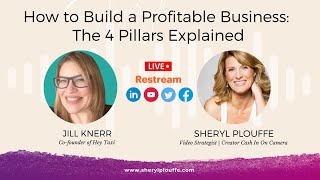
Jill Nehr, co-founder of HeyTaxi, breaks down four pillars for turning a side hustle into a profitable business: earn more, keep more (through smart tax write-offs and bootstrapping), access community and mentorship, and believe in yourself. She warns entrepreneurs against chasing revenue numbers without considering costs.
Chapters
If you're going to have a business, it's really the difference between having a business and having a hobby. So we've brought Jill Nehr on from HeyTaxi today to Cash In On Camera to talk about her 4 pillars of profitability. And I love this conversation, Jill, because I am a believer that profitability needs a new definition, right? We think so much about profitability as just being the product that I serve— or sorry, or that I offer.. But it's so much more than that. So I would love for you to share with us. I know you've been working with HeyTaxi and you established in 2020 and been working with female entrepreneurs for quite some time. Why is it that we're so confused about what profitability is?
Oh my gosh. Well, Cheryl, you and I connected on this very deeply because I think today anyone starting out has the intimidation factor of the $10,000, the $50,000 a month, the $100,000, making a million dollars in 6 months. But that is earnings, that is revenue, that is not your profit. So one of our first pillars is about earning more. And earning more, yes, you want to have the $100,000 a month, but you don't want to spend $600,000 getting there. You don't want to be in debt. A lot of people build up to that, but they haven't made wise choices in their business. So earning more is really important, and it's important to have multiple streams of revenue, not have simply one product, one service. Um, you know, I think you have a few courses, you have different things, you're not just banking on one offer, right? No.
I want to dig in on just something that you said there, and this is something we see, it's very prevalent on social media, right? Especially people who are running ads and these complicated funnels and things. It's like you know, um, you're made to feel like you're this small because you're not making $100,000 a month, right? But what you don't know is what is it taking that person to achieve that. Is it really the most profitable business? If it's, if it's costing you $120,000 to make the $100,000, you're really only making $20,000 a month. But the optics of it is really what they're going for. It's a big problem because if you dig in and you actually were to see the reality of what they're actually taking home, it's a very different picture.
I would add, Cheryl, that say you hit $100,000 and that would be awesome. You see somebody who hits it and truly makes $100,000 profit over 3 months and that's it. You also want a sustainable business model. You want something where you have consistent earnings. You want a long-term— most of us— legacy business. So when you start out with earnings, yes, earn as much as you can. But our second pillar of profitability, which is what you and I are talking about, is keep more. And the keep more is actually the impetus for starting HeyTaxi with my partner Dawn Cermak. We realized that there were so many people out there launching small businesses and especially home businesses, and they might take 6 months or a year. They might invest in setting themselves up, um, professional development. They put a lot of money into a business and then they haven't made anything. And what we want them to know is that as of day one, if you have a business, you have an iPhone, you have laptop, you you have a write-off. If you are consistently showing— this is US tax code— that you are in business to make profit, and we teach our, our members how to actually follow the steps to show up like not as a hobby but as a business having a profit motive. But you can take a loss, but with the taxes you're earning money. If you think about keeping more, if you or your partner have a W-2 income, then that business loss helps the bottom line. So I want everyone to know the power of taxes and keeping more. We also believe in making smart money choices. If you're starting out a business and say you, you have $5,000 to start a business or $100,000, don't spend it all on one thing. You don't have to have the Facebook ads, you don't have to have the website, you don't need the $40,000 a year coach when you're not ready for it. All of those things have value, but there's so much noise, Cheryl, telling people this is what you should do, this is how I did it. Well, did they do it in year 2? Did they do it after they were consistently making $5,000, $10,000, $20,000, $30,000 a month? I think there are a lot of mistakes being made that burn small business owners out from either— like I said, they don't know they can actually start taking tax write-offs when they're not yet making a profit or making a lot of money. And they invest too much too early in, in valuable assets and valuable training that really they don't need in their first year. And I can't afford it.
Yeah, I would love to know in your— you know, we often hear the term bootstrap, right? That if you're going to start a business and you're gonna have to bootstrap it, meaning that you're gonna have to kind of be very resourceful and try to make, you know, move and create a momentum with very little investment. What is your definition of bootstrapping?
Well, I would say we all start out from somewhere. We all have different knowledge bases when we start HeyTaxi. During the pandemic, I actually took a course on doing courses. I don't know how to do courses. I, to this day, know just enough about our platform, Kajabi, to know enough to manage a VA. And thank God she's very skilled. But at the beginning, I said, I need to know basic things to get us up and running, because until we launched and until we figured things out, I was just paying for a platform and taking a course or self-teaching. So there's a point at which no matter if you have some money to invest, I think it's a good idea to be knowledgeable in every part of your business that, you know, so you don't have to invest too soon. And as I said before, you don't have to— people think they have to have a website. You can get a free Facebook page. You know, there are a lot of decisions that you make. So you can, you can go a long way on bootstrapping is my point. You can go a long way on a hundred, couple hundred dollars a month. Or even the first few months doing a lot of free engagement online. I mean, there's social media, there's social media, and there's PayPal. You don't, you don't need to do a lot more than that to start a business and start making money.
I think a lot of people who are starting off starting a business, they look at people, the gurus, they look at, you know, I'm thinking about, I'm just looking at my bookshelf here, Marie Forleo, right? I'm just looking at her book here. So Marie Forleo as an example. She has been at this, I think, for 20 years. Okay, so she knows a lot. But 20 years ago, she didn't start off— she didn't start 20 years ago with a, a custom website that cost $15,000 and a coach for $100 grand and a— what, you know, like, that's not where she started. It looks like she— it looks like she was an overnight success. So then you see all these people who are like, oh, I guess that's the path I need to follow. I need to invest like Marie Forleo does today, as opposed to what she did 20 years ago. Which was bootstrapping, which was taking out, you know, I don't know what we had at that time, maybe a flip phone or something. But like on a blank brick wall, you know, it wasn't about the fancy studio and all the rest of it that she has today. So I guess my question is, what do you suggest to people who don't know what they don't know? They don't know what stage they should be at because they don't recognize what stage they're at.
Well, it's really interesting, and it's something actually I developed for our members. And you didn't know about this, but I have a Swiss cheese survey, and I created it actually to help our members. And it helps you find the holes in your business profitability. And it's a quick survey, and you can take it, and I would— I'll send you a follow-up little report. But you're self-scoring yourself. You're saying, social media, marketing, do I have bookkeeping, do I do my taxes? Like, where are the areas in sort of full scale what you should know about a business and what are you ignoring? Like, if you're all over the social media and you don't have a checking account or you don't know anything about the taxes, etc., you know, you're missing key parts to actually build a long-term business that's going to be successful. So I'm happy to share that with your audience. It should be available on our website. But what I want them to look at is, you know, if you think of the pillars of a business, yes, you need to know your customer. You have to think about marketing. You need to know something about your finances and not putting more out the door than coming in the door. You need to ideally have some sense of your business taxes and making sure that you're maximizing those. These are basic things that intimidate a lot of people, but it's key to just starting out and making good business choices. And I really think that knowledge is power. Not everybody has spent— I've spent over 25 years and DC, profits, not-for-profits, doing HR, finance, strategic planning. So I know this, but it also is very accessible. And I just think people need to slow down and be thoughtful about where they're spending money. We talk to people, Cheryl, who have gone into their retirement, and you know there's a penalty. That's a huge thing to, to go into your stability, your nest egg, not a savings account, but your retirement to fund things, and then you burn out, or you have a household, a family who's saying, what, what in the hell are you doing? You know, and you're not showing a profit. And it just becomes— it becomes a very stressful situation. So I think people need to pause and say, what do I actually— what's actually going to bring me emails, right? That's part of your profit, you know, not just getting on social media, not just going live, not just being on events, but actually getting the contact information so you can continue to touch on those prospects. I mean, a lot of people put a lot of noise into TikToks and into Instagram, and I love all of them. I do follow all these things because I have a 16-year-old. But what are you doing to make sure that that is going to be— there's going to be a return on that investment because your time is an investment. So there's just a lot of— I mean, it's common sense if you know it, but I'm not going to say that everybody should know these things.
They don't. They don't know it because you and I both talk to people all the time who are, you know, going, gee, I've been doing this for 4 years and I'm not making any money. I haven't had any clients in a long, long time. And come to discover, as you dig into it, that— but they have a beautiful website that they spent $10,000 on, this custom website, but they don't realize that the website is not the thing that's actually driving the traffic. It has a different purpose today than it did 10, 15 years ago. But they don't know that. So a lot of people are, you know, they're stuck in this cycle of trying to imitate what they see other people doing. They think it's the right path, but they don't know any better. And I think it really comes back to proof of concept. You know, starting on like the idea of bootstrapping. I like the idea of, you know, and I didn't necessarily do that too, too well in the early stages either. I was a person who was you know, probably investing in things that I didn't really have the money for. But, um, but I did it anyway, and I found a way. I found a way through it. And I was still bootstrapping some things, but I think I did invest in things that I probably shouldn't have at that time. Looking at it now, it's like, okay, now would have been the time to invest in that thing. But I didn't know any better. So I think it's sometimes challenging for people to know, well, where am I at in the journey? Because it is a journey, it's a path, it's a marathon, not a sprint. And so it can be really challenging. But proof of concept, I just want to ask you about that, the importance of that. Where do you see that falling in, into the grand scheme of building a business?
Well, I actually— it's— this is a great way to segue into our third pillar of profitability, which is access. Access is— part of it is access to community, access to trusted mentors, and colleagues in this virtual space. It's unlimited, but finding people that will tell you, you know, you can probably pay a graphic designer $150, but you're starting out, find a VA for $8. You know, just somebody who's been there. Lessons learned is one of the most valuable ways to bootstrap or anything is learn how do I do it? How did you do it? How did you start your business? What were the key lessons learned, the mistakes made? And, you know, I think we did Facebook ads way too early. You know, there's just things we all do.
No, we all do that. Yeah, we all have some lessons we learn.
Yeah. But then you want to share it with others. And I really love that in Hey, Taxi, that we're women supporting women. So I find, I believe it's a safe space where we can be completely honest with you. You never should have gone into retirement. But one of my favorite Maya Angelou quotes, when you know better, you do better. So don't beat yourself up. Also, people fail at business because they beat themselves up over failure, and failure is just an opportunity to learn. Yeah, it can be hurtful, it can be hard, but you have to learn from those lessons, but also learn from the lessons of others more successful than you. Some of that can be done simply from listening to podcasts of people that you look up to because they share their lessons learned. Getting in a community, going to a course with people who are experts in their area.. But I really think you should find some synergies with the core values of the people you engage, whether they're your bookkeeper, your coach, your, you know, anybody you engage with, a trainer, somebody who puts out a course. I think you need to feel that they align with where you're going and where your core values are. And you asked about proof of concept. So sort of the other thing is once you get a trusted community or you have a peer group, It's really great to go out there and say, hey, would you, would you give me feedback on this? I mean, it is a test audience of your peers and saying, hey, I'm trying this course, but what do you think? Or have just getting free advice. You know what the easiest way to reach out to somebody that intimidates you that you think they'll never talk to you to say, would you give me some free advice? Everyone loves to give you free advice. I hate to say it, but it's so invaluable, but you're not asking them for a sale. You're not asking them for a sponsorship. You're not, you're asking them for their guidance. And I think so many people will be willing to get on a Zoom and talk you through something or share their lessons learned. And I think that is really important.
I think that's one of, you know, that is one of the tenets that we teach with Profitable Podcast Method is the idea that you're building relationships so that you can then have the avail of going to someone in your network and being able to ask that question that could be worth $25,000. The answer to that question could be worth a lot of money to you. But being able to build your network and connections, to be able to rely on people in your network to ask questions, I think is a big part of it. So, um, so we've gone through the first 3 pillars of profitability. What is the 4th one, Jill?
Okay, so we did earn more, keep more, access more. This is my favorite, it's believe more. Oh, hello, because You know, we all want to be the empowered CEO of our business, but so many of us at any level, you can ask, and it's— I think it's more in females— we have imposter syndrome. I'm not good enough. I don't know enough. I don't know anything about taxes. How can I run a business? I don't know anything about business plans. And but I might know that, but you know about social media, you know about graphic design, you know about, um, meditation practices. Like everyone has a different zone of genius and a different expertise. So I want women not to downplay what theirs is just because they don't know everything. Nobody's going to know anything. And I think it's so powerful to find— and again, this is community and access— other people, and in our case, women, who will build you up, who will say, you know, everyone starts somewhere and we're here to make sure everyone succeeds. And I think that is the kind of community, that is the kind of response you want to get from anybody that you ask for guidance, you ask for suggestions. I mean, I have found through the pandemic, I have met so many— I mean, I would say hundreds of women I never knew before, women who are fascinating and passionate and exciting and doing amazing things in areas I never would have thought there could be businesses. Just not that they couldn't, but wouldn't have known. And so I want everyone out there to know You can do it. You can find a way to have a profitable business following your passion and your own zone of genius. So find other people that are going to support you in that belief.
I 100% agree. And thinking back on my own journey, there were definitely things that I did that, again, building community, things, access, really leaned into that. Did some bootstrapping, also invested in things, maybe some things a little earlier than I maybe should have because I didn't know any better, but I learned the lesson and then I applied that going forward. The entire process is a process, and, and it's just great to be able to have a framework like you've described here of these 4 pillars of profitability so that we can really think about it from the perspective of, do I have a hobby or do I have a business? And I think that is often the case where we have people who are behaving as if they have a hobby.
Or they have other people telling them that it's a hobby. Yeah, just don't listen.
Yeah, true.
Yeah.
How do people get in touch? And actually, you have a mastermind retreat, I think, is coming up as well. Would you tell us a little bit about it while I show it on the screen?
Of course. We are so excited. We are hosting our first International Business Mastermind Retreat for female entrepreneurs, October 26th through 30th in Puerto Vallarta, Mexico. It is going to be a small group of 15 women, and we are going to release blocks. We're going to do experiential, like, mindset, personal growth work. We are going to do your Profitability Pyramid. We are going to do business plans, the strategy behind that. We are going to talk about how this group of women who are going to have 5 days of connection and celebration and learning how we as a group at that end of that 5 days are going to go forward and make an impact on the world. And I'm so excited because I think we all know that as women, when we earn more, we give more. We do want to make a difference. And so we're going to come out of this with a mission, but we're also staying in a luxury villa, chef-prepared meals. We are not slumming it, and it's actually very reasonable, but it's going to be an experience of a lifetime. And you are going to meet women that you will always have at your side going forward.
So I'm really excited. It looks like a beautiful resort and an awesome opportunity. I'm putting the URL on the screen, ataxiacademy.com/mastermind-retreat, if you are listening to the podcast. So fantastic stuff. One thing that we do, Jill, on the show is we have a little segment we call Stop Marketing Like It's 1999. What is a— and it could be related to this or unrelated to profitability, but what is a tip, a tool, a tactic that's helping you and Don market HeyTaxi that's working for you at the moment? It could be, oh, I found this amazing app, or we started this new strategy, or something that you'd like to share briefly with the audience.
Yeah, I laugh because I think of something that worked in '99. Think of the Home Shopping Network. People would keep tuning in to see a live video, to see people who are live, who are engaging them. But they became known elements. They became friends. They became personalities. So if you pivot that, don't put yourself on 24/7 just talking nonstop. But if you show up with your personality in small bits, I think videos— when you show up live, when you go on video, when you do an interview, any chance you have to show up, share your story, share who you are, That is the way to connect with your ideal client, not just putting up pictures of pretty houses or lakes or, you know, you, you, you and your family as much as you want to share. But sharing who you are at essence is what's going to attract the people you want to attract.
Yeah, I agree. It's the human element. People want to connect with other human beings. And that's what I'm hearing you say. Jill Nehr, thank you so much for being on Cashin' on Camera today. I'm looking forward to speaking at your VIP guest training that's coming up for your members.
Yes, and that would be in our Facebook community, Cheryl. So anybody in this audience can join the Hey Taxi Facebook community for free and get some live trainings and see Cheryl again sharing more of her genius zone. Awesome.
Thank you so much, Jill, for being on the show today. Really appreciate it.
Thank you so much.
More from Sheryl



From 'agreeable' to 'ruthless mentor' to 'strategic sparring partner' #substack #shorts







