How To Conduct A Successful Connection Call
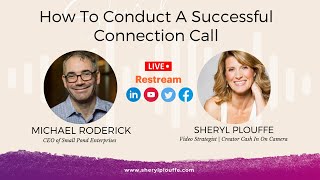
Sheryl Plouffe and Michael Roderick break down connection calls, the non-sales conversations coaches and consultants use to build networks and find referral partners. Keep them 15 to 30 minutes, structure around your origin story and theirs, and always ask "Who can I connect you to?" End with a concrete next step like an introduction or podcast invite.
Chapters
People who introduce you to more people and then you keep building. And the next thing you know, you have a network of people that you know. I love how that works. And Michael Roderick is someone who that happened to us actually last month. We had a connection call. And on that call, we talked about a lot of different things. And what came of that conversation was my asking him to come on to Cash In On Camera to share just how he conducted that call because it went so smoothly. And I could see some of the things that he was doing. And I thought, you know what? We need to bring this to the audience. So great to have you here, Michael. Connection calls are known by a variety of different names. But why is it so important to have connection calls be part of your marketing strategy?
Yeah, so the biggest thing is that connection calls help you to be able to actually refine the market that you're selling to. When you have a connection call, you can start to figure out, is the offer that, that I have attracting the people that are, that are interested in it? Is this a good person who could be a referral partner for me? It's a good way for you to start to not only vet the offer that you have, but also start to figure out like, who are my people? Because you don't want to be marketing to people who either can't afford your services or can't refer you. And you want to take the time to really understand what's going on with somebody else, sort of where somebody else is, so that you can say, okay, now I know that this offer kind of fits for this, you know, for this market. And now I know that this is the type of person who is a good referral partner or is a good person to sort of have within the, within sort of the immediate circle.
Yeah. And you have to ask the right questions, which I know we're going to get to in this conversation. I want to back up just one step though, just to explain what we're talking about here in terms of what a connection call is, right? We're talking about connection calls. Sometimes people in the virtual space today might call it a virtual coffee. We hear that term a lot. Or people might say it's an introductory call. This is not necessarily even really a strategy call, nor is it a sales call. This is a call to meet people. So, I just want to make that distinction because there's so many different kinds of calls that we do in the online space. But this is especially important for people, coaches, consultants, frankly entrepreneurs of any description. But really connection calls, you can call it whatever you want. But it's really a crucial thing because you're trying to expand your network. So, back to what you were just mentioning about the questions. If you're asking the right questions and you're leading the conversation the right way, which you're going to share with us, you're able to discover, like you said, you know, is this— is there a connection here? Can we work together in some capacity? And what are, what are some of the capacities in which we could discover that we might be able to work with a person if there's a match?
Yeah, so I, I always love to start with origin story and get a sense of sort of why is this person in the business, like what are they currently doing, like where are they because it tells you exactly where they kind of fit within the entrepreneurial world. So if you're talking to another coach, you're going to learn either they just started coaching, they have been coaching for a really long time, you know, they, they work with coaches, right? Or let's say you're just talking to somebody who's in sales. You're going to learn, is this somebody who is teaching sales? Is this somebody who is actually in sales for, for an organization? And you're going to start to figure out more about that type of person, that type of role, and that's gonna inform all of your future outreach. So as you start to think about like, who do I wanna know? Who's it helpful to know? You're gonna see those things and you're gonna start to say, oh, okay, now I understand what this position actually is. Now I understand what this person actually, what this person actually does. So the next call you have with somebody who fits that category, Now you can ask even better, more specific questions because now you have other groups to kind of compare them to.
And one important distinction I think about connection calls too is that this is not the call where you're uncovering every single thing there is to know about that person on the face of the planet, right? Like, it's a very specific kind of call and typically it's going to be— well, I mean, I think I have an idea of what the right length is, but I want to hear from you. What is the ideal length in your estimation for, uh, you know, a connection call or a virtual coffee?
So I think it varies based on where you are in your business. I think in the early stages of your business, you are more than welcome to have a 45 or 60-minute call to start to, to start to just like get used to that process, right? But as you go up the chain, and especially as your time becomes much more sort of truncated, you do want to get into more of that 15 to 30 minutes max kind of world. Otherwise you're gonna just fill up your calendar and your calendar cannot just— and I think this is super important, I think a lot of people forget this— your calendar cannot only be filled with connection calls. Yes, that is death. It is a very, very dangerous thing. I've seen lots of people end up in sort of a death by meeting you know, kind of scenario because they, they set up all these connection calls, they meet all of these people, but they never really have any other call that helps them move their business forward. So you have to be very careful of that.
Well, I'm glad that you said that about the 15 to 30 minute mark. I'm about at the 20 minute mark. I find 20 minutes is just the right amount of time. I have mine set up in my Calendly, and you know, people use different scheduling tools or I mean, if you're starting out and you want to do them manually, I guess that's possible. But I love having a scheduling tool. I think the 20-minute mark is just about enough time for each person to go through and share enough about themselves and to come to determination of is there something here? Should we move to something else? So, I love that. Exactly. So, you mentioned the origin story and kind of starting there. What is another component of a successful successful connection call? Yeah.
So I think it's really important to, at some point within the call, have a discussion of the trajectory that the other person is on. Now, that can be in regards to sort of what their, you know, what their vision is, what they're hoping for next. That can also be in reference to a problem or a challenge that they're experiencing. But one caveat to that is I am not a very firm believer or very interested in the idea of opening with how can I help you or tell me what your problem is, because it ends up really kind of shifting the power dynamic. And I think you want that to be like a nice flow. So I think if you get to later on in the conversation and you feel like, okay, yeah, we're kind of on the same page, I think it's fine to open up with, you know, is there anything right now that's a challenge for you or something that— a code you're trying to crack? And ask them that. But I never, never start from the place of how can I help you? What do you need? Because it really just changes the entire flow of the conversation, at least in my experience.
Yeah. And as you said that, I couldn't help but to think that the dynamic changes then and it becomes— it goes from being a connection call to becoming a coaching call because now especially because we both work with people who are, you know, service-driven givers. We want to help people. And so if you go down that path, you could suddenly find yourself in a place where you're coaching, and that's not the intent of this call.
Exactly, exactly. And that's a danger I think a lot of, uh, a lot of coaches specifically end up having, is that they try— they think that, and they've been told in some cases, that you need to show your expertise in the, in the conversation in order for somebody to hire you. But in a connection call environment, they don't even trust you yet. So you can't just jump into a coaching conversation because they don't even know whether or not you have that credibility. So I always say stay away from that, you know, take the time to kind of get to know them, observe what's going on. Feel free to make a suggestion if there's something that you're like, oh, I found that this has worked for me, or I found that this has been helpful. But never go into that realm of like, this is what you should do, because nobody wants to be told what to do.
Right. Yeah, no, it's a really good point. So, one thing that happened when we had our connection call about a month or so ago is you did something where you said, I don't remember how you worded it. Maybe you can remind me how you worded it exactly. But you said, "Who can I connect you to?" It was this idea that you wanted to figure out if there was someone that you could introduce me to. How did— why is that an important component of the call?
Yeah, so the thing is, most of the time, especially if it's a connection call, you're probably not going to be the thing that the other person needs. Like every once in a while that may pop into play and they're like, oh my God, what you're talking about is exactly what I need and I wanna do this. But 9 times out of 10, that's not going to be the case. So the best thing that you can do in that scenario is change their perception of you from a service provider to a resource. The second that somebody sees you as a resource, you completely change the dynamic. And the best way that you can present yourself as a resource is to basically say, listen, I'm doing this. I'm out there talking to lots of different types of people, and there's a pretty good chance that I might be running into somebody who could help with whatever your current thing is. You know, whatever you're thinking about right now, whatever you're kind of looking, looking for right now. So if you've got some ideas of folks, it's, it's helpful for you to talk, talk about, you know, talk to. I'm more than happy to keep an eye out and see if, you know, I can send some folks your way.
Yeah, I love that. And as a result of that, you connected me with Ella Mae, and now she's, she's likely going to be on this show. And then, you know, it's Yeah, and it's really great. So that's another component of it. And I didn't want to like jump the line here on your methodology, but what is another component of a successful connection call?
Yeah, I think it's figuring out, is there a, is there a next step? Is there something else that you're going to, you know, is there something else that you're going to do together? And sometimes there isn't, right? But I always like to think about, is there some additional layer, you you know, to this depending on sort of who the person is and sort of what the conversation is. So in some cases, that's the person invites you to be on their podcast, right? Or invites you to sort of have a conversation, or you invite them to be on your thing, or you make an offer of an introduction. But there, there should be some element that basically makes it so that the call just doesn't die, right? So that there is something at the end that both parties can kind of look forward to and be thinking about and say, wow, you know what, that, that was such a cool experience. And then I'm reminded of that person later because I got this introduction or because I found out about this other, you know, this other cool thing and sort of going through that, you know, that process.
Yeah, I love that. And I think that that requires a little bit of thought and some strategy before you start conducting these calls. And that's the reason why we're doing this topic is to to let that be a reminder that you want to have some idea of what are some options that you have available so that when you get to the end of the call, it isn't just a dropped call just for the sake of it, right? It's like, yes, what's the next step? So in this case, it was, hey Michael, come on my show and let's talk about this because it's an important topic. But are there some other things that we're missing in terms of the components of a successful connection call?
I mean, I think that there are, there's the aspect of you have to be conscious of how much you talk versus how much they talk. And I always like to spend more time asking questions and have whatever I have to say be as succinct as possible. So I actually take the time to really, really polish what it is that I have to say so that I can tell you my origin story in under a minute. And then I can tell you the way that I provide value for my clients in less than 30 seconds usually. And it makes it so that even if we spent 90% of the call talking about you, I can give you exactly what I need to give you, and we are still— you still know something about me. I think that sometimes the mistake can be either you spend the entire call just talking about the other person and you never let them know you know, about you and sort of what the scenario is. Or the flip side, you spend the entire call talking about you and you never really get into— you never really get into them. And then they don't want to have a call anymore.
Right? Yeah. It's finding that ratio. And I think that you have to have some awareness as you're conducting that call to be able to identify, am I talking too much? Am I overtaking? Am I monopolizing this conversation or not? Exactly. You and I, I'm sure, have both been on a lot of networking calls and a lot of different Zooms over the last many years where not everyone has that skill, shall we say.
Yes. Yeah, yeah. I classify my meetings in 3 categories. So the top-tier connection call meeting that I have is we have a really great conversation and there is some way that, you know, we can potentially help each other. And there's probably multiple ways that we can help each other. Then there's the middle-of-the-road sort of trading type of thing. It's like a two-way, like, I'll do this for you, you do this for me, and it's kind of like, yeah, we kind of like each other, you know, let's kind of see where it goes. And it's just like we're not as motivated to be as helpful because it's really just transactional, right? Like it's really sort of back and forth. I often refer to it as the two-way pitch meeting. Which a lot of people teach in networking environments, which is bad education, right? And then the last, the last one is what I call the steamroller meeting, and that's when you are basically Bruce Willis in The Sixth Sense because they just go, go, go, go, and you really don't ever get a word in edgewise.
Right, that's so funny. Well, I love these tips. I think this is This is a really great framework to conduct these types of calls. And listen, if you're watching on video right now, we're on YouTube, Facebook, Twitter, LinkedIn, and you're watching this, or maybe you're listening to the audio podcast and you're saying to yourself, I'm not conducting these types of calls. I'm just going straight for the jugular. I'm just going straight for the sales call. Really give consideration to incorporating the connection call, or the virtual coffee, or the introductory call. Into your marketing strategy because this is really key to growing your network and building relationships. And it is really— this is all about relationships. So, and you know what I love about this? It just segues perfectly into what it is that you're building, Michael, with Referable Brand. Can you tell us a little bit about that?
Sure. So the work that I often do is helping thoughtful givers become thought leaders. And a lot of the time what happens is entrepreneurs really know their why. They've got that piece down, but they don't necessarily have their IF, which is their innovative framework, their way of presenting to the world their big idea, their concept. So what I do is I help them create that referable brand. I help them come up with that thing, that powerful persuasive framework that's going to help them really kind of get their ideas out there. So basically I focus on that aspect of referability.
Yeah, and do you do that with the Referability Rater? Is that how you do it?
Yes. So basically, if folks answer the questions in the Referability Rater, what it does is it tells you how referable you are. So it will actually help you see where are the gaps in my referability, and it'll give you a score so you can see, okay, these are the things I need to work on in regards to how referable my ideas are, how referable my brand is. And then it kind of breaks down those things so you can see where are the areas that you're falling down in that, in that side of things.
Yeah.
And the URL for that again is, is myreferabilityrater.com.
Fantastic. Awesome. Hey, one thing that we do on Cash In On Camera is we have a little segment we call Stop Marketing Like It's $19.99. And I would love to know what is something that you're doing to market yourself, whether it be, you know, a tip a tool, a tactic, or technique that's really working to help you get yourself out there?
Yeah, I have fallen in love with the aspect of a voice note or a voice message. It is so, so powerful to basically drop a line on one of these platforms and have somebody physically hear your voice. It is just It has been a game changer for me in just sort of just dropping a line to somebody and being like, hey, I was thinking of you. Here's what I'm thinking. Here's what I noticed about the thing that you wrote. Because so few people do it that it just like, you get, your responses are so much faster. If you write something, you may wait forever for somebody to respond to it. But if you send a voice message, it's very, very rare that people do not respond.
Do you have a— is there a special tool that you use that you'd like to share? Is it like, is there an app?
All of the platforms have a voice message sort of component to them.
Okay, you're not using a third party to do that, but you're doing it within the— like, say you're using the voicemail functionality within a lot of the messaging tools.
Exactly.
I see.
I love it. Exactly. Like all of these, yeah, these platforms, they have like, if you look at the bottom, they'll— it'll show you like a little microphone. You just click on that and it lets you record like a 50-second, minute-long voice message.
It's funny, sometimes like I'll talk to people and I'll mention maybe like I'm more on the video side, so I'll say, hey, if there's a video functionality, you know, send a quick little video. But audio is amazing as well. And then often people say, oh, I didn't even notice that was there. It's like, yes, yeah, look at all of the functionality that's available to you. And if the more The more dynamic I think that you can make that, the better off that you'll be because you'll stand out. You will stand out.
Yeah, exactly.
This has been great. Thank you so much for this conversation today. I think you've given our audience some great food for thought around how to conduct a successful connection call with these tips and really look forward to staying connected to you.
Yes, same here. Thank you so much for having me. It was an absolute blast.
Good. Thank you so much.
More from Sheryl



From 'agreeable' to 'ruthless mentor' to 'strategic sparring partner' #substack #shorts







