How To Create a Powerful Marketing Message That Stands Out
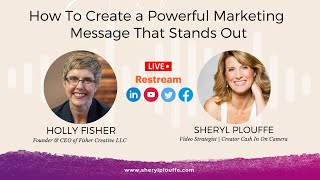
Holly Fisher explains why confusing marketing copy kills engagement. Listen to customers to find their single biggest problem, then position your business as the guide and them as the hero. Your website's top line should state the problem you solve and the benefit to visitors, not your company history.
Chapters
Clear marketing message. Not just a marketing message. A clear marketing message. Holly Fisher is with us today to talk about just that. How can you create a powerful, clear marketing message that's actually going to move your business forward and help you to stand out, which is obviously very important in this day and age. Holly, it's so great to be here with you. You and I are both Dames. We met through the Dames. And so, I'm just excited to have you here today.
Yeah, I'm happy to be here. Thanks so much for inviting me on the show.
This is an important topic because I think a lot of people really get caught up and overthink sometimes their marketing message. What is— why is it so important? Why is it so important to have a clear marketing message?
Yes, you're right. A lot of folks get caught up in trying to be really clever and really cute with their marketing. And then what winds up happening is people don't really understand what you do. They don't really understand what you offer or how you can help them solve a problem. And so sometimes it's really important to just kind of take that step back and go, okay, do people actually understand what I do? It feels sometimes really simple, but that's okay.
I can't help but to think that really it's about more of a less is more type of approach when it comes to this.
Absolutely.
It is hard to do, I think, because you're absolutely right. I think people think, I've got to be really clever. I've got to outsmart other people. But when you do that and you take that approach, you end up confusing people. And then, if you're confusing people, a confused mind does nothing, right?
Exactly.
And it's hard, I think, because I think I've gotten caught up in this as well. And maybe I still get caught up in this. And that is, it's like, well, I have to try to find a way to stand out from other people who are saying the same thing. Because gee, isn't it just obvious that if I'm using plain language, if I'm using clear language and lots of other people are using clear and plain language, how do I stand out then?
Yeah, the thing about that is that a lot of your competitors are probably not using clear language. They're probably getting caught up in the, I have to be clever. I have to be cute. I have to come up with some something really catchy, it's some sort of jargon, right? Marketing speak. And so if you can be very clear, then you are going to be able to stand out because, you know, our brains are designed to conserve calories, right? So if I land on your website and I'm having to spend a lot of time figuring out what you do and how you can help me, I'm not going to do it. I'm just going to bounce and I'm going to go to the next website that's going to be more clear and I can navigate more easily.
I think sometimes that when we are in business, whether we're starting out, whether we've been in business for many, many years, we have a lot of vernacular that either we've created or that has been developed over the course of time. So again, cute names and things of that nature in our businesses. And we think, oh well, if I'm marketing, I must include those things in my marketing. It would make sense if I'm trying to sell that thing with a cute name, that course, that program, that mastermind that I spent 6 months trying to figure the name out for. I better include that in my marketing. But that's not always true, is it?
Absolutely. It's really easy for us because we are so close to the business to just assume people know what we're talking about. But if you're marketing to people that, you know, they don't work in your business, they don't know exactly what you do. They don't don't speak the jargon, right, or the terminology that maybe you use internally. So you really have to remember that you need to remove all of that kind of jargon and insider language from your marketing and use the words that your customers are using.
I'm so glad you brought that up because that was exactly what I was thinking about. There is something to be said for gathering intelligence about your ideal customer and client. And there's a variety of different ways in which you can do that. Like, you could, you can read comments on your social media, you can survey people, you can just listen to conversations and make notes about how people are saying different things or what kind of questions they're asking. So how important is it to actually be listening to your ideal person?
Yes, that is so important. I spend a lot of time talking with my clients about that, going, okay, what are the words that people are using? Like when they come to you and say, I need whatever, like what are they saying? And if you're hearing the same things over and over again, that's a really great indication that, you know, that's a real problem that people have. And if they're talking about it in a certain way, then you need to be talking about it in that same way, because then it's gonna trigger something in their mind that goes, yes, that's exactly my problem. That's exactly what I'm looking for. They get me.
Yeah, you want to have the other person saying, 'Gee, how did you get into my brain? How did you know that?
Do you—
are you spying on me? Is my office bugged?' Did you— I actually had— it was probably one of the best compliments I ever received where I had someone respond that way to me at one point. You know, they're saying, 'Gee, that's exactly what I was thinking,' or 'That's exactly how I feel.' And I thought, Okay, great. I'm on to something, right? I'm actually using the language and really what's resonating with them. And it was probably the highest compliment that someone could have paid to me without them realizing it.
Yeah, you're 100% correct. Yes. And so you do have to really pay attention to the things that your customers and your clients are saying to you. And like you said, you can just do that even just with listening. You know, if you do a lot of discovery calls or even consultations with people, just notice if the same phrases, the same words, the same problems continue to kind of bubble to the surface.
I think when you're starting out, it's one of the most important things that you can do as you're, especially if you're in a service-based business. If you're having consultation calls or strategy calls or calls by any other name, that you would get off of that call and make notes. Make notes about the language that they use, the problems that they were and how they actually said and expressed those problems. It's one of the most important things you can do. Now, I know that you are a StoryBrand Certified Guide. You and I are both fans of Donald Miller and his StoryBrand framework. Love it. So, talk to us about what can we do to really stand out in the marketplace. Creating a clear message, very important. But how do we go about doing that?
Yes, absolutely. Well, definitely recommend checking out Building a Story Brand by Donald Miller if you haven't already done that. That gives you a great overview of that framework that does help you create that really clear message. And a couple of really important points in that are making sure that you have identified that problem that you're solving for your customers. And you do have to land on really one problem. Sometimes as businesses we think, well, we solve all, all kinds of problems for people. And we really need to land on the one thing, you know, if you're solving a problem for, let's say, 85 to 90% of your customers, right? What is that one thing? So making sure that you've thought about that problem, that obstacle that people are having to overcome. You also have to think about how that problem is making them feel internally, right? People make a lot of decisions based on emotions. And so we need to understand how they're feeling. And then also it's just really important if you, if you spend any time listening to StoryBrand, you'll hear us talk about the importance of being the guide, making your customer the hero of the story. It's not all about you. It's not all about how long you've been in business, all the accolades, all the wonderful things you've done, your company history. It's really about how are you helping customers and clients be more successful.
And I think that's how it was. It was done long ago, right? Back in the day, as they say. People's marketing and their promotion of themselves was very self-centered. It was, 'I am the president of such and such and I have— and here are my accolades and my awards,' and things like that. And it just, it's progressed to a point now where that just really doesn't work anymore. It's not to say that you can't utilize those things as credibility tools to demonstrate that you are an expert or an authority in a certain space. Like, I think there are ways you can use it and should. But it shouldn't necessarily permeate, I think, every part of your marketing. Because at the end of the day, people really want just results. I don't think that they're as impressed with whatever letters are behind your name, or what certification, or what award, or whatever thing that you got. It's important. I'm not saying it isn't. But Should that be the first and foremost thing that you go out there with in your marketing message? Probably not.
Yeah, you're 100% correct there. If your website— if the first thing on your website is your company history, if it's a picture of your team, if it's a picture of your building, right, that's a problem, right? Again, like you said, there is a place for that. We can certainly include some of those things to help add that credibility and that authority, but First, we need to make sure that people understand the problem that we're solving for them and that we really have their best interests at heart. We're all focused on making them or their business or their families or whatnot be successful. And once we've made that message really clear, then we can talk a little bit more about all of our awards and accolades.
Well, I know that obviously building websites and the wireframes and the kind of the layout of websites is something that you do in addition to copywriting and that sort of thing. Let's just talk about websites real quick because I know on your website, you have a really great free guide that helps people understand what some of the mistakes that they're making on their website. And it ties into what you've just mentioned, right? The beginning of your website shouldn't be, "Hey, here's my team or our company history." Yet, why do so many people gravitate toward doing that?
I think we just get— we get excited about our business. I think people are just— they want to talk about their business. They're proud of their business, as they should be. They're proud of the work they do or the team that they have. Again, that is 100% appropriate. You should be proud of your business, right, if you're a business owner. But again, we have to remember that as consumers, we're always thinking, what's in it for me, right? We do it ourselves, right? If I'm going to a business or I'm looking for a particular service, I'm really focused on, okay, here's, here's the issue I have. What can you do to help me with it? Right. And I'm less concerned about when your business started and, you know, you were in this location and then you moved and then you built a new building. Like, I don't care. Help me solve my problem. Right. I don't need all of that backstory. Right. Okay.
Well, let's take a look because, you know, your website's obviously obviously beautifully designed, and, and it's a really great case example of how to do it right. Yes, you know, it's very clear, and nowhere in this, at least above the fold here on your website, do we see the history of you've been a StoryBrand Certified Guide for 5 years. As impressive as that is, it's not in this section for a reason.
That's right, right, exactly. You want to make sure that when people land on the website, they know what they're, what they're getting, right, what you do and how they're going to benefit. And then of course you have to give them a way to engage and interact with you in some sort of call to action.
Yeah, and there's a whole— obviously there's, there's a lot to say about that. We could do a whole entire episode on just how to lay out a website. That is an entirely different topic. But coming back to the, the clear marketing message, um, you said solving one problem or identifying one problem. Sometimes I think that's really difficult for people to do because they know that they do solve multiple problems. So How broad do you go in the definition of what that one singular problem is?
Yeah, that really can be a struggle for folks because they do, as you said, feel like they're solving a lot of problems. So it's really figuring out that one thing that people are coming to you for. And again, that kind of goes back to what we were talking about earlier, sort of listening to people. What's that one thing that they're always saying, I need help with what? Right? A lot of folks are calling me, I need help with a website, right? I need help with copywriting. And so, you know, I have to figure out what is that problem that folks have so that I can really speak into that in my marketing.
And I think that there is something— obviously it has a huge connection to the offer and the things that you do and how you serve people. And sometimes I think that maybe that's where the confusion lies because we We have business owners who are out there doing so many things in the course of their business. They offer solutions to 20 different things. So then, when they go to market those 20 different things, they end up having a very convoluted and confusing marketing message. And it really stems from the fact that their business itself is not structured properly.
That's a great point. Absolutely. And sometimes, it's a matter of just sort of figuring out Where do you, where do you want to get customers? What do you want customers for? If you're offering a bunch of different things, are they all successful? Are they all profitable? You know, maybe you need to really focus on a certain aspect of your business that is going to be generating more income, more customers, more revenue, and really use your marketing message for that. Yeah.
Which then helps you streamline. So if you start at that level of the business itself, and say, okay, maybe there's some work that needs to be done on who I am and what I do and who I serve so that then when I get to the part where I'm creating the marketing message, I can be more clear because I am identifying that one problem. Internal feelings obviously is really important. And yeah, putting yourself saying, you know what? This is about being the guide and not the hero I think is a key thing. Absolutely. Holly, these are all great points. I want to ask you, we have a segment we call Stop Marketing Like It's 1999. This is where we dig into Holly and we start to kind of figure out what do you do specifically to help yourself to market yourself? And it may be what we've talked about or something else, a tip, a tool, a tactic or technique that's helping you to market for the year we live in.
Yeah, I think some of it goes back to what we were talking about with the website. Back in 1999, websites were pretty new, right? And so I think our temptation at that point was to go, I'm gonna tell you all about myself. On my website because it's new and it's exciting and I want to brag about my business. And so now we know better, right? And we know that our website needs to really be focused on the customer. So I think that's a huge shift and a great way for you to stop marketing like it's 1999. And I've even done that myself when I first started my business. I think I had it a little more focused on me, right? Let me tell everybody all the things that I've done. Yeah, me too.
For sure. We've all done that. We all did that.
Yes. And now that we know better, we do better, right? And so we can change our websites and we can really make them focused on how to invite that customer into a story and help them become the hero.
Well, I was just showing actually on the screen, you have an awesome free guide here. Can you tell us about this?
Yeah, this is a free guide, 3 Things Missing from Your Website. And actually, they're very simple things that you could probably change today that would really really help improve your website.
Awesome, Holly, thank you so much. This was really fun, great conversation. Hope you'll come back sometime and maybe we can dig into the website stuff more specifically on your next appearance.
I'd love that, that would be wonderful. Thank you.
You're welcome. So people can get in touch with your website. Are there other ways? And you have a Facebook group, I think, as well.
I do, yeah, certainly. My website's a great place to find me and track me down. And then I do have a free Facebook group called Fuel for Your Marketing open to anyone, and I share a lot of marketing tips and tricks and different things in that group. So anyone's welcome to join that. Fantastic.
Holly, thank you so much for being here today. Really appreciate it.
Thank
More from Sheryl



From 'agreeable' to 'ruthless mentor' to 'strategic sparring partner' #substack #shorts







