How To Get Real, Engaged Followers That Convert To Sales
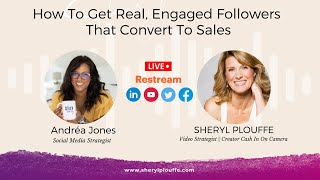
In this livestream episode of Cash In On Camera, host Sheryl Plouffe interviews social media strategist Andrea Jones about building an engaged audience that drives sales. They argue that follower count alone is insufficient; true value lies in engagement and community building. Andrea outlines the need for upfront investment—either time, money, or both—and recommends setting clear time boundaries (e.g., about an hour per week for content creation) while using organic tactics before spending on ads. A core content strategy is presented: one out of every five posts should directly promote an offer or a next-step action (consultation, lead magnet, DM), while the remaining posts focus on value, usefulness, humor, and shareability to spark engagement. They discuss brand‑awareness tactics such as short, discoverable videos (Reels, TikToks), thoughtful comments on high‑profile accounts, and collaborations with complementary professionals. Self‑awareness is emphasized as a way to diagnose where a creator is in the customer‑journey funnel and to adjust the mix of content and promotion. Andrea advises early‑stage entrepreneurs to handle engagement personally to gather audience insights, reserving outsourcing for later when the business vision is clearer. Throughout, they stress the importance of useful, audience‑centric content, short‑form video for initial awareness, and longer, deeper content for later funnel stages. The episode concludes with Andrea sharing her contact points (The Savvy Social Podcast, Instagram @OnlineDrea) for listeners seeking further guidance.
Chapters
Followers is a great, great thing. However, having engaged— that adjective is very important— having engaged followers is even better. Andrea Jones is with us today, and she's here on Cash In On Camera to share some tips and really to help us understand the importance of engagement and how it can lead to more sales. She is a social media strategist, and I'm excited, Andrea, to get into this conversation with you because we were talking about this in the green room before we went live here. We're live right now on YouTube and Twitter, Facebook, YouTube, all at the same time. So, anyone watching this right now who has a question for Andrea or myself, please post it in your chat or in your comments section and we can bring it up on screen and answer that for you live. But Andrea, I just wanted to jump into this concept that we were talking about offline. You know what? Social media, to my estimation, is really like a place where I see a lot of people just going for the jugular, right? Right? They're going in for the quick sale. I don't see social media that way. How do you see social media as it pertains to sales?
Yes, and I think the challenge with social media is that it is so public, and so we see it as this opportunity to treat it like a billboard or like a radio ad or, you know, some of these other traditional forms of marketing. And really, the opportunity is all in connection. It's all in building that community of people who will not only be, eventually become your clients and customers, but become advocates for you and your brand and will do your marketing for you, uh, will be those examples of what's possible with the service and the offers that you have in your business. So yes, it goes beyond just the follower number and it's really like you said, the engaged follower count. That matters the most.
So when I hear that, it sounds to me like we have to put some sweat equity in, into it. Would you agree with that statement? And tell me a little bit more about what— how do we get more engagement?
Yeah, so there is some investment up front. Either you're going to invest your time, your money, or both. And for a lot of business owners, we are doing a combination of those things. So when it comes to time, social media, it's very easy to spend a lot of time on social media. It's very easy to just scroll and look around And so one of the things I recommend for business owners is to give yourself some boundaries for that time. So typically, you know, looking at my Instagram here, I spend probably about an hour or so a week creating the Instagram content. Um, and so when we're talking about that time element, we want to kind of give ourselves those boundaries for social media. Um, when it comes to the monetary or the money that you can invest, you can do so many things with ads, but typically I recommend starting with something organic. Putting that time in creating content and then spend the rest of your time actually engaging and networking on the platform as a business owner. Um, I'll give an example for me, for instance, a lot of my clients and customers aren't on social media, so I'm spending my time networking with the people that are in their areas, people who are connected to them. So as a social media manager, that's looking at people like web designers, brand strategists, um, video editors, you know, people who also market to my clients and customers and creating collaborations with them. Very similar to what we're doing here on this live show.
Yeah, I mean, and this is a great example, right? I mean, you have a podcast, I have a livestream podcast as well, and we can utilize these platforms to create valuable content that educates and inspires and motivates other people. We're not selling anything here. And, and I think that's sometimes where people fall off, where they go, well, gee, it sounds like it's a lot of effort maybe to go through. But the benefit of creating these relationships is that you build your network, you're creating content, you're, you know, providing value, you're being seen and visible in the marketplace. And all of these things, I think, cumulatively contribute to your online presence, you know.
Yeah, I 100% agree. And when we're thinking about that balance of content, you know, you do still want to have things that talk about your offers directly. But what I recommend for a lot of business owners is instead of going straight to that very last step of buy this thing from me or sign up for my service, think about the next steps that people take towards getting closer to becoming client or customer. So that could be booking a consultation call, it could be signing up for a lead magnet, it could be even something as simple as sending you a direct message. And so when you're talking on social media, I do suggest one out of every five posts you are talking about your offers and offering that next step. But the rest of the posts are that, that those content pieces that really incite engagement.
I, I will make an admission here. I will admit something, and that is that I haven't done a good enough job, I believe, in doing that 1 out of 5 piece where I'm actually telling people what I sell, which is odd. I plan to fix that, but nonetheless, I think I've been so hyperfocused on value content content that I haven't been also balancing that out with what I actually sell. And so sometimes I, you know, I get a lot of referrals. I'll get on calls and then people come to find out what I actually really sell and they go, oh, I didn't— you— I didn't know that. So that's something I know that I need to fix. I think it's about self-awareness. And I'm admitting this publicly right here because I want audience to know, you know, we all suffer from this. Like everyone isn't going to nail it 100% of the time, all the time. So let's talk about self-awareness and how can you gain more self-awareness of what it is that you need, what you don't need. How do you get to a point where you really can clearly recognize, you know, where you're at in your journey?
Yeah, and I think part of this really boils down to understanding the bones and the structure of a great social media strategy, which is part of why I love talking about this subject so much. It's, it's almost like if you decided that you were you wanted to get stronger and you wanted to build muscle, you could just go to the gym and just keep trying all of the weight machines and hopefully you'll get there. But you kind of have to have that structure, right? Fingers crossed, hope you get there. But having that structure, whether it's a YouTube video or hiring a coach or something like that, can really help you know if you're on that right path. And so yes, I teach a lot of this on my YouTube channel for building out that structure. And then you can become self-aware enough to know, okay, this is the piece that I need to work on. This is the piece that needs my attention or needs some more improvement. And just know that similar to building muscle, everyone's at a different stage in that journey. Right. I know if I were to do that today, I'd be on like 5-pound weights, like 10-pound weights. I would be very low.
I'd be on those little tiny 2-pound weights, just kind of doing like finger weights. Yes. So I want to go back to something you said earlier. I think really the where we were going with it was the customer journey. Is understanding— this is something that I do and bring into the strategy and content plans that I create for businesses. Starting by looking at first the customer journey. And the customer journey can't— you don't just jump to the end of the line and go for the sale without having had and gone through those previous steps. So, brand awareness is the first step. People can't do business with you if they're not aware that you exist. So let's just talk about it from the first level there, from brand awareness perspective as it pertains to social media. What are some tips that you have for someone who's just saying, okay, I know I need to improve my social presence. Like, I'm all about the video and that's what I would recommend, but I'd love to know what you think about where do people start to build brand awareness.
Yeah. And this is a lot, a lot of where your time investment goes into. So either, um, creating that video content, you know, right now things like Instagram Reels, and TikToks are highly discoverable forms of content. And so you're literally creating content that the algorithms is going to try to serve up to the right person. And so by showing up in that spot, that's a really great place to, you know, bring, bring in the right people. Um, on social media as well, leaving really thoughtful comments on high-profile accounts is something that works really well right now. This isn't about Spamming. This is about giving and being of service. And so going to those people, going to those accounts, networking, providing value is a great way to grow that. And then creating share-worthy content. So this is where that word-of-mouth marketing comes into play. If you have a great content piece and you have an audience to support it, they will become your own marketing by sharing it. How many times have you shared a post to your Instagram stories or retweeted something? Or even I took a screenshot of a post today and texted it to my sister because I thought it was hilarious. So when we're thinking about some of those things on social media, increasing that brand awareness comes down to those actions.
And another way of looking at it too, if you're watching this and you're saying, okay, well, I've been posting consistently on Instagram, for example, but people aren't sharing my content or people aren't engaging enough with my content. I wonder what's wrong with it. You know, look at it and say to yourself, is it very obvious that I'm trying to sell something here? Because chances are pretty high that if there's any sense, people can sniff that out from a mile away. So if there's any sense like you're selling at this point, they're probably going to be like, I want no part of it. And you mentioned something interesting where you said, I shared, I screenshotted, I sent them something to my sister that was funny. I have found that I love things that make me laugh. I like humor. And then anything that's useful And that, that's probably more pertains to like my world, is what I would help people to create would be useful content. When you create content, what do you think about in terms of what direction to go in? Is it— does it always have to have like a usefulness? Does it always have to be humorous? What are the qualities that the content you create has to pass through before you put it out there?
Yeah, and I love that you said the useful piece because it really moves it away from us, the business owner, and moves it towards our customers. What would they want? It's not about what we want sell. It's about giving our customers and clients what they want to see and creating that usefulness thing. So, you know, at the beginning of the year, for instance, one of my clients who is a doula created content around the vaccine and being pregnant. And so when you're talking about useful content, yes, she's sharing part of her experience, but she used her expertise to share things that people wanted to see. And it's one of her most popular IGTV videos. Where she created this video. She spent 30 minutes creating this value piece of content and people keep sharing it to this day because of its usefulness. So it's really diving into that, that type of content that is really super valuable for your audience, especially if you're an expert in your space.
I feel like at the brand awareness phase, as, and I think we're both fans of video, we both agree that it's a great place to start. I like to keep the videos short. For that first stage of engagement because people don't know you yet. And then as they get to know you, I think you have the license then to be able to maybe delve in a little deeper and provide more value. That could start to get more into like tutorials, trainings, that sort of thing. Do you like that approach, or is there anything at fault with what I've just said?
Yeah, I mean, I love it and I think it really fits with the direction that social media is going. I would say maybe one caveat or one difference would be a platform like YouTube where you can have a really deep video, but because it's search-based, people are looking for exactly that video. So, you know, it can be much longer. But when we look at things like the, the TikTok revolution of every platform coming up with micro videos, these are less than 1 minute, less than 30-second videos. So if you can get your usefulness across, your humor across in that short amount of time, you've got people hooked in and bought into you and your message. And so I love the power of creating those short videos and then having deeper, more meaningful and thoughtful content later on in that sales funnel.
You said something earlier that resonated with me, and I hope it will really sink in with anyone watching this video. And that is that it's either going to cost you, you know, time or money? Like, from the engagement perspective, like, what— where do you want to go with this? Engagement doesn't just fall from the sky. Like, you have to put effort into it. And so, you know, let's say someone is, you know, at the early stages of their business. They're looking to grow. They're kind of in the hustle phase. You know, is it better for them to hire someone, you know, pay money to have someone else engaging with those posts? Or is it better for them to be like, grassroots, I'm gonna get in there and I'm gonna be the one who is actually engaging and making comments and, you know, creating the content. Which avenue should they follow if they're in the hustle mode?
Yeah, I mean, social media is so highly personal— personalized, and especially at that stage in your business, I just think it's so important for the business owner to be doing those actions. It's very easy to pay someone and then not understand their inputs and not understand what metrics or KPIs that they're meeting because you don't fully understand their role and the role that that plays in your business. And so even though that's my job and what I do, I still recommend as new business owners, or if you're in that hustle stage, to build those connections yourself. Um, number one, you get so much data from the research that you're doing. You're going to see what people are talking about. You're going to see what problems and challenges they're bumping up against. But then as a business owner, you're also going to see what works. Oh, when I left this comment here, that worked. Or this video that I created, you know, within the first hour got this many views. I should create another video like this. And so when you're so intimate in that process, it's easier to do it yourself. Then when you outsource, you have to understand that that person you're outsourcing it to is not the visionary. So you still have to carry that direction and give them that vision of, you know, go this way. Um, but you have to know kind of what's in that role first to be able to outsource that, uh, personalized, of a tactic.
I'm so glad you answered that question that way because I feel I agree with you 100%. The intelligence that you gather and the insights that you gather about your audience are crucial in the early stages of your business when you're growing. After you get to a point where things are humming along, your message is more clear and you're kind of in a— you see and you've heard and you've connected with people and you get what it is that they want more of. Then I think you can start enlisting some help. But you'll always be the visionary of your business. So, I love to hear you say that. Andrea, this is so much fun. I think we could probably go on for a long time because there's so much to unpack. But speaking about engagement and the importance of that and really framing that for the audience today was awesome. How do people get in touch with you if they want to reach out to follow you and connect with you on social?
Yeah, well, if you like podcasts, I do recommend checking out my podcast. It's called The Savvy Social Podcast. We dive deep into this. In fact, I just did an episode all about metrics. So if you're wondering what metrics you should look at specifically for engagement to see if this is working, I think that'd be a great episode for you. And then my favorite platform is Instagram. I love hanging out there. I'm @OnlineDrea. Um, if you're listening or watching this, send me a DM. I'd love to hear from you.
Awesome. Well, thank you so much for coming on. Maybe we will talk about a different topic in the future here on Cash In On Camera. Really appreciate the time. I know you're so busy, but great to have you on today, and I hope that these tips will help our audience today. Thank you so much.
Oh, thanks for having
More from Sheryl



From 'agreeable' to 'ruthless mentor' to 'strategic sparring partner' #substack #shorts







