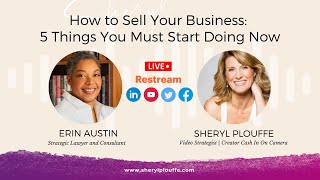
In this interview, host Sheryl Plouffe talks with strategic lawyer and consultant Erin Austin about converting a service‑based, lifestyle business (coaching, consulting, etc.) into a saleable, IP‑driven asset. Erin explains that the true value of such businesses lies in their intellectual property (IP) – the expertise, deliverables, webinars, social posts, and any digital products created. She stresses that to sell the business without the founder, owners must decouple their time from operations by building and protecting IP. Erin outlines the first two steps of her five‑step framework: (1) Verify ownership and protect all IP, ensuring that everything used to serve clients is either original, properly licensed, or otherwise owned; (2) Use clear, well‑crafted contracts to define rights, responsibilities, and relationships with clients and subcontractors, treating contracts as a protective tool rather than a hurdle. The conversation also touches on licensing or certification models as ways to monetize IP, and Erin promotes her website thinkbeyondip.com for further resources. The interview is paused due to connectivity issues, with plans to resume and cover the remaining three steps later.
Chapters
Have you ever considered selling your business? And maybe you're a service-based professional, a coach, a consultant, and it's never really crossed your mind because you built this as a lifestyle business. But we're going to talk today about how you can turn your income-generating, uh, business today and turn it into a saleable wealth building asset. And perfect person to talk about that with us today is Erin Austin. She's a strategic lawyer and consultant who has worked with some names you'll recognize, like, oh, I don't know, Warner Brothers, Lionsgate, MGM. So Erin knows a little thing about how to do all of this. So Erin, great to have you on Cash In On Camera today. I'd love for us to start with, um, You know, a lot of coaches and consultants don't really consider selling their business because they've built it as a lifestyle, right? They're doing that. But I'd love for you to kind of make the argument for why we should think about selling our business at some point.
Wonderful. Thank you so much for having me. It is wonderful to be here. And yes, you know, I am actually my own avatar where I am a service-based professional. I have been making a very good income working for myself by selling my services. But over the years, as we become more and more expert, we develop a body of work and things that we're known for and that are special to our businesses and special to the value that we provide to our clients. And so these are the things that make up intellectual property. You know, when Lots of service providers think about, you know, their time as their main asset, but it isn't. It is your expertise. It is your intellect. And that's what intellectual property is. It is the product of your intellect, and those are absolutely assets. And when we think about our intellectual property and we think about building a business that we may be able to sell someday, obviously, you know, unless we want a job, we're going to have to be able to sell sell that business without us. So that means we have to figure out a way to provide our services in a way that decouples our time from the running of the business so that it runs independently from us. And that— the key to that is developing our intellectual property.
Yes. And so when you say intellectual, when you— does that mean assets like courses, programs, like digital assets, or is it just, you know, thought leadership, maybe ideas and things that are maybe not quite as tangible?
Well, it's all of the above. I mean, all intellectual property is intangible, but it is not just the big things like software, like courses, like books, which we think about, but that people feel that they need to get to a certain size or a certain audience in order to create, uh, that type of product. But it's all the things that we do every day. If you are service-based professional, every time you create a client deliverable, that is intellectual property. You know, every time you, um, run a webinar, that is intellectual property. Every time you post on LinkedIn, uh, that is intellectual property. And even— and that's the things that you create, but you also have intellectual property coming into your business. So when you're using subcontractors, say you are a web developer and you use a subcontractor to create a graphic, I know, and you know, that is intellectual property coming into our business. So you have to be mindful of the flow in and out of our business. And when we look at what we develop over time, I like to look at it as a body of work. And so it can be that that body of work is bundled into something that we consider, you know, something that's a product, a digital product, like what you mentioned, a course or a book. Or it could be that we are actually exploiting our body of work in its entirety, or it— or as a whole, such as through a licensing program. Or certification program. So there's a number of ways that you can harness the intellectual property in your business and exploit it separately from your time.
Yeah, I love that licensing or certification model is very interesting. I know someone that comes to mind actually, who I think is on track to build something around certification. And so it makes a lot of sense. I know that you have a framework to help us, you know, to do this, really to make our income-generating business into a saleable asset. And I'd love for you to share your 5-step framework or the things that we need to be considering and doing now to prepare ourselves for an eventual sale. What is your first step to help us on that path?
Well, there we need to be thinking about protection first. So we need to understand Uh, do we own what we think we own? Are we making sure that we are capturing all those rights in our business? So I like to start with thinking about the origins of the things that you're using to service your clients. So is it something that's original with you? Is it something that maybe you got from a third party through a certification program? Is it something you got over the internet? And so those things, when we are working one-on-one, we're not generally thinking about those things. We are generally are not in, uh, in danger of getting in trouble. But when we— as we grow our businesses and more people have eyeballs on what we're doing, then we need to make sure that we own what we think we own.
Yeah, I love that. Yeah, and I think you're right, you know, sometimes we may not be aware that there is some type of restriction on some aspect of what you've done or what you've built. And it could just be very innocent, but doing that due diligence of figuring out, you know, am I protected, it makes a lot of sense. Yeah. What is your second step, Erin?
And then, oh, thanks. So then we have contracts, and I know people are very, uh, seem to be afraid of contracts. And sometimes we have very large clients, and there's no denying this, that when we work with, uh, certainly the public companies or very large companies, they will have very large agreements and they can seem overwhelming. But it is important to understand them because they really do dictate what rights we have, as well as they're considered a manual for how the relationship is going to work. And when we— even when we're working with smaller clients You know, we may have our own contracts, and they don't have to be complicated. We shouldn't be afraid of them. They, they can be in, you know, understandable, non-overly legalese language. But again, you know, the contract is your friend to make sure everyone's on the same page, and that really benefits everyone.
Erin, I just want to let you know that I am experiencing a little bit of an internet connectivity problem. I'm not in my normal location today at home, and so I want to make sure that we capture all the points that you're making. So I'm wondering if you would be okay to reschedule this interview and pick it up at a slightly later date just to make sure that we capture all of these important steps. Would you be open to that?
Absolutely, absolutely, completely understand.
We talked about this before we started the live stream. I said, you know, it's possible that, you know, the internet is not quite maybe this I'm used to doing here. So, um, what I'll do though, Aaron, is, um, I will briefly put your— let's put your website up on the screen, the less— even if we have some, maybe some live viewers who would like to check in on and check you out. But we will bring you back. Yeah, tell us about your website.
Yeah, thank you. So this is at thinkbeyondip.com, and you can see in the upper right-hand corner of the free resources button. I, I'm kind of a graphics kind of nerd. I love to take concepts and create graphics for people who are visual learners. And so if you go there and sign up for my newsletter, weekly newsletter, when you get our free assessment, and that assessment talks about the, the journey from kind of that hourly freelance post-corporate mentality to the exit, uh, to creating a saleable business where you're thinking like a, a CEO, that you're thinking about creating value in your business and how you can separate yourself and become independent. So, uh, head there to get all the goodies and sign up for the newsletter.
Okay, so here's the plan. We are going to— I'll reschedule this and we will have you back and we will go through all of the 5 steps required to help you prepare, things you need to be starting to do now to prepare yourself to sell your business. And we'll be able to go through all this because I love what you've shared and we've only gotten to point number 2. There's lots more to explore.
I don't like that. I will—
I'll reach out to you, my assistant will reach out and we'll reschedule it. Sorry for the inconvenience, but We'll, we'll make sure that we capture all of these important points at a later date.