How To Survive (And Make Your Business Thrive) In A Post-Pandemic World
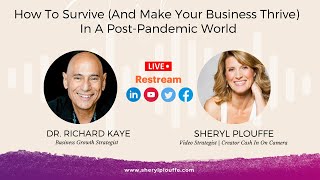
In this Cash In On Camera interview, host Sheryl Plouffe talks with Dr. Richard Kay, co‑founder of CEO Space, about how businesses can not only survive but thrive after the COVID‑19 pandemic. The conversation begins with Kay’s personal experience of pivoting his organization from live events to Zoom, illustrating the need to move beyond certainty and embrace uncertainty. They discuss the power of collaboration and joint ventures, using real‑world examples from healthcare, home inspection, and hospitality to show how partnering with complementary businesses expands reach and revenue. Both emphasize that networking is the foundation of net worth and that relationship‑first approaches—asking “How may I serve you?”—outperform hard‑selling tactics. The interview highlights the scarcity versus abundance mindset, urging entrepreneurs to shift toward service‑oriented, WIIFM (What’s In It For Me) messaging. Kay outlines CEO Space’s methodology for post‑pandemic planning, shares a free resource of five empowering negotiation tips, and offers practical marketing advice: define your ideal cohort, be visible through podcasts/webinars, and let the right audience find you. Throughout, the tone remains conversational, optimistic, and supportive, providing actionable strategies for entrepreneurs seeking growth in the new normal.
Chapters
Think of the state of your business today. And depending on when you're watching this, if you're watching us live, you're watching the video, or listening to the audio version of this conversation that I'm about to have with Dr. Richard Kay, will determine kind of where things are at in the world. There's no question the pandemic, of course, has changed everything. So, I really want you to think about the state of your business in the post-pandemic world versus what things were like beforehand. Give that some thought as we have this conversation because today, we're really going to dive into how you can actually make your business thrive in this post-pandemic world. Dr. Richard K., so glad that you're here joining us on Cash In On Camera to dive into this because I know you have a very unique methodology. You've got some really interesting strategies around this. But I want to just ask about your personal experience through the pandemic. What was it like for you as a business owner and your involvement with CEO Space to really go through the pandemic?
It's interesting. Yeah, we've all been affected. I mean, there's absolutely no way that you have not been affected, even if you're buried under a rock. At CEO Space, Cheryl, we used to do live events. We used to do several events a year. And one day we got a call— it's a global organization— two calls, one from Paris, one from Italy saying, "We can't get on an airplane." We began doing Zoom. I'm sorry, I got messages coming in here.
No, that's okay.
Turn them off. I can't hear you.
But you know what? And that's what happens when we do live. Anything can happen. We welcome it. It's all good.
It's very important. It's telling me my Google Drive isn't updated. You know, who cares? These are the important things.
I love it.
So we're a woman-run organization. September is CEO, President, and Ellen is Vice President. And they scrambled in over 48 hours because that's when we were supposed to do the event, created the first live Zoom event. And we emailed everyone, hundreds of people back then, saying, hey, here we are on television. And the organization is thriving through that. And on a personal level, I don't know about you, ladies and gentlemen, I used to travel 2, sometimes 3 times a month. And we're now going back to that. This is the vehicle that we use, whether it's this particular platform, most people use Zoom. That's how we conduct business. So before we went live, we talked about, you know, certainty and uncertainty. When you're certain, absolutely certain about something, That's stagnation. That's death. We have to expand and grow.
I want to dig into that a little bit more because on the surface of that statement, there's no growth in certainty. One would presume that that was, you know, maybe having certainty would be a good thing. But in your opinion, having certainty is almost a detriment, correct?
Absolutely. Cheryl, there's an old saying that if you do what you've always done, you're going to get what you've always gotten. You're certainly familiar with that. Deal with that. Yes, that wasn't true in the past. It certainly isn't true now. And let's use CEO Space as the metaphor here. If we were saying, hey, come, come to Dallas, we're going to have an event, it's like, uh, what happened? So the certainty of knowing what you do may bring comfort. And Tony Robbins is the first one I've heard who said that the quality of your life depends on the level of uncertainty you can tolerate. If you're in a relationship, you have a certain level of certainty. But thank God for all the uncertainty that's there. That's what makes life more enjoyable. So we have a baseline that we can call certainty. For people who go into an office, you go into the office and you do, but every day is different. And relationships are the best example of uncertainty. Thank God they're always different. Get boring if they're always the same.
I want to give an example of an email that I received today. I'm not going to name names. I won't get into the specifics of this situation. But it's someone who's close to me who sent me a long email today about the state of her business. And it's not in good shape. And it's someone who is really thinking of closing down, closing up shop, that sort of thing. And the idea that led, you know, the reason why that it's at the situation is the way it is, is because things were a certain way. There was a lot more certainty, I think, in her business before the pandemic, and then everything dried up. And now as things are kind of getting back, like you said, we're getting back into live events and things are kind of starting to move in a different direction, slowly, mind you, but still going in that direction, that people aren't coming back. It's completely dry. And so I wonder what kind of advice you would have for her or many, many other business owners who are finding that their businesses dried up after the pandemic because how can they make things get back to where they were? Or will they ever get back to where they were? How can they thrive? And I think I'm leading you toward your methodology.
So, many people lived in scarcity. I mean, people still do live in scarcity. There's not enough. It's me, me, me, me. And if that person has a client, They're not coming into me, so I want to harm or put that other person out of business. Now, we've seen some of that stuff. People today, the vibration of the whole planet, in my experience, is raising that people are expressing more about collaboration and cooperation. I'm going to share a story with you, and you don't need to know who this person is, don't even need to know what her business is. I'm a retired chiropractor. And as Tony Robbins says, this is not to impress you, but to impress upon you. I was famous in San Diego. 6:30 News, morning television talk show, San Diego Tribune, Los Angeles Times, PBS special about me. And I was younger, so, you know, I believed all that stuff. Over the 9 months following my first program at CEO Space, my practice doubled. I stepped into collaboration and cooperation, which was a relatively new model to me. So if whoever this person is happens to watch this, you may want to send it to her. I start— I learned about this stuff that today we call joint ventures and alliances. We didn't have that language two decades ago. So I said, okay, who is in the same space as I, meaning quality of life, that we can share prospects, we can share clients, we can share people. So I called massage therapists, I called acupuncturists, I called people, took them to lunch, spent a lot of money and time with lunch. But what happened is we wound up serving more and more people. And Cheryl got to a place one day, I said, who is the most obtuse kind of person? I called an orthopedic surgeon. And I don't remember his name, so I'll make up a name. I said, Jack, same conversation. I took him to lunch and we started serving more and more people by referring to one another. And here's the key, ladies and gentlemen, make certain that you don't step into scarcity and steal that client. Now, you might say, okay, I'm not a doctor, I can't do that. Well, there's a friend of mine who was a home inspector at the time. Home inspectors, I think, were earning like $45,000 a year. Same model. Who did he decide to joint venture with? HVAC— heating, ventilating, and air conditioning people— gardeners, landscapers, roofers, etc. So they worked, and he's— he went to $1 million a year, and now he teaches people how to do this. So you don't have to be a doctor, you don't have to be a home inspector. Every single business you can find someone to collaborate and cooperate with, serve more people, which is the key, and oh yes, make more money.
I love it. And I totally agree with that. In fact, I think back on any level of success that has brought me even just to this point. If I think back on what has actually led to the most reward in every sense of the word, It has stemmed from relationships. It has stemmed from collaborations and joint ventures and meeting people and networking. And I think you and I both agree, right, that the networking is, you know, network work is your net worth. It really is about that. It isn't because I had a fancy marketing funnel on automation. It's not because of, you know, running ads and all these different tactics that sometimes people get caught up in. It was really from talking to people. I mean, it's just as simple as what you just said. Let's have lunch. Let's talk. Let's discuss. Let's build a relationship, which leads to more opportunities. Business opportunities is really where it's at. And so I agree with that.
Yeah. And then, I mean, that takes me off in a whole different place. We are all on networking events today. How do I know? Because you're watching this, right? So you're all on networking events. And how many times— and I was on one earlier this morning. And within a heartbeat after this chat in the Zoom went on, here's my name, here's what I do, buy me, buy me, buy me, buy me.
Oh geez.
Yeah, it's like, really?
Yeah, no.
You mentioned something so vital and that's build relationships first. No one wants to buy you just because they know your name and what you do. And I say you, mean your product or service. So ladies and gentlemen, build relationships. Today, taking people to lunch is a different thing. But online and follow up with people. A friend of mine, I live in Taos, New Mexico, a small town, 5,000 people here. And Lee owns a restaurant. And when COVID hit, all the restaurants, all over, just shut down. They didn't start to open up for in, but they opened up for to-go. And he still can't open because he can't find anyone to work. He said, Richard, I'm paying $15 an hour. This is— it's not an abundant community. He said, I'm paying people $15 an hour to come work. He says, nobody wants to work. So get out of your comfort zone. That's the certainty. I would be a little obnoxious here of lying on the sofa watching Days of Our Lives or something. You know, there's certainty in that. There's no growth. So you as an entrepreneur, you have to grow.
One of the things that I think people need to think more about is this idea of getting out there. You know, like you said, networking. We're both part of networking groups. We are. I think we met through a networking group, right? So we both do that and understand the value of doing that and do it properly. As you just pointed out, it's not— that's not the place to start pitching all your wares. But people don't have patience anymore. They just have no patience. They want to ram that product and service down your throat. They want you to buy it. They want you to, you know, and I think there's a lot to be said around patience. What's—
I laugh because when I retired from chiropractic, my then wife used to say, you finally figured it out. You don't have to practice anymore. You don't need patience. So that's another thing.
There's a doctor joke.
A poor one, but yeah, um, patience is so important. And, you know, as you said, people ram it down your throat like it's— no, that's— you must build relationships. Building relationships, and that going back to when I learned how to do that, my business education in, well, the first CEO Space program I attended, I was married to an attorney, and she looked at me and said, Richard, I learned to be an attorney, you learned to be doctor. How come no one ever taught us how to do business? It's like, whoa, we don't get that. We may be masterful at our skill or a craft. Where do we learn to do the business of that, Cheryl? And CEO Space just happens to be one amazing place to accomplish that. So even if you don't get to or explore CEO Space and see, and that's it, it's you get to accelerate the growth of your business. And here's a little marketing thing. If you go to that website, and it's ceospaceamerica.com, C-E-O-S-P-A-C-E-America.com, here's a little bit of marketing strategy. That website is not about how wonderful we are, how we've been here for 30 years, that Forbes and Inc. says we're the number one conference. Nobody cares, ladies and gentlemen, your website is about you. And you talk about how wonderful you are. The website, your marketing has to be about the consumer. We all tune into the same nefarious radio station, WIIFM. What's in it for me? So, when you're marketing, talk about what someone is going to get out of it. Whether, as the woman who wrote you the email, is in a little chaos, a crisis. What is someone going to get out of it if they come to work with you? I've been a business coach for 472 years and I can help you. Now tell me what's going to happen to me. Am I going to grow my business? Am I going to grow personally? Am I going to have better relationships? There's a picture of a billboard I took when I teach a class on negotiation. It says, Banking Done For Us. I said, excuse me? I was like, really? And that went through all their marketing and Now, if that billboard said, "Banking done for you," what's the difference in the tone of that?
We see a lot of that though in the entrepreneurial space. And I think there's a— when people are not thriving, right? When they're trying to survive and they're in that mode of just like trying to make ends meet, there tends to be kind of an aura or maybe an essence of desperation that I think people can sense. And that doesn't bode well for you to move your business forward.
It scares people away. And it has the same resonance as a word I used earlier, and that's scarcity. We can tell, most people can tell when someone says, I am desperate, please buy me, use me, as distinct from how may I serve you? And I'll go back to one of our first conversations because it's one of my questions. How may I serve you? And don't worry about what you can do for me. When you show up, ladies and gentlemen, to serve other people, I mean, who would you rather play with? Someone who says, I need your business, or how can I serve you? And then the referrals come from that too.
Yeah. And it's funny when you say that, when you say those words, I actually think of you because it was impactful to me and how you It was so simple. That sentence is so simple and it was just so direct that I recall that from the calls we've had. How may I serve you? In particular, the word serve always struck me. And so obviously, these are things that you do at CEO Space and how your mentorship and all that works. And so I would definitely encourage people to go and check out CEO Space and the good work that you're doing there. I wanted to kind of dig into this planning methodology or strategy that you have, the pandemic one. Can you explain what that is all about?
Yeah, it's kind of stuff we talked about, Charlotte, stepping out of the past. If we embrace, and I'm going to use my friend who owns the restaurant, the same thing, having a cadre of waiters and bus people, it's not going to work. It will ultimately go out of business. Change your thinking. As Zig Ziglar used to say, we're living, many people live in stinking thinking. We can't function the way we used to. The biggest thing is step into the collaboration and cooperation and seek new venues. You asked me earlier, how has it affected me personally? Is I'm now doing things in addition to what I used to do between doing personal coaching and mentoring and helping people become best-selling authors and having them get stage learning how to interview and talk in sound bites. I never did that before. And that's just my personal story. And where did I learn that? By hanging around with top-level entrepreneurs. There's an old saying in real estate, if you've got the most expensive house on the block, it's wrong. Same thing in business. If you're the smartest one in the room, you're in the wrong room.
That's right. Yeah, that's right.
Hang out with people who know more than you and are willing to share. The changes.
Yeah. I want to put your— I'm going to put your email up on the screen so that if anyone wanted to reach out to you by email, Richard, they could do so. And I'd also love for you to share— there's a resource that you offer, including 5 tips, The Secrets of Emerging— of Empowering, sorry, Negotiation. Can you tell us a little bit about that?
I teach a program on The Secrets of Empowering Negotiation. And here's a typical example. I was on a networking program and someone said to me, why don't you give stuff away? Now, my first reaction was, huh?
Why would I do that?
So I created a form where it's a 13-page PDF rich with 5 powerful negotiation tips, how you can change your life. And I want to make a distinction, Cheryl. Most people have never learned how to negotiate. They don't know how to do it. I grew up negotiating by the seat of my pants. You know, I thought I was pretty good at it until I began to study and learn. I've studied with some of the masters. And most people have a perspective of negotiation as I win and you lose. Yeah, that's what most people look at. I used to teach Level 2 of negotiation, I win and you win. And people say, that's really good. Then I stepped into Level 3, I win, you win, and our cohort wins. And then 4, I win, you win, our cohort wins, and humanity wins. Hmm, what would happen, Cheryl, if we lived our lives not just negotiation, but in every communication, every transaction. What's the bigger picture? We would not have this stuff that's going on in the world today. We would not have this. That's all coming from chaos. It's all coming from scarcity. Rather, it's all coming from scarcity. In the Russia thing, it's only about one thing. It's about oil. Ukraine's got oil. And if we were to work together— I'm not going to go political, don't worry— but if we were to work together there's enough for everybody. Yeah. So that, that's what these 5 tips on communication are about. And there's going to be a link, I suspect, that you can download it, and it's free.
Yes, we can put the link. Yes, we can definitely put the link in the comments depending on where you're watching this. And if you're listening to it, certainly you can reach out to, to Richard and get that. One thing I wanted to ask you before we wrap up is that we do a little segment here called Stop Marketing Like It's $19.99. And you kind of alluded to it a moment ago, like when you were a doctor, you probably didn't have to do a lot of the visible things that we're doing today. And so I wonder what is a tip, a tool, a tactic, something that's working for you to, as you put yourself out there and you're visible, what's really working for you from a marketing perspective today in this post-pandemic world?
Great question, because back then when I was practicing, we didn't have The internet, the computer was for writing reports and, you know, doing, uh, the backend stuff. Be in, be visible, podcasts, webinars, and stop trying to sell to people who don't want your product and service. There are what, and it doesn't make a difference what, I mean, I was a chiropractor, you know, I wasn't going to market to people who were so ensconced in the medical model. Yes. Can they use my services? Yes.. And sometimes I did outreach to them, and I did that, like, for example, through calling an orthopedic surgeon. So ladies and gentlemen, know who your market is. You're not a market for everybody. There are people who have no desire to use your services. So the invitation is know your cohort, know who you are selling to, who's the ideal person and refine and define your market, you'll have a deeper reach. And by the way, the peripheral will show up and ultimately discover you. Just do it gently and come from that place of service. How can I serve you? What is someone going to get out of your product or service? Build the excitement and they come to you. Not everybody, but the right people.
Yeah. And I think that's a perfect place to end, right? It is how can you thrive in the post-pandemic world and your business. It's exactly everything that Richard just mentioned. So, I love this. Great conversation. Would love to have you back sometime. Or maybe we can do another one where we talk more deeply about negotiation.
Oh, that would be fun.
Yeah. Okay. Thank you so much for being on Cash In On Camera. We really appreciate it.
Thanks, Cheryl.
More from Sheryl



From 'agreeable' to 'ruthless mentor' to 'strategic sparring partner' #substack #shorts







