How Will Web 3 Impact Your Business?
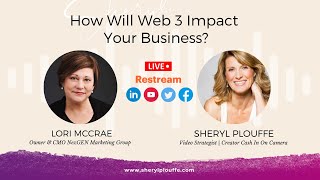
Lori McRae, founder of NextGen Marketing Group, explains why Web3 intimidates business owners and how to start small. Begin with education through influencers like Gary Vaynerchuk, then pilot a single digital asset for as little as $100. NFTs can work like loyalty points: an HVAC company might reward purchases with branded tokens.
Chapters
Revolutionize the world is an understatement. It is happening. It is going to happen. It's happening now, actually. And the question is, are you prepared for it? Is your business prepared for Web3? And we've brought Lori McCray from NextGen Marketing Group to talk about that today. When I opened up your website, which I'll show later, Lori, I got excited because I was like, oh, Lori's really into all the things that I'm growing such an appreciation for and such a passion for myself. Personally, because this is the, this is the way of the future. Web3 is where everything is going. So what is it about Web3 you think that maybe is, um, scaring some business owners at this point?
Oh, for sure. Well, thanks again, Cheryl, for having me on. It's such a pleasure. Um, I think Web3 is very daunting because there's a technology curve, right, in the world. Um, and you know, it's kind of 25 to 30% of people are innovators or early adopters of technology. And the rest are people that kind of jump on later once it's proven out. So, I think what is concerning a lot of people is, first of all, they don't understand it. We're just learning it ourselves in the past year. They don't understand. They don't know where to go with it. They don't know where to start. And So for us as a digital marketing agency, what we're trying to do is help walk people. It's almost crawl, walk, run on this one. Um, we want to help people kind of understand Web3, understand the implications for their business, and then get into it slowly. But, um, it's related to crypto, which is scary for a lot of people, although 91% of countries right now are in some form of cryptocurrency. But it is a very daunting area and it's misunderstood.
So, well, Web3 is the evolution of the World Wide Web, right? We started with Web1, we're currently in Web2, and just starting to transition now to Web3. It's the next evolution, but it— I think, and correct me if I'm wrong, but my understanding of what Web3 is, is really a a culmination of a lot of things. You mentioned crypto, right? Decentralization, um, NFTs, which I think we could talk about today as well. Um, just so many different aspects of it, and, and there's a lot to it, and it can be really— I think you're right— daunting for a lot of business owners. Now is the time though, I believe, to start just educating yourself about what it is. That's— is that your understanding of like the phase that we're in, and what would be your advice to business owners at this point?
Oh gosh, that's an amazing question, and it's the biggest question really. So you mentioned NFTs to start. So NFTs actually started in 2017, um, but the concept of Web 3.0 didn't even really hit the mainstream until last year. Yeah, but they say a month in Web 3 is like a year in Web 2. In other words, it's advancing so quickly that people can't afford to not understand what it is. So, to your point, absolutely start following key influencers. There are some people we've been following over the last year that help us get into the space. I mean, I am not a geek. I'm a marketing agency owner and I've been doing digital for a long time. But I'll tell you, I follow the leaders., you know, and I think that's a good place to start. Start jumping on webcasts, follow people like Social Media Examiner, Michael Stelzner. Yes, yes, you know, he's, he's very strong. He's talking a lot about this. There's conferences, there's digital conferences right now where you can jump in and just listen. I think that's a good place to start before you even start to think about how to move a company or a brand into it. It's really important to just get aware of what it is. Um, I do want to distill it down for a minute and talk about that, because what we've done on our website is we've tried to, to make it very easy for people to comprehend what it is, because it is multifaceted, right? Um, so great, that's up now. We describe what Web 3.0 is.
Yes.
Um, there's many components involved. We're not going to do a deep dive today, but the questions that we ask on our website is, you know, are you ready? You know, do you know what NFTs are? NFTs, so that is a great way to get into this because NFTs are basically non-fungible tokens. People don't really understand what is that exactly. So my, my easiest example of that is if you have a child or you know of you know, children that are playing right now online, things like Roblox, Minecraft, those are the biggest metaverses right now that exist. And what these kids do— mine does this— is he buys skins. And what you're doing is each child's identity. So, and that's what Web3 is all about. And this isn't about children, but they are the wave of the future. So they are going to be— in 10 years from now, they're going to be running the world, right? So they are actually getting trained right now in this blockchain-type world. And what it is, is when you buy skins, for example, they enhance your digital identity. So they're buying skins from an entity, and over time, even though now it's quite centralized, over time it will become decentralized so that the skins are available through Bitcoin, through crypto, through a wallet. You're going to create wallets, and these wallets will be on your own blockchain. So they're centralized they aren't going to Visa, MasterCard, PayPal. They are staying within your own ledger, if you will. So people will accumulate money, they'll accumulate crypto, just like our kids are buying skins, and those skins make them more valuable. So it's, it's kind of an odd thing, but it's like dressing your kids up in the finest clothes to go to school. Our kids are now dressing themselves up online with gaming cars, characters, and they're making themselves stronger, better, faster, and they're dressing up for school. It's just the school is Web3. So our kids are on it, which is amazing.
Our kids are, our kids are paving the way, and I think that we as adults need to look at that. I think of Fortnite, right? My husband would always like say, why are, why are we buying virtual outfits, right? That's what it can seem like on the surface. But if we dig deeper and look at patterns and where that's starting and how it's evolving, it's paving the path for where everything is going. The metaverse, as you just described, and NFTs. I have, I think right now, 3 NFTs. So I have a wallet and I've started diving into it.
I too— You go, girl. That's awesome.
Yeah, I've started, you know, I started to figure it out. I figured out, okay, how do I create a wallet? How do I purchase an NFT? Where do I purchase an NFT? And, but Michael Stelzner, I think, is a great resource. I think Gary Vaynerchuk is another great person to follow in terms of what he's done as an example of what's possible with NFTs. There are so many different people that are in the space who are really going 100% in because they see the future. I think you and I both on the same mindset of that is the future. I think there's still a lot of people, as you said, who don't know where this is all going. How is this going to impact business specifically, do you think?
Right, well, in many ways, because NFTs really can start from a value, a currency you create within your own organization. So big companies who spend millions, so I'm going to talk about them and then I'm going to talk about, you know, even small entrepreneurs and small companies. Big companies like Starbucks, Gucci, Anheuser-Busch, they're all into it. They have, have NFTs. They are already selling NFTs on these gaming sites. They're in the world. They have full-time, um, people in place, VPs and, um, CWOs that are basically taking them into this space. Okay, now if you're an average business owner or even the owner of a franchise You can't even imagine spending the kind of money that they're spending even hiring someone to do this. So, the webcasts I've been watching are to test, start the conversation in your company, follow key influencers, and start to join communities and learn. That's where we started the conversation. Then, start creating your own currency. And that's part of the— one of the services we're offering is to guide people through this because People already have products and services to sell. Now what we're suggesting is that you create NFTs out of what you are already selling. NFTs are similar to loyalty programs. We all know Canadian Tire Money. That was one of the first NFTs out there, to be honest. Way, way, way ahead of its time. So what we're talking to companies about is getting into this with a loyalty program. So say for example, I'm an HVAC company and I sell air conditioners and furnaces and a number of other services. As people purchase, they gain points just like our kids in gaming, right? They gain points that they can buy skins with or they can purchase or a combination. So now, what does this sound like? Aeroplan, Air Miles. Okay, this is not that different. It's just creating your own currency to start with creating loyalty programs within your company. So, if I do buy that air conditioner, I'm rewarded with say, 10,000 points. If over a year, I accumulate 50,000 points with this company, I can now purchase things like a new water softener or purchase it with points or filters.
So, what it's doing is it's creating loyalty to that company.
So, what does it do for companies? It keeps people in their wallet. It keeps people in their in their, um, fold, if you will. My battery's running low, pardon me for a minute here. It keeps people in their company as opposed to going to a competitor, which is so important. So in this HVAC example, if I have NFTs with a company, I can now spend more money with that company. So it's a loyalty move to begin with. Then as money builds up, you're into a currency.
Right? Yeah, I think it's, while you're plugging that in, I think, you know, it's fascinating when you really think about use cases of NFTs. And we think of NFTs, at least those who are maybe somewhat in the know, we think of them simply just, you know, as artwork, you know, as kind of the predominant one that's really come on the scene the last couple of years. And that's certainly what I have in my NFTs are artwork, you know. But NFTs can be anything. It's all because it's built on the blockchain. It doesn't have to be necessarily artwork. If that's not congruent to your business or your brand, you could get creative about what your NFT is. Building community loyalty programs. I think also too about events. Let's say, you know, having maybe some type of NFT that is like a lifetime ticket to said conference or, I mean, the opportunities are limitless with what you could do with NFTs, which is super exciting.
It's huge. And I think people right now kind of might be looking at this saying you're speaking another language. And certainly that's where the education piece comes in because there are going to be influencers. There's going to be thought leadership. And right now, the key is to just get in, understand it, start the conversation. Because what will happen is, just like anything, the opportunities will end up coming to us through the web. We will start to see ads and we will start to see opportunities present, like Facebook, for example. And they will lead us. So, they're already in Meta Business Suite. They were a year ago. The metaverse is different. But what they knew was this is coming. So, we're going to brand something within our Instagram and Facebook platforms called the Meta Business Suite, which allows you to cross-post, cross-sell, etc. Yeah. So, it's a bit of a crawl, then walk, then run. And the run part, I would say, is going to be 8 years out. But you have to start thinking about it and setting the foundation now, or else you won't be ready, right?
That's— and yeah, I 100% agree. I think that this is the time. It's such in its infancy right now, right? This is the time to start educating yourself. Podcasts, you know, summits, videos, YouTube courses. I mean, anything that you can do to just educate yourself about what is going on, where is this all going to, and start with the basics. What is an NFT, right? What is the blockchain? Like, you can go to YouTube and you'll find a whole host of people who've made content about this already. You know, you can join Discord communities. You can certainly— the people that are in this space, in the Web3 space, are all about Discord and they're all about Twitter. So go on Twitter and you'll find all kinds of influencers in this space, and they're holding Twitter Spaces. Michael Stelzner included, and others. And you can learn so much. Clubhouse is another great place that you can start to learn. But NFTs is a great, uh, opportunity for businesses. But be strategic. This is not about just run out there and create 10,000 NFTs and lot— you have to be very strategic about what you're going to do with that. And obviously that's your specialty, and people will come to you for help on what is the strategy behind it. I think tokens is another thing, right? Should I have a coin? Is there such a thing? Should I have the Sheryl coin? I'm not convinced of that yet. But for some businesses, maybe it would make sense to have their own coin. Cryptocurrency. Let's talk about that because more and more I'm seeing this and I follow different people on Twitter and you'll start to see big-time enterprise huge organization, more regulation, um, around, you know, cryptocurrency. I actually had something recently where I was purchasing something and it gave me the option at the bottom to pay in cryptocurrency. It was the first time, that was last week, first time ever. And I said to Randy and Brody, I'm like, look, look, look, I get so excited because I know this is a sign, this is a sign, it's happening, it's a sign, we're moving in the direction. Um, talk to us about cryptocurrency and how that relates to an impact for, for business owners.
Well, I love what you just said because when I said to you the opportunities will come to us, we'll start noticing it, the, the web will push it to us. Okay, so we're going to notice that just as consumers. We'll also notice it as business. But let me talk about the potential. I took this stat today and then we'll talk about, you know, how to get into that or why that's important. So Web 2 right now, the two biggest entities in Web 2, Instagram and Facebook, um, and sorry, YouTube, uh, consist of $500 billion in sales. Web3 in the last year, the two biggest, Athenius and Bitcoin, are $1.5 trillion. Like, so we're comparing the two biggest entities that took probably 10 to 15 years to build up, $500 billion to $1.5 trillion, and that's really just happened in the last year. So when we talk about um, how big this is going to be. It— like I said, a month equals a year in Web3, so it's just going to start leapfrogging. And, and after this, people will start seeing in 2, 3 months these words: Bitcoin, wallet, metaverse. They're going to see this all over the place. It's going to be like that shiny car that you just bought, and now you see that shiny car everywhere. That's what's going to happen with this. It's going to start popping up. So the, the reason, um, I think the question— back to the question about, about cryptocurrency, um, and, and Bitcoin. What is happening is, yes, governments are on to it. It was— it is deregulated currently, but now they're on to it. So all these countries are a big piece of this. They're trying to decide, how do we get a piece of this puzzle? How do we regulate this? Because it makes them very nervous. Because understand, companies that make money off of cryptocurrency and make money off of Web3 do have to pay taxes on that. So they want to know, how do we get into this and regulate this? Because right now you and I could go in, we could buy crypto, we could buy something on Gucci, we could buy anything we want crypto. Our accounts could grow and grow and grow. We usually would stay with them and let them grow, not cash them in. It's not like— it's, it's not— it's supposed to be a long-term game. It's the new mutual fund. But But the government is uncomfortable with that because with people holding their own wallets and their own money and it's decentralized, they're nervous about where people are going to be spending their money, right? So what we need to watch is how the government reacts. And as soon as September in Canada, there is going to be a bill out on this. How it affects things, nobody knows yet because we don't know what's going to be in that bill, so can't predict that. But can say this, um, crypto's not going away. Crypto will be the new currency of the future. We will become eventually a cashless society, maybe not 100%, but, um, I'll tell you, more places now— I went to Wonderland yesterday with my child and they're not accepting cash.
So we were in, we were in Michigan, uh, just not too long ago for a ball tournament. We couldn't we couldn't pay with cash. No. So, so when— because we're already a cashless society, 100%.
I mean, the— absolutely going there. So what does it mean for companies and brands? Why is this important? The, the reality is if people can't pay with cash anymore and they can't pay with certain credit cards, they're going to have to pay with crypto. And, and so companies that don't have, um, some kind of digital asset or virtual asset, uh, set up will not be able to participate in the crypto world. We're going to have to understand that the wave of the future is connecting with these communities. And this is what it is. It's about communities. What's interesting is that it doesn't have to be done overnight. And I think that's where people go, oh my God, you know, the people that are the late adopters are really scared by this. But again, a crawl strategy is important, just understanding it. A lot of people right now are saying, let's just get the conversation started in our company. Let's have that young guy out of school start doing some intellectual property research on where this could take our company. Some companies are hiring for this position. A lot of companies are just saying, hey, let's start forming groups within our company, strategic groups where we start as a team discussing opportunities. So, maybe a company right now doesn't have the money to buy, so to speak, or hire the services. But even starting the conversation with your young people, you know, and it's who are the young people? They're the Gen Z and the, what is it, Gen Alpha, right? Gen Z and Gen Alpha. That's the future hires. That's who we should be talking to. We should be talking to the graduates right out of university. Bringing in, they know all this stuff.
So, well, it's native to them, right? They've grown up with all of this. This is totally normal for those of us who, you know, in our 50s here, um, we have to learn all this stuff. You know, we, we, it was, we, we remember a time where there was no World Wide Web, right?
Right.
And it's like we're seeing that, but the evolution of this is happening so fast and much more rapidly now. You know, it's interesting. I think back on your experience before you started NextGen. You started your own marketing company. You worked with big companies, right? Johnson Johnson, Kraft General Foods. And so those big companies are allocating— I don't know specifically those companies, but companies like that, that magnitude, they are investing millions of dollars to do tests.
Okay.
Yes. Right now. So that's kind of what they're allocating. They're allocating money to do testing about various different things in this space, in the Web3 space. For those of us who know coaches, consultants, small business owners, um, you know, we are not going to be allocating millions of dollars toward doing tests. But what you can do is be educating yourself, and you can be dipping your toes into some things like, like I have, you know, just buying— if you try getting a wallet, purchasing an NFT. Now, the very first NFT that I bought, you know, I learned something from it. It's not worth what I paid for it, but I learned so much in the process of doing that. And now I've learned something. Okay, apply that to the next NFT that I buy. Apply that to the next NFT that I buy. But I think it's just a process that you have to start dipping your toes slowly into some areas. And that could be your investment, right? In that you're not putting a million dollars into figuring— doing a little test. It could be $100. Yeah, so the thought thing that helps you to understand it better.
100%, you are so bang on. The experts are saying right now that small companies or service-based companies or entrepreneurs should be creating one digital asset, a virtual asset, and try selling it. So, don't worry about right now shifting your whole business into it. It would be crazy because we're at this part of the bell curve on early adoption, right? We're not there yet. We— the mainstream of people that we do business with would be overwhelmed by us saying you can play in crypto for this service today. What?
Um, tell me what crypto is again, right? Right. Yeah, we have to start where we're at. And I think that's the majority of business owners. As you said, the majority of people are not early adopters, you know. And so this is where we have to educate and hopefully this helps to at least paint a picture of first steps that you can take to start learning more about how this will impact your business. I think the thing that I would like to communicate, and maybe you do too, Laurie, is that this is coming whether you like it or not. This is happening.
Well, you know, absolutely. And so I think back to what you said, and what you said earlier was when we entered our professional careers there was no World Wide Web. I remember someone in a big agency I worked in. I won't date myself, but it was a while ago. And he said, hey, there's this thing coming. It's called the World Wide Web and we'll be able to research stuff on that. And we looked at him like he was crazy. I never forget his name, Cecil Morris. And we thought, Cecil, what have you been drinking today? Like, what is going on with you, buddy? And You know, it came in a, in a blink of an eye. A year later, we were all on the internet searching and researching and dial up.
Remember the dial up and the tone dial up and all crazy. And now here we are and we're talking about something just so wild. But I believe that, you know, we see signals certainly that think the pandemic and that whole period of time that we've just come through has just helped to accelerate a lot of different things in the online space. And so, you know, here we are. But I think your point is that there are a lot of aspects to it. I'd love for you to tell people where they can go to learn more about this.
Absolutely. Well, I mean, we are a resource to help companies dip their toe in the water. I do have a page up on our website about being Web 3.0— sorry, ready, I'm tired. There is a quiz. It's a short quiz that might be a neat way for people to dip their toes in the water. And then, we do, if you scroll down there, there's a 5-phase plan with the 6th step being end results. So, we can walk companies and individuals through this at their pace and see where they need to be. But there are resources out there. We are actually linked to a technology company that can bring a company into Web3 on platforms. So that is a, is a big resource because a lot of people may say, where do I even start with having a Web3 website? It's different. Web2 websites are not going to be compatible with this. So it takes a specific technology to, to get there. So we are partnered with a firm that's just launched huge. There was a press release out of New York. It's online gaming. You'll see it soon. It's in the car racing space. Anyway, Lots of stuff coming. It will be fed to us in dribs and drabs. It's, it's not going away. You're right. It's something we should all be aware of. But our goal as a company is to help our clients and prospective clients get their head around it. So, we want to be kind of that resource to bridge this gap, this knowledge gap. Maybe people don't have time to do the webcasts and the podcasts and the seminars. And I get it. But we want to say, okay, we're here as a resource to help companies start the conversation if nothing else, lead them through that conversation. Um, even we are set up on LinkedIn, we have over 13,000 connections, and we are even thinking of getting into the recruiting of talent for Web3 needs, um, because of our connections being so high. So, you know, I guess we view ourselves as a resource, as a helper, as a, as a, as a gap builder as a gap filler and just help people through it, help guide them through it.
Yeah, nextgenmarketing.ca is the website.
That's our website. And if you look across the top of the website, there will be Web 3.0, and that's where you can jump in and take a look.
I love it. And I think that probably, Laurie, over the course of time, you'll have to come back on Cash In On Camera because I, as this evolves, more things. We're learning more. We're going to dive in deeper. And I'd love to have you back sometime. But before you go, I'd love for you to share a tip, tool, tactic, or technique. Something that's helping you at NextGen to market yourselves or you maybe even you personally that you'd like to share with the audience.
Yes, I want to help other people always. And one of the biggest things is for us is social media, LinkedIn because I'm a B2B person. That's where our customers are. We have an AI program that builds our network. It's all pre-scripted. And that's how we've really gone from 500 followers, connections I guess it was 3 years ago to over 13,000. So, I'm a big LinkedIn person. I do believe in AI products because the scripting and the automation of it does all the work in your sleep. So, I will often go to bed. At night and in the morning wake up with 5 new connections and 6 new meetings or whatnot off of just this spinning AI tool. But you don't have to get into all of that if you're not ready. But LinkedIn, I find really helpful in building businesses if that's the audience that's watching today.
Yeah, if you're in a B2B space, you have to be on LinkedIn, no doubt. And so, if people want to connect with you on LinkedIn, is it under NextGen or is it under your name?
I do have NextGen, but the best way is to connect with me under Lori McRae. And, um, yeah, find me there and jump in, send me a message and, um, an email. I'm, I'm— or just, yeah, just find me, connect, and then we'll chat.
That's great. Thank you so much, Lori. This has been fun. I think it's going to be amazing to watch this, the evolution of Web3 over the next 10 years. I, I'm sure we'll have many more conversations, maybe publicly and privately about this. So thank you so much for being here.
Thank you for the opportunity, Cheryl. Great to see you as always.
Nice to see you.
More from Sheryl



From 'agreeable' to 'ruthless mentor' to 'strategic sparring partner' #substack #shorts







