Human-Centered Communication
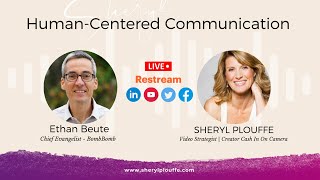
Ethan Butte discusses how businesses can cut through digital noise by shifting from attention-grabbing tactics to trust-building relationships. He defines three types of digital pollution, critiques the outdated AIDA sales funnel in favor of a customer-centered loop, and argues video is essential for authentic connection. The key: treat people as they prefer to be treated, not as targets.
Chapters
business, you need to pay close attention to this conversation with Ethan Bute, who is here today to talk about his new book, Human-Centered Communication. We're going to dive deep into certain sections of this that I think pertain most to what you need to know. I mean, you need the whole book, but we don't— in the interest of time, we'll be able to dive into all of it. But in particular, areas here that are really going to move the needle for you. So Ethan, so glad to have you on. I've been following your work. You may not know this, but I've been following your work for years. I'm so excited about this book because now more than ever, this is key because we live in a very busy world. What a lot of people would describe as a saturated world, right? So, how do business owners break through that noise and use what you talk about in this book to be able to really make an impact specifically around video? I mean, you talk, you and I both love video. We use it. But why is video so important now more than ever?
Thank you so much. I did not know that. We have spent some time together before, but I— but it's a privilege and I appreciate the invitation, the opportunity to have this conversation with you today. So in general, specific to the video in the way that you asked that, you know, we're obviously doing more work. And by that, I mean we're doing more selling, we're doing more serving, we're doing everything that we do in our businesses. We're doing more of it digitally, virtually and online than ever before. And these spaces are really, really noisy. I think everyone can relate to that term. Oh gosh, it's so noisy. Like, think about being away from your inbox for 2 days and what it feels like to go back and try to sort through and figure out what's useful, what's not useful, what's, what's real, what's selfish, what's helpful to me. All these things, right? It's so much anxiety around it, but it's also really, really polluted. And we can get into that. But, you know, with the level of noise and pollution that everyone is encountering, we need to find ways to do two key things. Think about what's in it for the other person or the other people before we type a single letter or before we record a single second of video. And then we need to find ways to give people what they need to make healthy, safe choices to move forward. And by that, I'm speaking to the visual and emotional impoverishment of so much of our digital communication, that faceless, typed-out text that isn't nearly as good as a simple webcam video, whether it's live, whether it's recorded. This ability to communicate with our whole selves, with our face, our voice, our personality, our tone, our expertise, our sincerity, our enthusiasm, all the subtlety and nuance that's so important to humans connecting and communicating with one another. And again, helping each other make good, healthy, safe choices about whether or not to proceed, uh, in, in this case, in a business situation. And so the more we can be thoughtful about what's in it for other people, and the more that we can find the right spots to communicate these messages— and we can get into this layer too, you know, when is video better than the more prepared we are to take advantage of those opportunities and to help other people by communicating with our whole selves, I think the more effective we'll become in enhancing our relationships, which then enhances our reputation and ultimately enhances our revenue.
In this book, you make a case against digital pollution and you just alluded to this idea that there is so much pollution out there. Let's lay the foundation down for what What is digital pollution in your view? How would you describe that best for our audience so that really we can lay the foundation for the rest of this conversation? Because this is really key to understanding. And it's funny because I've had just several examples, I believe, of digital pollution that have landed in my inbox and in my email just in the last few days. I'd love to share some examples with you, real examples of what's happened to me so I can get your opinion on what to do about that and whether or not this is in fact, in your view, digital pollution. But let's lay down the foundation of what that is.
Sure. So Steve Passanelli, my longtime friend, longtime team member, our chief marketing officer here at BombBomb and co-author on this book and on— I don't know if you can see it if it's out of frame, but the orange book is out of frame right now. Yeah, that's right. That orange book behind me. We co-authored both books together and he came up with this really short, concise, powerful definition of digital pollution. Unwelcome digital distractions. Unwelcome— we don't want it. Digital— it's happening to us digitally, virtually, and online. And distractions— it takes us away from what we really want. It's not helpful, it doesn't serve us, it's not for us, etc. And so this could take a variety of forms. And so I'm curious to hear your examples in a minute. Um, but, but the, the— on one end is what we call innocent digital pollution. Um, and that's, you know, no one is intending any harm, no one is intending to slow us down, no one is acting in a selfish way. But for For example, when you pick up your phone, right? Where's mine? Here's mine. So you pick up your phone and they're like 78 text messages, and you're like, what the heck happened? And someone put it—
no, how did you know? Were you looking at my phone?
Yeah, he still puts you in a group message that like, I didn't need to be in this group message. It would have been better just kind of a one-on-one. I don't need to know what everyone else's responses are to your question or whatever, you know. So no harm, but it slows us down. It's distracting, it's frustrating, it's confusing, it's annoying, it may make us more anxious, etc. So that's on one end is innocent. There are of examples of innocent pollution. It could also be that typo or that autocorrection where you're grossly misunderstood and it leads to some confusion. Sometimes it's funny or silly, but it's always kind of like distracting and slows us down and prevents us from, you know, going on with the things that we really care about. On the far other end, we have intentional pollution. And by intentional, this is potentially threatening, dangerous, costly, etc. This is phishing, malware, cyber attacks. Is this email from who it says it's Is this link actually safe to click? If I touch this attachment, will it load some bad stuff onto my laptop? All of these things. And so that's happening all the time as well. That's why cybersecurity is a multi-billion dollar industry. And at BombBomb here, we just all went through our annual security training so that we can like be on the lookout because it's a threat to our business. If one person on our team touches the wrong thing, it could infect our, you know, all of our immediate local infrastructure. And so, and we're not unique in that. That happens to everybody. It happens on personal devices, it happens on business devices. And so that's intentional pollution. And then in the big middle is consequential pollution. And we use that language because you probably intend to create or deliver some value. Now I'm speaking to the person who's polluting, and we all probably pollute sometimes despite our best intentions. We don't intend to slow people down or confuse them or frustrate them. We intend to create or deliver some value. But in the process of doing it, we're creating an unwelcome digital distraction for one or more people. And then the other key thing to know here is that not only should we obviously do a little bit of reflection, a little bit of assessment, and consider where we're doing more harm than good— I think it's probably in more spots than we think, and it all falls into that consequential category. But even if let's just say we're in like a really high-ticket environment, we can deliver bespoke communication, like true one-to-one, true human-to-human, unique digital messages and experiences because, you know, the margin on our product or the price point is so high that that just makes sense. Like most of us are in the middle. Some of us are very high-volume, low-value, low-margin situations. You have to automate pretty much everything to, to even make it work. So we recognize there's a continuum there. But even if you're doing truly really bespoke work at one or more points in a customer experience or in a customer lifecycle, your message or your experience is arriving in an inbox or a message box or in a feed that is loaded with noise and pollution. And so you may not get the attention that you deserve. Someone that wants to hear from you may not even get your message. How many times have you heard from somebody, oh, and if you don't see it, check your spam folder, right? This happens all the time. And so That's because this environment is so noisy and polluted and the machines are trying to help us. We're trying to help each other, but it's still difficult to get through. And so trust becomes more difficult to build and more fragile and attention becomes much more difficult and expensive to get. And so these are all different levers that we need to pay attention to and push and pull at different times in different ways to try to find this more human balance in the face of all of this pollution.
'Well, Ethan, I'd love to give you the example of what happened because maybe you can help me identify what kind of digital pollution this is.' I haven't responded since we had a very brief interchange. So, let me lay the foundation of how this went. This is someone who friend requested me on Facebook. I go through the obligatory check them out on their profile, decide if they're a real person or not. Looked legitimate. Accepted the friend request. And then, immediately got a message saying— and I don't want to be too specific because I don't want to throw this person under the bus. But you know, we help grow businesses. We can help you make $400,000 a month. Let's get on a call.
That's $400,000 a month, you said? Yes. Amazing. I'd get on that call yesterday.
I should have, right? Right. So, $400,000 a month organic. You know, grow your biz. Let's get on a call. And are you open to hearing some suggestions? 'Yes.' So I answered and said, 'Not ready to get on a call just yet,' because in my mind I'm thinking, 'I don't even know you, right? I'm not ready to get on a call. But if you have a YouTube channel or some content that I can consume, I'd be open to taking a look at that.' And the response was, 'We advise getting on a 7-minute chat, so what do you say?' And I haven't responded.
Yeah, okay. So much going on here. First of all, it's obviously selfish. They don't care to be your friend. They just don't have your email address, and I guess they find that this is a great way to, um, generate some conversation. Did this person look legit to you? I mean, obviously they did, right? Because you accepted it.
I would not have accepted the friend request had it not looked legit, right?
So such an interesting thing, and you see this all the time on LinkedIn as well, right? You accept the connection request and then you immediately get the copy-paste, and some of— some layer of this is probably even automated I would call this consequential pollution. I don't think it's actually dangerous. It's obviously very selfishly motivated. They offered no observation about why they're happy to be your friend. They offer no specific observation as to how they might specifically or personally help you. The $400,000 figure seems ludicrous on its face. Like, if, if you have a product that can generate that kind of revenue, or a system or a process that can generate that kind of revenue consistently, you don't need to be blind for requesting people to get people to buy this thing because your customers would be telling everyone they know, um, how on earth did you absolutely radically change your lifestyle? Well, I picked up this service that helps me generate nearly half a million dollars a month now, right? Like, it's just ludicrous on its face. It's just such an overpromise. There's not a chance in heck that that 7-minute call is going to be worth 7 minutes of your time, much less whatever the cost of the service or the package is. It's just such a silly tactic. And the thing is, I mean, it's very kind of you to even take that extra step and provide some guidance. And you see that conversation on LinkedIn all the time, too. It's like, accepted a connection request. Take a look at this response that I got. And if they're kind of like blur out the face and name, kind of like you were kind enough not to specifically mention any details here. But what they're doing is just— and you'll see this. I know that you're only partway through the book so far, but I think Dan Tye in Chapter 13, who's the 6th employee in the The first salesperson at HubSpot specifically talks about this situation. So I call this consequential digital pollution. It's not harmful. It's, it's a little bit lazy and greedy and selfish, especially if there are automation tools that are managing the friend requests as well as those kind of automated replies.
I want to change focus to Chapter 3. I know you mentioned 13 and I will get to it. I think this book is So important, Ethan. I just want to commend you and Stephen both for authoring this because now more than ever, as we've already pointed out, we do need a more human way to connect. And this chapter, Chapter 3, focuses on a more human funnel. I'm personally not a huge fan of the word funnel, but I think in marketing, it's the term that we use and we all understand what we mean when we say a funnel. The traditional funnel is built on this idea of an AIDA sort of model, right? The attention, the interest, desire, and action model. And we typically know that it starts really wide at the top and then narrows down. In your book, though, you talk about how that model is broken. And so why is that model broken and what is the alternative solution to that model that we all know so well?
Okay, I'll try to be fast on this because I love that you keyed in on that. So, The traditional funnel is broken because it's all about what you need and want. That's the way that we design it. It's the way that, like, what do I need to say to get someone to do this next thing, to do this next thing, to do this next thing? And then it ends with the close, the commitment, the purchase, the transaction, the credit card swipe, the signed invoice. And we all know that that is the start of the relationship. So many businesses right now, the profitability comes after the renewal. Right, whether that's a monthly, quarterly, or annual renewal. Very often the sales and marketing spend, it makes it such that that first point of commitment or that first sale, except maybe in a widget type situation or, you know, you see a lot of funnels lined up around courses and other types of things. Really, it's about the bowtie funnel puts the commitment at the center, right? So it starts wide, gets narrow, gets to the commitment or the purchase at the center, and then widens back out with onboarding impact and growth, and it produces this positive growth loop in the lower right side. And what we want to do is get as many people as possible to the positive growth loop. And likewise, we need to look at who is getting to that growth loop and then reverse engineer so that we can start talking to more of those people and filtering some of those people in the beginning. There's no reason to bring someone to spend your time and energy, to use your team's limited resources, to use your potential customers' and customers' limited attention to to bring them through this process only to realize that the impact isn't there for them or the impact isn't right for them, or there's no opportunity for shared growth together so that lifetime value is limited. They may not even be a profitable customer. And so some people will use flywheel for this, by the way. I know HubSpot and some other, uh, organizations use flywheel as this concept. It's the same thing. It's this positive growth loop. Which customers are coming? Which ones are buying? That's usually where we stop. And then we feed that back and our marketing then is tweaked to who's buying, who's buying, who's buying. What we need to do is who gets onboarded well, who gets the impact that they're seeking, who continues to retain, grow, expand to get more and more impact. And the honest thing that we need to be focused on here is that the revenue, you know, we all put our big— we're probably doing it right now. We're starting to look at our 2022 revenue, putting it up on the big board and building a plan, all these details to get there. The revenue is not the— I mean, the revenue is the goal. It's true for us. But if we focus more than we do today on customer impact, customer success, customer outcomes, customer benefit, when we focus more on what's in it for them, the revenue in a way takes care of itself. And so if we can seek to create more customer impact and recurring customer impact, then we can create more revenue and we can create more recurring revenue. So this idea that sales and marketing is exclusively about awareness, interest, desire, buyer action or whatever words you want to use in a traditional funnel. That might be your responsibility, you know, in general, but we need to be working together with our service and success teams, account management, whatever you call it in your organization. We need to look at that whole experience because even if you're not in a subscription model, you're still winning on repeat and referral business. You want a greater share of purchasing or share of wallet. All of these things are about that growth loop, and all of these things are dependent upon creating and delivering more recurring customer impact. If we're looking at a model that doesn't include the entire healthy relationship with a customer and feeding that information back to the top, then we're not, in my opinion, not building a successful model for our organization. We're not set up for success for the long term.
And I like how in this chapter in particular, you do actually give examples, you know, going through the funnel that you're suggesting and how that would work and how there are certain things you can do at each stage of that. I love this because to your point, it's acquisition of a new customer. It costs a lot of money and time and energy to acquire a customer. And what's better is to say, how do I keep them? How do I maybe serve those people further? And that's actually more financially responsible on your part as a business owner to say, How can I do better for the people I've already brought into my circle? And using rehumanizing business communication, which is the whole premise of your book, I think can really help to do that. So ultimately, end up having businesses that are more profitable if you use these tactics and these strategies that you've outlined in the book. Absolutely. And I have to admit, Ethan, I'm guilty of going out and talking about the attention economy. It's something that we obviously need to get attention on ourselves. It's really the premise of what I do. I help people be positioned as authorities and get that attention on them so that they can have the opportunity to then connect and do all the things that we need to do in order to serve people. But in the book, you talk about how that may be a flawed view of the economy that we live in now. So what is your view on that? The attention economy versus the what?
Trust economy. You know, I think you and I, even though you teach attention to people, I think you and I are probably exactly eye to eye on this. Attention is just a necessary precursor to what we really want, which is trust and engagement and relationship and reputation, so that when we put another message or experience in front of somebody, there's a level of familiarity there, there's a level of trust, and they'll actually give it the attention that it deserves. And you continue this positive growth loop just in terms of connecting and communicating with people. So we do need attention, but what I'm really trying to draw out there is, is the idea that if we're only seeking attention but we don't have a great plan plan for how to make that turn into value for other people, then we're actually teaching people that we're not worth their time and attention. And we get a lot fewer at-bats in this than we think. And so the worse we are at turning attention into trust and engagement, the more difficult, expensive, and time-consuming it's going to be to get attention in the future. And if we lose sight of the fact that every single message and experience we're putting in front of people is training them whether or not we're worth their time and attention again in the future, and we're doing like hacks and tricks and magic and potions and these kind of like silver bullet, like, like, you know, you see it all the time in your feeds, like all these like new little hacks to get attention. That's fine as long as you have a fully developed plan to turn it into something useful for that person, because they're only going to be fooled once or twice and then they're going to say, not worth my time and attention, ignore, delete, or worse, block, because blocking is easier than ever. Last thing here, machines are curating so many of our messages and experiences, as we established off the top, because there's so much noise and pollution. And so if someone continues to ignore your emails but they don't unsubscribe, at some point in the future you're going to stop seeing them. They're going to get set off over in another different place because the machines know what you're paying attention to. They know what you're opening and what you're not, what you're touching, what you're not, what you're liking and commenting on and what you're not, what you're going straight by and what you're dwelling on. The machines know all this, and as it becomes more difficult to manage our own time and attention, we're going to rely more and more on machines. And so this idea that we can kind of hack and cheat and shortcut and silver bullet attention from people as people trying to, you know, sell and market and serve people, it's just not going to last very long.
Yeah, it's a short-term strategy because of the way the world has changed. And we're seeing, you know, now we're talking metaverse and all these different things are on the horizon. I mean, I just can't— I think this book is just so crucial for so many of us to really dig deep into and fully, truly understand so that we can move forward in a more human-centered way. One of the things that we do on Cash In On Camera, Ethan, is we have a fun segment we do at the end called Stop Marketing Like It's 1999. It's my ode to Prince because I'm a huge fan. So I'd love to know, and we may have already covered some of this, but maybe this could also tie into like a parting word for the audience. But what is a tip, a tool, a tactic, or a technique that you'd like to share to help people stop marketing like the old days?
Gosh, I'm going to go with two and I'll go really fast, even though it's not my default. By the way, if you've watched or listened this long, you know that that's the case. But the first I'll say is just keep in mind the basic golden rule. Pretty much anyone in the history of humankind who set out to establish why we're here and how we're supposed to live. Every religion and philosophical system has arrived at some version of the Golden Rule: treat others as we prefer to be treated. I think 1999 was about mass blast, broadcast, etc. Most of us don't prefer that, so I don't know why we would continue to do that for other people. And then, because the tools are available, start moving more toward the Platinum Rule, which is treat others as they prefer to be treated. How does Jennifer like to be treated? How does Jeff like to be treated? How does Tim like to be treated? That may feel intimidating, but the tools and resources are there to move in that direction. So that's one— golden rule, platinum rule. The other one, of course, and I know that you believe this too, is that we need to get comfortable using video. We need to get confident using video. Faceless, typed-out text is so limited in terms of its ability to to convey so much of why someone can and should work with you, stay with you, respond to you, say yes to you. Yes, I'll return that call. Yes, I'll make that introduction. Yes, I'll fill out that survey. All the little yeses that we need. There are opportunities to use video in place of what would otherwise be faceless, typed out text that has no personality and no differentiation. And so, you know, if you're watching or listening and you feel like like, yeah, I tried that, but it didn't go well. Maybe I should try it again. Or, yeah, I've been on the sidelines for a while. Reach out to me, reach out to Cheryl, reach out to— there are people in your network that are willing and able to help you do this. There are a number of people pioneering this movement. Steve and I have been at it for a decade. Most of the people we included in the book have been at it for a long time. I know you've been at it for a long time. And so, um, that's what I'll leave people with.
This is a great book. You need to get this Human-Centered Communication by Ethan Butte and Stephen Passanelli. And it's just a wonderful read. I'm excited to go through the rest of it. And I so much appreciate you coming on, Ethan, and sharing these important messages because this is really what's going to move the needle for a lot of business owners who right now might be struggling to make an impact, work through the noise, and want to really be noticed so that they can build that trust that is paramount in order to be able to serve more people. So thank you so much, Ethan, for being on today. I really appreciate it.
Thank you. You've been very kind and generous with your time and with your words, and, um, it's— I appreciate it very much. Thank you.
Thank you.
More from Sheryl



From 'agreeable' to 'ruthless mentor' to 'strategic sparring partner' #substack #shorts







