Humanize Your Online Presence
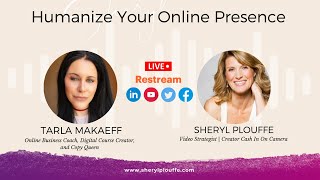
Tarla Makhaev, a 7-figure copywriter, explains why entrepreneurs struggle to build trust online: they hide behind their brand instead of showing up as humans. She calls it the "3D version" of yourself—sharing your roles, struggles, and small flaws in bite-size stories that move people from small talk to real connection.
Chapters
There is no denying that it is really impossible to build a business online today if you don't have an online presence. And today we have 7-figure revenue copywriter Tarla Makhaev with us today to talk about this concept of how you can humanize your online presence. But before we get to that conversation, first of all, let's kind of like call out what the problem is, Tarla. With people's online presence. What is it that you're seeing that entrepreneurs are doing, or the biggest mistake that you're seeing people make when it comes to people's online presence?
Yeah, thanks, thanks for having me, Sheryl. So I believe the biggest mistake that people make is that they're not humanizing their brand. So they're talking a lot about their product or their service and expecting people to buy But in the meantime, people really don't have any connection with you. So what is going to make you stand out from everyone else who is essentially maybe promoting a very similar service?
You make a good point because most things have all been done before. They just haven't been done by you. So you have to bring a certain flavor to what it is that you do and position that in a specific way in order to stand out from others. That makes a lot of sense. And you mentioned connection. People who are just kind of going out there and they're just like, sell, sell, sell— some people are having some success with that. So then I think what happens is entrepreneurs see that and they go, oh, well, that person is rah, rah, rah, just selling their products and services, or at least that's how it looks on the surface. And then they go, well, I'm going to emulate that, I'm going to imitate that because it's working for them. And then they don't hit the same results. So do you see that happening a lot in the online space as well?
I do see that happening, absolutely. There are people who definitely don't really want to talk about themselves. They want to keep things private. They say, why should I talk about my personal life on social media? Like, I want to retain my privacy. I'm not a celebrity. So there are people that are able to do that, but the thing is, is it's really more of a temporary connection with somebody because you're offering some value to them through your service, your product, but there's no nothing longer term to build like a deeper, more solid connection that will really want them or make them want to keep coming back. So it's kind of like when you get to know a friend or you meet someone at a party, they, they become an acquaintance, and then maybe you know, a friend, but it's kind of surface level. You're talking about the weather, you're talking about inconsequential things, but you never get to know them on a deeper level. They might still be considered a friend by you, but you're not gonna have that trust factor that you have when you know, like, details of their lives that they've confided in you. And it's the same thing online.
Yeah, I think it's the difference between having small talk with someone at an event and having a deep, personal, rich conversation over a glass of wine with someone. Like, those are two very different scenarios, and that's what it sounds like you're painting here for us. Just a quick little mention, I want to mention that we are going live right now to, uh, all of my social media platforms. If you're watching this on the video, you'll notice there might be just a slight delay to Tarla's voice, uh, in this video, but the audio is coming in loud and clear, just so we know we're all on the same page with that. So let's continue this conversation around your concept of the 3D version of yourself and how you can actually build those stronger connections and help people to know, like, and trust you. Explain to us what the 3D version is in your estimation.
Yes, so the 3D version is essentially showing all of you because we're 3D. We're not just a business owner. We are a friend. We are a girlfriend. We are a wife. We are many different things. And so when there are things in your life that happen that, you know, are difficult struggles or things you've overcome and you share that with your audience, so anything from your day-to-day activity, documenting your life from errands that you're running, you're going on a walk with your dog. People feel involved. People ask me about my dogs. No one's ever met my dog online. So, you know, there's that, but there's also going a layer deeper. So there are people who are maybe good at doing that part, but I feel like there's very few who are good at going deeper. And the people who are really good at it, who anyone can emulate— obviously you using your own life story, not theirs, but is to look on YouTube. A lot of these YouTubers who, you know, do a video that they were going through a divorce now, and all of a sudden that video on their channel gets the most views. They might be a makeup influencer, but that's what people wanna watch. It's because people wanna relate to you on a personal level. They wanna know that you're flawed just like them. They wanna be able to relate to you. And sharing stories is as old as time. So by doing all this, you're building this bond on a deeper level, the know, like, trust that you mentioned, and then people feel more connected to you, and then people might wanna do business with you more so than if you're just talking about business. It's cold and it's not connected, in my opinion. When you're only talking about business and you're never talking about yourself, It doesn't instill trust for me, and it's also that way for a lot of other people.
I think adding that personal element in is very important. However, a lot of people struggle with showing the bits of themselves that are less than perfect, less than, you know, less than successful, shall we say. Like you said, the struggles, uh, the things that people overcome. I think a lot of entrepreneurs myself included, have been in a place where it's like, well, I don't know if I want to show that because that will show that I maybe I don't know what I'm supposed to know, or maybe that is going to reveal an inadequacy about myself that I don't necessarily want to advertise. But what I'm hearing from you is be willing to do that nonetheless. I feel like I'm starting to be better about doing that, but I still have some fear around that. I still have some fear around kind of letting out all of the things that might not be wonderful, right? Because entrepreneurship is hard. There's a lot of struggles. There's a lot of challenges. And it is a challenge even for me, I think, to go out there and be as vulnerable as what I'm hearing you say we should be. Why? What can we do to overcome that sense of like, I don't want to show all the bad stuff.
Take baby steps. You don't have to show everything. You, you're in control of what you do or don't show. You can start out with small things, you know, I'm always late, you know, oh my gosh, I'm always late, like this is something I struggle with, really minor. To me, I talk about my depression and anxiety, but I don't do it in a way as to depress other people. I do it in a way to empower other people where by the end You know, I'm saying, you know, I'm either still dealing with this or have overcome this. We can get through this, everyone, whatever we're going through, or I've already gotten through it. You can get through it too. It's an empowering, uplifting message. So being vulnerable is a strength. A lot of people don't want to show what are perceived flaws, but everyone else on the internet who's watching has those flaws too. And It's not about you, but it's about your audience. If you can help one person overcome some problem, even if they're watching me, I'm talking about depression and I've lost both my parents, I reveal that. And even if they can't relate to that, I mean, a lot of people can relate to depression, anxiety, let's be honest. But even if they can't, if they're struggling with something, you know, like a health condition, an illness, but they see me talking about that, that might inspire someone to talk about that too. We might say, what, why is this, how's this related to my business? Why is this even important? It's important because for me, I want to leave a legacy that's more than about just business. If you have a platform, I feel like you have a responsibility to help other people beyond selling the products and services. And so just take that little baby step, talk about something that's like a minor flaw, you know, like, like I said, being late. Yeah.
And, and you know what, I think that if you can find a way to take a vulnerability, a story of something that you overcame, a struggle that you might even still be going through, but you're finding solutions to, and you put that out there. But turn that story into, now, how can I make that matter to the audience? What lesson could I share with them that I've learned that will also help them? Sometimes I feel like people who don't do this well end up going online and just sharing kind of a stream of consciousness, and it doesn't really relate to the person on the other side. I think that's a It's finding the way to how can I make this relatable to somebody else. And sometimes I think one of the problems that people have is they put it out there. It feels like a therapy session. Like it feels like their own therapy session. And you're kind of like a bystander going, 'And this relates to me how?' The truth is people are selfish. We want to know, well, how can I learn something from this? And I think sometimes that's one of the troubles that we see online. I'm just getting some messages here saying, thank you for encouraging me with this. I can relate. I feel I'm not good enough. I think a lot of people feel that way, right? They don't know that they can actually take those stories and make it matter to someone else. Erin actually has a question here, Tarla. Is there a certain way to do that that is authentic to you?
You're just sharing in a post. Like Cheryl was saying, you do not want to have it be a therapy session for yourself. If you've not fully processed an event or something that's happened to you, don't post about it online. This is, yeah, not for therapy. This is to have something that you've already processed through, that you feel comfortable sharing. Literally write a post about it. I write a post and Think about like who's one of the most popular people in the world. It's Tony Robbins. Why? Because he inspires people. People watch the news that's negative. We have— we've just been through a pandemic. People want to feel inspired. If they see like, oh my gosh, this person's been through like this hero's journey and look, they're coming out the other end, I can do it too. So when you're inspiring people, it'll give them chills, it will motivate them. They'll want to be around you. Don't we all want to spend time with people who motivate us, inspire us, and encourage us? And then they're really going to be interested in you and your business. They're going to like you as a person, and then they'll be like, I like this person. That person may not be the best at what they do even, but it's like their personality, and they're like, I like this person. Open, they're real, they're raw, they're vulnerable. I want to work with them.
As you've been sharing your, uh, 3D version and how it can really bring all of us on into our online presence, and that that's really the solution to, to fixing that and humanizing it, I was just thinking of stories of my own and how I could maybe potentially be more vulnerable. And I, and I just got a thought about years ago. I remember years ago looking at my— and this was before I had things organized on the back end, like this is when I was like running my business through my own personal checking account, right? So, which is obviously not the way you do it, but this is in the early stages. I didn't know any better. But I remember looking at the bank account, it was $100 in it. $100, right? And I just remember going, that is the scariest number I have ever seen in my entire life. And as you were just describing this, Charla, I'm thinking, you know what, I've been through it. That was a struggle, and I've probably learned some lessons from it. But that might be an example of a story that I could now bring out now. I wouldn't have wanted to do that back then because I hadn't found the solution to it at that point. I was still struggling. But now I have found the solution. So that would be an example of a story that I could go back in the ethers and grab in and pull out and say, okay, how could I write around this? How could I write a post? How could I make this matter to somebody else who might also be at the earliest stages? So I would encourage if you're watching or listening, think of a story now. Maybe it's similar to mine, right? Or something that Tarla talks about online too. It could be like, What is something that I could go back, pull forward for other people? And Tarla, when you talk about the copywriting work that you do, how do people— or is there any kind of specific structure around how people should attack the writing of the copy when they're writing something very personal and vulnerable?
So I just say free flow it with that. When you're being vulnerable like that, I wouldn't be following copywriting formulas. That's if we're talking about sales pages, that's— or emails, that's like maybe a totally different conversation. But if you're writing a post on social media, if you're getting on video, I don't get— I'm going to be honest, I don't get on video a lot to share. And I have, but it's probably several times, like deep, deep things like what we're talking about with the depression, anxiety, or losing my parents, because I've cried on video. I've cried face to camera like this, start crying, not expecting to or knowing I might. I've had that happen a few times and I'm totally fine with that. I've done others where I was walking the beach and maybe they saw the beach, but they heard me and I started crying. And that's okay. I don't want to do that all the time, but I would suggest to people, because that's totally fine, but for me, it's uncomfortable for me too. Look, I'm human. But what I would say is in a post, it's easier. You have control. You can like pre-think about how you're gonna write things, but don't think about it too much. Literally just start from the beginning and kind of share your backstory as to what the situation is. It doesn't have to be about business. If your business isn't where you don't want it to be, you don't, you don't have to share about your business. Personal, to me, is even more important. But I love your demonstration of what you said for your business because it's like we look at people all the time that are in a great place now, and almost no one talks about when they weren't in a great place. And so people can't relate to that. They're like, oh great, you're making 7, 8 figures, but like, but were you always here? Like, where did you start? What went wrong? And that also makes people feel that they can also accomplish things when they're like, oh well, they didn't start out here, they've also had issues. So I just encourage everyone, like, take little baby steps and you're going to end up really inspiring people, number one, and maybe change lives. I've actually— I'll just say this really quick gratefully that I had, I've had people tell me that I've saved their life. I mean, just from sharing the depression and anxiety stories, that's pretty powerful. I don't know these people. I've never seen them, met them before. You just never know the thing that you say to inspire someone, how it's going to impact their entire lives. So keep that in mind.
I love that. Tell us about your website, Tarla, if people want to connect with you.
Yeah, you can visit me. I think we'll drop it below with my name spelled out, but you can visit my website, uh, tarlamakhaev.com, and everything's there about me. So I have a book called The Essential Guide to Your First Month of Online Marketing. I have multiple courses on both online business, and I have one coming on copywriting. And yeah, if you head there, all the info is there to find out about me, my business, my my business coaching, my digital courses on how to start and grow your business online. Fantastic.
The last thing that I want to ask you is, what is a tip, tool, tactic, or technique that's helping you, Tarla, to market for yourself for the year that we live in? What is it that makes you be like, oh, I found this amazing app, new strategy? It could be related to this topic or unrelated to this topic. What's something you want to leave the audience with today?
I want to encourage you to have an email list and a funnel. So get a sales page that you pre-write. It might take you a long time to write it, but once you've written it, it will sell for you on autopilot. You won't have to repeat yourself over and over. And then obviously that what goes with that is an email list. So you want to make sure that you have an email list. You take people off social media. So if ever your Facebook or whatever account you're on goes away, you have a way to stay connected with them and share all your goodness with them.
Tarla, thank you so much for coming on Cash In On Camera. This was very insightful, and I'm so happy to know you. And we've connected on Clubhouse, and now we're a lot on Instagram, and I know that we're going to have many more conversations ahead. So thank you so much for coming on the show and sharing your insights today. We really appreciate it.
Thank you so much for having me. I appreciate you.
More from Sheryl



From 'agreeable' to 'ruthless mentor' to 'strategic sparring partner' #substack #shorts







