Hybrid Courses & Programs with Samantha King
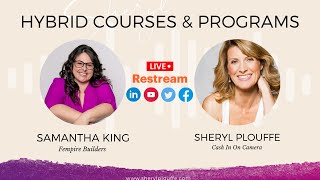
In this conversational interview, host Sheryl Plouffe talks with digital‑product expert Samantha King about hybrid online courses—programs that blend self‑directed content with live, high‑touch elements. They discuss how to start by mapping a client’s journey, the importance of accountability and interaction, and various community‑building tools (Facebook groups, office hours, Bonjoro, WhatsApp, email). The conversation moves to beta‑testing and pre‑selling as ways to validate a course before full launch, and how a hybrid model can fit into a minimum‑viable‑product approach. Samantha promotes her upcoming "Friend Zone to Authority Island" event, outlining its three‑day structure (getting out of the friend zone, building authority, monetizing). Finally, they share a modern marketing tactic—strategic collaborations with complementary creators via podcasts, virtual summits, and joint‑venture partnerships—to replace outdated 1999‑style marketing. The interview wraps with practical advice on aligning a hybrid course with the broader business funnel and ensuring it prepares students for the next offer.
Chapters
Katha King, I'm excited to talk about hybrid programs and courses with you today because as you know, the, the leader of, um, Fempire Builders, I mean, you're all about digital products. You're really all about helping people to package their expertise and to do that in such a way where they can have online courses that run without them. But I'm curious to know your perspective on hybrid. You know, so first of all, let's just talk about hybrid. I know what I think it is, but I'd like to hear from an expert's opinion. Like, what do you think hybrid courses really and programs really represents?
So for me, when I think, when I think of, let's first start with what I think of an online course, right? I think of an online course as something that's self-directed, meaning that you create it, but your students consume it on their own and without you. And I have, when I talk about this with, with my clients, when I talk about it on stages, I talk about making sure that the course fits into your business properly and being clear on what you want your course to do for you. And that doesn't always necessarily look like the standard self-directed course. I make it, they buy it, they take it. Some people like to have a hybrid option, which is kind of what we're talking about here, in which there's a little bit of self-directed learning, but there's also a live learning component, whatever that may look like. And it is something that happens. It's completely possible to do that. And it might be the style for you. I love that.
And by the way, you know, with Cash In On Camera, we're really all about helping people go from unknown experts to becoming like seen as the authority. And now you and I both have a real strong belief system in the power of authority. I think online courses are a great, great way to do that. But sometimes people who are at the early stages of their business get really caught up in having the things that they see people who are way further ahead of them have. So let's talk. So where should people actually start?
Absolutely. When you're— and I actually, you know, when you're thinking about an online course, I actually say the place you need to start is with your clients, journey, right? They're going from A to B because a lot of the time, and the reason I say to start here is because a lot of the time people go, this is a hot topic, everybody wants to learn about this, or, you know, this is what I want to teach about. But really what you need to do is talk to your market, talk to your audience, and figure out what their journey is and how they see you fitting in it. Because you need to know first of all how you see yourself fitting in it so you can position it. But you also need to know how they see you fitting in it. And what I mean is they're going from A to B and somehow you fit into this, this journey between A and B. And that's really where you need to start and then talk to your audience and then you can start thinking about a course. Yeah.
And I agree with you 100%. I think a lot of people start off, they're like, I want to have a passive income source. I want to have an online course that's Set it and forget it and the money just rolls in. And I'm gonna get notifications on my phone.
Bing!
You made another sale. That's ideally, of course, where we want to get to. But there are some places that you have to go before you get to that point. And by the way, those of you who are watching the live stream right now, we're on Facebook, we're on Twitter, we're on YouTube as well. You can leave comments or ask questions of Sam and I and we can answer them for you. We can even bring the comments up on the screen if you see fit. So do so, and we'd love to be able to make this interactive and answer questions for you. By the way, Sam has an amazing event coming up. We're going to tell you a little bit more about that at the end of this conversation. I'm a part of it too. I'm excited. But right now, we really want to dive in for you on hybrid. So hybrid courses is a great— in my opinion, that's been, I think, where I have had any level of success has been when I've started with more of a hybrid model. Because I listen to what people are asking for. And then, I do a little bit of teaching in amongst that. So like, there's an automated portion of it. But I really feel strongly about having that interaction, that high touch. So speak to us, Samantha, about that high-touch aspect of an online course. How important is that?
I think what I typically find and what my course makers find is that for many people, it really is important to have some kind of to have some kind of way to interact with them and check with them. And for me as a former teacher, it really goes back to being able to check for understanding because when we're in the front of the classroom talking to students, we're constantly asking questions to check for understanding. But what you'll find in the online course world is it's also good for that accountability. People are so busy now that they need, they need you to hold that space for them. And that doesn't mean that you have to teach it live. Right? You don't have to teach all of it live. That would be more of an online program, but you can build in certain pieces of it that obviously fit with your schedule and what you want for your business to show up for them and really help them work through what you're teaching them, but also help them start to take action and get results. Because, you know, a lot of the time when we, when people take our courses, we may wonder, like, are people actually enjoying it? Do they, do they get, are they getting anything from it? When we put out a survey, we may not necessarily get any responses. That's why if you have some kind of way to have a little bit of live teaching in there, whatever that looks like, you can do those things. You can check for understanding, you can make sure that people are actually taking action, getting results, and that's also going to help you get referrals for that course later because everybody loves to talk about the things that worked for them.
So I, you know, I love that idea, but there are probably 8,000 ways to do that because there are so many tools and methods. You know, I think about Facebook groups as probably one of the more popular ways that people have had that type of engagement. Do you still recommend Facebook groups as the place to do that sort of feedback and that availability to be able to answer questions maybe live or in a, in some way?
I think, first of all, I think nobody can compete with Facebook groups. People try, people are trying, they really are. Online course makers and online business owners are trying to get their people off of Facebook anywhere in any way they can. But Facebook is still, it's still something that people use, right? So it's a great, that is a great way for community building. You can also have it as an opportunity to have people post things for feedback if you wanted to. It can, people can ask questions in there. I think one of the things though that may happen is when it gets when your Facebook group gets too big, you know, you may, you may have people that are hesitant, right? Because there's a bunch of people in there that they don't know, and maybe they don't want to connect that way. And you also don't want to have to open up a new group for every, what I call every cohort, right? Every time you run this course or program, you don't want a new Facebook group of thousands. So I think there's, there, there is that potential, but there's also things like holding office hours, and where you can have people come in and it's every Thursday for 2 hours and people get to submit their questions. Ahead of time and you can go live on a platform like this right into the group and answer questions, or you can allow them to book 15-minute slots in those office hours. I think there's another great, you actually use this tool, Bonjorno, where people, they can submit their questions to you and then you can answer them, right? There's absolutely no, there's no reason why you couldn't have even a WhatsApp chat, right, where people can talk to each other back and forth. It doesn't have to necessarily be a group. It just needs to be something that works for you and that, that works for the students to be able to provide feedback and progress and for you to check for understanding and help them get going. But I think the biggest key here is knowing what they want and just giving them that because then they decide to do something else. But if they're not going to use it, then what's the point?
Yeah, and I think it's looking at how important is community building to the end result that you have set forth for them as far as like the deliverable of this program. Because if community is really important, then you're going to want to— and you just gave some great examples of ways to foster that— it might need to be a community type of platform, maybe a Facebook group or some other way to do that. Whereas I think, you know, if you can do maybe a one-to-one, you know, maybe using Bonjoro, or is it possible even, Samantha, to use just plain old email to get that type of feedback? Would that be too antiquated?
I don't think that it would be. I think that it, again, it depends on what you're putting in the email, right? Because these people want to get to know you. They want to feel you. And you know, when you're designing your course, you're going to decide whether, you know, it's you on video. You're going to decide whether there's slides, whether you're on camera, whether you're off camera, all of these things. And so for you, you want to build that relationship with them. So if I was going to do email, I might still want to have like a prerecorded Loom video that they could click on and watch. And it might be me, even if it's just me saying, hey, like giving them a pep talk, or even if it is just me saying to them, hit reply with this thing. People are more likely to take action when they feel connected to you. So I do feel like even if you were going to use email, you'd still want to have some kind of personalization, something to get them to warm up to you. And I think that, you know, with email, again, you have to think about, is it automated? Or like, if you have 100 students, are you going to send all of them a personal email at once? Right? Right. Email is more for managing, communicating information. But if you want them to check in and do something, you're probably going to need to figure out a way outside of email.
I'd love to know your take as well on beta programs. I've done several of them. I've actually taught some of you to do it and then they went and had some success with it. Like, I'm a big believer in beta programs or a minimum viable product kind of approach. Is that a good idea? And does the hybrid model play into either a minimum viable product approach or a beta program?
I think that any beta program, minimal viable approach is always important because let's think about how much time it takes to create a course. And do you really want to get to that point and then nobody wants it, right? You can do, I mean, the first step really is that market research, getting your ideal clients somehow to answer questions, get feedback. So, you know, kind of what you're creating and how you're going to position it. And then I think a great sales page and even pre-selling, the course or the hybrid, the hybrid course/program, you know, this is something that is key because you can run it and you want to make sure that people want it and you can run it in beta mode in which maybe they're getting a reduced rate or maybe they're getting a little bit more from you so that you have all of this. Um, they're getting a little bit more from you. So you have more opportunity to get feedback really, because that's what beta, that's what that is. It's really for you to make sure one, that people want it. For you to run it once and see if they want it the way you're teaching it or if they want it the way you're envisioning it. So I do recommend beta. I do recommend pre-selling. Put up a sales page.
I'm a huge fan of that. Listen, if you— listen, there are a lot of people out there who, if you ask them, you're like, hey, I'm thinking about doing a course on blank. Do you think that's a good idea? They're like, oh yeah, that's the best idea I've ever heard. But when you ask people, you say, is this a good idea? And are you willing to pay $500 to learn from me in a beta program over the next 6 weeks? That's a different thing. So it's really about, are people willing to pay? And I love taking that approach. I'm with you 100% on that. Pre-sell. Don't be creating a course for 6 months only to find out that nobody wants that thing. So yeah, Sam, um, you know, I love this conversation and I want— you know, I love it that it ties perfectly into authority. You know, nothing says authority like having an online course, like having— whether it's hybrid, whether it's a standalone, you know, having a program, having a course really sets you at another level. And I know that's really what you specialize in, but you've got an event coming up. I'm a part of it, which I'm excited to be a part of, your Friend Zone to Authority Island. Can you tell us about that event and how people can get tickets to it?
Absolutely. This is a great event for the people out there who feel like they're constantly creating content and never getting to that point they're seeing the return on investment. And by return on investment, I mean monetizing. They're not seeing people go from their audience to their clients. And so that's what this event really is about. And we're talking about how to get you from that friend zone, how to, how to get your audience to stop seeing you as that cool business owner who gives stuff away for free on Instagram and start seeing you as the next expert that they should hire. And so we've really, what we've done with this event is we've brought together experts from all the different areas of the marketing pie, because I think Cheryl, you would agree, online, somebody— people are always trying to give you a piece of the pie, right? A piece of what this is. But behind the scenes, they've got the whole pie in front of them, right? And so what we're doing with this event is we're bringing all of those pieces together. Day 1, we're talking about getting out of the friend zone. Day 2, we're talking about building authority. Day 3, we're talking about monetizing it. And it really is an event that is designed for you to get action items, to get the tools so that at the end of it, you can create your authority building roadmap and you know what monetization strategy fits within the dream for your business.
Yeah, I love that. And so, authorityisland.com/register. You can get tickets there. I created what I really think is an epic training. And I'll say that of my own self because I really put a lot into the repurposing of live streams and it's a— I think it's It's really something that people can learn a lot from. And there are so many experts that you've brought together, Samantha. So, kudos to you on doing that. You've done a really great job. I'm excited to be part of that event. So, go and get your tickets to Friend Zone to Authority Island. You can do so at authorityisland.com/register. And Sam, I want to ask you one last thing. So, we have this segment that we do. It's called Stop Marketing Like It's 1999. If you know anything about me, I'm a huge Prince fan. But I don't believe that Business owners need to be marketing like it's 1999 anymore. And as a business owner yourself, I'd love it if you could spend maybe a minute or two just sharing with us what is a modern marketing technique that's really been working for you in terms of building Fempire Builders so that people can stop marketing like it's 1999.
Yeah, absolutely. It's funny because in 1999, I think I was like 16 or 17, but whenever I hear the 1999 word, the word 1999, I think of Prince as well. Because you can't not like, You can't not hear that, right? Like, it's $19.99, right? But yeah, so let's talk about this. The biggest thing for me right now, and it's something I teach my course makers as well to help them rule Authority Island, is find the people who serve the same ideal client as you but don't do what you do, right? So really tap into that collaborative piece with a strategy and figure out who they are and then reach out to them. Do they have a podcast? Could you go— like, what is their stage, as you would say, Cheryl, right? Could you go live with them on their Instagram handle or whatever platform it is that they're on all the time, right? How can the two of you work together to reach each other's audiences, right? And I think that's the biggest thing. You, you want to get out in front of other people's audiences. Start using other people's audiences to help you build your authority, because you're both there to help the per— you're both there to help the same person. And if you can both come together and do that, won't they won't they get their help even that much more faster, right? So things like podcasts, I speak at virtual summits as well where my ideal clients are hanging out, and you know, I obviously host my own virtual summit, but I have absolutely, you know, taken that time to figure out who's working with my client and then figuring out, okay, well, what could this look like? How could I go on and add value to their audience and help them become— be seen as an expert while also helping them help their audience?
I love that. It's something that I have been doing a lot more of in the last year, is looking to collaborate, building joint venture relationships and partnerships with people, doing more speaking. All of those are strategies that really work. So I love that you honed in on that, that idea of collaboration and looking at who are the people who have the key to the audiences that I'm trying to reach, and how can I have a special spin You know, maybe it's through content or through speaking that I can get in front of those people. So I love that, Sam. Thank you so much for sharing.
Absolutely.
Yeah, any parting words about hybrid courses and programs? What do people need to know as we leave today?
I think the biggest thing that you need to know is if you're going down the online course route or whether it's hybrid, figure out what fits in your business and make sure that the course that you're building is going to prepare people for the next offer that you have for them, right? Because they're going from A to B and chances are they need to be taught, you know, 4 or 5 things before they get from A to B. And some of those things can be self-directed. And of course, some of that'll need personalization. So spend the time to figure out what it is you want your course to do for you and what it is you— how it fits into your business and what it's going to teach your ideal client. And then understand where they're going next. And you should know that before you even launch the course, right? Take that time. Put that foundation in place.
That's great advice. That's great advice. Yeah, I love it. Samantha King, thank you so much. The address to get your tickets to Friend Zone to Authority Island is authorityisland.com/register. So, go grab your tickets and connect with Samantha online. She is a wealth of information as far as digital product creation, online courses, she's your girl. And thank you so much for being here today with me, Samantha.
Thank you so much for having me.
More from Sheryl



From 'agreeable' to 'ruthless mentor' to 'strategic sparring partner' #substack #shorts







