Is Authenticity Just A Buzzword?
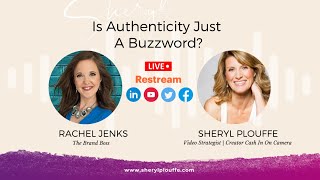
Branding expert Rachel Jenks argues authenticity isn't overused, just misunderstood. True authenticity means aligning your words, actions, and lived experience. Fake reviews and sales pitches disguised as compliments erode trust, while her "Identify-Amplify-Multiply" framework helps entrepreneurs find and scale their genuine voice.
Chapters
authentic online. But the truth is that over the last few years especially, I think the word authenticity has lost maybe a little bit of its luster, has become overused. Today we're going to talk about authenticity. Is it just a buzzword or is there some validity to authenticity? And the perfect person to have on Cash In On Camera today to talk about this is the brand boss herself. Rachel Jenks is here and we're going to discuss this topic. So Rachel, great to have you on the show today. Authenticity is something I think we both agree with, right? We want people to be real and to be natural and authentic. But do you feel that it's an overused word? And if so, why?
That is a great question and thank you for having me, Cheryl. I don't think that it's overused. I think that it is misunderstood. And I think that there's a difference because authenticity has become something that people think, you know, you can slap on as your values and now we're an authentic brand. And it really goes so much deeper than that. Authenticity isn't something that you slap on what you do or who you say you are. Authenticity has to do with whether or not you are who you say you are. And so it goes even deeper than what most people tend to think of as their brand, right? It goes all the way into the life that you live. If how you are showing up in the world is not how you are actually living your life, then you are not living your life authentically. And this can happen in all kinds of ways. In fact, can I share kind of a funny story that happened today, Cheryl?
Love stories. Lay it on us.
All right. So we have all gotten these DMs, these emails, right? "Hey, I love your work. I was looking and I saw a couple of things and I have some suggestions if you want to hop on a call, blah, blah, blah, blah." Right? So I got one of these emails today. "Hey, I really love your podcast. This episode," which by the way was several weeks ago now, "got so much value out of it. I went ahead and left you a 5-star review." And you know, as a fellow podcaster myself, I just, you know, I have some ideas and how you could grow and blah, blah, blah, blah, blah, blah. And I was like, "Let me just go look." There was no 5-star review, right? And so that email in and of itself was not authentic. And you know why I'm bringing this up? Because that's the second one I got today. So I also got a Facebook message today which super annoys me. Don't send me personal Facebook messages trying to sell me something. That's just not cool. And so I got this Facebook message, "Hey, I see you're in the branding space. That's awesome. Yeah, I know that like I don't know what I'm doing in that arena, but I'm grateful for people like you who do." And so of course my thought is, okay, do you want to know more? Oh yeah, I'd love to know more. So I start sharing more. Oh, I'm so sorry if you misunderstood. I guess what I was trying to say is— it was a sales pitch. And he's like, yeah, you know, you might do really well with a group coaching program. Oh, okay, good. Have you paid attention to any of my social media? Because I have one. So I'm, I'm a little bit spicy about this topic today because why? Both of those messages were not authentic. Not only was it a message with an agenda, right? Which, you know, I mean, let's face it, when it comes to those conversations, usually there is an agenda involved, and that's not necessarily a bad thing. But don't tell somebody you left them a 5-star review if you did not leave them a 5-star review. That's called lying, right? Don't send me this message that's like, oh hey, I'd love to know more, No, actually, I just want to sell you my thing. And clearly I've paid no attention to anything that you do. So I'm a little spicy about that at the moment, but just because all of those messages were not authentic, right? Just be real, be a real human, have a real conversation with real humans. That is all that anybody wants from you in 2022. And so when people are showing up in the world, whether it's in a message, whether it's in their marketing, whether it's on video, because you can see through that, right? Not actually in alignment with either what they're saying or who they are. That is a disconnect. And you will feel that. You might not even be able to articulate it, but you will feel it. And that is showing up inauthentically.
Yeah, I agree. I mean, I think that that that strategy that you just, just described is indeed a strategy to reach more people. And it doesn't sound like you are necessarily saying that's a bad thing to have a strategy to meet people or to connect with people, but make sure that if you're going to execute on that strategy, that you are actually following through the thing you said you'd do. In this case, a 5-star review, because if you check and it isn't there, then you are now labeled as a liar because you said you did something that didn't actually happen. And so that is inauthentic, which to your point makes it so that it's not necessarily an overused word, it's just a misunderstood or misrepresented word.
Yes, and I, I just want to jump in for a second. Yes, I am not, I am not discounting that strategy. What I am saying is be authentic and be honest, right? Don't say, I love your work. Have you ever considered, you know, website design? And you haven't even looked at the person's profile and they're a website designer, whatever the case may be. Like that kind of stuff happens all the time. Have you, would you like help with sales? And that person actually has a sales business. You know, like if you are going to give somebody a compliment, give it, you know, give that person, a real genuine compliment. Don't say, I love your work. If you've never actually looked at it, like if you're going to use that strategy, then make sure that you are using that strategy authentically. And I didn't mean to go so far on that strategy, but no, I just thought that was such a good example, right? If you're gonna use a strategy, use it authentically, make sure that you are connecting authentically because that's, see what that person just did, like you pointed out, is they branded themselves to me as dishonest. So now, how likely do you think I am to engage with that person even if they had some good ideas, right? I'm always open to ideas. We all have things we can learn and grow and whatever. But if somebody's dishonest, are you going to listen to them? I don't think so. You know, if somebody says, hey, I'd like to learn more— oh, I'm sorry if you misunderstood. Well, do you want to or not? Like You're the one who told me you want to learn more. So whether it's a message, you know, whether it's a message in your DMs, whether it's a conversation, whether it's showing up on, you know, in your marketing, make sure that you're being real about it, right? Nobody likes to be buttered up. Nobody likes to feel buttered up. And if you are doing that, then you're not actually being authentic because you're not being honest. I think Authentic and honest can kind of go hand in hand as well. I agree.
Now, how does that relate to branding? You just hinted at it in that now that brand, their brand is tainted in your eyes because of that experience. But talk to us a little bit more about the connection between experiences like that that are inauthentic or dishonest and how that comes back to hurt a business owner in the end from their brand.
Perspective. Sure. So when we think about branding, everybody jumps to this stuff. And you know, for those of you who are listening, I'm pointing to my visuals behind me. And that's just a tiny, tiny fraction of the equation when it comes to your brand. Branding is not like cattle branding of the olden days, and people still think that's what it is. It's not. It's not about us putting our mark on something. In order to truly understand the power of branding, you have to think about it in reverse. Every single interaction that anybody has with you on any level, online, offline, grocery store, whatever, is an experience they're having with you that is that opportunity to build or break trust. That is the true power of branding. So if you look at this comprehensive experience, whenever somebody isn't who we thought they were, Whenever they don't follow through on what we thought they said they were gonna do, right? That breaks trust, that doesn't build it. Why? Because they weren't authentic, they weren't genuine, they weren't being honest, they weren't whatever, they weren't, we don't have a consistent experience with them that aligns with what we believe to be true about them. This is the true power of branding. So another example that I have of this was a couple of years ago, back in New York, I was considering buying a house and I needed to work with a mortgage company. And I was driving down the road one day and there was a mortgage company and the sign said, "We're always here for you." And it just kind of stuck in my head and I was like, "Okay, let me go check it out." So I called that mortgage company and went to voicemail and didn't hear back. And 2 weeks later, I called that mortgage company and went to voicemail and didn't hear back. I think it was a full 3 weeks before I heard from anybody after multiple calls. And then that person said, hey, you know, corporate could probably help you with this. No phone number for corporate, no nothing. So I had to look that up on my own, call corporate, and again, I got sent to voicemail jail. So by the end of this experience, I really started to question, who is the you that this company is always there for? Because clearly it wasn't the potential customer. So that is an example of being unauthentic. And here, We have this brand. We're always here for you. No, you have a marketing tagline and your experience doesn't align with that tagline. So actually the brand that you have is not what you thought it was. And now—
Yeah. And it brings up a good point because in that example, that those are just words at that point, it's lip service. It's just words that we put up on a billboard and there isn't any meaning or intent or meaning behind those words. But in the work that you do, the Brand Boss, and the work that you do, I think, on your own podcast and what you talk about and the things that you represent are having meaning behind the things you say, how you say them, where you say them, what design you, you choose to say them with. And that's the most important thing that I'm hearing from you. Is that a mistake that you see a lot of people making where they don't have that alignment?
It's one of the number one mistakes that I see businesses making, and they are breaking trust with customers all the time and don't even realize it. And you know, this ties into the realm of personal branding as well, because there's all of this noise in the marketplace. I know we talked about this, Cheryl, offline. There's all of this noise in the marketplace about positioning yourself as an expert and posturing this and whatever. Okay, if that's not really who you are, then at some point somebody is going to have an experience with the real you that doesn't align with that. And you just broke their trust. So why would you intentionally have a marketing strategy that sets yourself up to break trust with your customers? And yet I see people doing this all the time. And you don't have to posture yourself as anything. Be who you are. We are all so worn out and so tired of the fake, right? There's so much, stigma about that in marketing because there's been a lot of the fake. Now on the flip side, if you look at the influencers who are truly popular, right? Like, so if you look at Gary Vee, for example, there are so many people who try to be like Gary Vee. Gary Vee is not trying to be like anybody else. Gary Vee is Gary Vee. And what you love about him isn't only his style, it's that he's being authentic to who he is. He's showing up as himself. If I try to be Gary Vee, it's not going to translate the same, 'cause I'm not Gary Vee. We're two totally different people, different personalities, different experiences, different voices, different all of that, right? So whether it's Gary Vee or Simon Sinek or any of these other people that I have seen so many business owners try to pattern themselves after, well-intentioned by the way, I'm not saying that they do this intentionally or anything like that. Anything like that all the time. But even in our best intentions, if you're trying to be like somebody else, then you're not showing up as who you actually are. And at some point, somebody is going to have an experience with the real you that doesn't align with who they thought you were, who they perceived you to be, whether it's your company or your personal brand, and that's going to break their trust. And that is just so sad to me. And I see it happen all the time.
Do you think, Rachel, this is a question that's more related to visual and how people show up online or in a video or in a photo as it pertains to their brand? So for example, if someone, let's say a business owner, is really touting this idea of being natural and being yourself and being natural, but then they show up in a very different way. With like pancake makeup and false eyelashes out to here and, you know, hair 18,000 different ways and colors and, you know, where it's pretty obvious like they're not representing themselves physically or visually as natural, but yet in their messaging it's all about natural. That would be kind of an example, right? That kind of thing. So it's non-congruent. Do you see that?
Exactly. Exactly. It is that has to do with that non-congruent. I see that a lot. I see the people who think they have to have a talking heads video on LinkedIn telling everybody else what they're doing wrong, which, hey Cheryl, it's nice to meet you. Let me tell you everything you're doing wrong. Like, does that actually make you want to have a relationship with me? I don't think so. You know? And so it's stuff like that. Or like you just talked about, you know, this is all natural, but here I am in my ball gown and my pancake makeup or whatever the case may be. It can be from that extreme. Down to little teeny tiny things, right? And so I think that the real reason that we do this as business owners is that we're afraid to be who we are. And there are a couple of reasons for that. Would you like me to get into that for a second?
I'd love to hear that.
Okay. So the reason I'm so passionate about it and the reason I get a little bit spicy about it is because the power of branding is about trust. And trust comes before transactions. When you focus on the relationship, the transactions will follow naturally. The purpose of business is to solve problems and take care of people, and when you have forgotten the person in the equation and turn them into a dollar sign, then you have missed the entire point of business, in my opinion. And so all that kind of stuff devalues the person, because if you're like, oh well, I just want to show up this way, you're not actually showing up to be real, to have a real conversation with that person. And so the 3 reasons that I see business owners doing that are number 1, imposter syndrome. We are terrified that somebody's gonna think that we're showing up as something that we're not. The very definition of the word imposter means somebody pretending to be somebody they're not. So if you are showing up as who you actually are, and by the way, there is nobody else like you on Earth, nor has there ever been, nor will there ever be exactly like you, then how could you possibly be pretending to be somebody that you're not? But it's actually when you're showing up as somebody you're not, whether it's well-intentioned and you think you should show up this way, you have to show up this way, other people are showing up this way. If it's not who you are, then you are showing up as an imposter. Ouch. The second reason that I see business owners doing this is, again, it's super well-intentioned. I did this myself. That's why I'm so passionate about these three things. I have done them all and walked through them all. So the second one is, I don't need it to be all about me. It's not all about me. I'll just let my business do all the talking. We get our business from referrals. It's fine. Like, just let my portfolio speak for itself, whatever the case may be, right? I don't need it to be all about me. I don't need my face on the internet. I don't need my voice on the internet. Okay, great. Maybe you don't. I sure didn't. But you know what? The people that I'm here to impact needed my voice on the internet, needed my face on the internet. Needed me to show up. You have to be discoverable to be discovered. And if you are here to impact the lives and the businesses of other people, which again is what we do through our businesses, you have to show up so the people who need you can find you. And sometimes it has to be all about you in order to not be all about you. And so the thing that really hit home about that for me is if I am playing small, because I don't need it to be all about me because I'm more comfortable, because this keeps me safe, then it's not actually humility, it's selfishness.
I agree.
So that's the second one. The third one is just being overwhelmed. Like, okay, I'm wearing all the hats, I'm doing all the things, like, where do I even start? I don't know, like, how do I figure out who I am as a personal brand? How do I figure out how to show up? All of these things. So those are the 3 things: the imposter syndrome, what I like to call false humility because it's well-intentioned but it's actually selfishness in disguise. I went there. And then overwhelm. And those 3 things keep so many business owners playing small or showing up inauthentically because they think that's what they have to do. All the while, the person that you are here to impact isn't looking for somebody else. They're looking for you.. And if you don't show up as who you truly are, they won't find you.
Yeah, I agree. And there's so much fear that under— that is the underbelly of all those points, that valid points that you made. So much fear is underneath all of that. And at some point you have to be willing to face those fears and do the things you've just outlined in order to get the results for yourself and others. Because it is, it is selfish of you to hold back all of the, the goodness, the, the value and the help that you could be providing to people because you're putting up a wall in front of yourself because you're scared. And, and so it's selfish, I think, to hold back. If there's something that you do that truly can impact other people's lives, you have to switch the way you think about that and forget about your fear and be willing to do it anyway.
Yeah.
And that is how you can serve more people.
Absolutely. And for me, that's what changed everything. When I realized it's not about me, it's about the people I'm here to impact. And when I go on camera, it's not about me. It's not about how I'm feeling in this moment or whatever. It's about me giving what I'm here to give to you.
Yeah.
And that changes everything. It sure did for me.
So this word authenticity. We've really unpacked it today, I think. And it's not a buzzword and it's not overused in your opinion. It is— I think it's bordering on getting overused. But nonetheless, I'm still a supporter of it. I think it is the best word that I could use to describe, I think, the thing that we've been talking about today, which is that you need to show up and really be yourself, which can sound cliché, but That is the truth. And that's exactly what you help people to do at Brand Boss Studio. So tell us a little bit about your website and I'll show it on the screen so people can learn more about you.
Sure. So what you're looking at right now happens to be the landing page for my group coaching program. So I have a group coaching program where this journey that I have been on the last 3 years of learning to identify, amplify, and multiply the impact of my own personal brand. I can now walk you through in just 12 weeks. It is a self-paced program that has a group mastermind component to it. I also do one-on-one consulting and coaching, and I have full done-for-you services as well. And what this Identify, Amplify, and Multiply is all about is, like I said, this journey that I've walked. And so in order to show up authentically, you know, when it comes to, um, antiques and things like that, like the ones who are that are, you know, said to be authentic are of higher value. Why? Because you know it's a genuine original, right? So what does it look like? What does your genuine original look like in your personal brand? Who are you? Who are you not? What is your unique voice? What is your unique authority that you bring to the table? Which by the way, has to do with your personal experience as well as your professional experience and blending those together, because nobody else has ever lived your life, right? So, All of these things that go into who you are as a personal brand. And then how do you amplify it? How do you know where to connect, who to have the conversations with, what about, and then how do you multiply it? How do you see more results for less effort? So this isn't overwhelming for you. That's kind of a 30,000-foot view, but that's everything that I dig into in the group coaching program.
Fantastic. Thank you so much, Rachel, for coming on and, and really helping explore this word authenticity with with us all today. And I really appreciate your insights. And I do like your framework around your 3 points. So thank you so much for coming on the show and sharing that. I think our audience will be the better for it.
Thank you so much, Cheryl, for having me. It was an honor to be here today.
More from Sheryl



From 'agreeable' to 'ruthless mentor' to 'strategic sparring partner' #substack #shorts







