Land More Clients with a Solid Project Management Plan
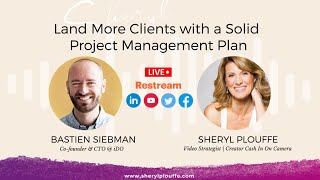
Bastien Siebemann built an agency serving over 300 clients by using Asana to automate content creation and client management. He uses the tool to run a content factory that feeds LinkedIn, YouTube, and TikTok, and to track invoices, leads, and client touchpoints. Around 20 to 30 clients, spreadsheets stop working and you need a real system.
Chapters
impact how you land clients and how many clients you land. Today on Cash In On Camera, we are speaking with Bastien Siebemann, who is a really one of a handful of recognized leaders on Asana, which is an amazing project management tool. And we're going to dig into it today. So Bastien, so great to have you here. You're in France right now, right?
I am in France. It's actually 6:00 PM for me right now.
Great to have you here on Cash In On Camera. I want to dig into this. Tell everybody a little bit first about Asana, what it is. I mean, we're going to be speaking to this from the perspective of project management tools, but you happen to specialize in Asana. So just tell us the overview of your involvement with Asana and how you became one of the few anointed and global experts on this particular tool.
Yes, Asana is actually a work management solution allowing you to really collaborate with your teams and even work by yourself more efficiently. I happened to choose Asana myself about 10 years ago as a tool to manage my own company. And I started to get better at Asana, and we were just a handful at the time. And people started to ask me for help. And one day someone asked if they can actually pay me for help. And I started side hustling like this. I was lucky enough to live in Europe, so I was working during the day in Europe and I was side hustling in the evenings for US clients doing consulting on Asana. And things led to another. I actually became active on forums. I wrote several books on Asana. I started to have really a lot of different clients. The word actually started to get out there and That led me to actually have my own company now. So we are an agency specializing on Asana itself. We worked with over 300 clients all around the world, and we do everything from A to Z when it comes to Asana.
There's a story under the story here. I know we're going to dig into project management plans and how to land clients with it and the importance of that. But what's interesting about your story is that you actually became an expert. I mean, it took time, but you became an expert by virtue of the tools that you were using to grow your other business. And I think that it's interesting, right, to see that as a real-life example of how you might be doing something in your day-to-day and really getting good at using a tool. And who knows, you might even be able to follow in Bastien's steps and become a global expert on that particular thing.
Yeah, exactly. It wasn't, it wasn't the goal at first. And being an Asana consultant actually did not exist at all at the time. It was too small. And after years and years, I started to realize that this ecosystem was actually growing. The community was growing, and we started to see consultants emerging and companies emerging. And also the tool itself, Asana, was structuring different programs around the tool to help people like me emerge and create companies. But it wasn't the goal. And I think it's important to go with your passion, go with your gut. And if you feel like there's something there, maybe push a little bit further and see if you can maybe sell your time, sell your knowledge, try to create something. And in my case, I think the key element was to just create content, write a book, another book, do videos, answer on forums.. And that really helped me become better, really show my expertise. And that led me to have actually clients contacting me almost every day to work with me instead of having me reaching out to them to work with them. They've seen me online, they've seen the way I work, the way I talk, they've seen my expertise, and they come to me directly thanks to this content I created.
Well, let's talk about the content. Because you have this philosophy, it's almost like a flywheel philosophy that content brings clients and clients generate content and that it continues to feed unto itself. Can you explain why it's important to understand that concept?
Yeah. So when you— this is something I understood afterwards, obviously it wasn't the goal again at first. When you create content, you improve your expertise and people get to know you and they work with you and then you have clients. And when you have clients, you work with them and you have sessions and trainings and workshops and audits. And all those sessions help you get better and they also help you have ideas for content. So you create new content and that brings new clients and they bring to you new problems. And that's a cycle that, that can live a very long time. And really can help you grow your business without doing some outreach to find clients by yourself.
I think this is a great example of, in your case, you did it with a particular tool, a project management tool. But this, what Bastien just shared with you, is something that can be applied to the coaching and consulting industry in general, right? If you are good at whatever it is that you do and you're helping more clients, you're actually gaining a lot of intelligence by the questions they're asking, the language they're using, the problems they're having. And then if you follow that up by using, you're creating content and maybe demonstrative content especially, that can help to fuel your business. So let's dive into the project management side of things. How did the tool, Asana in this case, but a project management tool really help you from a content perspective? Was it about organization? Was it about efficiency? Explain to us how that played into the development of, of your brand.
It's about organization and saving time and being efficient. We, we built and improved over time an entire content factory. So to give you an example, each, each topic we want to talk about goes into an ideas bucket list, and then we decide which idea should be written about. Then it goes into the content factory. When it goes there, we have to write the text in one language, English or French, and then that gets translated to the other language automatically through automation and the work of our assistants. And we also have to shoot a video in English and one in French. Once that's done and we validate in the tool the different content we created, we get all that stuff created automatically. Like all the channels we have to publish on gets created. We have one task for LinkedIn, one task for YouTube, one task for TikTok. They get assigned to the right people doing the thumbnails and the summaries and the upload and everything gets done magically by people from the team. And then in the end it gets published after a few days. So that's again, that's kind of magical and it works really well because of the tools we use and the processes we've put in place.
You made a good point there about having a team of people who, yes, you have these tasks. It's staying very organized. It's very efficient. But there are team members who are actually actioning and creating that content. Is having a project management system a good idea for someone who is doing all of the doing themselves, meaning that they are a solopreneur? They're the people maybe in the earliest stages who are doing all the things. Is it too soon to have a project management tool?
No, I think it's never too soon. And even if you are just by yourself, it does make sense to have people around you, even if it's an assistant, like 1 hour per day or 2 hours per day. It does bring a lot of value. But if you're not there yet, I think it does make sense to still have a tool to be able to capture ideas, organize your ideas, plan your different campaigns. And usually we juggle so many topics at the same time., it's just really hard to manage by just using pen and paper. So a tool like Asana can really help you get some clarity on all the different things you're working on.
So let's speak to this idea of landing more clients. Explain to us the connection between having the system, being efficient, being organized, having a team member or maybe several team members over time as you grow your team to create that content, How is that connected to helping people land clients?
Creating the content is the first step, obviously. The second step is having someone emailing you when they want to work with you. But that's only the second step because usually even if you answer, they don't follow up. So you need a system to be reminded to follow up with people. You need a system to rate all the leads that you have to know on which one you should spend time. Even when you signed the client, you need to manage the quotes, the invoices, the sessions themselves, the agenda of the sessions. All of that has to be managed somehow. When the work is done, you need a way to track testimonials. You need to remember to ask each client a testimonial. You need a way to gather their testimonial with the rating, and you need a way to get back to them based on what they said. And We always say that it's easier to work again with the same clients instead of finding new ones. So you need a way to be reminded to talk with your clients as often as possible and push to them new things you're working on. All of this has to go into a system because once you reach a certain level of a certain number of clients, it's not manageable with piece, uh, piece of paper or just emails. You need to have a system to be able to put everything in sync.
This one. Bastien, is there a magic number of clients where you should really start to build in those automations, those reminders? Like, what is a manageable— let's say for a coach or consultant, what is a manageable number of clients to have where they're maybe not developing the systems that you're talking about? Is it after 10 clients you really need to be looking at this? Is it after 7? Is it after 20? Do you have any sense of at what point a coach or consultant should be looking at something like this?
I think there's so many steps, as we've talked about earlier, there's so many steps even with a single client that I think on day one you need a way to track what's happening. Even if you start with a simple Excel spreadsheet, that's fine. So you could start with this. And then as soon as you have to collaborate with someone, even an assistant, you need to have a system, and an Excel spreadsheet is usually not enough to collaborate. In those cases, you need a way to be able to discuss on specific topics. You can't send each other emails because it's going to be too hard to manage. So I think, I think before 20, 20 to 30 clients, you can probably do everything with an Excel, and then it's probably better to have something else to get automated reminders and automation and things like this to help you streamlined. And if you have 30 clients, that's probably because you actually talked to like 200 leads. That's right. So that means you have like 230 people to manage. So you probably need a tool even before having 20 or 30 clients.
Yeah, that's a great point. I love the idea of having project management because it keeps things organized. You were mentioning about automations and having reminders. Are you suggesting that those reminders be set up like a blanket reminder for a specific group? Is it based on tags or is it more of when you bring in a client, especially if you're, let's say it's a private client, that you're specifically creating specific customized reminders for that one person?
Yeah, it's a good question. We have different types of reminders. For example, an invoice will have a default reminder after 30 days because when you send the invoice, after 30 days it has to be paid. That's the default reminder. If it doesn't get paid, we usually remind the client and remind again every 10 days. So we have defined default values. When it comes to the relationship with the client, it all depends on the priority and importance and potential of that client. Obviously, a client with a big potential, you have to talk to them more often and be reminded about them more often. A client you did not enjoy working with, you will never remind them, obviously. So we have, I think, different scenarios and different automations in place to make sure that nothing falls through the cracks.
What about taking notes? Every conversation is different. Different things are happening, different things are said that need to be tracked. There's different follow-ups that are going to happen. Tell us about note-taking as far as the project management side of it.
"how do you suggest taking notes?" In a tool like Asana, you have tasks. So for example, in our case, a client will be a task, an invoice will be a task, a meeting will be a task. A task is an object that gives you the ability to have attachments and comments and discussions with your team. Even if you work by yourself, and I do this all the time, I comment for myself because I know that 2 weeks from now, 6 months from now, I need to understand what happened, what I did, in which order, at which date, and at which time. So I even comment for myself. So if you structure things by creating different types of tasks organized in different types of projects, then you can use comments to really explain the details of what happened, to get that accountability and the ability to go back in time and analyze if you have to.
And so on the subject of tasks, And coming back to content, are tasks also the way in which you would organize the content structure and the content plan?
Yeah, definitely. So in our case, each content is a task and each publication of that content is a task as well. So for a specific topic, for example, this podcast, once it's released, it will be a task. And the fact that I will talk about this on YouTube will be another task, on LinkedIn will be another task, etc., etc. Because each task has an assignee, which will be the person doing the publication, a date which will be the publication date, and potentially we might want to use the comments to discuss how to publish this on YouTube and do something specifically for YouTube. So we try to split things into having different tasks, uh, even for the same topic.
And Bastien, I want to ask you about the difference between a project management tool like Asana versus a CRM? Are they the same or are they different?
Um, they're definitely different. A CRM usually goes a bit beyond in terms of features. To give you an example, we use Asana as a CRM, and we decided to do so because we want to go as far as possible with the tool to see what are the actual limits of the tool. What Asana doesn't do is sending emails. This is what a CRM would do. A CRM would allow you with just a click of a button to send an email to someone and remind them of something. Asana doesn't do this, at least not natively. We found ways to make Asana do this for us, but it doesn't exist at first. So usually a CRM is more of a specific tool that has a specific set of features, when Asana is more generic and more wide in its approach, allowing you to do a lot of different things but not having very specific features that you might need in that specific case. That being said, the technical foundation of a tool like Asana allows you to build things on top of it by using what's called an API. So we are able to create tools and automations ourselves and even send emails directly from Asana. So we're starting to get really close to an actual CRM, uh, by using a tool like Asana.
I love that. And I would like to ask you, what is a— maybe aside from project management, aside from Asana, what is a tip, tool, tactic, or technique that's helping you to market yourself and to help market your agency?
I think again, it's content, just putting content out there and really showing the way we work, what are our values and how we think.. And I think by creating content, that's the ultimate way of doing this. And again, people come to us, they know exactly the way we operate because they've seen us talking about the way we work on YouTube. They've seen webinars of us talking, they've read our books. So it changes the whole discussion. It's not about, please show me why you're the best. It's about, I want to work with you. When can we start? And here's the scope of what we need.
It's brilliant. I love the idea of being chased rather than chasing other people.
It takes, yeah, it takes a long time.
It takes a long time. Admittedly, yes, it does.
You have, you have to create a lot of content. And to give you an example, I'm the number one contributor on the forum, so I'm the one that answered the most questions, which is thousands of questions over time. But I go there every day and I spend 10 to 15 minutes every single day to answer on the forum. Even the most simplest question, I go there and I answer just to keep that ranking of being the first one.
And that's the ultimate lesson, I think, in this, in this episode, is to understand that if you want to be seen as an expert, if you want to be chased rather than chasing people and finding clients that way, you need to be organized. You need to be creating content. You have a project management plan. And tool that allows you to do that so that you can start really creating and contributing to a conversation at scale. And over time, that is what's going to help build your brand and get you to a place where business is not as challenging and as difficult as it is for sometimes people who are struggling to, you know, position themselves a certain way and get clients. So Bastian, this is really helpful, and I, I love that you came on the show today to share your thoughts on project management and planning for content and how that connects to landing more clients. I would love for you to share where people can learn more about you on your website.
Yeah, they can go to our website, so ido-clarity.com. They can also find me on LinkedIn using my name. And yeah, they can learn everything about us.
That's wonderful. Thank you so much for coming on the show and sharing this. This is a topic that is near and dear to my heart. I love the idea of authority and content. It really makes a lot of sense to me, and I'm sure that our audience is the better for it. So thank you for coming on the show today.
Thank you. Have a good day.
More from Sheryl



From 'agreeable' to 'ruthless mentor' to 'strategic sparring partner' #substack #shorts







