List Building With Video
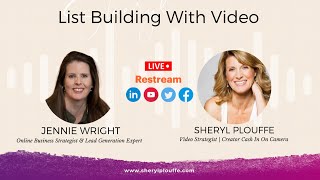
Jenni Wright explains how to use video to build email lists and sell products. Short, low-commitment videos solve small problems and build trust, while your paid offer solves a big one. Consistency matters more than perfection: post weekly, keep brand-awareness videos under two minutes, and move followers into owned email lists.
Chapters
It might be a surprise for you if you are building on social media, you're building an audience. That's great, that's awesome. However, you don't own those audiences. That's why you always hear experts talking about list building. And Jenny Wright is a list building expert. She's a business growth expert, and she's here on Cash In On Camera today to talk about list building from a different vantage point, and one that of course is near and dear to my heart, which is video. So welcome, Jenny. Let's dive into this topic, building your list with video. Why is it so important to build a list?
It builds bigger connection and allows people to get to know you and build that trust factor so much more quickly than if they're just reading copy, right? So if we're only reading copy, it's really hard to discern more about the person, right? And when you're watching video, you get to see facial expressions and you hear tonality, and you know, you can make those snap decisions of, oh, I like that person, or oh, I don't like that person, versus just with copy, you don't really get that unless it's really well written and it's fun and sassy.
And I think it has something to do as well with the fact that people want to learn in different ways. Like, people— some people gravitate more toward, you know, textual content, and some people are more kinesthetic, and, you know, etc. Does that play into how you teach list building in general?
Absolutely. So any of the landing pages and the different kind of pages and things that I create, sales pages and whatnot, they all play into those different learning styles or those different styles of connecting with content. So we, we will always have video, we will always have really good copy, but we'll always make sure that we have even some long form in there for people who enjoy long form copy that allows them to connect. But I find that video is one of the things that ticks up the conversion rate on a landing page to build your list and on sales pages to convert that list. But on even on a regular webinar page or even on a PDF download page, having a little video absolutely can mean a between a 5 or even a 10% tick, like an uptick in your conversion rate on your pages.
And so in this conversation today, we're not going to dive into the how to make the video part. We're going to kind of jump the line to the point where Let's presume you either have made the video or you have ability to make the video yourself. You have that skill set, or you've outsourced it to someone like me who's making the video, right? You have like the creative, um, around the video. Now we're going to talk with Jenny about what do you do with it. You mentioned a few things there like webinar. Um, I think we're probably going to end up talking a little bit about YouTube as well. But where do we want to start this conversation? Because you have a lot of people who are maybe, say, not as tech savvy, right? They get a little bit afraid of the technology. But let's talk about how things are today. In my view, it's never been easier to use video and embed that into a landing page, a website, versus what it was like, let's say, 10 years ago.
10 years ago, it was— you needed 3 experts and a couple thousand dollars to get all this kind of stuff done. Now, it's It's so simple, especially just using your iPhone to record video. You can record amazing quality video on your iPhone even and upload that anywhere you need to. I mean, obviously YouTube is really easy to use. It's also free, which I like. Um, and it's very low barrier to entry. There's literally a little button with a little camera on it. Click that, upload your video and you know, off you go. What I like to use video for in terms of list building is to get people to know you before you start promoting your offer, whatever that is, your lead magnet, et cetera, to build your list. And I love using video for things like Reels, stories on Instagram, and video posts as an example, as well as things like YouTube. And even if you can get LinkedIn Live, go for it. Because what that does is it shortens up the runway. If you think about it this way, whatever you want to launch, let's just say you want to sell your group program and you have no followers. On social media, but you want to sell 50 spots into your group program. Unless you build up your social media and your email list in what we call the runway period beforehand, you're not going to hit your goal. And you're going to want to 100% use that runway time, which can be as short as 3 weeks to as long as a few months, to build up that connectivity with people, to build up that trust and get people to get to know you. And the consistency thing is the key here. I always tell people I need to get consistency tattooed on my arm and just be like, read here.
Exactly.
Just right here it is. And, and, and, you know, Cheryl can tell you guys this as well. Any video strategy that you use or implement is only bettered by the fact that you're consistent. If it's start and stop and start and stop, it's not going to have the same effect as if you're consistent. So this is where I know that Cheryl teaches about having a weekly show, which I think is a fabulous idea. And I think everybody should be doing it. And this allows people to get to know you better and sort of suss out what you're about before they make any investment in terms of giving them, you know, giving you your, their email address or investing with you.
Yeah. And the cool thing that you just explained was that, listen, if you have a, let's say in the example of a group program that you anticipate selling in July, let's just say, right, the work needs to be done ahead of time to build that connection, as you talked about, that the know, like, and trust factor, which you've heard about, building that up before you get to the point where you're like, I need to sell this now. Because if you just kind of jump the line and get to the point where you're like, okay, I'm just going to go out there and do promotion, it doesn't land with people because you haven't done the work. Where list building comes into play is that you can build your list throughout that process and continue to build it over the over time with content that has nothing to do with selling your group program. Well, it has a connection, but it's a covert connection.
Yeah, it's adjacent. We call it like adjacent.
There you go. Yeah, so let's talk about that, like how you can make content that is connected to your ultimate goal without it being salesy.
Absolutely. So think of your— think of the course or the product that you sell as solving a big P, a big P problem. Okay. P for problem. And the content that you're creating using video on social media or creating webinars and things like that are solving small p problems, right? That's the value in the content that you create. So the free stuff is the small p problem and the paid stuff is the big P problem. And using very low barrier to entry, just like Instagram, YouTube, using your cell phone and things like that to create these kinds of videos. Going on TikTok even, you're going to be able to leverage video in such a way as people will get to know you. So a small p problem is an example for my audience is how do I, you know, how do I know what to create as a lead magnet, right? What lead magnet is the right lead magnet for my audience? So I create small p content saying, hey, people learn in different ways. There's, you know, 4 or 5 different styles that people learn. I suggest that you have 3 different lead magnets. Here's what I suggest. Bam, bam, bam. Uh, you know, this covers the majority of how people learn and it's going to get you the best possible result. What you were talking about a little bit earlier with the launch in July, my runway for something like that would start in February where you're just creating a mixture of lifestyle content as well as small p problem solving content. And just letting people get to see behind the, the window, behind the screen, so to speak, right? So, um, showing pictures of you or video, taking video of you behind the scenes, just living your life, really helps create that connection with people. We want people to start following us. In the absence of you sharing about you and those small p problems, what happens is they're going to go find or look to somebody else who solves that or is more present. So that's our competition.
What I love about the idea of the small p problem is that you're chunking it down into smaller problems that you're solving for people. And in my video mind, I think that's really appropriate for the shorter form content because I really think that from a list building perspective— and I'd love to know your opinion, Jenny— but from a list building perspective, I look at it as the customer journey. This is brand awareness level, right? People don't know who you are yet, and so you want to have shorter form content. And in my mind, that's under 2 minutes. It could be 15 seconds on TikTok, could be a minute on IG Reels or whatever. But under 2 minutes, to my way of thinking, really fits the bill on that brand awareness or first level of contact with prospects who are out there. Do you buy? Do you go with that?
Like, do you like that idea? Okay, totally agree with you. And to solve the next problem, which is the next thing that people think about, before you guys even ask, I already have the solution for you. Because the next problem that people constantly bring up is, well, what do I talk about? And the easiest answer is, is that you talk about the, the thing ad nauseam, right? So even though you think it's pedantic that everybody should know how to do whatever it is that you do, they don't. And that's why you're the expert in your field, right? So creating that, that 15-second TikTok or that 30-second whatnot, you can, you can get out there like, hey, here's 3 tips to be more— to get your brand out on social media, or here's 4 ways that you can start start turning into, you know, turning your diet into a plant-based diet. Boom, boom, boom, boom, boom. Right? And you can, you can just start talking about that because your ideal client has no clue. And those starting steps, that, that customer journey you were touching on starts with the basics. And if you can help people understand the basics, then you can start to grow quite a loyal following of people who are like, yeah, okay, she's helpful. And you can create that. I call that your story arc. So you can start with the basics and then you can start arcing up. Into the more challenging and interesting pieces of content that are synonymous and lead to your eventual offer.
And when you're helpful and you're positioning yourself as someone who is worth following, guess what? People follow you because now you're worth following. But it doesn't end there. I think, Jenny, it's also having that infrastructure obviously set up so that you can capture and take people off those social platforms onto your own platform or your own list. So you do have to have the infrastructure set up for that. In other words, a landing page, an opt-in page. It goes by many different names, right? Lead magnet, other people, you know, people call it different things. But you have to have that infrastructure set up and in place. Otherwise, you're building on social media, and there's nothing wrong with that, but you don't own those lists. So you don't own those, that audience, so to speak. And it sometimes can be challenging to reach out to them in a succinct way if you have, you know, like I have 18,000, um, you know, followers, subscribers on YouTube. I've got, you know, 5,000 on Instagram or whatever. And if I didn't have a list— and it's not to say that all those social people are on my list. Yeah, because they have to opt into the list. So the list is smaller than the social following, but it's still all in one place. So let's speak to that.
Absolutely. And we've all gone through in the past, you know, couple years, the blackouts that have happened with some social media. We've had Facebook down, Instagram down, You know, LinkedIn has had some issues, right? And what happens when those go down is if you have an email list, you're going to be able to email those people and present whatever it is that you want to do, any kind of an offer or solution. And getting people off of social media and into your email marketing world, they call it your ecosystem, is not as difficult as people think. You do have to have that infrastructure that you mentioned earlier. That could be as easy as a landing page, like enter your name and email and get my 25 'Tips to Achieving X,' right? Simple checklist. What a great way to get people off of social media. And this is where you really want to utilize that bio, that link in bio area, to get people to come and join you. The thing that people miss is that they create the lead magnet and then they don't know how to drive traffic. And driving traffic is really— I mean, it's really not that difficult. All it has to be is creating a consistent call to action. Again, that word consistency, I'm getting it tattooed right here. I promise. I promise. And, and consistency is just making sure that within your regular social media posting, that you say, hey, if you want some help with this, I have a 25-point checklist that'll help you with this. Or I have a 3-part video series that's going to give you the step-by-step on how to, you know, achieve ABC and XYZ. Go check it out. It's at January.com/whatever. And that is not a hard CTA. It's just a, hey, if you need help with this, 'Yes, I'm happy to help.' And it gets people into your email list. And if you do it consistently, then you grow your email list consistently. And that's where we have to work on.
So I just want to go back to something you said earlier, which was the idea of repeating yourself, right? I think about when I was on TV for all those years, and I did weather for 17 years. Do you know how many times I repeated myself every single day for 5, 6 hours a day when we were on TV? Right, I watched you. You did?
Of course I did. I watched you. I've— I watched you deliver the weather on a consistent basis, and I'm sure you probably said the exact same words thousands of times.
I did. And but this is something— and this is something I talk about a lot, that there are so many parallels in my opinion to what I did professionally, to what I do today, and what I teach and preach, is that you do have to, as an on-camera personality or business owner, influencer, whatever you want to become, you have to get used to saying the same message over and over in different ways. It's— everyone's not going to see every single post you do.
Exactly. And that's, and that's a thing. Well, I've already said that. I already did a post about that, Jenny. When?
Yeah, once.
Once, like 6 months ago. Oh, do you think everybody's seen that? Like, do you think people go back? No, no, right? So just find a different way of communicating it. You know, I talk about lists. I've been doing this for 9 years. I've been talking about list building until I'm blue in the face, but I keep repeating the same message over and over again. And then it also becomes kind of kitschy and fun. You know, it doesn't get boring. It actually doesn't turn people away. It keeps people loyal because you're always sort of peppering things a little bit differently and you're adding a little bit more personality. And, you know, the person I was on camera 4 or 5 years ago, was a lot different than the person I am now. I mean, I was a lot more wooden and very, you know, just monochromatic in terms of how I spoke. And I've developed my ability to at least, I think, I hope, be a little bit more personable on camera so that people are interested in what I say. But the message is still the same. Build your list, have a great landing page, try for optimizing your conversions, engage your list, and make an offer when it makes sense to the person on the list versus you. And congratulations, you know, you'll have sales. And then rinse and repeat.
Jenny, can I just sidebar just a little tiny bit into your story? Because, you know, Cash In On Camera, the idea here is to help people build their businesses by being visible. And you have a very unique story behind, you know, some of the challenges that you have faced in terms of being seen on camera. Are you willing to share that story with us? Yeah, in terms of— I think it would be helpful for the audience to know just how everyone goes through that period of time where they're like, how do I get seen? What steps do I need to take? And what do I have to really, um, you know, fix in myself in order to want to do that? Can you share that story with us?
Absolutely. Thanks for asking about it. So there's, there's two facets to this story. One, I prefer to be behind the scenes. I was actually a stage manager for theater productions in a previous life and loved that because I'm behind the scenes calling the shots. I'm really good at being bossy. But when this online business piece started to grow, I was still hiding behind the scenes. You might see a static picture of me, but I was never on video. And there was a reason for it. When I was 19 years old, I had my wisdom teeth removed by, um, an elderly dentist. Doesn't matter. But when he did it, he severed the nerve in my face. So I have no feeling on the entire left side of my face, my teeth, my tongue. It's all gone. And it has been since I've been, you know, was 19 years old. And that's a bit of time now. And I had to relearn how to speak. I had to learn how to press my tongue against my teeth to say tuh, the, suh, anything where your tongue touches your teeth. I had to relearn. In addition, at the time, and this I've done some work with this, but my mouth and my face was lopsided because of the the nerve damage. So I've had to work on smiling level, like a level smile, right? Not looking like Jean Chrétien when, you know, at the time, right? So all of that was— made me feel very self-conscious, and I didn't want to be in front of camera because if I got nervous, I would stutter a little bit because of this, this whole situation. And I had to work really hard to overcome it. And eventually the discussion that I had in my head was, you know what, Jenny, this isn't about you. Nobody gives a flying leap if you're— you've got a facial thing going on, or it doesn't matter about your weight because I'm very, you know, I'm very self-conscious. It doesn't matter about this, that, and the other. It doesn't matter because it's about them. And you have this gift, and unless you're putting it out and getting out in front of people, they're never going to know that it exists, and you're going to continue to be behind the scenes and never have that spotlight. That you kind of know that you want. And so I had to overcome it, and I overcame it. I did it, and I did it in grand fashion. I did 56 Facebook Lives in a 2-week period.
I love that, just go all in.
Trial by fire. And I improved, you know, I mean, my first one was ridiculous. Uh, the last— by the time I got to the last one, I was multitasking. I had guests, I was writing comments live as I was going, I was, you know, I had pages up and everything. And I was like, oh yeah, this isn't hard anymore. And I was just I just got through it because the only way out is through, and I just did it until I was okay with it and comfortable with it. And now I don't even think about it anymore.
I am so glad that you did that because you're one of my favorite people online, and to think that I wouldn't know you had you not taken those steps breaks my heart. So I'm just so glad that you took those steps and overcame those obstacles.
Thank you.
It's a really great story, and I think it'll help other people who feel nervous or apprehensive in some way about something that's going on in their lives. So that's, that's really helpful. Uh, I want to ask you about opt-in pages. I've heard different things about should you include a video on an opt-in page or not. Like, my feeling is this: I think if you have a sales page— and that's very different than an opt-in page, it's further down the line in the customer journey— but I like videos, uh, you know, VSLs, like video sales letters, on an actual sales page, but I'm not as keen about having a video on an opt-in page at the very earliest stage of someone's engagement with you. What's your opinion on that?
Yes and. So a basic landing page for a 25-point checklist doesn't need a video. You can, you can convert people really, really well with just the copy. But when you ask more of the person, more of their time, more of their engagement, because it's, you know, a checklist doesn't really take a ton of engagement. They download it to their, their desktop and they look at it when they want. But if you ask them to participate in a video, like to watch a video or participate in a free challenge or to watch a webinar, you're asking more of that person. And to do so, you're going to increase your ability to convert them to do that if you include a video. Right? Because now you're asking for more. So the more investment or commitment in terms of time or energy from the potential person signing up, the more use video has.
I love that. I think that's a great guideline to use. If you're creating something simple, it's downloadable. It's a checklist, a PDF of some description. Maybe you don't need a video there, but the more you're asking of them, the more likely you should be adding a video to that page. Yes, Jenny.
I'm so sorry, I was just gonna say, and the video should be longer and more detailed the more the ask is. Yes.
And I think it's also— there's more strategy or structure that's required in, within the creative of the video depending on what it is you're trying to accomplish. I agree, right? Yeah. One of the things we do on Cash In On Camera is we have a segment called Stop Marketing Like It's $19.99. So what's working for you, Jenny, right, uh, to get out there market what it is that you do? What's a tip, tool, tactic, or technique that's working for you today?
Mine is transparency. Transparency and authenticity. Those have been buzzwords for a while, but they work really, really well for me. I am very open about my stories. I'm very open about who I am. I'm always sharing the fact that, you know, things on my side may not be rosy and beautiful. I'm not the, the, the Instagram image per se, but I I deliver on results. I always talk about that. That seems to be working. That conveys really, really well.
And tell people where they can learn more about you. System to Thrive is your podcast, which I am proud to be on. And yeah, I just want people to, to be able to connect with you. Where should they go?
System to Thrive is a great place to go if you want to hear more about me with the podcast that I do with my co-host Allison Lex. You can also go to it's jenniwright.com, with the caveat that I, I beg you to excuse the look, which is why we're showing the System to Thrive website, because my website is currently being redone and, you know, doesn't look its most amazingly best, but it is functioning. So those are the two places, and just find me online, connect with me on social, and feel free to DM me.
Yeah, that's fantastic. Thank you, Jenni. I really appreciate you being on Cash In On Camera today. This was Great conversation about list building with video. And obviously, if people have more questions, they can reach out to you. So really appreciate your time today. You are one of my favorite people online. I appreciate your, your time today.
Thanks so much for having me. I really appreciate it. This is amazing, and I love what you do.
Thank you.
More from Sheryl



From 'agreeable' to 'ruthless mentor' to 'strategic sparring partner' #substack #shorts







