LIVE Podcast: Business Strategy & Growth on the Spiritual Path
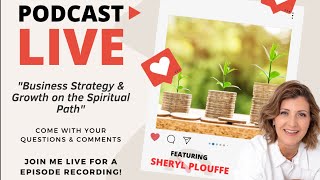
In this live YouTube podcast recorded on May 27, 2023, host Harrison interviews business strategist Cheryl Plouffe to explore how coaches, consultants, and intuitive/spiritual entrepreneurs can scale their businesses. The conversation begins with the fundamental obstacle of not knowing who to serve, emphasizing a deep, intuitive clarification of the ideal client beyond a generic avatar. Cheryl and Harrison discuss the balance between intuition and tactical action, warning against staying in a purely meditative "monk on the mountain" mode and stressing the need to translate inner downloads into concrete steps. They address fear, the importance of embracing failure, and applying an 80/20 approach to prioritize action over endless consumption of content. An abundance mindset is presented as essential, countering common scarcity beliefs in spiritual circles. The dialogue moves to brand values, integrity, and staying grounded as a brand takes on a life of its own, with a focus on setting and honoring values. They examine the role of personal boundaries, energetic hygiene, and the decision to share personal life online, highlighting the risk of burnout. The significance of voice—through podcasts, YouTube, and other media—is framed as a tool for impact and creation. Cheryl advocates shifting from content consumer to producer, limiting comparison, and cultivating conviction in one’s message despite algorithmic setbacks. Expectations and goal‑setting are unpacked, with advice to view goals as flexible pathways and to pivot when expectations aren’t met. The conversation concludes with personal reflections on love as simple moments of peace, and Cheryl shares her upcoming 7‑Figure Podcaster Program designed to help spiritual thought‑leaders monetize their voice.
Chapters
Welcome everyone that's just joining live. Just finishing setting up. We get started in 2 seconds. And just making sure we're live on Facebook. There we are. All right, let's get into it. Starting recording in 3, 2, and 1. Good evening, morning, afternoon, beautiful beings. Welcome back. To the show. Welcome back to another loving spiritual deep dive conversation today with a powerful guest that I can't wait to introduce you to and just have a divine chat with. Before I get to her and her beautiful expertise, a reminder for the people joining either live here on Facebook, LinkedIn, and YouTube, or listening to this on the podcast: if you get a bit of value out of this chat today and it hits your heart in some way, please share this out far and wide with a lover, a family member, a friend that you think it can give value to. And leave your comments, your feedback, your perspectives over on Apple reviews and Spotify feedback. That helps us build the show. If at all in this chat today on our live channels, I'm going to be checking Facebook and, uh, YouTube where I can. If you have any questions that pop up for either myself or Cheryl, pop it in the comments section. I'd love to add you into this conversation today. We are going to be talking about a lot of business strategy and growth along the spiritual path. And today I have the beautiful, the loving, and divine Cheryl Plouffe to come and help me do that. Cheryl is a business advisor. She's a business strategist. She helps coaches like myself, and most likely you if you're a coach, consultant, or expert, scale your business either through YouTube, podcasts, and other digital platforms. And today I really set the intention with Cheryl to dive into a lot of the strategy around all of this, but really from the perspective of an intuitive spiritual soul. Cheryl, with all of that, welcome to the Cosmic Love Antenna.
I am so pleased to be here, and just hearing your introduction has put me in this calm state where I'm really going to dive in, yes, to strategy, but I'm also going to tap into my intuitive nature as well for the course of this conversation. I'm excited.
And that's— I'm excited to feel that, Cheryl, because I've, you know, I've had the pleasure to connect with you on multiple occasions now, and each time I do, I feel that, that side of you impact me deeper. So now that I have you in my space, it's, it's going to be interesting to see what comes up. So let's, let's start. Let's get straight into it, Cheryl. Let's not waste any time. I guess I want to ask you to start this conversation. What, what do you think is the number one reason a business, let's say a, a coach, a consultant, a, a, a spiritual being like myself that wants to build online, what is the number one reason that they don't start to grow or they can't scale in your perspective?
I think the conversation needs to begin at the point of clarifying and truly understanding who it is that you want to serve. Now, on the surface, that might sound like an easy question to answer, but in my experience, it's not an easy question to answer. And I still see a lot of people struggling with this question. I actually was speaking with someone this morning on a consultation call, and we spent 90 minutes on that. And it still isn't 100% dialed in. There is a lot of confusion around that because we've been taught in the marketing space to think of it as an ICA, an ideal client avatar. It's this, this very formulaic, almost robotic way of looking at someone and very one-dimensional. And I think that it starts there. It starts with this true deep understanding of who you want to serve and The truth is, Harrison, that's a decision. That's just a decision that you need to make as a coach, consultant, expert of who do you want to work with? You have an option. It's your business. You get to build it however you want. In fact, most people got into this line of work and this career that they're building, this business that they're building, because they felt called and served to do this. Yeah, you have beautiful opportunity to be able to choose who you want to work with. It's not like a job. Where you're told you're going to do this. You get to choose. And I think it starts at that level.
So I, I get flashbacks already as you explain that to me. Flashbacks of, of the past and flashbacks of a very recent present where I'm sort of going through this whole process myself of reanalyzing, you know, the person that I want to serve. And I guess that question comes up from my heart and I'm interested to hear what your experience is around this. How often is the person that we want to serve in our business a previous version of us? How often is it us in, you know, 5 years ago, 10 years ago, that is now our quote unquote perfect avatar?
And you're— Probably most of the time. Yeah, probably most of the time. I mean, in terms of percentage, and there isn't any I'm not drawing this from any statistic. I'm just saying in terms of my own experience and working with people and even thinking of my own self, listen, I'm not immune to this challenge either. I had to go through this very challenge myself in making a decision about who it is that I wanna serve. And I also do think that it's something you want to revisit periodically within the course and the journey of your business as well to ensure that you are indeed serving the person you feel that you want to serve. And so I'm not I'm not immune to this. I absolutely have put myself through the wringer on this, my own self. But I do think that the majority of the time, it probably is a former version of yourself. It is likely, very likely, that it's a former version of yourself. And why is that? Why? Because we can relate to that person. We know that person intimately. So long as we can remember back to that point in time where we were, we know that person so well And but we have to remember who we were at that point, at that point. And we also do need to decide whether we do want to serve that particular version of ourselves in the past.
I think about this podcast as an example of what you're saying in terms of, you know, whenever I tune into an episode that I want to record— and I'm sure you experience this on your show— I think about the current, either the past lessons, or for me, it's actually, it's very current lessons I'm, I'm moving through in the moment that I'm passionate about to, to move through my own life that I teach on. And I find that that has the most resonance because I think in many ways it, it aligns with our most current self, right? It aligns with, okay, I'm going through this, I'm learning these tools so I can, I can share them with my, with my current client base because they, they might resonate with it as well. Right?
Yes.
On that note, Cheryl, I want to ask you— we spoke about this at the start of the chat, and I want to dive a bit deeper into it. A lot of my audience tuning in, some here live today, some here on the— most listening on the podcast replay, are very empathic, very intuitive, very connected to their, their spiritual abilities, if you want to call it that. And I'm wondering, as with the people that you've supported and maybe even in your own life, where do you think the role— what do you think the role is of intuition in starting to expand and make certain choices within your business to help it scale and grow? Is it, is it important?
I think it's important if you are that person, if you have self-awareness around who you are and that you do recognize yourself as being a spiritual person, a soul that's having a human experience. Like, if you have those beliefs, which I do, then I think that intuition is important to recognize and listen to, to a point. Not, not to the detriment of the building of the business. So, for example, let me give you an example. I think if you are self-aware and you're in— you, you recognize that you do have intuition, that we are connected to a higher source, and, you know, all of that, and you ignore that because you heard a guru talk about a specific strategy or tactic that feels like the next shiny object, that you have to ignore your intuition to follow that next path, right? I'm not a big proponent of that. You know, I think you have to balance it out and just go inward. And we talked about this on my show, right? This idea that you presented on my show, which was this idea that the answers are within you. And that if you go inward and you ask for guidance and then marry that with a strategy, marry that with a tactic, and then go down that path for a while and see what results happen. But I do think you have to listen to your, innate wisdom within yourself if you have that belief about the world and the universe.
You know what I hear when you say that, Cheryl, is it's a beautiful, beautiful balance between the divine feminine and divine masculine, right? It's— I think it's— I, I see this in myself. It's very easy as someone who is in the spiritual world all the time to, to stay— I call it the monk on the mountain syndrome. Right? It's very easy to stay in that meditative state and getting all the beautiful downloads. But then when we come into our business and we need to take action and we need to get, get some stuff done and start to implement some of those downloads, it can be easy as an intuitive empathic soul to not do any of those things, right? To stay in and maybe, you know, receiving all that guidance and all those downloads from gurus or even in our inner knowing, but not implementing, not taking action, not failing forward in many ways. So I'd love to know, this is just coming through me, what would you say to that, to that person, Cheryl, that has difficulty, that doesn't have challenge with getting the downloads and getting the intuitive insights, but has difficulty with making it happen, taking the action needed?
I think it probably stems from fear. And if it stems from fear, then what can we do to overcome that? Well, I think it has to do with knowing and understanding that no matter what action you take, you, you might fail. You might fail, but you have to be okay with that. I think that's the key. There's a lot of fear in, in entrepreneurial space. You're a coach or consultant, you're starting a business, you're growing a business, you're scaling a business. There is a lot of uncertainty and you don't really know what the path is, and you're doing the best that you can, especially in those early stages. And so you have to be okay with failing. You know, you will have to fail forward, and that's just part of the journey. Um, but I think in light of your last question, I was just thinking of this, that there's probably something to be said for the 80/20 rule.
Mm.
You know, I wonder if it would work out better for someone who is only taking in the downloads and really only going inward and only working from their intuition, and they're not doing the actions, the tactical, strategic actions, facing fears, getting out there and doing speaking. Maybe they start a podcast, whatever the thing is. To think of it as, okay, well, what if I applied the 80/20 rule to that? What if I took action, you know, and, and, and did the things for 80% and then tapped into my intuition for 20%? Yeah, or vice versa, you know. But having this balance, whatever balance that might look like, because I don't think that intuition alone is going to help you build your business, I guess. Point. I mean, you— a business means it's an exchange of, of value and exchange of energy, really. So there are some tactical things that have to happen in order for you to grow and to grow your business. And I think maybe in the spiritual space and the intuitive space, there might be a tendency to have mindset issues around, well, earning money, it's not all about money, it's about serving people. And that is true, but at the end of the day, a business is about the finances too.
Well, let's— Cheryl, let's break that myth right there, because that's a— that's a— as soon as you said that, so much inside of me just came up to like say, oh, let's, let's break that down. I want to pull it out. You said being spiritual means sacrifice, or being spiritual means— and this is, uh, you didn't say this, but I see this in other spiritual communities being spiritual means we have to overlook wealth or overlook abundance in many ways. And I'd love to get your perspectives on this, but how I've come to see this is your infinite state that you're made of, your love frequency that I often refer to as— it's, it is pure abundance. It is pure potential. It is, it is unbounded in its energetic capacity. And in— and when we equate that to money and finances, it is abundance. So this is not a conversation of, if I'm spiritual, I must sacrifice and have nothing. It is, if I'm spiritual, I deserve it all. And that's because that's your baseline state. What comes up for you, my friend, maybe in your experience around this?
I agree with you. I definitely think that if you're going to be a successful entrepreneur or business owner, that you have to adopt an abundance mindset, and that it isn't about— I mean, certainly there is competition within your industry or within your space, but I like to look at it more from a collaborative perspective. There's enough for everyone. Yes, there is enough for everyone. I was having a discussion with someone this morning. She lives in a small town and she is thinking very myopically in terms of like very small mind around the growth that she could have in her industry. She has 35 years of experience in what she does, right? So it's not a question of can she do it, does she get people's results— we know all of that. But she lives in a small town and she keeps thinking about very small, you know, look, what about my local people? And yeah, that's great, but We have to think bigger than that for ourselves. And I wonder if there might be a tendency for people to have stopped dreaming or to have stopped having this grander vision of what's possible, be it because they don't think they deserve it, or maybe because of their surroundings. And we're so much in a bubble in where we live and the people that we're surrounded with, and we just forget that the world is a very big place and there's enough for everyone. Yeah, it's— Oh, I wonder if that might be some of the issue.
Not only is there enough for everyone, you said it when you said co-creation. When we, when, when we accept that we are abundant, when we accept that we are full of this potential and we connect together much like you and I are doing right now on this podcast, it, the, the, the term, the phrase comes into my mind. High tides rise all boats, right? So when Cheryl connects into her abundance, when Harishan connects into his abundance, and we meet together in this context of a, you know, a business connection, it doesn't just impact our individual lives. We create something new together, right? And I just want to share this from a spiritual lens. You know, in many ways, that's what we're here to do. We're not just here to expand in our own journey, We're here to expand together as an interconnected collective. Does that, does that resonate, Cheryl?
Yes, it does. And I think we are, we're here to create. Yeah, that is really the journey that we're on. And so if we can do that with others and we can put on the hat of abundance and we can look at the world as not Oh, what am I lacking and what don't I have? And they want, they want to come up, they're coming to get me. And all this sort of negative thinking. Yes, unfortunately we're bombarded by these types of messages on social media. And it's a shame. I almost don't want to open my Facebook anymore because I just keep getting these types of negative messages. I'm just not in that space and haven't been for a long time. I just won't allow that type of messaging to permeate who I am in my being. I just won't let it happen. And that's why I don't watch certain types of shows and certain types of movies and negative imagery and things of that nature. I'm very guarded with what I will allow into my world and into my head and into my space because I want to keep fresh. I want to be open-minded, abundance-minded. I want to think of the world as an— as infinite, um, and our universe is infinite and we are limitless. Those types of messages are what I prefer to think of.
Cheryl, what you're describing— and we talked about this on your show— what you're describing is self-care, self-love acts that you apply at an energetic level, right? You, uh, much like you are being mindful, like you would be mindful of what kind of food you're consuming, you're doing the same thing with your energetic environment. Right? And we all need to do this. I just want to make this clear for everyone tuning in, you know, on Cheryl's channels, my channels. This is a practice, right? Every day, for example, I start my morning with an energetic cleanse, right? I make sure that if, like last night for example, if I had went out and maybe talked to some people that had those scarcity beliefs and they projected them onto me, I don't start my day with within that belief system, I cleanse and release. Cheryl, what practices do you have? What practices do you have in your life that you apply that help you come back to this baseline state of abundance?
I don't think that I have practices per se, Harrison, that I do to the level that you do, right, of having an actual cleansing process. I think mine is more awareness-oriented in that in the moment, if I feel like, oh, this is something that I don't want to have a memory of, I don't want to bring that into my space, I will just turn it off, do something different, go down a different path, choose a different channel, you know. And so I'm more about making those decisions as they come, but I don't have any necessarily any practices morning routines or practices that I do, although yours is a great example of one that is probably worth considering to do. I don't have any routines, but I do try to be mindful of what I'm allowing into my system. Definitely think about day to day.
And most aren't doing that, Cheryl. Like, you're understating the power of awareness. Yeah, right. The act of being mindful. It's so easy for us. The reason that we get caught in these belief systems of, as example, scarcity, is because we think we are them, right? And we haven't applied that awareness that you just talked about to add in space between what is actually us and the belief system that is running through us. So, you know, you underplay it, but just for people listening, I think it's very powerful. To be, to add in that conscious awareness in any aspect of your life. I want to shift here, Cheryl. You're welcome. I want to shift here, Cheryl, to another one of your deep wells of knowledge and wisdom, and it's within the, in the realm of still business and, and, and growth within the business world, but specifically with podcasts and, and using the voice. So I wanna start this aspect of this by asking you, what is the role of the voice in the expansion of a business overall? Why, why is it so important to consider?
I think it's important to consider your voice, and I don't mean just the vocal voice, the voice of your message and the impact that that can have and The modality might be a podcast, the modality might be a YouTube channel. There is a, there is a level of visibility that needs to happen in order for you to have ultimately impact. And that's really what it is. Your voice is intended to impact other people. And so coming back to our point about creation, that's the point of all of this. This, the point of this is to create something and to impact others with those creations. Make the world a better place, pass on that knowledge to other people, lift other people up. And so I think that the role of voice, as far as messaging is concerned, is really about— it's about creation and it's about impact.
Yeah.
To others.
So all of that makes sense, Cheryl, and I have seen that in my life. I've seen that in the work that you do. But a little piece of me comes up in rebellion to what you just said, and I move through this from time to time. I know a lot of people in my community, beautiful lightworkers and healers in my community, that want to get their voice out there. They experience this limiting belief of, yeah, but who am I to share my voice? What if I'm not good enough with my voice? What if my words don't matter? What if, you know, I'm not, I'm not enough in the words that I speak or the message that I wish to share? What would you say to that person that has that, I would call illusion, moving through them?
There might be a time and a place as you're building your business and you're putting yourself out there and you're voicing your opinions you are bringing voice to your, your thoughts, your ideas, your insights, your wisdom, and you're putting that out there where it isn't received. There might be a time and a place when that's the case, and that's when I think you have to dig into the well of conviction. And I think you have to dig into the well of belief in yourself. You have to believe in what it is that you are voicing. You have to believe in that message so much that you're willing to continue. You, you want to be able to continue despite the fact that the algorithm on Facebook did not put your message in front of the number of people that you had hoped it would.
Mm-hmm.
And you have to have conviction around and belief around what it is you're sharing, so much so that you're willing to try a different tactic. Maybe it's a different way, a different platform, a different modality. But what doesn't change is the fact that the message needs to reach people. And so then you just find another way. And I am thinking of one particular client of mine right now who Facebook was not treating her very well. She's great at what she does, but she would go on Facebook and there would be crickets. And then she started to doubt her own ideas. She started to doubt Am I good at what I do? Because it feels like no one's listening. And we're transitioning her to a different strategy, into a different tactic, because it isn't— it's not that her message is, is not landing. It's not that she's not good at what she does. It just happens to be that, you know, maybe it's just not resonating with people on Facebook, or the algorithm just isn't, you know, in her favor. But that doesn't mean that she's not great at what she does. And so sometimes I think it can be very traumatic. There's a lot of trauma for people who feel so, you know, they feel like they have a message to share and then they're doing something that isn't working. But you have to have belief in your message so much so that you're just willing to find new paths to make it happen.
First of all, I can relate to the the social media aspect of getting lost in numbers and metrics. And it's so easy for us, especially based off our— you said the word trauma. I speak a lot about this on my show, and I won't go too deep into it now, but depending on our upbringing, our childhood, it's so easy for us to attach our sense of worth to these numbers because we're looking for that We're looking for that attention. We're looking for that validation. We're looking for that, that mom, that dad, that lover that left us, and now we want that back, right? So it's so— what I would add to this, it's so important to do your healing work as you're doing this because that'll start to help that, uh, that false illusion of the value that you're creating. But I want to go back to a word that you said, conviction and belief in yourself, Cheryl. And I'm, I'm wondering how you experience what this— I'm gonna use the word feels like in your body, right? Because I think it's very easy for us to take on other people's message, take on other people's voice, take on other people's teachings, and it's beautiful. We need to learn from others. But I think there's a difference between taking on what other people are saying and speaking our unique voice, speaking our unique message. So I'm wondering, in your opinion, Cheryl, how would one, as, as a sensitive being that's starting to spread their voice and starting to find that conviction, find that message, how do we learn to distinguish between, you know, what we're picking up from other people and what is actually our unique message that we're meant to be sharing right now?
You might have to limit how much you take in from other people. And from an online business building perspective, I would love to see more people becoming producers rather than consumers of content. Because if you consume a lot of content but you are not creating and you are not producing and you're just taking it in, taking it in, watching other people, looking at others and comparing yourself. And then it starts to create this pattern of, well, who am I? I'm not her, and I can't possibly ever do it, and she's further along the path than me, or he's got things and I'll never be able to accomplish those things. So I wonder if switching that around and saying to yourself, hmm, what if I— not to say that I don't, I don't subscribe to put your head in the sand and not know what's going on in the world, But maybe you limit it. Yeah, maybe you limit the amount of content that you consume and you step more into the role of producer of content.
Yeah.
And when you marry that with conviction and belief around a message that you feel compelled to share in the world to have impact on others, and you follow that path, you would have to dig into your own resources, um, around what do you believe about those things, your own thought leadership is something that has to rise to the surface because you're not as impacted, or say, not coerced, that's not the right word, but influenced, influenced by other people's whatever it is that they have going on. And so it reduces the likelihood of you imitating others.
Yeah.
And it increases the likelihood that you're able to tap into your own resources and your own thought leadership on a, on a specific topic.
Yeah, I love that, Cheryl. I think that's becoming a producer instead of consumer. That is such a powerful— I've seen that in my life, right? I've switched. I still consume a lot of content, but I've, I produce far more content than I consume. And I've seen that. I've seen— and I want to share something with you and get your perspective. This adds on to what you're saying around, you know, how we can start to recognize that we're sharing our unique voice rather than sharing or copying someone else. I noticed a very distinct shift in the content that I've been producing. And when I rewatched it, so when I first started producing content, I would, I think a lot of people here can relate to this. I would look at the content I would create and I would, there would be a part of me that, oh, I don't wanna look at that. I don't wanna listen to that. I feel like there's a resistance. I sound weird. I look weird, you know, all the things, right?. And I noticed a shift when I started to tune more into my unique message. I'll just use like the reels that I produce as an example. I can, I can watch 99% of my reels now and I motivate myself. I look at, at the content I create and I'm like, ooh, that's, that's really insightful. And I don't, and this is less of an ego thing, more of a I feel the intention. I feel my uniqueness. I would call it my frequency behind the content that I'm producing. So I'm wondering, does this resonate with you, Cheryl? Is this something that you've noticed? What are your thoughts?
I think that what you've just described is being a student of your own work, right? Being a student of your own work I think could be really powerful. And a lot of people don't like to watch themselves on video and listen to their audios. And but if you become a student of your own work, that, that could, I think, be very powerful. I love that. I think that makes a lot of sense. And maybe one, in one way, when you become more of a creator, a producer, rather than just a consumer— I'm not suggesting we're not consumers, of course we're all going to consume content— but balancing that out is important, that if you become more of a creator, more of a producer, and you start looking at the work that you do almost from a third-person perspective, and as opposed to being so tied up in the, in the emotion of that, maybe a little bit more objective. I think celebrities do this really well, like someone like, um, Shania Twain, for example. She is from my hometown. She's from my hometown. I think a celebrity like Shania Twain can kind of look at the performance, look at the concerts, look at all of the, the business of Shania Twain as a separate brand. Yes, it is her, but I think she can— I don't say divorce herself from it, but it becomes its own product. The product of Shania Twain is its own entity, and it's running its own thing. She just happens to be Shania Twain. I think, you know, Jennifer Lopez might be another example. People, celebrities who have built these brands around themselves, but it gets to a point where that, that is unto itself a whole product.
Yeah.
And so I wonder if there might be some learnings there for all of us. Say, okay, what if we happen to be driving the ship? Yes. But what if we're building a brand that can stand on its own two feet and we can look at it more objectively?
That brings up something very, uh, potentially triggering. I've noticed in when we start to create a brand that has its own life, life form, and has its own energy, has its and it's helping people and shifting people and doing all the beautiful things that we want it to do. I think what starts to happen— I've noticed this both as the consumer of other people's brands in this form and also as someone who's creating his own brand, seeing in the people that follow me— what starts to happen is stories start to be created and more specifically pedestals, start to be produced around that brand. Like, I think of Jennifer Lopez, right, as the example that you gave. Jennifer Lopez is just a woman. She's a woman like, like you. She's a soul like me. And but this brand, because of what you're saying, has taken a life of its own. It's very easy for the human that is at a different level to her quote unquote, level to create this pedestal of separation between she's up there, I'm down here, and, and there's this big divide. So I guess the question here, Cheryl, is as we start to build these brands and build these businesses that have this energy and life of their own, how do we still stay grounded? How do we still stay human and, you know, if we want to interact with the people that follow us, how do we move through some of these stories and pedestals that are created?
I don't know that I have the answer. I don't think I have the answer. But what I might say is that if it gets to that point where the brand really takes on a life of its own, how do we keep the humanity of that going? And I think that's just a choice that a business owner needs to make to say, you know, what we're going to do, we're going to look at our values.
Values.
We're going to look at what do we value, what are our, our values overall as a brand, and are we living by those brand values, you know. And those brand values hopefully are things that really pertain to the humanity of, of who we are. And so if one of the brand values is integrity, that everything that happens within you, you yourself as a person, and the— or the brand that you create would live within, and decisions would be made with integrity in mind. So meaning that, you know, it might be a situation where, who knows, maybe something happens in the business and it costs, you know, $20,000, $50,000 to rectify that problem. And but because we live in integrity, we're going to absorb that and we're going to make it happen because it's the right thing to do. So I, I think, I don't know the answer, but I think that if you stick with your brand values, whether you are creating a brand that's taking on a life of its own, or you are the brand that you would live by and make decisions accordingly. Hmm.
What are your thoughts on sharing your life around the business?
Cheryl.
So, you know, I want to dive deeper into this because this is something that, you know, I'm in myself, and I'm sure you've worked through in your own life. As— and I agree with keeping those values at, at the forefront and, and channeling through all your business activities. But I think there's this other side that there's a lot of different perspectives and opinions on, and I'd love to hear yours, of whether or not we share our social life, share our, you know, our non-business world with our business, family, community, the tribe that we're building in order to infuse those values back in, in order to bring that humanness back in. What do you think is the value, if any, of adding in our social life? I'll give an example, whether it be through you know, Instagram stories or a live video where we're out and about and connecting. Is there value in that?
There is value in that. I think there's value in showing personality. I think there's value in showing people behind the scenes. I think there's value in showing the honest representation of how things are going, and people are interested in that. So from a strictly strategic perspective, people love to engage with that type of content. But what I think it comes down to is your willingness and how comfortable you feel by sharing those things. And that's a personal decision. I'll tell you that I felt more comfortable years ago of sharing everything that was going on. I feel less comfortable today in sharing everything that's going on, but I still do it occasionally. And so now I don't feel— and partly I think, Harrison, the reason why I don't share every single thing that happens in my personal life on social media is because I have taken myself off of the hamster wheel. And I just decided I don't want to be bound to a hamster wheel of algorithm carrot dangling. And I just don't want to live that kind of life. And so really, it's making a decision about what kind of life do I want to lead. And I like social media. And I will share when I feel inspired, but I don't rely on that for the health of my business necessarily.
Yeah.
So I feel like it's a personal decision. I think if you are a, a parent with young children, you have to really look at this very, very carefully and that it can be far more damaging than advantageous to, to put young, young children online. And so I don't love that. Now, I used to do that. I used to put our son on social media a lot more in my own, uh, social media in, in days past. But no, I think it's a personal decision.
Yeah.
And, um, I just decided, you know what, I just don't want to live— I don't want to be having to like document every single person that happens in order to get the algorithm to put my content out. I'd rather have a different, stronger strategy than that, which is what I focus on now and teach other people. To do.
It's— I hear a lot of boundaries. What you're describing here, Cheryl, is, you know, setting up healthy boundaries. And I would add that, you know, it's not just children we need to be mindful of. Of course, children as they're growing and developing. But for all the sensitive empathic souls tuning in today, as we start to awaken along our path, we become more sensitive to energy, full stop. Our energy within, but particularly, as we've already talked about today, the energetic environment outside of us. And as we start to grow our brand, especially on social media, as you were describing, if people are entering our world and we don't— because we are putting ourselves out there and we don't have those boundaries, I'm sure you've experienced this to a degree, Cheryl, we feel it energetically, right? It— just because someone isn't physically coming into our home, but they're coming into our DMs, or they're coming into our, you know, any way that they can contact us, that still impacts us energetically. And if we don't have those boundaries, then in my opinion— I'd love to get your thoughts on this— this is what leads to burnout, right? This is what leads to, you know, that hamster wheel that you described, you know, running off the tracks, because we, we're just getting bombarded. And this is no judgment on all the people. They're just being humans. But we're being bombarded by the immensity of the energetic world. Do you agree with that?
I do. And sometimes I get messages that are negative, or I get messages that I can tell are not coming from a good place, or there's some kind of ulterior motive, you know?
Yeah.
I mean, I don't even really give those messages the time of day. I mean, I don't even— I don't reply. I don't bring those in, you know. Um, maybe in the past I would have responded to literally every single thing that came in, but I don't feel the necessity to do that anymore, you know. So I'm careful about who I respond to, and there's a lot of— there are a lot of people who are using black hat tactics to try to infiltrate your world and, and that sort of thing. So you have to be careful. And you're right about boundaries, having those boundaries and just making a decision, you know, of how you want to run your business.
And for all of the people pleasers out there, myself included, you're allowed to say no. And that doesn't mean you don't love, right? You're allowed to, in your example, you know, block that person, not respond to that person. And that doesn't mean you're failing anyone. That doesn't mean you are any less valuable, right? You're, you're putting your mask on first, right? And that's, that's helping you help other people.
Yeah.
Cheryl, I want to— a few more questions here before we finish up. I want to pick your beautiful mind around— we've hit on this to a degree today, but I want to get specifically into this within the business context and starting to expand and grow in all the beautiful ways. This word of expectation, right? Moving through, you know, as we start to grow our business, I've seen this in my life. It's very easy to— we set goals and we move towards them. We take actions. We maybe, we bring in our intuition, we get the download, and then we take action. We move towards the goal. And we set expectations on where we think it should go, what we think it should look like. I'm wondering, Cheryl, in your experience, from what you've seen, how do we handle expectations? And I guess more specifically, how do we handle them when they're not met?
Oh, this is a tough one. I think it's great to have goals. I think it's wonderful to set goals, but what's better is achieving them. And that actually is— so right now, as we are doing this interview, I'm actually sitting at my client's place of business that I've been working with for, you know, many, many years at, uh, at Cambridge Center Honda. And Nicole, who is the owner of this dealership, is also the, leader of a mastermind that I've been a part of for as many years, and it's called the Growth Academy. And at the Growth Academy, Nicole often does these 90-minute, these 90-day planning sessions, and she often says that. And why does she say that? Because it's true. And she has at this point 3 businesses that I can think of, right? She's just collecting businesses now. And so Nicole knows what she's talking about. And so I guess I would just borrow from her to say that It is not about— it's great to make, you know, set a goal, but it's more about achieving the goal. And that's really what it's all about in the sense of expectations. You know, you want to set a goal and then decide, okay, well, I'm going to achieve this particular goal that I've set for myself. And I have an expectation, a positive mindset around expectation that I can do it, I will do it. And it might need to take a different path of how it gets achieved. So it's not the, the goal itself and the expectation isn't what changes. It's the path by which it's the journey by which you achieve it that can change. And so sometimes that can be challenging because you have a goal and you know you want to reach that and you, and you work on your mindset and you know you can do it and you feel confident about your abilities and you have the skill and you're good to go. And then you go down a path for 8 months and it doesn't come to fruition, the, the expectation is not met, the goal is not met, it doesn't mean that you give up on that expectation or goal. It means that we have to find a different way to achieve that thing. So now we have to be willing to say, I'm going to pivot away from this thing that is not working. And maybe you work with someone, maybe you work with a coach, maybe you work with someone who can help identify that that's not that, that's insanity. The repeating the same action over and over is not getting where you need to go, and then you need to shift and pivot to something else. But, um, I think that it's good to have goals, you know, you want to be able to set those, especially from a business perspective, but it's really about achieving the goal that's most important. You might have to change your course and change your path several times, and that involves failure that we've talked about. So far and be willing to do that and fail forward so we can achieve the goal. And it's really about the journey. I don't think it's necessarily about the, um, the goal itself.
Let me throw something at you, Cheryl, and to see how this feels. And I think it, it, it beautifully resonates with what you're saying, but, uh, it adds a deeper spiritual lens to it and see if this connects to your experience. I've noticed moving to that expectation journey that you just outlined, there's a difference. Often suffering and pain comes when the human inside of us, with all of its stories and beliefs, and some of— most of them limiting, like we've talked about today, attaches its value to whether the expectation is met or not, right? So if I don't get the goal that means I'm less than, I'm unworthy, I have failed, you know, all these things. And what I've noticed, a way to move through that and continue failing forward, continue learning the lessons that need to be learned, is shifting from the free will, the human choices that are often programmed, and surrendering over to— I would refer to it as divine will. This is the higher knowing inside of us that has a, that knows the bigger picture that we're on, that we're moving through, that has, that things are always working out for us even when the human or the, our belief systems are saying otherwise. Does that resonate for you, my friend? Does it resonate when we start to describe this as a sort of we're surrendering over to a higher power that knows more than what maybe the human conditioning does?
It does, because I feel like I've had those conversations with God, the higher source, you know, of the universe. And I feel like at different periods of my life I've had that conversation and have been, I guess, in so many ways told that I'm on the right path. And I believe it.
Yeah.
For whatever reason, this really began for me when I was 15 years old. And I just don't know where it came from. But there was some type of inner knowing inside of me and voice that started to speak to me about how, yeah, okay, life isn't great right now. And you have come, you know, you come from a broken family. And yes, we have no food, and we have no heat. And, you know, these different circumstantial problematic things. Such as poverty that were present at those moments of my life and at that stage of my life. And somehow I just instinctively somehow knew that I was going to have to shake things up and do things differently in order to change and break that pattern. And it set me on a course that I'm still on today.
Yeah.
You know, where does that come from? Where does that come from? I don't know the answer. I don't know where that comes from. But I do have an inner knowing that I'm on the right path.
Well, first of all, Cheryl, that's beautiful. Thank you for sharing your, your lovely story with us. If I was to make a loving guess, where that comes from is that beautiful inner state of unbounded potential that we were talking about before, right? I obviously have a different life to you, but I've had similar knowingness move through me that I do deserve it all, right? I do deserve the, the most abundant dream that I could ever drink of, ever drink of and dream of, and then see beyond, right? We all do. And I think the day that that stops is the day that we believe otherwise, right? The day that that stops is the day that we say, ah, but I'm not worth that. I don't deserve that. I'm not enough. And that's the illusion, right? That's the, the non-real reality. The real reality is that knowingness that is pushing us into the moreness in many ways. Yeah. Cheryl, I'm really grateful-isotope-isotope that you've danced with me in these spiritual realms, and I really appreciate you. I have one more question I want to throw at you today before I let you go on your beautiful day. But before I get to that, I want to give you the opportunity, if people have tuned in either through your channels, my channels, have resonated with your beautiful voice and all of your insight here today. What do you have going on in your world that you're most excited about to share? I know you're releasing an exciting program around podcasting, correct?
That—
yes, yes, you're building.
Yes, thank you for asking, Harrison. One of the things that, that I'm working on right now in conjunction with 3 other talented business owners is the 7-Figure Podcaster Program, and that is a program that is designed designed to help an entrepreneur or someone in the thought leadership space to really be able to build, frankly, the business of their dreams using podcasting. And I think the title speaks for itself. So if you're interested to know more about that, you can reach out to me and have a quick conversation. I can provide you with resources, and so you have a better understanding of what that is. It's an exciting, game-changing opportunity for select people. And podcasting, YouTube channels, digital programs, these are all very important tools that we can use in order to grow and scale our businesses and have the impact and the influence and the income that we deserve and desire. And that's really the world that, that I live in. So I'm happy to help a coach consultant who feels that they're on a path toward having that impact through their knowledge and insights, be able to monetize that, move into a world of abundance. And the beautiful thing about abundance is that, Harrison, when you can be abundant in your own life, you're able to have more impact on other people because now you can contribute to other causes that are important to you. Yeah, right. So it does have a trickle-down effect.
I have to give you some love here, Cheryl, and it's going to connect to your beautiful program for all the people that are tuning in listening. It's obvious that Cheryl knows her stuff. If you follow her, you see her channels, you see the work that she does in the world, you've heard this chat. She is a wealth of knowledge, and that alone would be enough to encourage you to follow this path and this, this program that Cheryl is producing to get your podcast out there. But just something else to consider, to tune into as a sensitive empathic soul that I would classify myself as being in Cheryl's energy is very nurturing. It's very compassionate. It's very supportive. And I know if you're listening to this episode today and you follow me, you hold many of the same traits that I do, that you are an awakening spiritual being. And sometimes this business world can be very daunting. It can be— there's a lot of fear, a lot of limiting beliefs. And I just want to give Cheryl some love her energy, her grace, her kindness with her knowledge, it supported me to move through a lot of those limiting beliefs. So I'd encourage you to lean in and open yourself up to see, receive some of Cheryl's grace if you're feeling cold.
Thank you, Harrison. That is so nice to hear. I don't know that I do it consciously, but I think that it's, it's just in my soul to be that person. And I appreciate that you recognize that and that you called that out. And that makes me feel special as well. So thank you.
Yeah, it, it radiates from you, Cheryl. You don't need to do anything. So it's, it's one of your gifts. I have one more question and then I'll let you go on your beautiful day, Cheryl. This is the Cosmic Love Antenna. And one of the reasons I named it that is for me along my journey, how I've started to go deeper and relate to my higher power is through that love word, is through the consciousness of love that we are made of. So from that place, Cheryl, I'm wondering, in your world, in your experience, how do you personally define love itself?
Wow. I think for me, it's really these moments of peace. I think of moments of peace with my husband, with my— with our son, And they're typically, I guess, on the surface, just normal average moments sitting down and watching baseball. You know, it's just these peaceful moments. And I feel this, and I always comment to them as I just love this. And I'm just, I just love the simplicity of just sitting on the, on our couch with a blanket on and having a bowl of popcorn and having Brody next to me and Randy on the other side and the cats walking around and we're watching baseball. Grateful. It's moments like that, and they're simple moments. It's not about— for me, it's not necessarily about accolades or other things. It's the simple moments in life, you know, that— so I guess it's really a feeling at the end of the day that I, I love. And often those moments and those feelings come from the simplest of things. And I feel the love of my family, and I know that I'm on the right track because a lot of what I do is for for me and for them.
Beautiful. Cheryl, thank you for bringing us into your family life a little bit there. I love you, my friend, and I appreciate your time and your energy today. Thank you for your grace.
I love you too, Harrison. Thank you so much. This has been really a wonderful experience to have this conversation. It's just filling me up with kind of a warmth inside. And I'm sure that's, you know, energetics that are kind of coming to the surface. So I appreciate this.
I have that effect on people, Cheryl. Uh, beautiful souls out there in the streaming world and the podcast world, thank you for your attention, your time, your energy today. Remember, if this podcast hit your heart, it brought some value, some gems, share it out far and wide to a family, a friend, a lover that you love very much. But regardless, we love you. And until next time here on the show, we'll see you again very soon. Bye everyone.
More from Sheryl



From 'agreeable' to 'ruthless mentor' to 'strategic sparring partner' #substack #shorts







