Make More Money From Your Website
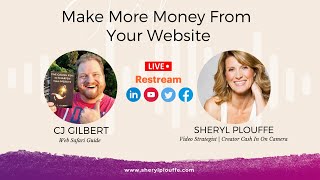
CJ Gilbert, a web developer, explains how to build websites that actually make money. He recommends organizing around three pillars: search, sales, and service. Launch fast with a simple site and iterate rather than waiting for perfection, since search engines reward growing sites.
Chapters
Here's a question. Are you using your website to the most of your ability? Are you really leveraging your website as a number one business tool? Question is, uh, is that today on Cash In On Camera. Sheryl Plouffe here with you along with CJ Gilbert, who is a web developer, and he has been at this for like over 20 years. So this is a person who really knows his stuff around websites. And we're going to dive in today on how you can make more money with your website. CJ, so great to have you here. This is an important topic, and so many resources, so much time, so much energy and effort is put into the website, and sometimes people aren't really aware of the fundamentals.
What—
why is it that the website is this elusive thing that sometimes takes people years and years to bring together?
Absolutely. Cheryl, thank you for having me on the program today. I'm excited to be here and talk to your community because I'm, I'm passionate about websites. I've been a website developer for over 25 years, and I've had my own company since 2006. And what I learned really early on is that I recognized most business owners know they need a website, but they didn't know really what to do with it. And Working through that process and working with different companies and people led me to start writing down some of my thoughts, and that eventually led me to writing my book, Five Golden Keys to Sharpen Your Website. And that led me to becoming an author and a speaker and a teacher. So not only, you know, here we are today, not only am I helping people still by building their websites and maintaining their websites, but I also have the privilege and pleasure of speaking to people through this format all over the world about what they can do with their website. So my number one takeaway that I have for you today is this, this phrase: your website is the only thing you can fully own and control online. Your website is the only thing you can fully own and control online. And that's one of the reasons I'm so passionate about it, and I'm here on a mission to teach business owners to think of their website like a tool for their business. And if you think of it that way, that will lead you to all the ways you can use it to enhance your business. And I believe in 3 key areas, and we're gonna, we're gonna pop into some of those areas today.
Okay, awesome. I love that because your website should be leading to more money, and, and maybe there are some steps in between, you know, from people landing on your website to when they actually become a client.
Yes.
Would you say that, you know, more often than not, that transaction is not happening on the first visit that someone makes to your website? And I think that's a fundamental thing we have to understand. So knowing that strategy, which is something that you focus so heavily on in addition to actually building websites, it's the strategy behind it that is so crucial. It's like, so walk us through what are the fundamental things that we need to really understand about Is it layout? Is it the color? Is it design? Is it all of those things?
It is. It is all of those things. And we'll, we'll touch on some specifics today. But let me begin by saying that what I see is the 3 fundamental pieces, what I call your 3 pillars of a successful website. And those are your search, your sales, and your service. So I'll highlight for you the first one, the search. This was covered really well by one of your guests a few weeks ago, Gordon, who talked all about SEO. And I was so excited to watch that episode because I agreed with everything he said. And if you haven't seen it, folks, go back and watch or listen to that episode with Gordon. I'm not, not thinking of his last name right now. Maybe you can fill it in for me.
Yeah. Yes, I'll find it for you.
You'll find it. He talked all about SEO and what you need to do on your website and off of your website to influence it. So check that episode out. It's full of golden nuggets, and it really is one of the first steps in getting people to your website in the first place. Once they're there, then we can focus on two other aspects: your sales and your customer service. I think today we're going to spend most of our time talking about sales because it seems like for most people this is their number one goal for their website. Yeah. And I always encourage everyone, when you're thinking of your website— in fact, when you're thinking about anything involving your business and your marketing, you should begin with these two questions. Number one, what are my goals? What are my goals for my website, for my marketing, for my videos, for my email marketing? Both from the perspective of, for me as a business owner, as well as for my customer, for my client. And that leads us right to that second most important question: who is your client? Who is your ideal client? And I encourage people to think about that and be specific as possible. And create that kind of ideal client profile or avatar so you know exactly to whom you're speaking.
CJ, question: if— and this happens a lot in the early stages, right, when someone's building a business— they don't necessarily have 100% clarity yet on who that ideal client is. Certainly they have some idea, but that's like a process, I think, that happens over the course course of time. Well, at least my belief is that as you're— and again, speaking as a content creator— that over time as you create content, you're going live, you're doing videos or whatever, and you're kind of discovering that over the course of time.
Sure.
What if that's true? Does that prevent you from being able to do all you can on your website if you don't have that 100% clarity about the ideal client?
Great, great question. I would say not at all. In fact, Another reason why I think a website is such an important, valuable tool, and that is it can grow and develop just like your business is going to grow and develop. You don't know from day one of opening your business everything you're going to do in that lifetime of your business or your career, who you're serving, the services you're offering, the products you're developing. That stuff also ebbs and flows and grows and develops, and you find yourself leaning more to one side or another, or the, the services you're offering. Just know that your website is a fluid, living, growing thing that can absolutely grow and change as your business grows and changes. I think one of the mistakes that people make is they think of a website in terms of a brochure almost. You know, they open their business, they get their business cards, the brochures, their website, and they create all these things and they kind of think, okay, good, I've done that, I'm done with it now. Now I can focus on these other things. And I would encourage you, if you're listening, to think of your website like that living tool. Do what it can do today, build what it can be today. If that's small, if it's one page, if it's anything, just get started knowing that you're going to add more and you're going to change things as you need to over the course of your business.
Let's— can we dive in a little bit more onto the sales part? Because that obviously is the part that people are saying they make that direct correlation between, you know, the money and the sales.
Yes.
Okay, so when you are designing, building a website, what is the, the— what is the direction that you more often than not take when you're guiding someone on how we're going to build this out? Is it Got to have the big button on the top, right? Is it that clear message? Is it the header? Is it above the fold? Like, what are the parameters? Or is it always consistently the same for everyone? Or is it more a case-by-case basis depending on the niche, depending on the industry, depending on the person?
Sure. All of those things are true. And I would like to begin by, by referencing something you said a few minutes ago about Not everyone who comes to your website for the very first time is going to buy anything. And I think one of the greatest things we can recognize is that anybody's sales process has multiple steps. One of the people I study and learn from is Eric Lofholm. He's a sales master and he teaches us about something called staged selling. The idea that there are multiple stages in every relationship and in every sales process. With that customer. It's all about the customer's journey, and I'll refer to that a lot. I'll always come back to, uh, to reminding people that their website is really about their customer, their client. It's really for them. So when you think of it in those terms and you recognize that your own sales process has multiple steps, that helps you in deciding what do you need to do, what do you need to add, because your website can actually assist you in each one of those steps.
I agree with you 100% on the— I hadn't like the staged selling, I guess, is what you've called it and what your person that you were just citing as well calls it. The customer journey is I think crucial in everything that you're doing in business. It doesn't matter if it's marketing or creating the content or the website or whatever. It's understanding that there is a process that people are walking through.
Yes.
You know, and so, Um, let's— can we break that down a little bit more and kind of walk through, like, from a website perspective, right? So I call, you know, the first step is, is the, the brand awareness piece. It's like people need to be brand aware. They need to know that you even exist before they're able to even go to the next step. So do you, do you subscribe to the idea of having content, maybe videos or whatever, right first thing on the website Or is that reserved for special landing pages, which are also different kinds of websites?
Sure. Great question. And the answer is yes to all of the above. But let me break it down a little bit. The, the number one theme mantra that I want to repeat a couple of times for you when we're, when we're thinking about sales on your website and the idea of sales in your business, in your website, your sales process, this is the number one phrase that I repeat. People choose the familiar. People choose the familiar. So the very first time someone comes to your website, they may not know who you are. They may not have any idea about what you're doing. Our goal is we want them to spend a little bit of time on the website. They're going to get to know you. They're going to get to know your staff, your products, your services, the way you do business. And as they go through that process, they're going to begin to develop a familiar feeling for you. And we used to think that people made a buying decision entirely based on logic and reasons and facts. But now we know that's not true. People make a buying decision really based entirely off of how they feel about something, and then they justify it with the facts. On your website, we can do both. Let them get to know you on a personal level. Let them begin to develop that familiar feeling and also give them those facts and figures and information that they need to have. And they'll put all of that together and they'll rely pretty heavily on the way they feel about you. And hopefully they'll choose to do business with you. And I believe the number one way that you can do that is with video. There's something really special about video. You can see people, you can hear people, you can, you can really get a taste of their personality, pick up some of their energy and their passion. And all of that feeds in and ties into them choosing to do business with you.
I have seen many websites that are full of, well, what I think is, is maybe perhaps overwhelming text, right? There's a lot of copy, and copy is great because it does help you to understand better, you know, whatever page you happen to be on, or if it's just a kind of an introduction of what it is that you do. I, you have to have good copy. What is your take on copy? How much is too much? I've seen a lot of websites where you, you're trying to fish through and you don't really, you don't really know where it's trying to guide you. Like, you feel a bit lost when you're in a website where it has overwhelming amounts of copy.
Absolutely. That's a phenomenal question. And I think it presents another excellent opportunity. So what I'd like to point out is that when we're talking about your website, we're essentially trying to serve two masters at once. Because we're always serving our human user, our actual visitor that's coming to the website to get to know us. But also we're kind of serving that machine that is Google and the other search engines. So we want to do both, but we also want to cater it to the way that humans behave and act. And we know that if we give people too much information or too many choices right off the bat, they'll shut down and they'll take no action at all. So we can actually do both at the same time by recognizing that your website naturally, organically will have a kind of hierarchy to it. So think of your— think of this as a basic website. You've got your homepage, your about page, your services page, and you've got your services listed on your services page. And ideally you have a page on each one of your services individually. Now, if you set up your website like that, you could recognize that you shouldn't cram all the information that's contained in the entire website on your homepage. And instead, the homepage should really be an entryway, a gateway, a foyer, you know, to let people take— kick their shoes off and start to get to know you. It doesn't need to be heavy with words. It can just show people, what do you want to learn next? Do you want to learn about our services? Do you want to learn more about me or about the staff, and you're giving people a couple options that they can take action on. They'll, they'll decide by clicking, I want to learn more about your services, or I want to learn more about this service. And then they'll go deeper into those deeper pages. And that's where a lot of the information needs to live is on those deeper pages.
What do you think about interactive video? You know, like interactive video, which is really taking off where someone lands on a website and you have maybe a bit of text, but there's really two, let's say two options. Like, are you interested in this or are you interested in that? And then the video is forcing that person to make a decision. It's interactive. And then it's really parsing out the audience based on whatever their decision. Do you like interactive video? Do you think that that's something worth looking at?
Yeah, absolutely. That's really interesting. Yeah. Give people just a snippet, a little explanation of Welcome to the site. Here's what you can expect. You may choose this option or that option depending on what's good for you.
Yeah, I love that. Absolutely. What do you think, CJ, is the amount of time— and maybe there's no definitive answer to this because I've seen people who spend, in my estimation, too much time, right, on the development of the website. It takes too long. So like, is there any kind of hard and fast rule around that? In other words, it's like Listen, it shouldn't take you more than 4 months to do, you know. Do you have any kind of time frames around what is an allowable amount of time to get a website done with your help, let's say, versus if it goes over this time frame, you're spending too much time on it?
Sure, absolutely. And I'll tell you the, the general answers, and I'll tell you some horror stories at the same time.
Okay. Uh-oh, horror stories are coming.
My typical answer is faster is better. Faster is better because the sooner, the sooner you can get something out in public, the sooner it can start working for you. It can start working with the search engines and it can start working with your clients. So even if all you could do is put up a one-page landing page or website today or within your first week or your first two weeks, and then take a couple months to develop out that bigger site, you do that. I would rather that people put up something small immediately and then add to it every week for the next couple months than not do anything publicly for 3 months trying to build that perfect website and then launch it all at once. This is actually going to help you in a number of ways. Google loves to see your website changing and growing. So it is actually more beneficial.
You can recognize that the website is growing and changing over time?
Absolutely, yes. Google is a, is a, it's a machine. It's an, it's a, we call it a spider is the word that we've, we've taken on because it crawls the web and it just memorizes everything it comes across. Google loves to see a website grow. So if you put up that one-page site today it'll see that and it'll begin to recognize that. I think Gordon even mentioned this word of authority. It's a big deal how long your website's been around, and the sooner you can put something up on your domain name, you're beginning to grow your authority. And so if you can put that up today and then take some weeks, months to develop more information, and then add that, and then add that— Google loves that. It sees it as a natural, organic, growing thing, and you'll get a, you'll get a boost because of that.
It is Gordon Van Wetschel, by the way.
Yes, thank you.
Perfect. Um, and so, okay, so as fast as possible, what if a website, you know, people are toying around, they're trying to make it perfect, and let's say it's been over a year. It's been over a year thinking, playing, tweaking, moving, and all of that. Is that too much time?
I think so. I think so. I often will— a question I get a lot is how long does it take to develop the website? And my common answer to that is anywhere from 4 to 6 weeks is pretty common. There's a lot of back and forth. How do you like this? How do you like that? There's a process we go through of colors and design and development, and then we come up with content and we're finding pictures. So they're absolutely needs to be some time that you take to do it right. You want to do it right, um, and yet it can go on too long. I had one client— here's that horror story— I, I'll tell you two extremes. My first one of these clients I'm thinking of, he said, CJ, I don't want to make any decisions at all. I want you to do everything for me. And he wrote me the check and said, go. I came back to him one week later and said, your site's done. How do you like it? He said, it's perfect. He wrote me the other check. Launch it. That's the fastest I've ever built a whole website, was one week because he said, CJ, do it. He gave me everything. Yeah, go for it. He trusted me. We knew each other through a networking group. We already had a relationship and he said, go for it. And then I have the other end of that spectrum, which is a gentleman that we were working on building this website. Quite robust, quite a lot of material in it. But the way that it ended up being is we would meet every week on a Tuesday to go over the new website and the changes. Cheryl, that went on for 2 years before he told me, we're just not moving fast enough. I'm just not happy. I just— I want to do something else or go somewhere else. We never launched that website. We worked on it for 2 years. It would have been ready to launch probably 6 months into that project. We could have— we could have launched it then and then kept going. But he just chose— he He was one of these guys. He wanted to move every comma and adjust every little pixel. And I think that was the downfall right from the beginning.
Well, CJ, I think we're going to have to have you back on the show at some point to talk about perfectionism.
Absolutely.
Because I have a feeling that that creeps its way into website development.
It does.
CJ, this is fantastic. Tell us about the gift that you have on your website that people can take advantage of.
Absolutely, absolutely would love to. Come to this site right here that you're looking at right now, mywebsite safari.com. This is a small video series that I created for you to get that core concepts of what your website can do for you. There's 7 videos, each one of them is less than 10 minutes, and there's some exercises, there's questions, there's worksheets. And the idea is there's nothing technical here. I'm not going to teach you how to build a website We're not gonna talk about HTML or CSS or PHP or any of these acronyms you don't care about. We're gonna talk about your business in practical terms, and we're gonna talk about how your website can assist you in that business development. So it's totally free. Please access it, go through it, ask me any questions you have in the end, because I would love for everyone to get a hold of this information and just dive in, begin to do an improvement on your website today Come back 3 weeks later and improve something else. Gradual improvement over time is the very best thing you can do.
I love it. We have a, a fun segment real quick that I'd love to do with you, and it is called Stop Marketing Like It's $19.99. What is something, CJ, that's working for you today to help you market yourself?
Absolutely. I've got a great answer for that. I want to remind you, your website is the foundation for everything you're doing. If you're going to publish something online, publish it to your own website first. But then there's a lot of great platforms out there. There's social media. I'm a huge fan of YouTube and video marketing, and I think it's amazing that we can go to all these other platforms where people— there's already an audience there. There's already people in communication and conversations. We can join those conversations, we can get to know them, we can see what they need, and then we can, through videos or through our posts, direct people back to our website and some of the other resources that we have. And I think that's a phenomenal opportunity.
CJ, this is fantastic. Thank you so much for coming on and sharing your insights. What I'm hearing is that we have to, you know, really think about strategy, that we have to think about the customer journey, that we need to park our perfectionism, and that we have to make sure that we're also doing this in in due course, but like in not letting it take too, like you said in your example, 2 years plus to launch a website. And that's obviously the work that you help people to do. So thank you so much for coming on Cash In On Camera today.
Thank you.
And I hope to have you back sometime too. And we'll talk about perfectionism.
Sounds good. Thank you so much, Cheryl.
Thank you.
More from Sheryl



From 'agreeable' to 'ruthless mentor' to 'strategic sparring partner' #substack #shorts







