Marketing Madness Monday
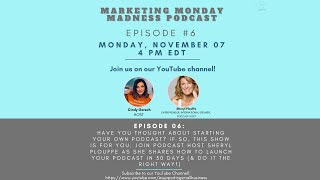
Sheryl Plouffe, a former broadcast journalist with 20,000+ hours on air, walks through her 30-day podcast launch plan for 6- and 7-figure business owners. She ditches perfectionism for a video-first, edit-less workflow and explains why podcast guests matter more than audience size: they become your network for referrals and client deals.
Chapters
Marketing Madness Monday, where we talk a little bit of marketing, a lot of other things. So we're not always talking all marketing. As you guys know, this replaced our Thursday Thoughts, which was really like very much more, I don't know, like, I don't know, I don't know what I want to say. Buttoned up, I guess, is the word I want to use. And these are a little bit more casual, but definitely you are gonna, you are definitely going to learn from these as well. And today I'm super excited because I have such a great person and someone with a ton of knowledge, Cheryl, with us. Cheryl Plouffe. And Cheryl was actually— we met networking, of course. And I feel like that's where I meet and how I meet everyone now, which is why I'm such a huge advocate for networking, which is so awesome. Cheryl was a part of my 20,000-member celebration back in September, and I asked her if she would also be one of my first guests on this video podcast, and she graciously agreed. So thank you so much.
And I'll just tell you— Great to be here.
Thank you. I will just tell the people a little bit about you. Sheryl turned her professional media experience into a thriving virtual video production agency and consultancy. She's an entrepreneur and international speaker and has broadcast over 20,000 hours of live television over a 25-year career. That's crazy. Today, Sheryl creates and implements custom content plans for 6 and 7-figure business owners so they can quickly get their brand known online. She's the creator of the Profitable Podcast Method, helping coaches get more clients, referrals, and speaking gigs. That's what we're going to talk a lot about today. When she's not working, she's a hockey and baseball mom and an avid Prince fan. We all love Prince, 1999, Little Red Riding Hood. Cheryl lives and works in Ontario, Canada, and we are so glad to have you here. I love Prince too.
Good.
He's—
I'm a product of the '80s, right? So I mean, Prince, Michael Jackson, Madonna, let's go.
I mean, I saw Madonna though, I have to tell you, on TikTok, and she is— I don't know what's going on with her.
I saw one the other day as well, and I didn't even know it was her.
Yeah, exactly. I, I don't know what she is— not aging gracefully, and she doesn't look great.
Agreed. Yeah, it is just— it's disheartening.
It really is. And then obviously Michael Jackson and Prince both left this earth way too soon.
Um, absolutely.
I would have loved to have seen either of them. I know you saw Prince in concert.
I saw Prince live, gosh, I want to say 7 or 8 times live. I actually danced on stage with him once at a sold-out concert. Uh, and what— yeah, it was crazy. Oh, The Police. Yeah.
The Police are amazing.
Absolutely grateful-isotope.
Yes, yes, yes, Johnny. The Police are awesome. I actually saw New Kids on the Block. That was my first concert. I've seen them so many times, but I just saw them like a month ago. They came to Atlanta.
Oh my God.
And I have to tell you, it was so fun. I felt like, you know, they put on a good show still. It was a lot of fun. I felt like an old lady, but you know, it was fun.
No, absolutely not. You can be any age. I mean, let's be real. You know, get out there and enjoy life. Life was way too short to care about what other people think.
I agree. And I'm like, you know what, if it's good music, it's good music, right? And it did bring me back like 25 years. So we'll have to have you tell the story about how you danced with Prince too, if we have time at the end, because I know that's a great story. Okay, so Cheryl, as she said, 20,000 hours on TV because you were a broadcast journalist in Canada for 25 years?
Yeah, 25 years cumulatively, and 17 of those I spent on national television as a weather meteorologist or sort of, you know, broadcast meteorologist. And I'm not, I'm not a meteorologist by profession, but I played one on TV. So I love that. But 17 years of my career were spent on national television. And even for several of those years, I was a news manager of a department of 17 people across Canada. So that would be a network of hundreds of freelancers and bureaus across the country and a team of 17, in addition to managing the editorial direction of that major media conglomerate. So there were lots of different things that I've done in terms of the media experience. But yeah, when we actually cumulatively looked at the number, I mean, that's the shocking number. I go, wow, I did 20,000 hours. I did 20,000 hours of broadcasting. But now I think about the 5 or almost 6 years that I've been in entrepreneurship as a business owner and how many more hours I've done just doing things like this, getting out and speaking, I've probably tallied a few more thousand, you know, hours onto it just from being out there and being publicly visible in this capacity too.
It's great, right? And we do have Ray. Ray is our Facebook commenter. We can't see you if you're watching from Facebook because it just says Facebook user. So hello to Ray. And I also wanted to say, which I forgot to say before, if you have questions or comments, please feel free to put them in whatever you're watching, if you're watching on one of Cheryl's channels, if you're watching on the YouTube, on our YouTube or Facebook, put them in the comments and we will be sure to answer them. Or if you just want to tell us who your favorite '80s music, you know, musician was. Um, looks like Johnny's was The Police. You know, you can talk '80s music all day. So, um, I, you know, I was also a reporter as well. I know we've talked about this and it does parallel what you're doing. Obviously it's very similar to what you're doing right now. You've just sort of taken what you were doing on TV and for a news agency and bringing it to the social media, to the digital marketing world. Do you find that that is pretty, that they're pretty similar, that you're using a lot of the strengths that you had as a reporter doing your job now?
I think anyone who comes from broadcast journalism, who comes from television production in the media world in that capacity, bring with them a set of values, experiences, experience, wisdom that you can bring into marketing. I think it's actually a really natural progression to go from broadcasting to marketing, because if you think about the parallels, I mean, in my capacity as an on-air person or as a news manager, what did I do? I was working for someone else to help them build their brand and to help build up their reputation. And the same is true as an entrepreneur, that now you're in charge if you're building your own business to do the same. So I feel like it's really a parallel. It was actually quite a natural progression, I think.
Absolutely. And what, you know, we've talked and you've talked so much about, and you're definitely a professional, is your podcast and your teaching, your coaching people on how to start podcasts. So let's just talk about it. I know that I've talked a lot about podcasting and as you said, it can definitely help your brand. It can get your name out there. Let your business out there. So let's talk a little bit about what it takes to start a podcast. I think a lot of people think, listen, this can be completely overwhelming. I have too much stuff going on. I can't even think about starting a podcast, but that's not necessarily the truth, right?
Right. There's so much to unpack here. And so I'm going to look at this from the perspective of what we're talking about today, which is really how to launch the podcast in 30 days, because there's a lot to it. The first thing that I would say, Cindy, is that if you look at a podcast, You first of all, you have to park, I believe, park your perfectionist tendencies. I would rather see people getting out there and doing the thing right and making progress rather than being stuck in this inertia of and stagnant place of waiting for everything to be perfect before they launch. So even for me, you know, Cashing on Camera is my podcast. It's a work in progress and I'm totally okay with that. I'm fine with that. And I think that's what it is. It's like you're not going to be able to learn anything from the process unless you actually start the thing. I talk— and the reason why I'm passionate about this is because I talk to people all the time. I'm on a lot of calls. I talk to a lot of people who are stuck, and they have, in many cases, a lot of the students who've joined this program that I run have been thinking of doing a podcast for 3 years.
Wow.
Wow. 3 years, Cindy. So think about the missed opportunities, the network you didn't build, the clients you didn't get, the referrals you didn't get as a result of waiting for 3 years. And if we dig in further, why wait for 3 years? Often it has to do with I don't know where to start, or I'm waiting for everything to be perfect before I do. And that doesn't get you anywhere. That doesn't get you anywhere. So My feeling is that you've got to park the perfectionism. And now, not to say that you shouldn't be prepared to some degree, and that's what we'll talk about next, but park the perfectionism and aim for progress rather than perfection.
Absolutely. I mean, I, I mean, I say this all the time now more and more, particularly with this virtual world that we're living in since the pandemic. People are getting so much more accustomed, so much more used to seeing people make mistakes live and having their kids run behind them or having the Zoom outfits on, as I like to call them, that they forget about and they get up and stand up and they have shorts on, which we've seen so many of those that I think people are just— it's part of life now. Right. And I know when I was a reporter, I was so stressed out, like, oh my God, I'm going to go live and I'm going to mispronounce a word or say something wrong that I think that's gone completely out the window right now. And so people are just more used to seeing things like your dogs running in or children running in or phone ringing or whatnot. So to your point, I think that that actually could be something that should relax people and make them feel a little bit more at ease if they start a podcast. But let's talk about some of those tips. What tips do you have to help people if they really are thinking of starting their own podcast?
Well, I think it does fall in line with the point I just made about the progress over perfection. So how do you launch a podcast in 30 days and do it the right way? I think you also want to park, you want to park this idea that it needs to be a big launch. It doesn't need to be a launch because really, when you think about launch, what does that mean? What does that represent? It means months of preparation. It means, you know, getting all the, the T's crossed and the I's dotted and like all these mechanics, all of this, you know, a lot of funnels, a lot of technology and the complicated things that you've got to try to to cobble together when you're doing a launch. Doesn't matter if you're launching, it doesn't matter what you're launching, but just the word launch unto itself represents this like very big endeavor that you're setting out to do. And podcast doesn't have to be that. It doesn't have to be a massive launch. The truth is the people, like, I mean, our focus here in how we approach profitable podcasting is actually, believe it or not, not as much predicated on the audience It's not that we ignore the audience, not that we don't provide great content in the podcast in and of itself, but from a business perspective, from an ROI and from a profitability perspective, we actually help entrepreneurs, digital consultants, digital entrepreneurs to be able to leverage a podcast to build their network, right? To be able to get clients, referrals, and speaking engagements. The audience part of it, which is the traditional way of thinking of podcasts, is kind of an It's, it's the bonus part of it. It's the long-term strategy of growth. What we're saying is that you can get instant ROI if you shift your focus around to how you're actually leveraging it for business opportunities. And so if that's true, then that means that we have to realize that the audience that doesn't exist yet is not sitting there with bated breath waiting for you to launch your podcast. Right. They're not. There isn't an audience yet to launch for. Right. So it's the thing around this whole idea of launching and making it a big thing. We help people launch in 30 days. What does that mean? It means you have to park your perfectionism and make progress. But it also means you want to do some key things that are going to help you to do that in 30 days. So it's not going to be a big launch. It's not going to be a complicated thing, but it is going to require that you give some thought. And it's really more about the conceptualization of the show and understand the path by which you're going to be using the podcast to get the things that we're proposing that you want to get when you're doing it our way. So that's— and I won't— I'll let you give an opportunity to ask a question about that because I could go on. But it's really about this idea of not really thinking of it as a big launch.
I know, I think that's a really great idea, great point. And you know, Johnny says he's been doing my own— I've been doing my own YouTube show for almost 7 years, and I've been podcasting that for maybe 4 years now, maybe longer. And it might always be a work in progress, but you just got to do it. And I think Johnny is head-on. And then it says Facebook user, but this is Deborah's because I looked on Facebook. Um, and Deborah said, I tried to make my lives perfect. I gave up on that. When my cat ran past the camera, stuck its butt in the camera. I've knocked things over and they laugh with me. I love that. It's so true, Deborah. Like, these are the things that people get used to. We are used to— I mean, it happens, right? Like, that's what happens. Many people know my dogs because they're pains in the butt and all they do is bark whenever I go live. They're creating that right now because I couldn't deal with it. So that does happen. But, you know, Cheryl, I mean, you brought up a good point though, that, you know, it's longer term. It's a longer term strategy. It's not going to happen overnight. There are going to be bugs that you're working out there, you're going to get more comfortable as time goes on. And Deborah said she loves my dogs. Well, I've told her many a time she can come grab them from me if she wants, but she hasn't showed up yet. And so, you know, what, what, what do people, what is that sort of long-term strategy or what is that long-term goal that why most people should start podcasts or the reasoning that it's a good idea if you're considering a podcast? What can you get out of it?
Okay, so from the long-term perspective, I mean, I really believe that we're, you know, we're— we've been in Web 2 for a long time, right? We've been in the second iteration of the internet and Web 2, but we're progressing here to Web 3. That's the next evolution of the internet is Web 3. So there's things like— that's why we're hearing more and more, you know, the last few years about like cryptocurrency and DAOs and, you know, decentralization and like all these different metaverse. That's why Facebook changed its name. Like all these different things are indications of where things are going in the future. So from a long-term perspective, my belief is that we're moving away from a place where, um, a centralized place where the, the social media platforms of the world control everything, right? We're going to start taking our data back. We're going to start taking control back in the new era of Web3. And, and as such, things like vanity metrics on social media are not going to matter as much. What will matter for business owners is how strong is your network? What kind of database of people do you have at your avail, right? That you can rely on for referrals, that you can get clients from, like, right? That you can find those speaking engagements, that you can even just call up. Like Cindy, I know I can probably send you a message, frankly, probably anytime with a quick question if I had, because I know what you're like because we have a relationship. And I know that you're giving, you give so much to your Facebook group and so much to everyone. So if I had a quick question, be like, hey, what do you think about this? I bet you, you would respond to me and be like, actually, I've never heard of that tool before, but I think, you know, here's another thing you might look at. I have that relationship with you. That is super, super valuable to me, right? Why? Because we have a relationship. You're not a faceless person who's just following me on Instagram, right? That doesn't do me any good. So it's thinking about your database and your network. So that's the long-term strategy. I believe that you can do that effectively with a podcast. Mm-hmm. So that's kind of where things are at. I just wanted to also follow up on what I think you said, Debbie, I can't remember the name, talked about here with the live video. That's another thing that comes up in terms of how do you launch in 30 days? You want to use easy-to-use technology, which I'm a big proponent of. I painstakingly choose my product, the different things that I recommend. That you use together to make your system, your profitable podcast system, very carefully, because I like easy-to-use things. I like tools that are not complicated to use. And one of those tools is the one we're using right now.
I found out because of you, Cheryl. I literally did. It's so fantastic. And I've told it to so many people. I would not be using Restream.
Awesome. Yes, this is one of the tools. But this idea of using, let's say, Restream, for example, allows you to go live. Why is that so important for you to launch in 30 days? Because there's no editing, right? Editing takes months and months, maybe sometimes years to learn how to do, right? Like for depending on your, on your capabilities. So if you want to launch quickly, you've got to look at tools that are going to allow you to either broadcast live or a term that you and I both understand, which is Look Live. So a look live is when you record a, let's say, a podcast episode that looks as if it's live. So there's no, still no editing, but then you take that look live and then you schedule it out as if it's going live at a later date. So those are just two strategies on how you can launch in 30 days if you don't get yourself bogged down in this whole thing about, oh, now I gotta get on 18,000 YouTube videos and learn how to edit, and I don't have an editing system and I gotta buy it.
Stop.
You don't need any of that. Let's talk about an editless system. Get the thing done already. You know, so I think that's a big part of, of this. Now, from a long-term, which your question was, what about the long-term? This is a sustainable way that you can continue to do episode after episode and rinse and repeat for years ahead.
Yep. Yep, it is. It's so, I mean, like I said that I was on your podcast and I found Restream and I was like, this is like the easiest thing in the world. And I was like, I got to check it out. And it really, I'm not sure I would have this podcast going if it wasn't for, first of all, I'm not paying, I'm using the free version right now. And I know there's a million other, if I had the, if I paid for it, which I'm considering, you get so many more features for it, like a million. But like you said, I'm not an editor. I don't have any fancy lights or editing equipment. I don't have a big boom microphone. I don't even have a bring like nothing. And so, and I know that like eventually I will, but it was sort of like, you know, I realized that Thursday Thoughts, which is what this has replaced, was going nowhere. And actually like it got to the point where I was embarrassed to invite guests to it because nobody would be on. So I was like, we got to try something else. And this was definitely planned in 30 days or less because I was like, I just gotta try something new, and if this doesn't work, then I'll think of something else. Um, so I think we put a lot of— people put a lot of pressure on themselves, right? That doesn't necessarily have to be right?
The technology today exists for you and I and anyone listening, watching this, to be able to execute this type of thing fairly easily. Now, these tools didn't always exist, right? If you wanted to try and do something like this, like, you know, 10 years ago, it was a little bit more complicated, um, you know, to launch a podcast before these types of tools. And I'm a big proponent big proponent of video first, right? Video repurposing to audio. But back in the day, if I think about some of my favorite podcasters who started their podcast in 2012, it was audio only for the most part. And it was very complicated. I went down that path too. I did courses, I learned, I did the 8,000 things on YouTube and I tried, I've actually tried several times to do a podcast in those traditional ways with different tools like Libsyn and things. It's complicated. It is complicated. And the problem then is you end up spending about 8 months, you know, trying to prepare yourself for it, and then it becomes unsustainable once you're in it because you're spending way too much time on each episode. What is your time worth? So it's really looking at the easy tech tools of today and figuring out how do they work together, how do they integrate with one another so that you can build in automation. Right? So automation, easy execution, reducing your post-production, editless podcast. That's, that's really the way that we look at it.
Yeah, it is so important. And I think, you know, besides recognizing and building brand awareness, which is, is, you know, one of the main reasons why people do do podcasts, they can, you can make money as well from doing podcasts. Can you talk a little bit about how that's possible?
Okay, well, if you look at podcasting from a traditional lens, right, which is audience, it's how many downloads am I getting, how do I get sponsorships, how do I get advertisers, that's a long-term strategy. It can work, but get ready, it's a long-term thing. It takes time because those things are predicated on audience numbers, and you have to prove those audience numbers to get sponsors, to get advertisers to pay you any kind of semblance of anything, right? Um, so if I'm talking to an entrepreneur, and many times I'm talking to entrepreneurs who have their own products and services and they want to reach six figures, they want to 7 figures. Trust me, you're gonna have to spell— sell a lot of sponsorships to make up 6 and 7 figures of income. That's not how you're going to do it. How you're going to get to 6 and 7 figures of income is by selling your own products and services. So if that's true, then you got to find a way to promote elegantly. I like to say promote your own products and services, right? It's not going to be— don't sit around waiting for 3 years for your audience to build up enough to a point where you get a sponsor who might be willing to spend, you know, $100 to have a 15-second spot on your show? Like, how far is that gonna go, right? For most people, are there anomalies? Of course there are, but it's like winning the lottery too, right? Like, it's, you know, so I would prefer— I don't play the lottery. My, you know, I have relatives who are gamblers, and I saw that go in a bad way. I don't gamble. I would rather have a good strategy that's actually going to result in something. So to your point, can you monetize? Absolutely. But you want to be smart about how you do it and not just wait for 3 years for your audience to grow. Think about how you're promoting your own products and services. But more importantly, it's the, it's the, it's really through the, the guests that you have on your show that are going to be the conduit to leading you to business development opportunities. That help you sell your products and services, right? Other speaking engagements that you can get because you're a host of your own show, referrals that you receive from guests who are on your show. Maybe this guest themselves even become clients of what it is you do. That is a far more fruitful and profitable way to approach podcasting.
It's so smart because it is sort of another way of networking in its own right. I mean, I have gotten recently because of the Facebook group that I run, the 20,000-member Facebook group, I have— people have reached out to me who I don't even No, asking me to be on their podcast. And it's interesting because I have met one woman who I don't even know how I met her, and she— we couldn't, we couldn't figure it out. And she asked me to be on her podcast, and that has now transformed into this new relationship that she's— she helped me write this, my book. I, I'm writing a book. It's actually being pre-sold, which is just crazy to me. She's got me in front of these two world, you know, national speaking, all this stuff. That never would have happened. I still don't know where we met, but it definitely was through networking somewhere because of her, of her podcast. And that's what— yeah, that's Debbie saying, that's why I joined Cindy, to get a strategy, a plan that I can use long term. That's exactly what it is. I mean, you've got to have some sort of a strategy, and whether or not podcasting is in it is really for the, for the person to, to decide, right? I mean, I can't— we can't say if it's good for them. They sort of have to make that decision on their own.
The other thing I would say too is think about, you know, if your products and services especially are high-ticket things, you know, if you're selling anything high-ticket, you're not selling that through a funnel. You're not. You're selling that on a call, right? So, so, um, you see that sometimes when people like have a high-ticket offer and then I see them spending, you know, 6 months trying to build the perfect funnel and I'm like, but that's not how you're selling your thing anyway. So, you know, it's really about relationships, isn't it?
Yes.
And so you really have to think about that. And I think that, you know, in terms of how you can launch your podcast in 30 days, aside from the points I've already made, is that you want to think about, like, don't get too— you don't need to get too, too far ahead of yourself in terms of thinking, like, you know, who are going to be my first 50 guests on my show?
Yeah, right.
It's like you just need the first one. You know, so when I'm working with students, I always say you just need your first guest, right? Until we can get you to the next stage, and then we'll start working on the strategies because we need to get you launched. We need to get it started. We need to get there as opposed to I got to come up with 50 people who are going to be on my show. That will come. We will work on that. But let's start. Let's first get it actually started, and then we'll work on that next step because it's better for you to put one foot in front of the other and actually make something happen than it is to sit there again and let that pile on. The, oh, I need to have 50 guests all aligned for my show, let that pile on on top of all the other things that are kind of going through your perfectionist brain. So really think about just that, that first guest to, in order to get it done. Once that happens, then you will move to the next stage, which is, okay, now I can build out, um, you know, a list if you will, people that you want to invite on. And the other thing is really about artwork. You know, I think you do want to think about artwork and those pieces of collateral, if you will, as you go to start your podcast. It's great to go out there with some semblance of artwork, right? So I like to do— I do spend some time doing that. Is like figuring out the artwork piece of it. What does it look like and all of that? We actually have a professional designer who does that on behalf of our students because design can be one of those things that often derail a project because there are so many iterations, so many revisions. So we do like to say, listen, we're going to make, we're going to make podcast artwork. We're going to come up with 3 different versions. You're going to choose the direction that you want to go in. And then we're going to refine that until you're absolutely happy with it. But then we gotta go with it, right? This is not a process of— we're not going to let you spend— we're not going to let your perfectionist brain spend 8 months revising the artwork. Just not going to do it because that would be a disservice to you. We're going to make— it's going to be good, trust me. We have a professional designer who understands what to do and how to represent the, the mood that you're going for. And, and that ties back into the last point, which is probably the most important point, Cindy, which is the concept of the show. If you want to have a profitable podcast, you must find the confluence between the thing you offer, the topic of your show, the essence of your show, what's it about, and the guests that you're going to invite on your show that can help you through that lens, right? Like you could talk about that topic,, but that can lead you to sell more of your things. It's the perfect, it's the confluence of those 3 moving parts that, that need to come under like one concept. And that's a big part of it. So once you have that, that's really at the foundation of it. Now artwork makes more sense. It makes more sense to understand, well, who should my first guest be? What kind of, you know, the tech and the going live and, you know, not necessarily getting too caught up in perfectionism.
Yeah, that makes a lot of sense. When you say artwork, are you talking about like an intro and an out? What are you talking about in regards to—
I mean artwork for the actual, like, for when you open iTunes or you open podcasts on your phone, like the little, the little artwork, you know?
Oh yes, yes, yes, yes, for the show.
Yep, that, that artwork.
Because do you— is yours— do you recommend that all podcasts go on Like, are it on like Apple iTunes or whatnot?
Yeah. So what we do, like, I'm a video, I'm a video strategist. So I'm always looking at video first. So it's like, you start with video, right? And then you repurpose it to an audio podcast platform. So our view is that that gets you the best of both worlds, that you get the video part, which is like what we're doing right now. And then the second part of that would be you take this and then you repurpose it to an audio platform. So now your podcast is truly an audio podcast in the sense that it's on Spotify, Apple Podcasts, Google Podcasts. And when that's true, right, you end up with like, you know, you have to have artwork.
Yes, I see. Yes, yes, yes, yes.
So, and there's very, you know, it's, it's square. It's like 3000 by 3000 pixels. Like there's certain things that you have to adhere to. And design for podcast artwork is very specific because it's viewed, it's viewed on devices like this. Design is really important because you want to be able to see the word. Often we'll see, I'll see podcast artwork where the words are so small there's no way that anyone on a mobile device could read it.
Yeah, yeah, yeah.
Right. So like there's mine, for example.
Oh, that looks great. Yeah.
Yeah, so it's, it's just, you know, I'm just trying to find an example here. I hate to call out people that I don't think are great, so I don't want to do that. But often we'll see artwork that isn't, that isn't great. So it's important to find that, that balance between you've got to get it done, you wanted to make, you wanted to make it good, as good as you can, but we can't linger on it for, for, we can't linger on it for 6 months overthinking it. You've got to go.
Yep, I love that. And that's such a great way to end things. I mean, you do, you've got to go, you got to believe in yourself, have the faith, the confidence to do it. And, you know, Cheryl, you've been fantastic. And if someone wants— you do offer help and coaching. If someone was interested in getting a hold of you, what's the best way to do that?
Well, there's a couple of ways. I mean, and I know I'm actually broadcasting this broadcast out to my network as well. Yes. Yeah. Um, Cheryl, pluff@gmail.com, okay, is my personal email. Cherylpluff@gmail.com. Send me an email. Like, if you send me an email, I'll be able to figure out what you need, right? Because I have, I have videos, I have downloads, you know, I have various things. But really, I have calls, you know. So in certain cases, I get on calls with people and help them figure out what is the path to profitability for what it is that you do. Again, the confluence of these things But I think honestly an email is probably just as easy as anything. You can send me a message. So if you find me on social media @CherylPlouffe, I'm reachable. I'm reachable. Send me a message. Hey, I heard you on supporting small local businesses. I heard you on the live stream. And then just ask your question. I'll be able to send you in the right direction.
Awesome. And I put it up there for a minute, but then it of course is acting. So I'm just putting it up there real quick one more time so everybody can see if it will let me.
Your— here we go. I did see it a moment ago.
Yeah. Okay. That's great.
Send me an email.
Awesome. Yeah. And Cheryl is in our group, the Supporting Small Local Businesses Facebook group as well. So you can always reach her through there. Yeah. And thank you so much, Cheryl. I mean, I think that you obviously have so much experience and so much advice with podcasts. And I learned, as usual, I learned a lot from you like I always do. So I really appreciate you coming on the show. I appreciate you giving your advice, your expertise. So thank you so much.
I really do appreciate it. Hey, anytime. I love what you're doing with your community. I love that, how responsive you are to your community. And I think that is indicative of, I think, where things are going in the future too. I think we all, as business owners, as marketers, we need to be more We have to listen, you know, we have to listen to our audiences and we have to be more responsive to what it is and how we can be of service to other people. I hope that I'm able to do that as well. And I know you do that for your community.
Yeah, you definitely do. You definitely are. You're just like you said about me, you do the same thing. I send you an email and you're right back with response. So I appreciate that. Definitely do.
All right.
And thank you to everybody who watched for us, watched us, and, you know, we'll be here. Well, I'll be here next week. Same time, same place. So thanks, everyone. Have a great night.
More from Sheryl



From 'agreeable' to 'ruthless mentor' to 'strategic sparring partner' #substack #shorts







