Maximizing Your Content: The Art of Leveraging vs. Repurposing
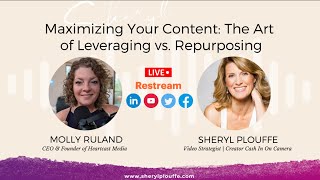
In this interview, host Sheryl Plouffe talks with Molly Ruland, founder of the remote digital content agency Hardcast Media, about how to maximize content through leveraging rather than repurposing. Molly shares how her agency shifted from a brick‑and‑mortar studio in Washington, D.C. to a fully remote operation in Costa Rica during the pandemic, growing the business 200% by serving global clients. She defines "leveraging" as using a single piece of content—especially a podcast—to create multiple assets (audio, video, blog posts, social clips, SEO‑rich metadata, transcriptions) that feed every platform, whereas "repurposing" implies re‑packaging content in a way that can devalue it. The conversation dives deep into podcast SEO: crafting keyword‑rich titles, descriptions, timestamps, and publishing transcriptions to boost Google and YouTube visibility. Molly explains how one episode can generate 15+ pieces of content, including short‑form vertical videos that act as bait for the longer show. They discuss the importance of clear, non‑cutesy language to avoid the "curse of knowledge," and how strategic podcast interviews can serve as business‑development tools by targeting partners who can bring new clients. Hardcast Media’s service model is presented as a "pinch‑hitters" team that provides end‑to‑end content creation—podcasts, short‑form clips, audiobooks, website builds—more cost‑effective than hiring a single specialist. Finally, Molly’s top personal marketing tip is simply to get in front of people through podcasts, speaking engagements, and networking, emphasizing authenticity and letting the audience decide. The interview offers actionable tactics for coaches, consultants, and entrepreneurs seeking to turn a single content effort into a scalable marketing engine.
Chapters
heart. It's also near and dear to the heart of our guest today on Cash In On Camera. Molly Ruland is here all the way from Costa Rica. She runs her business remotely from Costa Rica. I love that, first of all. But let's just dive in. Molly, so great to have you here on Cash In On Camera today where we can talk about content and specifically content and the difference between leveraging it and repurposing it. And there is a difference.
Absolutely. Well, thank you so much for having me here. I've been really looking forward to this conversation. So thank you very much. Yeah.
Tell us a little bit. I mean, you run a digital content agency and you do run it remotely. I mean, you're kind of living the dream that a lot of coaches and consultants and experts want to, to, to have. How did that all come to be? Tell us the story.
Well, I had a brick and mortar studio in Washington, D.C., in downtown, you know, Dupont Circle. But then the pandemic hit. And so, you know, having remote income was always— and Costa Rica was always like a 10-year plan. But then the pandemic happened and I closed the studio, but we just went fully remote and we actually grew the business 200% because we service clients all over the world now and not just in Washington, D.C. So it really opened things up. And I just knew that if I didn't go when I did, I wasn't going to— I wasn't going to get out. You know, D.C.'s one of those places that can swallow you whole. And so I saw an opportunity. I knew if I didn't take it and get my clients accustomed to the fact that I wasn't in the country now or then, it wouldn't be nearly as easy of a transition to say like, you know, what do you mean you're in Costa Rica? Everybody thinks I'm on vacation.
I'm like, I still work.
I just have a nicer view.
That's it. You just have a better view. Yeah. Yeah. Molly, uh, we, we have a lot to dig into here because content is something that is near and dear to our hearts and We believe in it. We know it works, but there's a difference in, well, I mean, there's production is one thing, but then there's this concept of the repurposing content versus the leveraging. And I'd love for us to kind of start there. What is the, what is the difference really between those two terms?
Well, I think really it boils down to mindset, right? It depends on perspective and definition and mindset. But to me, you know, like a podcast is a perfect tool to leverage for every single platform. So people think about having a podcast and they're like, oh, that goes to iTunes or whatever. No, you know, there's an audio file, there's a video file that's going on YouTube, second largest search engine in the world, or you can stream live like we are now. You can create a blog post, you can create multiple social media posts before and after the, after the event. You've got metadata going up there. You can put the transcription going on your website. It's an SEO content machine. And so a lot of people say, well, well, take your podcast and repurpose it. And you know, it's semantics. I realized I've always been one of those people when everybody likes something, I immediately dislike it and I can't even tell you why yet. But to me, repurposing sounds like, um, like those videos on Instagram when ladies buy like a cake from, from the grocery store and scrape all the icing off and then redo it and make it beautiful. But that's not what content creation is. You're not repurposing it. It was content to begin with and it is content in the end. You're just leveraging your time on multiple platforms by being intentional with your content. And I think it's a kind of a mind shift because I feel like it devalues your content when you're saying you're repurposing it. Like, are you, you're taking it out of the bin and you're retooling it for a different purpose. And, and to me, that's not at all what it is. It's, it's a runway and a content machine if you leverage it properly.
It sounds like you're more pro-leverage than pro-repurposing.
Yeah, because I think what it does is it takes the power out of the creator's hands when you're like, oh, I'm going to repurpose these assets. No, you're leveraging your time in a really intelligent way and you're reaching multiple platforms. So, you know, I think it gives a little more validity and it also just opens people's minds up because a lot of times when, when I'm sitting with new clients and I'm really explaining, they'll say, well, we don't really want to do the blog post and we don't really care about the metadata. And I said, well, then honestly, you shouldn't do it because the entire point of the podcast is the metadata. Right? Like, this, you know, if you understand marketing and SEO at all, even the slightest bit, you understand that it's just, it's SEO, right? The metadata is everything. So if you're not going to create a blog post and if you're not going to make the transcription available, it's like making a pie and not putting it in the oven. Well, you're halfway there, but that ain't it. And so you might as well have not made the pie because it's not going to taste very good. It's not cooked, you know? So it is such a labor of love. And so if you can really think about it in those terms, it makes it easier to wrap your head around the fact that this 1 hour of your time or 30 minutes of your time can generate so much marketing materials for you, especially if you're struggling to come up with a content calendar, you know, or struggling to manage your own social media, which a lot of entrepreneurs are, right? Yeah. This is a really great way to fix that problem.
Yeah. I mean, there's obviously different kinds of content that we can create, and you mentioned podcasts, so why don't we just stay in that lane and just talk about podcasting because it is a highly leveraged form of content that you can create. And to your point, the way that we produce Cash In On Camera and the way that we like to train other people to produce podcasts to scale their businesses is to do it this way. You want to limit the amount of post-production. You can do that by going live or going like what we call a look live. There's lots of different ways and tools. Simple tools to use that are going to allow you to leverage. And I think that that's one of the beautiful things about it, whether you're doing a podcast or maybe you're doing a live stream series, you know, multicasting, which is what we're doing here with Restream, is a great way to leverage. I think the repurposing side of it is if you were to create a podcast and down the line, I want to go back and I want to take clips from 5 episodes of my podcast where people came on and talked about email marketing, for example, and we did a compilation or we did a mashup of 5 smart— like, that would be a form of repurposing.
Exactly.
And it's different.
It is different because this is exactly— that's a fantastic example, and they both have value, but it's like, if you're gonna do the podcast, you might as well get every bit of juice that you can squeeze out of the thing from the from the start of it and maximize your time.
Yeah. And you made a good point about the, the, the written content, the textual content that could come from and be born from a podcast. So let's talk a little bit more about that. Be it show notes, blog posts, more the SEO side. Uh, tell us about how that works as far as leverage.
Well, the biggest thing to remember when you like, you're creating podcast content is, is really it boils down to like visibility and searchability and SEO. And so a lot of times you'll see people with their episode titles, they'll say episode 137. Well, you just lost the most important part of your SEO. Like you just gave the first half of the sentence away to something that nobody's searching for, right? The descriptions quite often will say, join Molly and her guest on Molly's Show hosted by HeartCast Media. And then we're talking about how, you know, John started his business. But what it should really say is we're talking about disruption and AI in universities today. 'with John so-and-so from this university on Molly's show, with Molly, on Molly,' you know? And we get that wrong so often. We always put ourself first, right? It's like the StoryBrand, Donald Miller, like we're not the hero of this story. And so if you can look at all that content as SEO instead, so the description of the episode should be SEO heavy, all your key takeaways and timestamps and chapters should all be about SEO because YouTube is the second largest search engine in the world. That same bit of metadata is going on all the audio platforms, YouTube and your website. And then when you put the transcription on page, it's great to have a button where you can download it. But if you put the transcription on page, then Google will see it. And they'll start to say, "Oh man, once a week there's, you know, we're going to build some domain authority because once a week you're talking about relevant topics." And we saw— these 3 keywords 17 times in this written text, so we're going to start sending people there. And I know SEO can be a really big, you know, overwhelming beast, but at the end of the day, we're all trying to get the attention of Google, right? And if people are searching for these terms and you're answering them better than other people, they're going to drive traffic to your website. So creating blog posts, creating LinkedIn posts, creating a newsletter around it, create a LinkedIn newsletter around it. I mean, you can take one episode of a podcast. And make like 15 different assets from it that are relevant, you know, accurate and timely and full of SEO. And if you're constantly putting new content on your website weekly, biweekly, monthly, that adds up. You know, I look at a lot of websites, I talk to a lot of people, and most people haven't put a blog out in like 7 months, and that might be generous, right? So a podcast is a great way to solve that problem too.
You mentioned getting the attention of Google, and I'd like to dig in a little bit more on that because a lot of viewers or listeners of this podcasts, or people who are, again, say, 5-figure, 6-figure coaches, consultants, they're still in that place where they're a bit confused, maybe a bit overwhelmed, trying to figure out what works. Why, Molly? I mean, I know the answer, but I want you to explain the importance of why do we want to get the attention of Google?
Well, because Google runs the world, you know what I mean? Like, Google controls everything. If you're not getting any hits to your website, people can't discover you, people can't find you, they can't book you, they can't close deals with you. So, you know, and making sure you're looking at what people are actually searching for right now on Google. You know, they're gonna, they're gonna look to see if those questions are being answered specifically and if you're answering them, they're gonna drive all that traffic directly to you. So, for example, I wanted to write a blog post about podcast pilot episodes. Nobody calls it a pilot except for me apparently. So I went online, I looked at a bunch of tools and everybody is searching for it to the tune of 180,000 people a month. Are searching for how to write a podcast intro script. So I wrote a blog called How Do You Write a Podcast Intro Script? It doesn't matter if I call it a pilot. That's not what people are searching for, right? And so sometimes it's like getting it out of our own way and just changing a couple of words will make you more accessible. So try not to invent words. Don't spell stuff wrong. Like you literally set yourself at the back of the line every time you do that. Like, what is it? Edupreneur or something. I'm like, that's cool. At a stage on South by Southwest. But if you want people to find you, ain't nobody Googling that. So you might want to, you might want to—
when I'm, when I'm teaching people and guiding them on how to name their podcast, for example, one of the things I always say is let's not, let's use English spelling. Let's not use trends with a Z or Zed depending where you're from in the world. Right. Uh, you want to be using the correct spelling. Spelling. And, uh, and no, these are all great points, and, and it's really what people are searching for. I think we often, as experts of what we do, we have the curse of knowledge. We know that it's a podcast pilot is what we would internally describe that as, as an expert, but that's not what people are actually looking for. And that's the curse of knowledge, is we know too much. It's almost a bad thing. You, you kind of really want to take a lot of your knowledge and kind of put it aside and just go, how would my ideal client, who is not the expert in this case, that's why they would come to me. Exactly. How are they searching for it?
Exactly. Well, you know, uh, it's a great point because coaches are the most guilty of that. They're like, I'm a somatic, traumatic, Reiki, like all these where I'm like, I don't— I might have every single one of those issues that you can solve, but I have no idea what you do because I don't understand any of those words. And And they put too many titles in front of it and gussy it up thinking that it makes it more valuable. And it actually just makes it unreachable because I have anxiety. I have things that I would benefit from all those coaches. And I was in a group one time and I even said to them, I said, ladies, I guarantee you I'd find value in every one of your services, but I have no idea what half of you do. And I looked at your page and I looked at your website and I still have no idea what you do.
Yeah. Since we're talking about maximizing content, you did mention Donald Miller. I am a big fan of Brand Story and Brand Script. And one of the things that Donald Miller talks a lot about is don't be cute. It's not the time to be clever. It's the time to be clear. And so clarity is a perfect tie-in to maximizing your content. If you really want your content to reach people, use clear language. And you have to do that. And, and so many people try to get cute and clever. Why do you think they try to get cute and clever?
Well, you know, it's good marketing, right? Like, we see it all the time. You know, Chick-fil-A has a talking cow on their billboard, like, pressuring you to eat more chicken, which I always thought was super weird. But nonetheless, like, you know, that kind of stuff works, right? A little irreverent, you know. But, you know, these companies are also spending millions of dollars on their marketing ads, so, um, being cute might not get the job done. You know, you got to make sure— and, you know, Is your target audience, is your client, is that they somebody that appreciates cute? You know what I mean? Like, I'm, I'm the type of coach that's like, more like a stand-up comedian than a coach, right? But, but the people who want to hire me, that's what they want. You know what I mean? So it's very clear what they're going to get. And so I think, you know, you know, dialing in on that is very helpful for sure.
Yeah. Yeah. Yeah, the clarity, but also to your point, knowing who it is that you're trying to attract will also help inform the type of content that you create. And if you are smart about that, you will create content that can be leveraged, i.e., a podcast, or content that can be repurposed, i.e., edited or repurposed into a new mashup of some description. Or you could even go into your content and repurpose it into short-form clips. If you have the macro, now you can create the micro because you can have maybe you or some— ideally someone on a team, or you outsource that to other people, uh, to go in and curate those clips and create short-form content from it. So I want to ask you about short-form content since you run your, your agency, Hardcast Media. What is your thought right now about short-form vertical content and the place it has in the world to help people grow their business?
I think it's brilliant, honestly. I think that it's just where we're trending as a society. And in some ways, that's kind of sad, right? Because our attention, you know, spans are like shortening by the moment. But, you know, what short-form video does is it pulls people into your long-form video. It's like, it's like a tasty hunk of bait at the end of your fishing line. And ultimately, that's what we're doing. We're trying to give people some value and they say, I either like this or I don't, right? Like, I look at Instagram accounts and right away I'm like, oh, I don't want to hear your voice anymore. Or other people like, oh, that's valuable. I want to I want to see more of that. And so it's, it's great. It's a great way for people to like learn about you a little bit and see what kind of vibe you have and what kind of content. And then from there they can decide if they want to subscribe to more. So, and especially since you can take one longer form piece of content and make it into tons of short form content, it's a win-win, right? So if you, if you're somebody who's thinking, I really need more social media, I should be doing my blog, I should have a LinkedIn newsletter. I should really be putting content on my YouTube channel, right? So instead of trying to tackle all these different buckets at one time, if you create one thing that can create all those assets for you, then it takes so much of that overwhelm off your plate. But I think short-form video is brilliant. I love it. I have found creators on those platforms that I really enjoy and I've learned from. Um, I think it's really smart. Uh, I think it's very sustainable and, uh, obtainable for a lot of businesses. I don't think it's a huge lift. I mean, 10 years ago, you'd have to go into like a Studio and pay somebody like $5,000 for the day. And it's a whole different era, a whole different world.
I mean, before the pandemic, and I don't know, you know, what the going rates are for professional video production right at this very moment, but having been someone who's been in media for many, many years, I know at one point it was $1,000 per finished minute of video. That would have been like the typical, again, rate for professional video production. So think about that. If you're trying to produce a 5-minute YouTube video, it's, again, if you want to have it professionally done, it's about $5,000, right? Depending. What these phones have done though, these phones have allowed everyone equal playing field. Now you can create this, the apps exist, you could Certainly, you know, outsource it to other people. And there are lots of SaaS products now that allow you to do this type of stuff. So, it's very attainable. Yeah. I love it. So, what do we— Yeah, me too. What in terms of leveraging versus repurposing? Again, someone who is trying to grow, someone who has a coaching or consulting business, which of those should they be looking at first and foremost? Is it leveraging or is it repurposing and why?
Well, I think you've got to have content to repurpose it, right? You, you know, like you said, pulling out 5 podcast episodes that you talk— like, you could do one for International Women's Month, and you could just do a week of women's podcasts, but you would have to have those women's podcasts first to be able to do that. So I think that, you know, um, build the content first and, and really maximize your time, right? Like, uh, I've read a lot of books in the last few years, and they talk about, like, writing a to-do list. And so, you know,— which, you know, one of the greatest things I learned reading all these books is take the straightest path to the money. Okay? Straightest path to the money. And I think as women or entrepreneurs, we create all these other things around just selling your thing, making the money, doing the thing. Just do it, right? Just get out there and be uncomfortable. And so I think that it's like, you know, you just sort of have to— you have to go out there and you have to create it and you have to maximize your time. Which activity is going to give you the most results? Is it writing that blog? Probably not. However, you do an interview podcast, that's a business development tool. That's a relationship, right? Like, you're probably not gonna hire me, you don't have a need to hire me. But like, we're friends now. I might see you at a podcast convention. We might have a glass of wine at the bar. Hey, how you doing? Cool. You know, that to me is enough, right? It's about building strategic relationships. But if you're a business and you want to move the needle, you could pick 12 people to strategically interview who can do that, who can get you in front of 100 new clients at the next thing, who does the booking for the biggest convention where coaches get to speak. Interview them for your podcast. Don't go for the person that has the biggest Instagram following or most, you know, LinkedIn followers. That's not it. Go for the person that can pick up the phone and go, hey, I want you to meet Molly, she's awesome. And then I got 5 new clients in the next month. I don't care if I get 50 downloads on that podcast, right? So I would say take the straightest path to the money. And if there's 12 people this year that you could woo by getting in front of them and doing a great introduction and impressing them with your knowledge and your skill set, and then doing a follow-up with them— hey, thank you so much, Cheryl, for me on the podcast. I was wondering if you would be on my board of directors. I was wondering if you would co-chair this event. I was wondering if you would share this with your audience. Whatever. You've built a runway with that person. And so I, I think, like, take the straightest path to the money. What's going to yield you the most results? And is it writing a newsletter that probably is not going to even be delivered to most people's mailbox and be opened by 13% of people? I'm going to go ahead and say no. But if you can do a podcast and you can easily throw that into an AI tool, even if you don't have a staff, and you can whip up a blog post. It won't be great, but it'll be a lot better than you putting it off for 7 weeks and sitting in front of your computer for 5 hours, you know. So I, you know, I think straightest path to the money is, is the short answer, and I think a podcast is it.
You, you, you, Molly, have just described my business model. That's pretty much it. Like, no, that so much of what you've just said is something that, that I teach because it's It's so important to understand that your business development activities are what move the needle. It isn't getting mired down in actions or tactics that are busy work that you think you should be doing. It's not about that. And you could have a million followers on Instagram and not know any of them, and they don't know you. What good does that really do? I would rather have, I would rather have 12, to your point, 12 or 30 or 50 or 100 really strong partnerships and knowledge of and access to people who can help. And we can help each other because now all of a sudden you're talking about a win-win relationship. I know when I was a manager at The Weather Network, and The Weather Network is one of the 50 best managed companies in Canada year over year over year. Why? Because the tenet there was always win-win relationships. And that was something that was drilled into us as managers. It was everything we do has to be a win-win relationship. That has translated over into what I do today. So, I absolutely 100% agree with what you've just shared. Molly, I want to give you an opportunity to tell us about your digital agency so I can show it on the screen here.
Oh, thank you so much. I appreciate that. Well, we— I've owned a multimedia company for the last 23 years. And Hardcast Media opened about 4 years ago. There's 7 of us. We produce content. So we're not a brand agency and we're not a social media agency or marketing agency, but we're a content agency. So we produce podcasts. We'll get you booked on podcasts. We'll create short-form video. We produce audiobooks and we also build websites. And then Camp Content is our podcast. But we're really focused on creating intentional content that has, you know, SEO value that you can leverage your time to get the most out of it. And really build relationships. So I think our real value proposition is, you know, ultimately me, right? When you start a podcast with me, we have a big strategy session and we really talk about like, you know, why do you want to interview entrepreneurs? What does it have to do with your insurance business? Let's, let's just look at this a different way. And everybody's always taking notes and going, oh my God, I didn't even think about that, right? Especially since the pandemic, can't network in the same way. So it's a great tool. So We're like your team, you know, your pinch hitters. We're the humans behind the curtain, if you will. I have full-time employees who've been with me since I started the company. You know, it's not a chop shop. You know, I have full-time video, audio, all that. So we like to think of ourselves as like your pinch hitters. So instead of hiring one person to do one thing and paying them every Friday, you can pay us when you need us and you get 9 of us instead of one person. And it's a much more cost-effective way of looking at content creation. If you're in that, you know, if you're looking to hire somebody.
Yeah. Molly, this has been fun. I'm so glad that we had a chance to connect. And the last question I want to ask you is what is a tip, tool, tactic, or technique that's helping you to market yourself personally or to market Hardcast Media and the work that you do? It could be podcasts or it might be something else that's really working for you today that you could share with the audience.
You know, I think getting in front of people, that's my short answer. Whether it's coming on a podcast like this or speaking at an event or going to a networking event or doing an online presentation, you know, I think the more you can just get in front of people because people decide if they like you in like less than the time it takes to blink their eyes, like literally, right? You know, and you can tell if somebody knows what they're talking about in almost as much time, right? You either like them or you don't. Get in front of people, let people find you, let people love you, right? I'm sure sometimes when I speak, people walk out of the room and go, oh my God, I'm gonna pray for her. You know, they go home and they're like appalled. And you know what, I'm cool with that because other people are like, I love you, right? And whether they work with me or they introduce me to people, and I would much rather work with people who understand me, understand how I talk, how I feel, how I act, and then it's going to be a much better relationship. Like, be, be yourself. And get in front of people and, and, and let your people come to you, right? Because, yeah, and go to places where people are looking for that business and throw your hat in the ring and then let them decide you. You know, if you want to get dates, go on Tinder or Bumble. It's the same thing. You gotta, you gotta put yourself out there.
Gotta put yourself out there. Molly, this has been so much fun. I knew this was going to be a fun interview. We are both of the same mind. We believe a lot of the same things, and I think that The tips that you've shared today and the ideas that we've brought forth will really help the audience. So thank you so much for being here today. Appreciate it.
Thank you. I knew it'd be fun too. So thank you very much.
More from Sheryl



From 'agreeable' to 'ruthless mentor' to 'strategic sparring partner' #substack #shorts







