Micro Media: How to Leverage Niche Audiences for Personal Brand Success
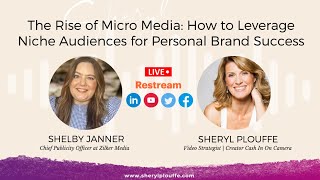
Shelby Yonner from Zilker Media explains why niche podcasts and trade publications beat mass media for building personal brand authority. One right listener can become a client, making micro-media appearances more valuable than large unfocused audiences. She shares tactics for identifying and pitching to the right shows using AI tools like ChatGPT.
Chapters
brand and you really want to have impact in the marketplace, you're going to have to understand how to leverage your niche audiences. And today, Shelby Yonner is here with us from Zilker Media in Austin, Texas, to help us understand something known as micro media. So we're going to talk about that today. Shelby, so great to have you on the Cash In On Camera podcast today. And tell us a little bit, like, let's start a foundation with what is micro media so that we all understand the language.
Yeah, for sure. Well, thank you so much for having me. When we talk about micro media, we talk about any sort of niche media outlet that when you look at the numbers of how many people it reaches, you might not be that impressed right off the bat. Right. I think traditionally when people are interested in PR, they want to be in the Forbes, they want to be in the Fortunes, the USA Today, the CNNs. They want to be on the Today Show. They want to be on these like name recognizable media outlets that reach a large number of people. And of course that's valuable. I'm a publicist. I've been a publicist for 10 years. I get it. Those are valuable. Of course they have a different type of value, but if you're looking to reach a really niche audience and to really drive specific targeted ROI, going on micro media such as a podcast or a video podcast like this one, or Even trade publications, if you're more in the B2B space, some of these trade publications, you look at how many people they reach and it's maybe, you know, a couple thousand up to maybe like 15,000 a month. And you're like, well, I don't know, is that exact, you know, is that a large amount of people? But if those are your customers that you're going after and it's super targeted, that's exactly where you want to be. And that I would argue is more worthwhile of your time and efforts to try to, you know, target in an earned media campaign rather than some of these, you know, name recognizable places.
It's interesting that you said that about these different media opportunities that in and of themselves might look like the numbers aren't that great.
Yeah.
And we, I think sometimes people overlook them, I think is your point that people overlook them as opportunities because it feels like, well, Is it worth it? Right. Is it worth it? Or what's the ROI of doing that? Mm-hmm. Talk to us a little bit about how that can work because it's really about crunching some numbers.
Right. So if you wanna take, for example, say your customer is someone in business development and you have to choose between two media opportunities or maybe two that you're going after, there's a podcast called Sales Enablement. And this is a big podcast that has been around for a really long time. I believe the host's name now, I am blanking on it. So shout out to him. Sorry, I've worked with him a couple times, but he gets around 15,000 estimated monthly listeners a month versus a Forbes, which gets, I don't know, in the millions, 90 million readers a month. But the thing is, not everyone's reading every single article in Forbes. I don't open up Forbes every day and comb through it. But those people who are in business development who are really committed to their career in biz dev, they're listening to this podcast. They are loyal listeners. They're listening to every episode. They are taking it very seriously when an influencer because podcasters are influencers and we have these parasocial relationships with these influencers. And when someone we trust invites you onto their platform, that's a big deal. So, and that's something else to think about when you're looking at just numbers-wise, you need to look at, you know, the host of a podcast, you know, who are they connected to? It's almost like networking more than earned media. So there's a lot of different ways to slice it and look at it.
Yeah. So you just had mentioned earned media. So it might be worth a conversation for our audience to explain the difference between earned, owned, and paid media so that we can have an understanding of what that is, because you're a PR, you're an award-winning PR strategist and expert in this space. And I think that this might be a great time to explain, you know, what the difference is, because What we're talking about here from the perspective of you being a guest, let's say on another podcast, is called earned media. Mm-hmm. Um, do you want to do, shall you, do you want to explain it or do you want me to?
Yeah, I'm happy to. So earned media is anytime you earn your way onto someone's platform versus paid media where you're paying for it. So my team members pitched me to you, to your podcast, and you invited me on. I did not pay my way onto this podcast. You know, there's nothing wrong, of course, with pay-to-play. There's certainly a time and place. And then that is, you know, also in contrast to owned and rented media. So we consider rented media things like posting on LinkedIn, any type of social where you don't own the connection to your audience because, you know, Instagram, Facebook, even LinkedIn, they can change their algorithm at any time and you no longer own that connection. So owned media are things like your newsletter list, you know, where you own that connection. No one's taking away, no one can, you know, steal your email list from you. So that's how I define it. Do you have anything else to add?
No, I think you're right. And there's sort of this subset of the rented, you know, which with, with social media, that is pretty much what you're doing is you're renting space and those places and they can up the rent anytime. Right. And we've seen that happen over the last many years. Right. So, So all the more reason why having this conversation around putting all your eggs in the social media basket isn't always the best way. And that if you can have a strategy for earned media, meaning getting speaking engagements, getting featured on other people's podcasts, and they don't necessarily need to be the biggest podcasts in the world in order to be effective. One of the things that I teach and really am a proponent of is The idea that if you're a coach, if you're a consultant and you have— ideally you have a higher ticket offer, right? You have something that you do that is priced anywhere from, let's say, $3,000 to $10,000. Everyone, I think, should have an offer in that range. And you go on a niche podcast, you are featured in some type of media where it might be a smaller audience. But the truth is it only takes one right person to hear that message, right? Have it resonate with them, to have them reach out to you and to become a client. And I think people, we get, we get, we think about social media and we think, oh, I got to be an influencer, I have to have a million followers on Instagram. But those are faceless people, right? What good is that really? I mean, yeah, it looks good from a, from a, from an optics perspective.
So what? Yeah, exactly. And you know, I, I'm on the earned media side here at Zilker Media, but my colleagues are working on the, the brand strategy digital marketing side, where I think that is really tough with a lot of clients. They say, how can I grow my list of followers? And we call that a vanity metric. And I, I know it's tough, right? But, um, yeah, I, I think you're exactly right. And, and also, if you're, you know, someone with— who's charging a lot for your services, you want people to be able to Google you and to be able to see that you're out there on doing some sort of PR. I really think that we call that authority by association credibility. Even if you're on a podcast that's smaller, I mean, as long as it's kind of like a good-looking podcast, like you land on these podcast websites sometimes that look like they haven't been updated in 10 years and you're a little like, you're like, eh, I don't know if I want to be on that. But If someone Googles you and that's really what first impressions are these days, right? Someone Googling you and they see you're out there doing podcasts, doing other things, they're going to be like, "Wow, they are an expert. They're going out to these podcasts and sharing their message, sharing their story." So that's just another reason why, because we're in this world of podcasting now where we have the giant podcasts that are like the new Oprah, right? Not everyone's going to be able to be on Brené Brown's podcast, sadly. I know we all would love to. I would love to, right? But getting on these niche ones, not only are you able to really niche down to your target audience, but it's a little easier maybe to get on the niche ones. And then you can have that earned media on Google for people to be able to see you.
Yeah. And again, it's not that I'm against social media. I think it's a viable distribution channel. To get out there and to be seen. And I use it and people should use it. I mean, that's where people are spending their time. They're on their mobile devices, they're on these social platforms. But just know strategically that you're, you know, things can change. And so you have to have something else, some other strategy. I think that's deeper than that. And if your business model is one where you're selling widgets and those widgets require that you have volume, like if your business model is you need volume, to reach the goals that you have for your business. That's a very different conversation.
Yeah. Right?
For sure. That's a very different conversation. Whereas if you are doing something coaching, consulting, you're an expert at a very specific thing. Again, you have a niche. You're trying to reach the audience for that particular niche. This concept of micro media can really, really help. Right. Let's talk about personal brand building, because I think that ties well into the whole piece around authority building. Building authority, what's the value in your estimation, your experience? What is the value to, again, an entrepreneur, an online entrepreneur to invest in building up their authority online?
Right. I mean, one of the biggest things I think we've seen in the past couple years is people's trust in institutions is really declining. And there are studies that have come out, especially um, after COVID, people don't trust a faceless organization anymore, whether you're a small business or a giant corporation. So I think it's hard for entrepreneurs and CEOs to say, hey, I'm gonna build my personal brand, I'm gonna invest this time and money, because it seems a little icky. They're like, I don't know, like, are my employees gonna think I'm stupid posting on LinkedIn every day? But Really, if you want to be a service leader and you want to lead that company to grow, you need to have a brand that people trust. And people trust individuals. Again, you know, that's Zilker Media's entire philosophy is people connect with people. And that's, that's true, right? Whether you are a business person or, um, or anyone, you know, you're not going out there and connecting with an organization if there's not someone who's the the face of it. And you also don't need to be the, the CEO of the company or the founder. You can be— I'm the chief publicity officer at Zilker Media, and I'm able to, to— I've, I've built my personal brand. It helps the company, but also personally, it just, you know, it helps people. I'm hiring right now for my position, and, you know, I see someone on LinkedIn who's out there who's grown their personal brand. It's also great for your personal reasons. There's just so many, you know, it's just the way that the world has, has gone at this point. But I, I do think that underlying reason for a lot of business people is the trust aspect.
Yeah, absolutely. Yeah, I mean, that's always going to be a foundational thing, right? The know, the like, and the trust. And I wonder if I could ask you, um, which really ties into one of the questions I like to ask all of our guests, which is, you know, one of our, our one of our sayings around here is stop marketing like it's 1999. We want people to market for the year that we live in and to live in the here and now. What is a way that you yourself, whether it be for your personal brand or for Zilfer Media, what is a way, a tip, a tool, a tactic, technique that you're using to help market yourself? It could be this strategy that we're exemplifying here, or it could be something else, but what do you find really working?
Yeah, of course, going and, and guesting on podcasts I think is really beneficial for your personal brand. A lot of people ask us, how do I find the right podcasts? How, how do I pitch them? And we have plenty of resources about that on Zilker Media. We also have a program called podcastguest.com that has lots of free tools. But I mean, if we're talking about cutting edge technology, I don't think we can sit here today and not talk about AI and GPT. Obviously like GPT-4 just came out early last week. I've barely started playing around for it, but. ChatGPT is free. It's super fun to play around with. I'm sure, you know, we're all marketers here, so we're kind of looking at it. But I recently asked ChatGPT, hey, uh, research podcasts for me. What podcasts are investment bankers listening to right now? And it gave me a list with an explanation. So, and that was, you know, that's not even the newest iteration. So, um, I recently— I think I'm on the waitlist for Bard, which is Google's Um, but I just started using Bing's, which I'm not an expert, but Bing is run on GPT-4, which is like the newest technology. Oh, okay. Um, and that, um, again, for PR, I've been asking it to, this is more like traditional journalists whose writing is out there, but saying, hey, can you go out and can you read this journalist's columns? Uh, let me know what they've recently covered within this topic area. And It takes a lot of the manual research out of it. So that's really cool. I'm really excited about AI. Me too. I've seen a lot of cool TikToks about it. I didn't know you could teach the AI to match your style. You can give it examples of things you've written and it matches your style, which I think that's super cool.
Which is so fun. I mean, you can have it, you can ask it to write in the tone of Brené Brown, as you were mentioning earlier.
Yeah.
Right. That's pretty cool. And so I agree with you. I think AI— this is part of the reason why we're actually integrating AI into the workshops that I'm doing around speaking and things of that nature, because it's not going anywhere. It's only ramping up and we have to learn how to use it to our advantage as a tool.
Yeah.
So exciting to hear you say that, that you're really exploring that.
Yeah, for sure. I'm trying. Yeah, I'm, uh, Yeah, I'm like listening to podcasts about it. I feel like— I know, we're all—
it's early days. It's early days.
Like, what's the quickest way I can like learn about it? Like listen to a podcast on my way to work. So yeah, I think it's super fun to play around with and really exciting.
Well, tell us about how people can reach out to you at Zilker Media.
Yeah, for sure. If you go to zilkermedia.com, that's Zilker with a Z as in zebra, you can reach out to us, learn more. We not only do media, we're a full-service PR and marketing agency. So we would be super excited to hear from you.
That's awesome. Good, good stuff. This has been really fun. I'm glad that you came on the show and you were able to help us better understand micro media, specifically micro media and how to leverage that to niche audiences. And really it comes down to realizing that if you are in a niche area, that's an advantage. Like, you can find speaking opportunities. Podcast is a great one to start with. There are opportunities for you to speak. There are opportunities for you to be featured in the media. And frankly, the more specific it is, maybe the better off you'll be in the long run. Absolutely. You know, so this has been great. Thank you so much, Shelby, for coming on the show today. We really appreciate it. Um, on the subject of AI, and you were just mentioning about that, I just wanted to show this. And for those who are watching the video, you can scan this QR code or you can just reach out to me on social media and find out more about, um, some of our upcoming workshops where we're integrating the AI into how you can use it for speaking. So scan the QR code or reach out to me on LinkedIn or any social media platform, and I'd be happy to send you a link to learn more about that, because AI is certainly something that's here to stay, and we want to be able to integrate it into our marketing strategies. Shelby, thank you so much for being here. We really appreciate your time and, and energy and, uh, your insights, more importantly, here on the show today.
Great, thank you so much, Cheryl. Cheers.
More from Sheryl



From 'agreeable' to 'ruthless mentor' to 'strategic sparring partner' #substack #shorts







