Next Generation Press Releases
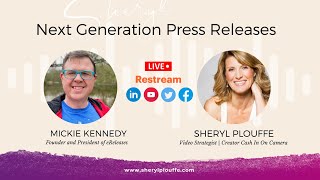
Mickey Kennedy, founder of eReleases, explains how small businesses use press releases to get media coverage. Well-executed industry surveys typically generate 8 to 14 unique articles. He recommends including candid images and video, and avoiding low-impact releases like simple hiring announcements.
Chapters
for your business, for your brand? Well, press releases might be a solution, and we have the perfect person on Cash In On Camera today to talk about next-generation press releases. Mickey Kennedy is here with us from eReleases today to talk about press releases. Now, Mickey, I come from broadcast journalism, and we had certainly our fair share of press releases that crossed my desk at some point, but they've really evolved. Tell me a little bit about like where press releases are today and how people and businesses utilize them today.
Right. So the good news is that, uh, a lot of people aren't using press releases, and it is one of the places that journalists go when they're hunting an idea for a, a story or an article. Um, you know, they're, they're also getting pitches and things like that, but it, it makes sense with the consolidation that there's just a few places to look at press releases on the wire. And so journalists are creating customized feeds. So they log into, say, PR Newswire, uh, you know, maybe they look at the fashion feed, but they can customize that feed to exclude, you know, ready-to-wear type stuff and certain keywords that would just be something that they're not interested in. So, uh, the value of going over a wire is that is the journalists who utilize the wire can make it very specific so that they're only looking at content that would be relevant to them. And that's one of the biggest values of going over a wire.
Well, and let's go back a little bit, Mickey, and just for those who are not familiar with what a wire is, can you describe what that is? Because they're going to be business owners who are entrepreneurs who maybe are watching this going, I don't even know what that concept is.
Right. So a lot of people are probably familiar with wires like the Associated Press, uh, UPI, Reuters. Those are wires for, uh, newspapers and publications. They, rather than write the article themselves, they license it. In that same respect, there's also, uh, three newswires in the US that are newswires of press releases, and they work a little bit different, their business model. But there, uh, people pay a fee to be on that wire and then their press release and their content is available to the media. In the US, it's PR Newswire, the oldest and largest. Business Wire is right behind them. And then Globe Newswire, which is really popular with publicly traded clients who are just looking for trying to get reach disclosure media. That's a requirement of the SEC. So that's sort of their bread and butter. But most companies are generally using PR Newswire or Business Wire. And the value of them is that it is an automated feed that's available to the media. Used to be that there were dedicated feeds that would go into a newsroom, sort of an intranet population. But now with the internet, it's, it's mostly behind a login. You have your login credentials at The Wire, you log in, you create your customized feeds, and then you just stay on top of it, checking them intermittently. For some people, it might be a couple of times a week. For some, it might be a few times a day. It just depends on, you know, how valuable they found the wire to be for them.
Well, you created eReleases, your company, like 23 years ago, and things were very different back then. You know, this was like, it was just a different landscape. And now you're talking about, um, really businesses and how they can put themselves in front of journalists. But these journalists are people who are subscribing to those wires, right? To be clear, correct.
Correct. Yeah, it's, it's completely, they're seeing the wire as a tool to give them ideas for stories that they could write. Um, the press release isn't the article. Uh, a journalist will turn it into an article. It'll be something that they write and it will be, you know, unique earned media that you would get as a result of that. Um, it, there is a confusion in the marketplace because there are, um, places that say they're wire in the name, but they're online syndication only. They never reach a journalist. They won't, uh, be turned into articles. But you, you might see your press release syndicated or appearing on a few different websites, and that can be a huge distraction because there are people who come to us and say, I've tried 5 or 6 releases over, you know, a— this wire service, and we're just they're just like nothing happened. And I'm just like, I'm not surprised because they say on their website they're just a syndication service and they don't even understand what that is. It's, uh, there isn't— there is no journalist in that landscape. It's basically you paid a fee and you appear on a website that doesn't rank very highly and no one saw your press release. But you know, there, there is a link, you can see the press release on the website, but that's as far as it goes. So you really want to make sure that, uh, you are working with a wire service that has relationships with journalists. And in the US, it's— there's only 3. Anybody outside of that is, you know, not a major player by any stretch of the imagination.
I want to dig a little bit deeper into what you just said, though, that the difference between a press release and an article. An article is written by a trained journalist who understands how to craft a story, and there is an art and a science to that. And this is just having a press release unto itself and putting it out there. If you just putting it out there for the sake of, you know, getting it distributed, it's not really going to have the same kind of result that you're, that you're after. So talk to us a little bit more about that idea of like, okay, we can utilize the press release to get the attention of a journalist who would then turn it into something tangible and readable that people would want to consume.
Right, so it, it's, it's not unusual for the press release to inspire an article that may be different. For small businesses, often what you're announcing and the article gets turned into, you can see they're, they're very similar. But for example, when Microsoft announced that they were getting rid of bulletin boards, online bulletin boards, it was like, we're doing this because it's a safer environment for children, and the That was the language that they used. And then the articles that resulted from it is just, they were scathing. They were just like, Microsoft is saying that this is to help children, but Microsoft is not getting rid of chat. It's not getting rid of Skype. It's not getting rid of a lot of places where things happen that affect children. What is happening here is they've not been able to monetize bulletin boards, and as a result, they are retiring them. And so you don't control what the media writes. So sometimes your spin on it may not be the spin that the media uses. Most of the time with small businesses it is, unless you're facing a crisis or something where you're really having to fight something, and sometimes your words can be turned against you. For small businesses and entrepreneurs, you, you very rarely fall into that, so you don't have to worry as much. But, uh, it is, it is funny how sometimes the press release and the article can be so different. What you are looking for is to put forward information that you feel is newsworthy and has a strong chance of the media responding to it favorably. At the end of the day, a journalist is a gatekeeper, and is what you're announcing interesting enough that they would want to share it with their audience? Journalists like to be curators. They like, uh, small businesses because of that. They rarely enjoy covering large corporations that can advertise and market. They like to be the ones who discover cover the little companies or the little things that you don't know about or don't have a relationship with already. And that's why I think that so many journalists will often profile a Kickstarter or an Indiegogo or something like that, something that's fun, that's interesting, it's novel, and not a lot of people know about it. So if you think you're too small for PR, I would say that the smallness actually is an advantage to you because the smaller you are, The less well-known you are, the more a journalist is likely to champion you and write an article about you.
Yeah. And journalists are, are really tasked with finding out the, figuring out the angle. And you as the small business owner, entrepreneur, and you're right, most journalists are not going to do like a big exposé necessarily on the average entrepreneur. Maybe more so on the corporate side, but those journalists make the decisions about how they're writing about you on their own. You don't control that. What you control is the information, as you said, what that press release entails. And I'd love to dig into a little bit more on how do small businesses utilize— again, next generation press releases is the theme today— how can they utilize press releases to put out that information that really paints them in a positive light? I think you do some, you know, you, you like to talk about studies and I think surveys and things of that nature. So can you speak to that?
Sure. So I, I say to anybody who is considering a press release or has tried a couple and they didn't work, I always say consider doing a survey or study in your industry. They always result in media attention. You want to ask captivating questions that are appropriate today. Right now we have a lot of stuff going on with logistics, supply chain, staffing issues, uncertainties with the economy. So if you were to take your industry's temperature right "on those subjects and more." You know, I always say, throw in a couple of odd left, left-ball questions as well towards the end of the survey. And just collect your information, get it put together. You know, what was the biggest "aha" moment or the most interesting result that you got from it? And lead with that in a press release. You're going to want to have a really compelling quote as to why the survey perhaps skewed a certain way. Because you're the author of the survey, you, you know, your opinion matters. And you want to say something that's really compelling and interesting in a quote, because a lot of journalists can build a great story or article around the great quote. And you're going to, you know, release that to the media and see what happens. One of the things that I get from people is, well, I don't know who to send my survey to. I don't have a huge community, so this wouldn't be appropriate for me. I've had many of my clients just reach out to an independent or small trade association, of which they may or may not even be a member, and ask if they'll send a survey to their members. Let them know that you'll be doing a press release over a wire, and you will certainly include them in the press release. The small and independent trade associations see this as a huge win-win. They don't get a lot of love, and they see it as an opportunity for them to get some exposure as well, and they'll certainly send it to their members, social media, as well as perhaps email as well. I like it when they do both. But often you'll get, you know, a few hundred results from your survey. You'd be able to analyze that, figure out what was the really interesting aha takeaways from that survey, and, you know, build a press release around it. Create a webpage on your website that has all of your data because sometimes the journalists might want to dig in and some of the other questions that you asked that you didn't really profile in the press release, might be a story that's relevant to them and maybe something that they're very familiar with. Um, that, you know, maybe you talked about, uh, your ad spend or marketing spend in the next 6 months, whether you feel like it's going up, down, or going to stay the same. Uh, that might be something that they're more interested in because it's, you know, it's an element of your industry that they cover. So having that page on your website is a great place for the media to link to, but it's also a great place for them to go and find additional information that they could really create an interesting article or a compelling article based on your survey or study. You know, surveys and studies generally get between 8 and 14 articles, unique articles.
Really that many?
Yes, and the ones that I'm involved with. Now, I think that I'm pretty good at coming up with some captivating questions. I'm very good being a poet, it's my background. I am really good at being creative and brainstorming unusual questions. I like SurveyMonkey because it's multi-page. So if someone only completes two-thirds of it, you've still got that data that you can use. And you put your most relevant and interesting questions in the beginning. Your odd left-ball questions, you can save them for the last page so that if they don't complete it, that's fine. You still have the other information.
But sometimes— But Micki, I just want to ask you about the length of these surveys. Because it sounds like some of the business owners who are watching or hearing this might say, Oh no, it sounds like I have to go and commission this big survey or this huge study. Right? It's like, oh, is this a scientific research study? It sounds like it's going to be expensive.
12 to 16 questions. Yeah, 12 to 16 questions is a sweet spot. I like to have 4 questions per page so that if someone gives up, you've still got maybe 2 or 3 pages of that information in there. So you still can analyze and use their, their contributions. It's not difficult. These are very simple questions, you know, like, do you plan on spending more or less over the next quarter, over the next 6 months, over the next year? Are you, you know, hiring? Are you having difficulty hiring? Or, you know, do you plan layoffs and things like that? So these are pretty straightforward questions. When you get to what might be a left-field or oddball question, you know, I say, what are the types of things that you talk about when you go to a conference? Because people tend to gossip about stuff. Gossipy questions are these left-field questions where they might appear like, you know, uh, you know, do you feel, um, you know, something that might be trending in your industry that people talk about but you don't see in print very often? That might be ripe for one of those left-field questions.
So I'm just, just playing with you here a little bit. In my, you know, world or industry, you know, video marketing, and we talk a lot about profitable podcasting around here, would an oddball question maybe something related to, like, for example, I think that Web3 is— we're on the verge of Web3 and that there's going to be a correlation between, you know, community building and Web3. Would that be an oddball question or would that be more of a question that's actually in the survey?
I think that that would probably steer more towards the mainstream. Left-field questions, like we did one in the auto industry., and we, uh, it was a survey that went out to independent auto repair shops and it was an open field rather than a, a multiple choice question. And it was just, uh, what's the strangest thing a customer left in their car while being repaired? It was statistically irrelevant because every question was unique because people were typing in 1 to 3 sentences and sharing these stories, but they were strange. They were odd. They were viral. Uh, we got over 10, maybe 15 auto trade publications picked it up. Over 20 or 30 small newspapers picked it up, uh, including the, the author's, uh, local newspaper. And it, it did really well. And, you know, some people publish like their top 10 ones that they liked, or the top 20 or so, but, uh, they, they picked and choose among the responses what they thought was really interesting. And I think that there was a huge human interest part of that. You know, it's, it's, it was titillating.
It's humorous too. And I think, you know, it's not to say that we're necessarily striving for virality, but obviously we're striving for as many views and lists, you know, listens or reads as we possibly can. But having that oddball question in there opens up the opportunity to have something more humorous or more shareable. Maybe something on the funny kind of side, it sounds like.
Right. It was just an afterthought. I said, oh, put this on there as well and see what happens. Let's see what happens. And everybody gravitated around it. And so it was, it was, it was really a lot of fun.
One of the things that we do on Cash In On Camera is we like to have a little segment called Stop Marketing Like It's $19.99. So I would love to know, Mickey, from you, what is something that could be a tip, a tool, a tactic, a cool app, anything that you feel is really working to help you and eReleases market yourselves today?
I would say video. I think that we are moving more towards video and multimedia. We put a lot of effort into doing some YouTube ads, remarketing to people who've already seen us and having a video conversation with them. I think video is very powerful. And also, I think that knowing that the next generation press release is going to include multimedia. You always want to include images when you are sending your release out because if a journalist is looking at potentially two stories and they have a web audience, they know that if you have a really engaging photo, that, that's going to make you win out over some other person who may be similar quality of a story that they're working on. This, the Images that work really well are the more candid shots, staying away from things that seem like they're clipart or too professional. I love it that it's— we're now in a position where being too so professional and spending a lot of money actually deters people. So, you know, candid shots, people using your product, real life, you know, customer-submitted photos and things like that. Those are all ripe for using when you send out a press release. And we're not seeing a video press release yet, but I think that over the next 5 years or so, we will see B-roll and other things be so much more important when you send out a release, because people are going to be taking that news and rather than putting it together in written form, they're going to be wanting to produce something in video. And I think having B-roll and other type of video creative for them is going to be really important. I may be off. It might be 10 or 15 years, but I think we're definitely moving towards that.
I think COVID has shrunk that timeframe because I think a lot of companies now, and I agree with you, I've always thought that it would be a great idea for companies to have some sort of like B-roll or footage of their company kind of at the ready. And it sounds like it could play into the future of press releases. Releases, which is really exciting. Yeah, that's absolutely fantastic. Listen, Mickey, I'd love to be able to send people to your website. Where can people go and, and learn more about e-releases?
Right, so our main website is ereleases.com. We have all of our social media there, but I do want to encourage people to go to ereleases.com/plan. P-L-A-N. I have a free master class there that goes through, um, 8 winning strategies that work. And these are the types of press releases that almost always get media attention. The survey and study is, of course, the cornerstone of this, but it's completely free. There's a lot of information there, and I would recommend anyone who wants to do an audit of their business to see what newsworthy ideas are available to them to take that class because it's less than an hour and it will really get you brainstorming on lots of things that you could do that are not the standard types of press releases that we see. I see too many press releases about a new hire where they have like a new director of sales or VP of HR. And while this might be a great hire, so few places are going to turn those into articles. So if you're going to spend money to go over a wire, want to do it with more strategic types of press releases that are more likely to get you articles.
That's great. I'm actually just going to put this in the, uh, here, let's just put this on the screen. And then people can see it as well. Let me find it here. So this is the URL, right? E-Releases.com plan. Okay, great. Vicki, this has been a lot of fun, and I think that that would be a very good 1 hour spent off for any entrepreneur or business owner to learn more about how they can utilize press releases effectively to help them get— obviously grow their business and be able to get more press. We really appreciate you being on Cashing On Camera today. Thanks for your time.
Thank you so much.
More from Sheryl



From 'agreeable' to 'ruthless mentor' to 'strategic sparring partner' #substack #shorts







