Pay Attention to Artificial Intelligence In Your Business
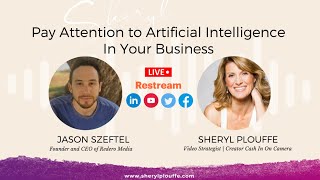
Jason Sheftel of Rodeo Media explains how AI reshapes B2B coaching and consulting. The most powerful applications blend AI with human touch: video avatars for personalized intros, chatbots for one-to-one customer experiences, and automation that frees up premium service for top clients. Over the next 3-10 years, businesses that balance AI efficiency with authentic connection will win.
Chapters
AI is something that we are learning to live with in our society, and Jason Sheftel is here from, uh, Rodero Media to talk about artificial intelligence and how it's impacting you. You might not even realize how it's impacting your business. And then we're going to talk about really the future. Jason, so great to have you here on Cashing On Camera. Uh, you have so much experience and knowledge to share about artificial intelligence, and we're going to to stay narrow to that topic today because it's a really a wide range kind of effect that we're feeling. And I'd love to start there. How is artificial intelligence— how has it infiltrated our lives and our businesses? And can you give examples of how we might not even realize that it's impacting us?
Sure. So thanks for having me, Sheryl. I'm really excited to talk about this. And it's really one of the most exciting things we're seeing across the business landscape is what businesses are doing with artificial intelligence. And I'll say just at a high level, the most sophisticated applications of it are actually not pure artificial intelligence. It's about creating a symbiosis between artificial intelligence technologies and then the human touch. So it's really about marrying those things, actually. If you do pure automated stuff, everybody's seen the emails, the marketing emails, all this stuff, it's— people are inundated with it. But it's really this combination of the human touch and then really sophisticated artificial intelligence processes on the back end, on the front end. And pulling those things together has been transformative for a lot of businesses.
So we're looking at this through the lens of B2B sales and marketing for coaches and consultants. So when you say high touch, what, what kind of examples do you— what kind of high touch do you mean? Or do you mean Again, email marketing might be an example of that. Is social media an example of that?
Sure. So I'll give just a quick example on the real estate and e-commerce side, which is just some simple online businesses. I was working with a company and actually a founder out of Michigan who's creating a really cool app that allows you to create basically a personalized introduction to your website. So let's say you're a, real estate leasing company, or you have a whole host of multi-unit properties, apartments, whatever, and you have one of those kind of generic websites, you can actually create a video introduction at the bottom of the website that is key to exactly who's found your website. And there's even artificial intelligence technologies like we've seen to create these images where you can create different people to actually give a welcome introduction to your website. And there's a lot of things like this where you're adding the ability to use natural language processing to have very, you know, human-sounding voices and human-looking people. And you can create all sorts of really cultivated, high-touch, you know, journeys for people as they interact with your brand.
But I mean, these tools that, and some of these tools I didn't even know existed, but The one in particular that comes to my mind is the one with the video where you could basically use this tool and it will create an avatar of any description, and that person, you can marry your own, uh, script or your own speaking to it and have it say whatever you want it to say. Like, it really is mind-blowing what is coming out now. And, and a lot of these tools we don't even know exist. People are still struggling with the basics of sales and marketing at this point, let alone looking at the future of, of all these amazing tools that are coming down the line or that exist today. Are there any other examples of tools that you have come across that are really indicative of the future and where things are going?
Yeah, just there's so many tools that are really being developed right now, which is really what's remarkable. But they allow, for example, just consultants, high-end knowledge workers who do not have the time to do a lot of the marketing, a lot of the outreach that they have. There have been tools to basically let you create lists, do all sorts of automated outreach, but we're really reaching into a very different world with this now. And there's a whole set of tools that are coming out. I mean, I'll give one, I mean, just one really exciting application of artificial intelligence is just like a really simple thing we're seeing is these chatbots on all sorts of websites everywhere. They're popping up everywhere. And what's happening is that businesses are combining, you know, they're splitting, they're segmenting their market. And the classic way to do it is basically, basically who are our best customers? And we'll give them a really premium experience. And then people who are our less valuable customers, but still valuable, we give them less premium experiences. So they get chatbots, they get all sorts of things that really save your resources for those really high-value customers. And the crazy thing is we're getting to a world where you can start to target people. It's not even just, segment, target, position the market. It's like you can have a market segment of one. We have so much information about what's going on online, what people are doing, where they are, who they are, what they're doing. You can just start creating lists of people and experiences for these people that we haven't been able to do. And you don't have to do it all yourself. There are tools that are coming out that are allowing it to happen. Well, that providing service for you.
Yeah, a lot. I suspect a lot of the businesses that you work with in— at your agency are maybe more enterprise-level type companies. But I want to speak to, again, you know, the six-figure coach, right, who's trying to get to seven figures and really wants to sell more of their products and services. How can they integrate AI into their sales and marketing strategies? Because you really pride yourself on developing really modern, modern types of strategies to help people actually do that. So what are some ways that, again, you know, a 6-figure, 7-figure entrepreneur could utilize artificial intelligence more effectively?
Yeah, I think using machine learning techniques to really iterate on your who your best customers are. I mean, this is really what I always come back down to with anyone I'm talking to, just as a friend, as a client, coach, whatever happens to be, is we've got to find who our best customers are, the ones who provide your business, your company, the most value over the, you know, the course of their engagement with you. And really not doing this once at the beginning and sort of saying, okay, I think this is my market, let me go for it, but continuing to iterate on it. And, you know, I actually, I'll be honest, I haven't seen any specific full-on technologies that are being created and marketed for this, but there are a lot of tools that if you have, if you can work with different developers, you can really create tools that are focused on iterating and say, okay, so let's say you have a set of 20, 25 main clients. Here's, you know, here's their industries, here's their age, here's their, here's the project we work with, here's the work we're doing with them. Here's our, you know, expected lifespan of the deal. You have this information. We know it really should be— it should be in spreadsheets or whatever, and you can start running processes to see, okay, so if this is who we're working with now, this is where the market is going, you know, who should we be looking for? Who should we be doing our focused outreach to try and reach? And this is, you know, this is really on the marketing technology side to try and— there's so many areas obviously of marketing and marketing MarTech, as I heard from the newest tech word. But it really is, there are a lot of ways to just get towards who your best customers are. And that is really for the 6 heading towards 7-figure coach, finding, it's not even, niche isn't even the right word, but just finding those best customers can do so much to pull you over the, you know, the next hurdle that you're looking for. And really that's also, building word of mouth and building that reputation and that credibility within those markets. It's very important. So that's always what I go to.
So based on that answer, it sounds like there is an opportunity to use more artificial intelligence in the business, more from the perspective of actually intelligence, like actually gaining knowledge about who your existing clientele or customers are with the intent of increasing lifetime value or retaining them or selling other products and services. It sounds less like we would use artificial intelligence in the lead generation or brand awareness phase. Is that true?
Well, I definitely focus on the business intelligence side of things. You mentioned earlier, I have a bit of a background in a lot of sort of macro geopolitical global stuff, and that's how I try and, you know, see the markets that I work with in the industries and give a sense for different companies about where their industries and all this stuff is going. And so the, the business intelligence side of the world's been really transformed. So you can really do a lot and using even your own internal data, you're, you're doing a lot before you get to the lead generation, right? Before you head to those areas. I think there's been a lot of motion in social media marketing and all these sort of those stages of the funnel, but there's really the core one when you're, you know, once you have your business, you gotta be in the right market, right? And so I guess I'm putting it almost right before the funnel, like not even top of the funnel, we'll call it before the funnel here. And it's about, you know, having a process in place for your business and for your consulting practice or for your professional service, whatever it is that is running on its own to make sure your market is the market you wanna be in, right? Cause there's no time that's wasted. More time wasted in any entrepreneurial endeavor or business endeavor than if you're just in the wrong market or you're just not in the right one. You're a couple degrees off. You're, you know, I mean, and I mean, just one of the things we all know, 60, two-thirds of all digital marketing spending is now mobile marketing, right? It's mobile. People know everyone's there, but a lot of it is so bad still. We know it's not very good. We look at our phone and we're not pleased. We're not engaged. We're not surprised. We're not any of that. And so the power, if you know who your market is and you know where they are and what they're doing, the power of just basic mobile stuff, which has been around for 10 years now, it changes the game even for simple stuff. So your lead generation across the board can be a lot better. Yeah.
I want to go back to something you said earlier, which is this idea of high touch. And as it pertains to artificial intelligence, you know, artificial intelligence can, I think, be— it can be a time saver. It can be— there's some efficiencies that we can use it for, etc. But is that an oxymoron, right? Artificial intelligence and utilizing it against high touch and high, you know, personal connection and things of that nature?
Yeah, I think this is probably the core of the challenge of marketing, like in this decade of what people need to really think about. The core challenge here is we have all these tools, and I'll tell anyone who's tried to implement a new— not even just artificial intelligence, but a new tech system— they know that you can get something that's so intricate and so complicated and just ends up being a disaster. It is just getting it to work, getting the processes to evolve within your company. It can be way more trouble than it's worth. And so that's One challenge, but this height, this getting the human touch is so important because we're— people crave it and ultimately we lack it. And a lot of marketing is, you know, just discovering what these, these needs and these wants and these desires are, and then, you know, finding the consumer offerings that really help to provide what people lack. And the, the human touch is so important in a world where people are starting to really implement AI, the companies, the businesses, the individuals that combine AI with human touch is actually going to be— it's going to be the most— they're going to be the most successful without a doubt because we are in it. Remember email marketing? Content marketing went crazy in the 2010s. It got ridiculous and endless emails. And there's a real thing here. Some people often— we're all so lonely when we get an email, we're like, oh my God, it could be from a random store across the street and you're still like, okay, like that's I still like it. But at a deeper level, we don't like when it's all fake. So if you look like last 3, 4 years, suddenly there's emojis everywhere. There's images, there's GIFs. It's trying to make it more and more human seeming. And there's a weird arms race going on behind the scenes between like the human seeming thing and let's automate the human seeming thing. And then you have to add more real human humans to make it human seeming again. So it's, it's again, what we're seeing is that you need a balance. The AI, the artificial, the technology, basically the technology. It's a combination of hot and cold, right? You have the really hot, warm, I guess you better warm human elements, but then you have the sort of colder analytical methodical technologies working. You want to combine them.
So Jason, is it really understanding then from a business perspective what parts of your business or categories or divisions of your business and opportunities to use artificial intelligence that could again help from an efficiency perspective against the high-touch nature of the connections that we still need to make. Like, I think that where we're going, and this is where I want to lead this question to next, which is the future, right? Kind of put your futurist hat on for a moment and look 3, 5, and 10 years down the line. But We do need to have, I think, a return, in my opinion, a return to the basics of human connection and talking to people and getting on the phone. Things that I think largely entrepreneurs have wanted to automate. They want to be like, I don't want to get on the phone. People are hesitant to want to talk to people. I don't know why, because we're wired for that as human beings. But put your futurist hat on for a moment. Where are we going with all of this in the next 5 or 10 years as business owners and the balance between where artificial intelligence could play in and help business out?
Yeah, I mean, just to think about, let's say we did, we used these artificial intelligence before the funnel to give you all your best customers and then you just went automated all the outreach. It's like, well, you have, these are the best customers you could possibly have. Maybe it's worth picking up the phone. Maybe it's worth going there. You know what I mean? It's like, Your data, the work you've done is telling you that you need to, that you've done the work, you don't need automate anymore. So we're all, every entrepreneur, every business owner is always trying to save time, but really you're trying to make money here and you're trying to do it in the most effective way. And the, I mean, a great example is just Tesla. They tried to automate an entire factory. They were like, we're gonna make a super automated dreadnought. And they had to redo it and add humans into the mix, 'cause it was just, it all got tangled and you had to go into the code to try and fix it when it was right. It was a disaster. So it's a similar thing in all of our businesses and trying to find the symbiosis is really important. I mean, I really say even this concept that you're not just doing artificial intelligence, you're trying to combine the human and the artificial, that will set your business up for real success in the next 3, 5, 10 years. Most businesses aren't going to be doing that. They're gonna do, they're gonna try and over-automate it. They're gonna get really seduced by, oh my God, I could save all this time with this process. But then you've built up a lot of other time in another process that you're now gonna spend on instead. So I just really focus on that. That's why I started with today. Just think about it. It's the warm, you want the warm and you want the cold and you want the really powerful artificial intelligence, but you also want that human touch because Get ready. We have artificial intelligence everywhere. We have fake. We're going to have— it's very likely in the next 3, 4, 5 years. It sounds crazy. We're going to have more than half of the content on the internet will probably be AI-generated. The images, the articles, the blogs, the stories. It's getting that good. The natural language processing, it's really getting powerful. I was just talking to a PhD student at USC about some of the work he's doing. It's ridiculous. That's really where things are going. You can see VC companies are already looking in that direction. And so again, the thing that can stand out, I mean, do what your business needs, get the information, do the right processes to have the highest quality information that doesn't decay for your business. And then come out with a strategy that engages people as humans.
I'd love for you to share the work that you do at Rodeo Media. Tell us a little bit about who you work with and how people can get in touch.
Sure. Yeah. So this is— so my story is actually I work in— I work primarily in a more law economics context. I worked originally with a lot of real estate companies, development companies, and it's more at a higher conceptual level of just— that work was more about where the world is going. It's about deglobalization. It's about what's going on in China, Eastern Europe. All this stuff. And then what happened, as I was giving commentary and discussing where all this was going, people like, okay, well, what do we do now for our business? And so this agency developed basically to help with the, the broader, you know, the first, the business strategy about, and the market understanding of where things are going, and then getting basically the view from 30,000 feet, then narrowing it down to what your business can do. And this is the company that provides a lot of the specific, you know, tools, technology, strategies, branding, capacity, you know, branding shifts, all that to make it happen. And so it really focuses on what is your company, what are you trying to do, who are your competitors, where are you competing, you know, what's your position, and then, you know, doing a full spectrum strategy depending on what the, the business needs to, to make that happen. And so it provides a lot of, a lot of things, uh, in just different pieces. I try and help anyone who has a, has a problem, and I'll just try and tailor a lot of this to, to their business. Because like I said, I have a really big macro perspective about where the world and all these things are going, and everyone's kind of seeing the world's chaotic. And so I ground people, just kind of let them know the lay of the land, and then we go and we try and craft a specific strategy that hits that 3, 5, 10-year goal for them. And it's, it's really productive. I think it's It's great. I mean, people are interested in anything I've said, I definitely recommend reach out. For example, this weekend I'm going to be working with an aviation company out of the San Francisco Bay Area. So that's exciting. I don't really want to talk more about it, but that's an exciting one that's happening.
Well, you mentioned a couple of times that you're an expert on deglobalization, and I think that's an interesting lens through which to see the world. And so I'm sure that people reach out to you, they can have that conversation with you. And I want to end by asking you, what is a tip, a tool, tactic, technique. It could be, again, it could be artificial intelligence related or not. That's helping you to market yourself personally or Robero Media.
Sure. I mean, I will say that video is really underutilized and not valued as much as it should be, both on the advertising side. You're getting some of the highest ROI out of video. People don't know, I mean, it's kind of crazy. It's great for SEO on websites, it's being ranked pretty highly. It's great for also, everybody should try and develop the capacity to be good on camera. It's not just for the TV and news hosts and all that anymore. Everyone should do it. And it's an evergreen thing. It's very simple. You don't need a whole, there's a real process of trying to find who you do things with and all that, but just, I think every business owner should get comfortable doing things on camera. It's really, if you expand, depending on how you expand your business, there's just so many opportunities with it. It's becoming a technology. Everyone has a high-quality camera on their phone. You can do with an iPhone 14 or 13, hopefully, I don't even know what they're on now. You can shoot really good video. You can shoot really good video. Yeah, you could shoot really, really, really good video. A friend of mine has a whole YouTube channel she does entirely with this iPhone, and it's better than my current camera, which has been freezing out. Maybe the audience has seen.
So it's impressive. Well, you don't have to convince this video strategist that video is the thing. It was the thing before the pandemic. It's the thing after the pandemic. That is primarily why I look at things through a video-first approach, because it is such a powerful medium and modality. So Jason, so great to have you here on Cash in on Camera today to share your thoughts on artificial intelligence for our businesses, how, and you know, how it affects us now, but also how we can learn to integrate it and still live with it while not sacrificing the things that are really going to help us connect as human beings. So I really appreciate you coming on today.
Thank you. It was really great to talk about it with you today.
More from Sheryl



From 'agreeable' to 'ruthless mentor' to 'strategic sparring partner' #substack #shorts







