Pop-Up Shop Success Story
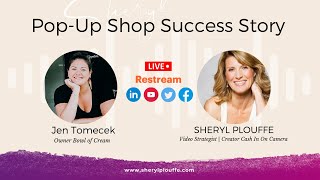
In this YouTube interview, host Sheryl Plouffe talks with Jen Tomacek, the founder of Bowl of Cream, a mobile soft‑serve ice‑cream truck operating out of a renovated 1970s trailer in Chatham‑Kent. Jen explains how she shifted from long‑hour park stalls to concentrated pop‑up events to keep product freshness, reduce labor, and create scarcity. She details the marketing system that drives attendance: building a library of high‑quality photos, posting concise image‑based announcements with date, time, and location, and using Instagram Stories to share authentic, behind‑the‑scenes moments, personal anecdotes, and real‑time updates. Jen emphasizes authenticity over polished scripts, showing the preparation of local fruit, baked goods, and sauces, and being vulnerable about the challenges of running a business with young children. She also shares practical tips such as checking Instagram’s “active followers” count before posting, posting frequently (even if it feels repetitive), and timing posts for evenings when followers are most active. The conversation highlights the supportive local community, the importance of repeated messaging (≈21 touches), and the overall philosophy of fitting business operations to a lifestyle that values freedom and flexibility.
Chapters
looking at a local hashtag, and local meaning Chatham-Kent, which is my new hometown. And lo and behold, I'm going through the Instagram and I'm looking at a hashtag, and I came across some very intriguing content by Jen Tomacek, and she is here today from Bowl of Cream to talk about her strategy to find herself in my feed, which I think is really interesting. Hey Jen, great to have you here. Local connection, we're both here in Chatham-Kent. Yes, happy to have you. Thank you for having me.
Excited to have you.
Listen, we're going to talk today about the pop-ups that you've been conducting at Bowl of Cream and why that's— and how that's been successful for you. We're going to dig in a little bit on that. But I want you first to let everyone know, what is Bowl of Cream, first of all?
So Bowl of Cream is a mobile ice cream. I renovated a 1970 trailer and I primarily have soft serve. Ice cream is my main, um, my main ice cream, but I, I jazz it up with lots of local, uh, goodies, fruit that is in season, local baked goods, and handmade sauces.
I love it. I mean, just looking at this video, I am hungry, and trust me, I'm a girl who likes her ice cream. So, um, I wanted to kind of start with you know, the pop-ups that you've been, you know, you've been doing. Where did you get that concept from and how's it been working for you?
Well, it kind of started from when I started my business. I thought, okay, I'm gonna be in the park every weekend, um, when people would want to buy ice cream. That was sort of like my main thing. And then I learned very easy, like very early on, that because the nature of my business is a lot of fresh local fruit, baked goods, that it was better to market when I was going to be there and have a concentrated time than sit there for 8 hours or 6 hours, that I could keep things fresher, that I could do sort of be more efficient. By having, by creating a pop-up and not being there necessarily every single day and oversaturating. But when I was there, I was busy.
So that's— this is really intriguing to me because what you saw was that you were doing it one way. And I just want for the viewers to be, you know, listening to this because Jen's example is obviously her soft serve ice cream truck and it's a very specific thing that she does. But I want you to be really listening to what she's saying because it can apply to what you're doing possibly. And that is the concept of doing, starting things off in one way and doing the very best that you can with the resources that you have and the knowledge and insight that you have. And you're doing it a certain way. But now, you start to go, 'Wait a minute. There might be a more efficient way of doing this to save yourself time.' And time is money. And so, that's really what it was. You were sitting there probably for 8 hours going, gee, like, if I could just concentrate this into a shorter period of time and have more people coming, then ultimately your business is more successful.
Yeah, and part of that is, is I grow, so people, more people find out. So you have to be willing to do the work at the beginning, whatever, whether it's pop-ups or private functions or fairs or whatever. Um, you got to be able to put the, the hours in. So I have, there's an element of being fortunate enough that I have the local market that will come.
Yes.
And business. But I did learn, especially from where I am now in Turner Park, I have a plug. So that gives me a little bit of flexibility. But before, when I was just primarily in Kingston Park, I was running from on a generator. So, and when I, when I started this, it was, I have 2 young kids and 1 on the way, and I was wanting something that would fit with our lifestyle. I don't want all our memories of the summer to be ice cream. So I was really trying to manufacture a way of still being really, really productive and successful, but without having to sit there for 4, 5, 6 hours, even at like a festival type of a thing.
So, right. Well, you said something interesting there too, is that We want to be able to fit our business to our lifestyle. And I think that's really important for a lot of us to take in. It's like, that's ultimately what entrepreneurs want, and that's why we go into business for ourselves, is because we want a certain amount of freedom— schedule freedom, you know, time freedom. We don't want to have a glass ceiling, you know. It's really, really, I think, about freedom. And this is what you've created for yourself. So I just want to congratulate you on that. I want to also dive into your strategy? So say you, you're doing these pop-ups where you're obviously being very strategic about like when you do it and where you do it, and lots of logistical decisions go into that. But from a marketing perspective, how is it that you're driving people to the pop-up once you've decided on the location and time?
Um, for me, it's— I, I guess maybe the, the main focus for me was what worked for me, and then I started thinking about what would work for my customers, and then just hoping that what worked for me would work for them. That sounds like maybe a bit simplistic, but yeah, I tried to figure out, okay, when would I want to be eating ice cream in the park with my kids? And what times would I want to be there?
And Do you base it around— do you base those decisions around events or things like that? Or is it more— no, it isn't. So, when you decide on the location, say you decide, you know, you're thinking about that. You're like, well, when would I be— I'm going to put myself into my customer's shoes. And when would I be taking my kids out to here or there? But then, what do you do? Maybe it has to do more like with social media. I know you have quite an Instagram following of over 5,000. Followers as of doing this live stream, which is, you know, a nice sizable audience. How are you using social media perhaps to drive people to the location of the pop-up once you've set it up?
Yeah, so one thing I would really recommend is I have a library of really nice pictures. I learned, um, Instagram is such a visual, um, app, social media, and Facebook too, um, that For me, trying to get a picture when I was about to go for a pop-up or when I was at a pop-up, either I had a line and the last thing I wanted to do was be taking a picture of the ice creams that were going through. So I've gotten Wade from Wader Likes Media and I've gotten other local photographers that I've had come out on just random pop-up days and gather as much content as I possibly can. There's some in there that I've taken myself, um, which is great, um, but it's so convenient to have that library of really nice photographs that showcase, um, you and what you're selling. So for me, it's the ice cream, um, and then from there, I really, uh, I've found out that For me, I'm not— long-winded messages on Instagram don't work. Give the people the information, let them know. So I found putting, uh, text on a picture and just giving them the basic information of like, okay, when, where, and how long, um, is kind of what, um, so you'll see like a pop-up. There you go, like October 9th, 2 to 5, Turner Park. So right on the picture, they know the information. So it's easier to send to other people. It's easier to just gather what they need and not get lost in, um, uh, you know, the, the message of it all.
Um, well, you're, you're really putting on the most pertinent information and, and making it easily palatable, right? Like people can consume it very quickly. And I think that's smart on your part because people's attention spans are low. It's part of the reason why, at least for us with the video content creation and implementation plans that we do, we keep— often those videos are, are short, you know, they're under 2 minutes, because we recognize that people's attention spans are very low. And even in your caption here on Instagram, right, you're keeping this fairly to the point. Um, do you also do posts on Instagram that are more story-based and lengthier, or is this typically kind of positive.
I mean, I was when I was first, when I was first starting out, just to sort of share. Like, if you can kind of go down, you can see there's some quotes for me, um, saying like, um, busy ants telling, um, or busy ants telling, uh, bees how to make honey. Where like, that was just sort of a quote where that resonated with me, that when you're having, when you have your business, nobody's going to understand your business except for you. And people can give you great ideas, but sometimes you're like, but that doesn't work for me. So yeah, I share a little bit more and more about my story and where I'm coming from at the beginning. And that's normally something that I reintroduce in the winter when I have a little bit more downtime. Right. I think it's important to show your face and be the be authentic and real so they can get to know you as a business owner. And that's kind of what I do through my stories. That just kind of happens organically, um, whatever I feel like sharing that day.
Yeah, and I love that you brought that up because I was just looking at some of your stories this morning and you are so authentic and natural and conversational, which I think is what stood out— why you stood out to me when I was looking through those hashtags and I found you was because I just love that I think that that's really what's working. You know, what's working is authenticity. What isn't working as much, I think, is when people are writing long-form scripts and then very stoically and corporately reciting that back to the camera. Like, that's not really what's working. And so I think yours was an example of think of what's working. And Instagram Stories obviously is a great strategy, especially for the people who are already following you., right? So you have, let's say, 5,000+ followers on Instagram. Now you can do stories to reach out and be— and let those people be notified. And you could not only really promote your pop-ups, but you can promote your brand in general. So what are some things that you do with it from Instagram stories that have been particularly working for you?
Um, for me, I just do what feels good. Like, I come— my, my main sort of motto you can kind of get lost down the algorithm, or what is right and what is wrong. You can find experts that will tell you whatever, you know, you should post at this time, and you should do 20% business and 20% personal. And I can't be bothered with that. I couldn't even be bothered with a personal account and a bowl of cream. I am bowl of cream, and I'm— and I'm right now, I'm happy to share the good, the bad, the ugly, and the, and the really good. So for me, it's just a motto of try to leave Instagram, social media, better than I found it. So whether it's a positive affirmation in the morning, or being real about what it's like to try and run a business with kids, or my concerns problems. I don't try— I don't ever worry about looking like I've got it all together, or look at me, I'm this like really successful businesswoman. I don't mind saying like, this is what I'm dealing with, or breaking down and crying and showing vulnerability on my stories, or just showing things that I'm trying to figure out. Like, you're always figuring out something.
Yeah, that's reality. That's reality as a business owner is that everything is not going perfectly all the time. And so, being willing to be vulnerable I think is a real power that you can get on there and do that. I mean, in my industry, you know, deal with a lot of people who are apprehensive about doing that because they want to. They really care so much about what other people think to the point where they're not willing to be as authentic. And that's something that, you know, we try and strive to help people to do.
Yeah, I kind of go back to— it's even hard to say, but as I'm working on— is done is better than perfect.
Yes.
So if I waited till I had a cute little outfit on and my hair and makeup done before I went on Instagram Stories, I would never go on. If I wanted it to be perfect, it would— I would never go on. So sometimes I fumble over my words Or I'll say, does that make any sense? But for the most part, people get what I'm trying to share and they are invested in it because I do share my thought process, why I choose to choose the ice cream I choose. It's not all created the same, why I choose the local berries, why I choose the baked goods, what about it, just seeing the prep, seeing the time that goes into it. I think that's— I always show, you know, we— today we're getting berries, today I'm making sauces, today I'm doing this, because it's easy to look and go, wow, like, you have a lineup at your pop-ups, um, that was an amazing 2, 3 hours. Yeah, but it took me days to get to, to get that. So, um, not because I'm trying to like make myself look like anything other than I am, but just the reality of, of what it takes to do bowl cream. So I think people are really invested in that and interested.
And, um, and, and I love that you are showing— two things come to my mind— you are showing behind the scenes, which people love. People love behind the scenes. I know when I was a TV broadcaster, those were the pieces of content that people really gravitated to. They want to see the innards and they want to see the background and how things are made. And so, the BTS or the behind the scenes part of that is really key. And then, another part that you've just mentioned that's helpful for all of us to consider is this. And something I'm a big fan of is the authority building, right? It's how do you position yourself as the authority in this specific niche. In your niche is obviously with food trucks and ice cream and desserts. And it's more than just the product that you're serving. It's about the feelings that people get. I know you talk a lot about that in some of content about the, the, the smells, the textures, the tastes are reminding people of, you know, times past. And so it's really about memories and tradition and, and all the feelings that they get, which I think is why your brand is growing so rapidly. And so it just makes a lot of sense to me and how you're doing things. I think a lot of us can take your example and apply some of these things to your own marketing, right? So, really appreciate, Jen, you coming on and sharing this. Also, I wanted to ask you, when you do your pop-up, do you have people who, let's say, you do an Instagram Story, you're using specific hashtags, and you're using Instagram or social to drive people to the pop-up. Do they ever say that to you? Like, when they get there, do they say, "Oh, I'm here because I saw you do the thing on Instagram and I didn't know until you posted it. And then, here I am and give me some ice cream because I'm—" got a craving?
Um, well, that's the only advertising that I use is social media and Facebook, like Instagram and Facebook. So every time I have a pop-up, I am always amazed that anybody shows up because I'm like, they're all here because, um, of the advertising I have done. So whether a friend has said, hey, this is what I've seen online, or look at the picture of this, they've tagged other friends or they follow along themselves. Yeah, that's— it's, it's never— it never, never gets old when anybody shows up, especially when the weather is, is not so great. My last pop-up, not my second last one, it was raining the whole time and I was like, no one's gonna possibly come, but people came out and supported, so It's never—
it never gets old. It's— I think it's a testament to the Chatham-Kent community, to be honest with you, because we've, we've lived here now since late 2019. Actually, around the time that you started your business is when we moved here, and we've always had ties to Chatham-Kent from years past. My husband worked here back in the '80s in radio, and so we've always had ties, but that we haven't lived here, you know, we, we have lived here rather since 2019. And what I've discovered about this community is that it is very supportive. Very supportive of local businesses. And so I appreciate you sharing all of your insights with us today because social media is an amazing form of advertising, promotion, and really getting your name out there. And it's available to all of us with mobile devices, and it's amazing what's, what's possible. I want to round out this conversation by asking you about a tip, a tool, a tactic, or a technique that's working for you today. Maybe something we've already mentioned or something else that you'd like to bring to our audience today as part of a segment we call Stop Marketing Like It's 1999. Do you have something you'd like to share with the audience today?
Just a little quick thing that I've kind of found through trial and error is if you're wanting kind of to get a feel of when your your followers or your customers are on the app and using social media, a really quick way is if you go on and look live, like you're going to do a live video, it will tell you 54, 103. It will tell you how many people are— have the app open. So if you're like, I don't know if I should post at 4 o'clock in the afternoon or 8 o'clock at night, No matter what, post. If you don't worry about the right time or the— always post. If you think that you're posting too much, that's the lie. Post again. Because there'll be people that say, oh my God, I didn't even hear about it. And I'm like, oh, I thought I was bombarding you with it. I thought I was annoying. I thought I was like— but so post. So don't get overwhelmed by that. But if you're wanting to know or kind of, you know, have an idea of when the most of your You know, I find for me, I want to post in the afternoon or during the day when I, when I'm working, but I really find I get the most traction when I post at night because people are— they put their kids to bed, they're on their phones, they're, they're looking, they're able to interact with people or interact, tag other people. Um, so I find I get the highest number when I do that.
So I don't know if you can see this, I'm on my Instagram right now, but I can see at the top here, this is what Jen's talking about. When you When you scroll over to the bottom here where you would do Reels, you go over to the live, and at the very top there you can see 58, 58 followers active now is what Jen's talking about there.
Yeah, so that just gives you a number, gives you an idea. Um, even if it's just for your own information, even it's not going to stop you from posting then or not posting or, or what have you, um, it just kind of gives you a feel of when people, when your followers are online and using that app.
So yeah, that's a great tip. Yeah. And it's funny, I've seen that and it doesn't stop me from— it's not the thing that's going to necessarily stop me from posting, but it's an intriguing number to take account of. And I think that you're absolutely right. Don't let it be the thing that's like, oh, there's not enough people watching, so therefore I'm not posting. No, do it. Post. You can't post too much, in my opinion. Right. If anything, that's the problem people are having. They're not posting enough rather than, than too, than, uh, than too much.
Yeah. Especially for me before a pop-up that week before, 2 weeks to 3 to the week before, really hammering home of that I'm going to be there to the point where I almost feel like annoying, but it's just, you'll, you'll be surprised that you get mixed or missed or how many people will say, 'Oh, you're selling ice cream pies?' Like, 'Yeah.' And I thought I was annoying them.
So, well, it's interesting because I was actually just speaking with a client yesterday and I was explaining how back in the Mad Men, you know, 1950s era, you know, with advertising, it was— the thing was you had to share a message like 7 times in order for it to really sink in people's brains, you know. And today, that number is like 21. And people have to hear the same message 21-ish times before it really sinks in and they go, oh, you're doing a pop-up, I get it now. So that's why you need to be posting regularly. And I love that you shared that you really are doing a concentrated campaign a week or two out from the pop-up, which is also helping to drive people to show up and then tell you that they—
you want to give them enough time, but you don't want to give them too much that it seems like this abstract date. And they're showing up in the rain.
They're showing up for their soft serve, delicious, handcrafted. Oh my gosh, amazing. Yeah. And thank you so much for being on. This has been a really fun conversation. I think you've shared a lot of gems today that I think will be helpful to our audience and appreciate being connected to you. And because I'm local, I'll be watching for your Instagram stories and for your promotions of your next pop-up. And you bet I'll be there having ice cream. Thank you.
More from Sheryl



From 'agreeable' to 'ruthless mentor' to 'strategic sparring partner' #substack #shorts







